

Many homeowners believe refinancing to tap home equity is always a smart financial move. The reality is more nuanced. Your current mortgage rate, closing costs, and intended use of equity funds dramatically influence whether refinancing makes sense in 2026's market conditions. This guide reveals when home equity refinancing delivers genuine savings and when alternatives like HELOCs preserve your financial advantage.
Table of Contents
- Understanding Home Equity And Its Role In Refinancing
- Qualifying For A Cash-Out Refinance: Requirements And Limits
- Evaluating Refinancing Benefits And Alternatives In 2026
- Maximizing Home Equity Benefits Through Refinancing Strategies
- Explore Competitive Loan Options With Lofirate
- FAQ
Key takeaways
| Point | Details |
|---|---|
| Equity access limits | Homeowners can borrow up to 80% of home value minus existing mortgage balance through cash-out refinancing. |
| Qualification standards | Minimum 620 credit score, 20% equity, and debt-to-income below 43% typically required for approval. |
| Rate environment impact | 2026 cash-out rates of 5.50%-6.50% may exceed older mortgage rates, reducing refinancing benefits. |
| Alternative options | HELOCs and home equity loans allow borrowing without replacing low-rate mortgages. |
| Cost considerations | Closing costs of 2%-5% must be recovered through savings or equity use to justify refinancing. |
Understanding home equity and its role in refinancing
Home equity represents the difference between your property's current market value and your outstanding mortgage balance. As you pay down principal and property values appreciate, this equity grows into a financial asset you can access.
Cash-out refinancing converts home equity into cash by replacing your existing mortgage with a larger loan. The difference between the new loan amount and your old mortgage becomes available cash. For example, if your home is worth $400,000 and you owe $200,000, you could potentially borrow up to $320,000 (80% of value), receiving $120,000 in cash after paying off the original loan.
Homeowners typically use equity funds for specific financial goals:
- Renovating kitchens, bathrooms, or adding square footage that increases property value
- Consolidating high-interest credit card or personal loan debt into lower mortgage rates
- Funding college tuition, medical expenses, or business investments
- Building emergency reserves or making large purchases
Cash-out refinancing often provides lower interest rates than personal loans or credit cards, making it attractive for debt consolidation. However, you're securing this debt against your home, which carries foreclosure risk if payments become unmanageable. Explore various loan options to understand which financing approach aligns with your situation.
Pro Tip: Calculate the effective interest rate on your equity withdrawal by including closing costs in your analysis, not just the stated mortgage rate.
Qualifying for a cash-out refinance: requirements and limits
Lenders impose strict qualification criteria to protect against default risk when you extract equity. Borrowers typically need 620+ credit score, verified income, debt-to-income below 43%, and at least 20% equity remaining after the new loan.
The loan-to-value ratio determines how much you can borrow. Conventional loans require maintaining 20% equity, meaning maximum 80% LTV. VA loans offer more flexibility, allowing up to 100% LTV for eligible veterans. Investment properties face stricter limits, often capped at 75% LTV due to higher default risk.

| Property Type | Maximum LTV | Minimum Credit Score | Typical Rate Premium |
|---|---|---|---|
| Primary residence | 80% | 620 | Base rate |
| Second home | 75% | 680 | +0.25%-0.50% |
| Investment property | 75% | 700 | +0.50%-0.75% |
| Multi-unit (2-4 units) | 75% | 680 | +0.25%-0.50% |
Closing costs typically consume 2%-5% of the new loan amount, directly reducing your net cash proceeds. On a $300,000 refinance, expect $6,000-$15,000 in fees covering appraisal, title insurance, origination, and recording costs. These expenses must be factored into your break-even calculation.
Second liens complicate qualification. If you have an existing HELOC or home equity loan, many lenders require paying it off through the refinance or obtaining subordination agreements. Appraisal values prove critical because they establish the equity calculation base. In declining markets, your assumed equity may not materialize, blocking approval.
Debt-to-income ratios include the new mortgage payment plus all monthly obligations. If your DTI exceeds 43%, you'll need to pay down debts or increase income before qualifying. Some portfolio lenders accept higher DTI with compensating factors like substantial reserves or excellent credit.
Pro Tip: Request appraisals during spring or summer when landscaping looks best, potentially adding value to your property assessment.
Check current mortgage finance rates before starting the application process to gauge potential costs.
Evaluating refinancing benefits and alternatives in 2026
The 2026 rate environment creates challenging math for many homeowners. Cash-out refinance rates range 5.50%-6.50% in early 2026, potentially double the rates on mortgages originated during 2020-2021's historic lows. Trading a 3% rate for a 6% rate means paying significantly more interest over the loan term, even if you extract needed cash.
Consider a $250,000 mortgage at 3.00% versus 6.00%. The monthly payment jumps from $1,054 to $1,499, costing an extra $5,340 annually. Over 30 years, you'd pay roughly $160,000 more in interest, far exceeding typical equity withdrawal amounts. This math rarely favors refinancing when substantial rate increases are involved.
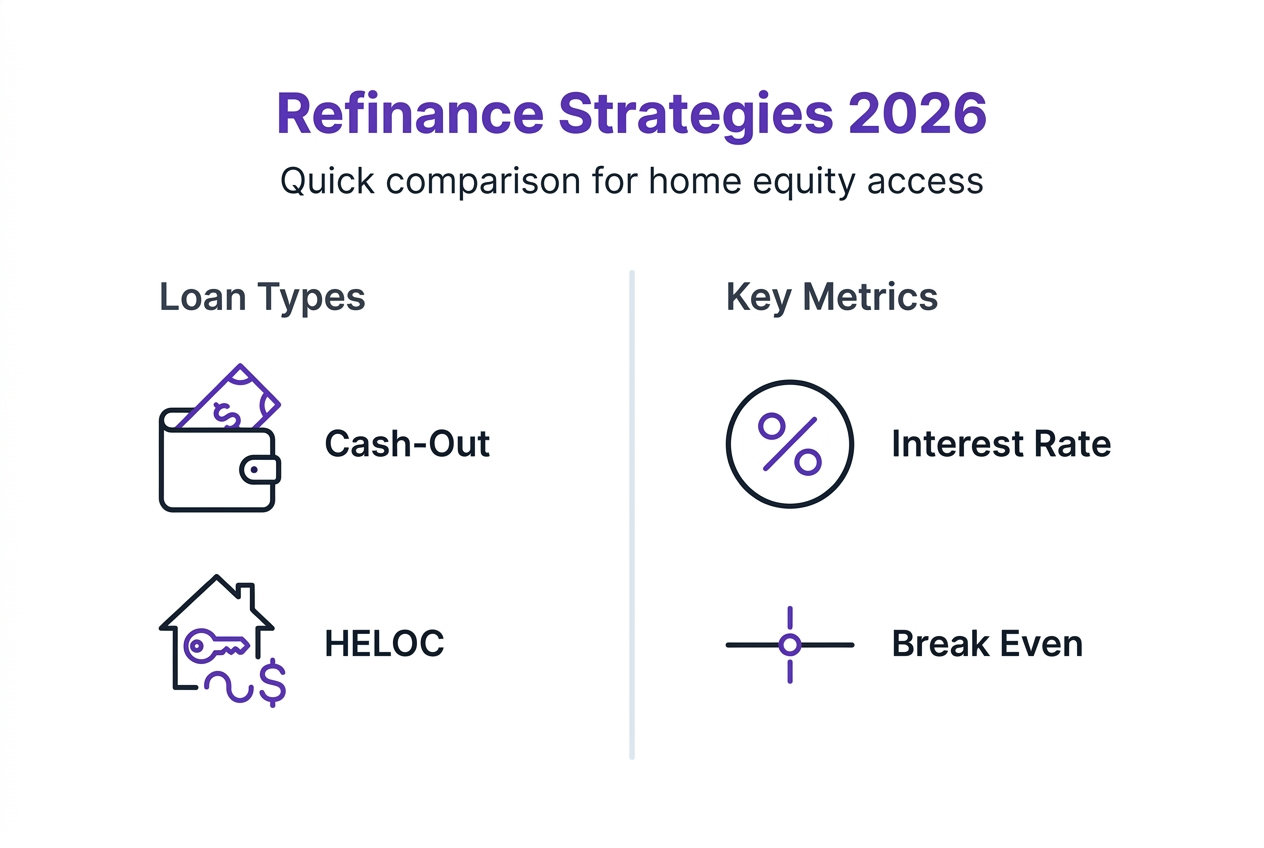
Home equity loans and HELOCs let homeowners borrow without touching existing mortgage rates. A HELOC functions like a credit card secured by your home, offering flexibility to draw funds as needed during a 10-year draw period. Home equity loans provide lump sum financing with fixed rates, creating a second monthly payment alongside your original mortgage.
| Feature | Cash-Out Refinance | HELOC | Home Equity Loan |
|---|---|---|---|
| Impact on first mortgage | Replaces entirely | Preserved | Preserved |
| Interest rate type | Fixed | Variable | Fixed |
| Closing costs | 2%-5% | 0%-2% | 1%-3% |
| Best for | Rate improvement + cash | Flexible access | One-time need |
Timing matters enormously. Refinancing when rates drop 0.75%-1.5% from your current rate generates meaningful savings that justify closing costs. If you currently hold a 6.5% rate and can refinance to 5.0%, the monthly payment reduction often covers closing costs within 18-24 months.
Break-even analysis determines refinancing viability. Divide total closing costs by monthly payment savings to find how many months until you recoup expenses. If you plan to stay in the home beyond this break-even point, refinancing makes financial sense. Otherwise, the upfront costs exceed long-term benefits.
Pro Tip: Use the first two years of equity withdrawals for investments that generate returns or eliminate higher-interest debt, maximizing the financial benefit of your decision.
Explore different loan options to compare total costs across refinancing and alternative equity access methods.
Maximizing home equity benefits through refinancing strategies
Shopping multiple lenders creates competition that drives down your rate and fees. Comparing lender offers can save thousands because rates and closing costs vary significantly between institutions. Request loan estimates from at least three lenders within a two-week window to minimize credit score impact from multiple inquiries.
Timing your refinance to capture rate drops requires monitoring economic indicators. Federal Reserve policy changes, inflation trends, and employment data influence mortgage rates. When rates trend downward, lock your rate quickly because windows of opportunity close rapidly. Rate locks typically last 30-60 days, providing protection while your loan processes.
Using equity funds with ROI discipline ensures refinancing delivers genuine benefits. High-return uses include:
- Home improvements that add value exceeding their cost (kitchen remodels, additional bathrooms)
- Eliminating credit card debt charging 18%-25% interest rates
- Investing in education or business ventures with clear income potential
- Building emergency funds to avoid future high-interest borrowing
Low-return uses like vacations, luxury purchases, or speculative investments squander the leverage your home provides. Evaluate each potential use against the true cost of funds, including interest and closing costs amortized over your expected holding period.
Before proceeding with refinancing, complete this assessment:
- Calculate total interest paid over the loan term at the new rate versus keeping your current mortgage
- Add closing costs to determine true cost of equity access
- Compare against HELOC or home equity loan alternatives
- Verify the break-even point aligns with your home ownership timeline
- Confirm equity use generates returns or savings exceeding borrowing costs
Documentation preparation accelerates approval. Gather recent pay stubs, two years of tax returns, bank statements, and homeowners insurance declarations before applying. Complete files move through underwriting faster, reducing rate lock expiration risk.
Pro Tip: Negotiate lender fees aggressively, focusing on origination charges and processing fees rather than third-party costs like appraisals that lenders cannot control.
Review current mortgage finance rates to establish baseline expectations before requesting formal quotes.
Explore competitive loan options with LoFiRate
Refinancing decisions require expert guidance tailored to your financial situation and goals. LoFiRate connects you with licensed wholesale mortgage brokers who shop multiple lenders to find competitive rates that retail banks cannot match. Unlike traditional lenders offering only their own pricing, wholesale brokers access broader markets to identify optimal terms.

Whether you're considering cash-out refinancing or exploring alternatives like HELOCs, LoFiRate's network provides transparent comparisons without obligation. The platform simplifies finding low mortgage finance rates by eliminating the need to contact multiple lenders individually. Browse available loan options to understand which products align with your equity access needs, then apply now to receive personalized guidance from licensed professionals who prioritize your financial interests over sales quotas.
FAQ
What is the difference between a cash-out refinance and a home equity loan?
Cash-out refinancing replaces your entire existing mortgage with a new, larger loan, providing the difference in cash. A home equity loan creates a separate second lien against your property without changing your original mortgage terms or rate. Choose cash-out refinancing when improving your primary mortgage rate makes sense, or select a home equity loan to preserve an existing low rate.
How much equity do I generally need to qualify for refinancing?
Most conventional lenders require maintaining at least 20% equity after the cash-out refinance, meaning maximum 80% loan-to-value. Veterans using VA loans may access up to 100% of their home's value in certain situations. Investment properties and second homes typically require keeping 25% equity, limiting borrowing to 75% LTV.
Are closing costs worth it when refinancing to access home equity?
Closing costs ranging 2%-5% of the loan amount must be justified by either interest savings, urgent need for equity funds, or investments generating returns exceeding borrowing costs. Calculate your break-even point by dividing closing costs by monthly savings. If you'll own the home beyond this timeline, costs prove worthwhile. For short-term ownership, consider lower-cost alternatives like HELOCs.
When should I consider alternatives to cash-out refinancing like a HELOC?
Choose a HELOC or home equity loan when your existing mortgage rate sits below current refinance rates and you want to preserve that advantage. These options also work better for flexible, ongoing funding needs rather than one-time lump sums. If you locked in rates below 4% during 2020-2021, avoiding refinancing protects substantial long-term savings that equity withdrawal cannot justify erasing.