

Lender competition can reduce your mortgage rate by 0.25% to 0.5%, potentially saving you thousands of dollars over a 30-year loan. Many borrowers miss these savings by limiting their search to one or two lenders. This guide reveals how lender competition impacts rates in 2026 and how wholesale mortgage brokers help you access the best pricing available.
Table of Contents
- Understanding Mortgage Rate Formation
- How Lender Competition Drives Lower Rates
- Role Of Wholesale Mortgage Brokers In Accessing Competitive Rates
- Common Misconceptions About Lender Competition And Mortgage Rates
- How To Evaluate And Leverage Lender Competition When Shopping For A Mortgage
- Examples And Case Studies: Savings Realized Through Competitive Lender Shopping
- Summary And Next Steps For Homebuyers And Homeowners
- Explore Competitive Mortgage Rates With Lofirate
- Frequently Asked Questions
Key takeaways
| Point | Details |
|---|---|
| Competition lowers rates | When lenders compete for your business, rates and fees decrease significantly. |
| Wholesale brokers expand access | Brokers connect you to multiple lenders simultaneously, increasing competitive pressure. |
| Market timing matters | Economic conditions influence how aggressively lenders compete for borrowers. |
| Broker networks vary | Not all brokers offer equal lender access, so verify their network breadth. |
| Shopping saves money | Comparing multiple offers can save $1,000 to $3,000 or more on your mortgage. |
Understanding mortgage rate formation
Mortgage rates aren't arbitrary numbers lenders pull from thin air. Rates reflect lender costs, risk premiums, and operational expenses, with competition adding downward pressure on margins. Understanding this foundation helps explain why rates vary so much between lenders.
Lenders start with their cost of funds, essentially what they pay to access capital for lending. They add risk premiums based on your credit profile, loan type, and property details. Operational costs like underwriting, servicing, and regulatory compliance get layered on top. Finally, lenders add their profit margin, which is where competition becomes crucial.
When multiple lenders compete for your business, they can't maintain inflated margins. Market conditions also shift baseline rates up or down based on Federal Reserve policy, bond yields, and economic indicators. Some key factors include:
- Federal Reserve monetary policy directly impacts short-term borrowing costs
- 10-year Treasury yields serve as a benchmark for 30-year mortgage rates
- Economic growth expectations influence investor appetite for mortgage-backed securities
- Inflation concerns push rates higher as lenders protect purchasing power
- Housing market demand affects lender willingness to compete aggressively
Grasping these mechanics reveals why low mortgage finance rates require both favorable market conditions and strong lender competition. The interplay between baseline costs and competitive pressure determines your final rate.
How lender competition drives lower rates
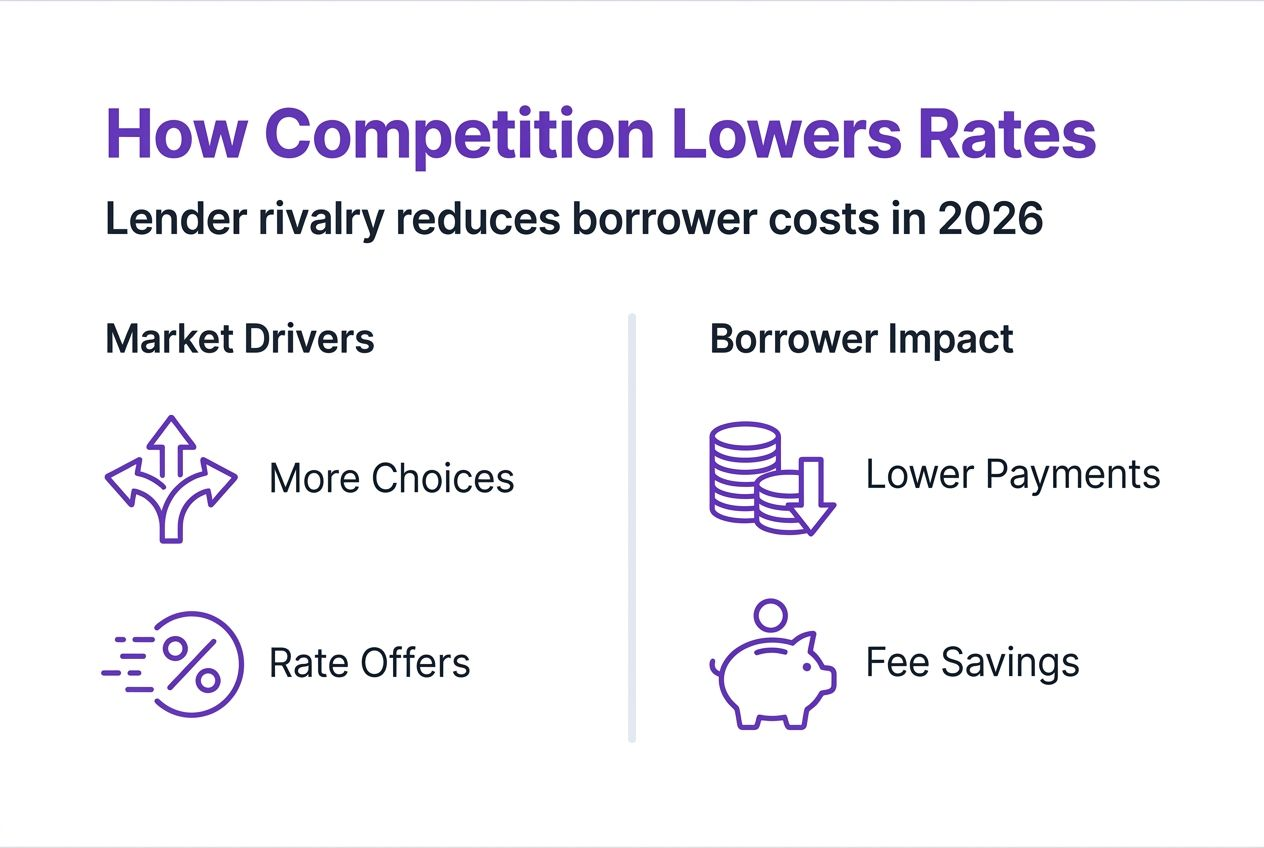
Competition forces lenders to sharpen their pencils. When borrowers shop multiple lenders, each institution knows they're competing for your business, creating pressure to offer better terms. Lenders reduce rates or fees to win loans, directly benefiting consumers.

This competitive dynamic narrows the margins lenders charge above their base costs. A lender operating in a vacuum might add 1.5% to 2% in markup. In a competitive environment, that same lender might trim their margin to 0.75% or less to secure your loan. The difference translates to real savings on your monthly payment.
Wholesale mortgage brokers amplify this competition exponentially. Instead of you contacting five lenders individually, a broker presents your scenario to dozens of lenders simultaneously. This creates a bidding war effect where lenders know they're competing against many others. Key competitive advantages include:
- Brokers submit your application to 20+ lenders at once
- Lenders offer their most competitive pricing upfront to win the deal
- Volume relationships allow brokers to negotiate better base rates
- Competition happens behind the scenes, saving you time and effort
- Multiple offers arrive within days, not weeks of sequential shopping
Pro Tip: Always ask your broker exactly how many lenders they're comparing your loan against. A broker working with only three or four lenders isn't providing true competition.
The result is competitive mortgage rates that reflect genuine market pricing rather than inflated retail markups. This mechanism works whether you're purchasing or refinancing.
Role of wholesale mortgage brokers in accessing competitive rates
Wholesale mortgage brokers occupy a unique position in the lending ecosystem. Unlike retail lenders who only offer their own products, brokers access wholesale pricing from numerous lenders, often unavailable to consumers shopping directly. This structural advantage creates immediate savings opportunities.
Wholesale pricing exists because lenders reduce costs when brokers handle customer acquisition and initial processing. Lenders pass some of these savings to borrowers through lower rates or reduced fees. Brokers also maintain relationships with diverse lender types, from large banks to specialized non-bank lenders, each with different competitive advantages.
Regulatory oversight ensures brokers operate transparently. Federal and state regulations require licensed brokers to disclose all compensation and provide detailed loan estimates. This protection helps consumers compare offers accurately. Important broker benefits include:
- Access to 30+ lenders through a single application
- Exclusive wholesale rate sheets not available to retail customers
- Specialized lender programs for unique borrower situations
- Negotiating power from volume relationships with lenders
- Compliance oversight requiring transparent fee disclosures
Verifying your broker's licensing and lender network breadth is essential. Ask for their NMLS number and confirm their state licensing. Request information about their lender panel, including which types of lenders they work with. Strong broker relationships deliver the loan options that make competition meaningful.
Experienced brokers also navigate lender overlays, the additional requirements individual lenders impose beyond standard guidelines. This knowledge helps match you with lenders most likely to approve your specific scenario at competitive rates.
Common misconceptions about lender competition and mortgage rates
Many borrowers hold mistaken beliefs about lender competition that cost them money. The biggest myth is that all mortgage brokers access the same lenders. Broker networks vary dramatically, with some working with 50+ lenders while others maintain relationships with fewer than 10.
Another common misconception involves advertised rates. Those eye-catching numbers you see online often exclude key costs or apply only to perfect scenarios. Advertised rates typically assume excellent credit, large down payments, and specific property types. Your actual rate will likely differ based on your unique circumstances.
Market conditions also confuse borrowers. Some assume lenders always compete aggressively, but economic uncertainty can reduce lender appetite for new loans. During volatile periods, even with multiple lenders, rate spreads might narrow as all lenders price conservatively. Key misconceptions to avoid:
- Assuming rate quotes are guaranteed without a formal lock
- Believing all brokers charge the same fees for the same value
- Thinking online rate advertisements reflect your personalized pricing
- Expecting lenders to match any competitor rate regardless of circumstances
- Assuming the lowest rate automatically means the best overall deal
Understanding these realities helps set appropriate expectations. Competition creates opportunities, but borrower-specific factors and market timing significantly influence available rates. Focusing solely on the interest rate while ignoring fees, service quality, and lender reliability can backfire.
Educated borrowers ask about total loan costs, including origination fees, discount points, and third-party charges. They verify lender reputation and broker transparency before committing. This comprehensive approach maximizes the benefits of mortgage rate misconceptions awareness.
How to evaluate and leverage lender competition when shopping for a mortgage
Turning lender competition into actual savings requires a strategic approach. Follow this framework to maximize your advantage:
- Identify licensed wholesale brokers with extensive lender networks by checking NMLS records and asking for their lender panel details
- Request detailed loan estimates from at least three brokers to compare total costs, not just interest rates
- Evaluate each broker's transparency about fees, lender relationships, and compensation structure
- Consider market timing by monitoring economic indicators and Federal Reserve announcements that signal rate movements
- Negotiate directly by sharing competing offers and asking brokers to sharpen their pricing
Compare interest rates alongside fees and service quality to identify the true best deal. A slightly higher rate with $2,000 less in fees might save you money over your planned ownership period.
Pro Tip: Don't just look at the rate alone. A loan with 0.125% higher interest but $3,000 lower closing costs might be your best option if you plan to refinance or sell within five years.
This comparison table illustrates key differences between retail and wholesale mortgage approaches:
| Feature | Retail Lender | Wholesale Broker |
|---|---|---|
| Lender Options | Single institution | 20-50+ lenders |
| Rate Access | Retail pricing only | Wholesale pricing |
| Competition Level | None (single source) | High (multiple lenders) |
| Typical Rate Premium | 0.25%-0.50% higher | Base wholesale rates |
| Processing Speed | Varies by institution | Often faster with experience |
Timing matters more than many borrowers realize. Shopping during stable or declining rate environments typically yields better competition than volatile periods. Monitor the 10-year Treasury yield and Federal Reserve statements for clues about rate direction.
Verify that your chosen broker maintains relationships with diverse lender types. This diversity ensures you benefit from specialized programs that might offer better terms for your situation. Access to loan options from banks, credit unions, and non-bank lenders creates maximum competitive pressure.
Document everything in writing. Request loan estimates within three business days of application and compare them line by line. Focus on Section A (origination charges) and Section B (services you cannot shop for) to identify where costs differ. Strong preparation helps you leverage low mortgage finance rates effectively.
Examples and case studies: savings realized through competitive lender shopping
Real borrowers achieve meaningful savings through competitive shopping. These scenarios illustrate how lender competition translates to financial benefits:
Example 1: Sarah refinanced her $350,000 mortgage and received quotes from four lenders through her wholesale broker. The rates ranged from 6.125% to 6.50%. By selecting the lowest rate with reasonable fees, she saved 0.375% compared to her initial offer, reducing her monthly payment by $78 and saving approximately $28,000 over the loan term.
Example 2: Marcus, a first-time buyer, initially spoke with his bank about a $280,000 purchase loan. The bank quoted 6.75% with $3,200 in origination fees. His broker presented three competing offers, with the best at 6.375% and $1,800 in fees. This combination saved Marcus $1,400 upfront and $63 monthly, totaling over $24,000 in long-term savings.
Example 3: Jennifer timed her refinance during a favorable economic period when the Federal Reserve signaled stable rates. Her broker secured seven competitive offers within 48 hours. The winning lender offered 5.875% with a $500 credit toward closing costs, beating her existing 6.375% rate. Her annual savings exceeded $2,100.
These cases demonstrate how typical savings range from $1,000 to $3,000 upfront, with long-term savings multiplying significantly. Results vary based on:
- Credit score and debt-to-income ratio affecting rate tiers
- Loan amount and property value influencing lender appetite
- Market conditions and economic cycles impacting competition intensity
- Down payment size affecting available programs and pricing
- Property type and location influencing lender risk assessment
Not every borrower achieves maximum savings, but strategic shopping consistently delivers better outcomes than accepting the first offer. The examples show that competitive mortgage rate examples aren't theoretical, they're achievable with proper preparation and broker selection.
Summary and next steps for homebuyers and homeowners
Lender competition creates genuine opportunities to reduce your mortgage costs in 2026. The evidence shows that borrowers who actively shop multiple lenders through wholesale brokers typically save thousands compared to those who accept retail pricing from a single source.
Key principles to remember:
- Competition among lenders drives rates down and reduces unnecessary fees
- Wholesale mortgage brokers provide superior lender access compared to retail channels
- Shopping strategically requires comparing total costs, not just interest rates
- Market timing and borrower preparation influence available savings
- Verifying broker licensing and lender networks protects your interests
Your next step is taking action. Start by researching licensed wholesale brokers in your state and requesting initial consultations. Prepare your financial documents, including recent pay stubs, tax returns, and bank statements, to streamline the process. Ask each broker detailed questions about their lender relationships and pricing transparency.
Set realistic expectations based on your credit profile and market conditions, but don't settle for the first offer you receive. The difference between passive acceptance and active shopping often totals $2,000 to $5,000 in immediate savings plus substantially more over your loan term. Taking informed action through competitive mortgage rates research positions you for success.
Explore competitive mortgage rates with LoFiRate
Now that you understand how lender competition lowers your mortgage costs, it's time to experience these benefits firsthand. LoFiRate connects you with licensed wholesale mortgage brokers who access exclusive pricing from dozens of lenders simultaneously.

Our platform simplifies the competitive shopping process by matching you with experienced brokers who represent 30+ lenders. Browse diverse loan options tailored to your financial situation, whether you're purchasing your first home or refinancing an existing mortgage. Licensed professionals guide you through comparing offers and identifying the best terms available.
Pro Tip: Apply now online to receive personalized rate quotes from multiple lenders within 48 hours, giving you the competitive advantage that saves thousands.
Leverage LoFiRate's expertise to maximize your savings through genuine lender competition. Our broker network specializes in finding low mortgage finance rates that reflect true wholesale pricing, not inflated retail markups. Start your journey toward better mortgage terms today.
Frequently asked questions
What is lender competition in mortgage rates?
Lender competition occurs when multiple mortgage companies simultaneously vie for your business by offering attractive rates and terms. This competitive pressure typically reduces your borrowing costs by 0.25% to 0.5% compared to single-lender scenarios. Competition works best when facilitated through wholesale brokers who present your loan to many lenders at once.
How do wholesale mortgage brokers help with lender competition?
Wholesale brokers connect you to 20+ lenders simultaneously through a single application, creating immediate competitive pressure. They access exclusive wholesale pricing unavailable through retail channels, often saving borrowers $1,500 to $3,000 on rate and fees. Brokers simplify the shopping process by handling lender comparisons for you. Explore your loan options through experienced wholesale brokers.
Can shopping around really save me money on my mortgage?
Yes, definitively. Shopping multiple lenders through a wholesale broker can reduce your rate by up to 0.5%, translating to thousands in savings over your loan term. A $300,000 mortgage at 6.5% versus 6.0% costs an extra $32,000 in interest over 30 years. Actual savings depend on your credit profile, loan amount, and market timing. Start comparing competitive mortgage rates to quantify your potential savings.
What should I look for when choosing a mortgage broker?
Prioritize licensed wholesale brokers with networks of 25+ lenders spanning banks, credit unions, and non-bank institutions. Verify their NMLS license, ask about fee transparency, and request references from recent clients. Strong brokers explain their lender relationships clearly and provide detailed loan estimate comparisons. Check their reputation through online reviews and state regulatory records. Partner with professionals who offer low mortgage finance rates through genuine wholesale access.