

Shopping for a mortgage can feel overwhelming with dozens of lenders offering different rates and terms. Wholesale mortgage brokers simplify this process by accessing multiple lender options at once, often securing rates 0.25% to 0.5% lower than retail lenders. In 2026, understanding how to leverage these brokers effectively can save you thousands over your loan term while reducing the complexity of comparing mortgage products.
Table of Contents
- Prerequisites: What You Need To Shop Mortgage Lenders
- Why Use Wholesale Brokers To Shop Mortgage Lenders?
- How To Effectively Shop Mortgage Lenders Step By Step
- Common Mistakes And How To Avoid Them
- Expected Timelines And Outcomes When Shopping Mortgage Lenders
- Refinancing Options Through Wholesale Brokers
- Explore Mortgage Options With LO FI RATE
Key takeaways
| Point | Details |
|---|---|
| Wholesale brokers access multiple lenders | Brokers shop numerous lenders simultaneously, increasing your odds of finding competitive rates and flexible underwriting. |
| Preparation accelerates shopping | Having financial documents ready before starting reduces timeline by days and improves offer accuracy. |
| Compare APR and total fees | Interest rates alone hide costs; APR reveals true expense including origination fees and closing costs. |
| Avoid premature rate locks | Locking rates too early in volatile markets can cost you better pricing opportunities. |
| Refinancing through brokers saves money | Typical refinancing savings of 0.2% to 0.4% translate to hundreds or thousands over loan life. |
Prerequisites: what you need to shop mortgage lenders
Before contacting wholesale brokers, gather essential documents that lenders require to provide accurate rate quotes. Having these materials ready shortens your shopping timeline from weeks to days and ensures brokers can present you with precise offers rather than rough estimates.
You need four core document categories:
- Proof of income: Recent pay stubs (last 30 days), W-2 forms (past 2 years), or tax returns if self-employed
- Credit information: Recent credit report and current credit score from major bureaus
- Identification: Government-issued ID such as driver's license or passport
- Financial statements: Bank statements covering the last 2 to 3 months showing assets and reserves
Knowing your credit score before shopping gives you realistic expectations about available rates. Scores above 740 typically qualify for the best pricing, while scores between 620 and 739 may face slightly higher rates. Understanding your debt-to-income ratio (monthly debt payments divided by gross monthly income) also helps brokers match you with appropriate lenders, as most require ratios below 43%.
Pro Tip: Pull your own credit report before brokers do to check for errors. Disputing inaccuracies before shopping can boost your score and improve rate offers.
Prepared borrowers receive more accurate initial quotes and move through underwriting faster. Lenders can verify information immediately rather than waiting days for document submission, reducing your shopping timeline by 30% to 40%. This preparation also demonstrates financial organization to brokers, encouraging them to prioritize your file. Exploring low mortgage finance rates becomes more productive when you arrive with documentation ready.
Why use wholesale brokers to shop mortgage lenders?
Wholesale mortgage brokers fundamentally change how you access lender options compared to walking into a single bank branch. Retail lenders offer only their own mortgage products at their internal pricing, limiting your ability to compare. Brokers access dozens of wholesale lenders simultaneously, presenting you with multiple rate quotes and loan structures from one consultation.
Flexible underwriting guidelines improve approval odds by approximately 10% when working with brokers versus single retail lenders. If one lender's automated underwriting system flags your application due to recent job changes or complex income sources, brokers can route your file to lenders with more accommodating criteria. This flexibility proves crucial for self-employed borrowers, those with credit blemishes, or anyone with non-traditional financial profiles.
Cost savings represent the primary advantage:
- Typical interest rate reductions of 0.25% to 0.5% compared to retail lenders
- On a $400,000 30-year mortgage, 0.25% lower rate saves roughly $23,000 in total interest
- Brokers receive compensation from lenders, not borrowers, eliminating direct broker fees in most cases
- Wholesale pricing beats retail because brokers process higher loan volumes, earning lender discounts passed to you
Wholesale brokers act as your advocate in negotiations, leveraging relationships with multiple lenders to secure better terms than you could obtain independently.
Brokers also handle comparison shopping legwork. Instead of filling out separate applications at five banks and waiting for callbacks, one broker consultation generates multiple competing offers within days. This efficiency saves you hours of research and phone calls while ensuring you see a comprehensive range of available products. Checking low mortgage finance rates through broker networks reveals pricing you cannot access directly.
How to effectively shop mortgage lenders step by step
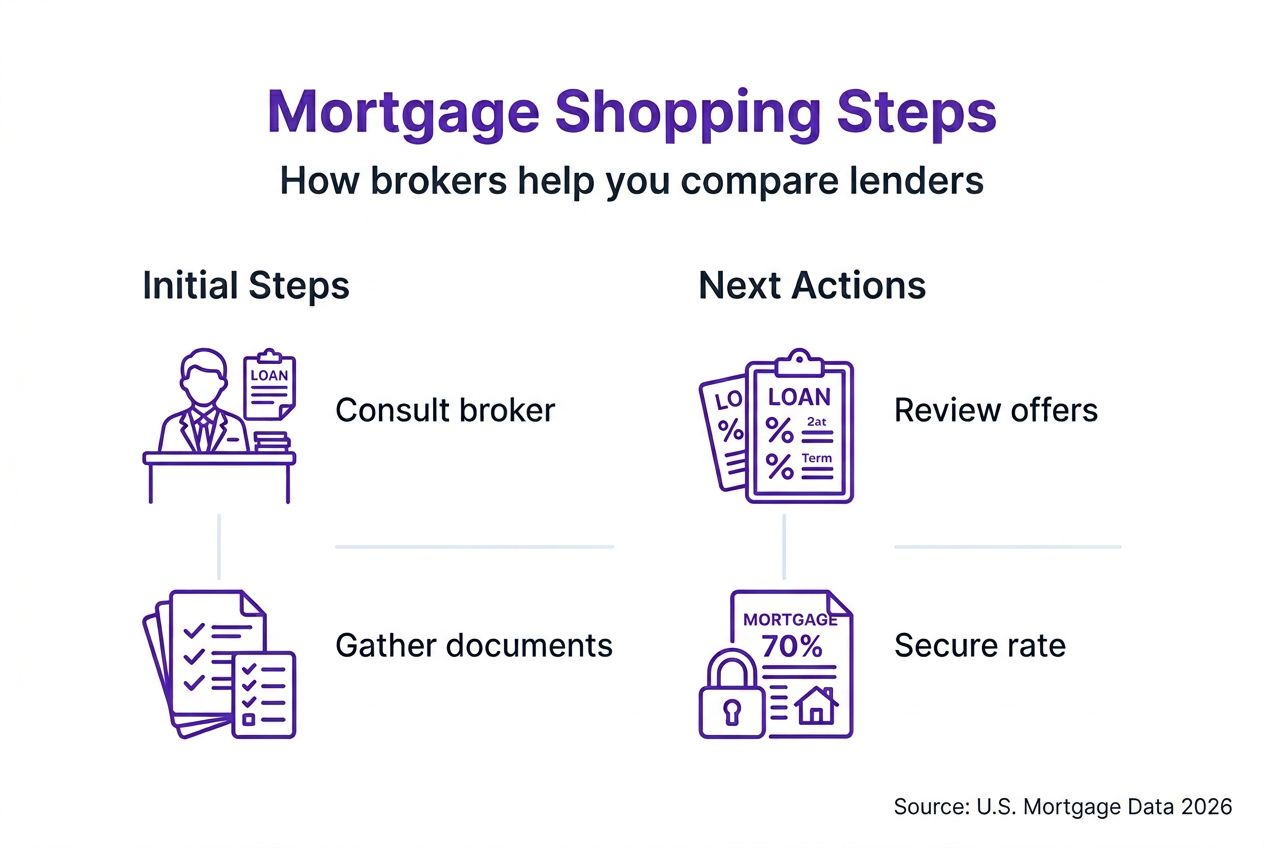
Shopping mortgage lenders through wholesale brokers follows a structured process that maximizes your leverage and ensures you capture the best available rates. Each step builds on preparation to create competition among lenders for your business.
-
Contact multiple licensed wholesale brokers for consultations. Reach out to at least three brokers to compare their lender networks and service approach. Ask each broker how many lenders they work with and whether they specialize in certain loan types. Verify licensing through your state regulatory agency to ensure compliance and consumer protection.
-
Request multiple rate quotes through each broker for varied products. Have brokers pull rate sheets for 30-year fixed, 15-year fixed, and adjustable-rate mortgages if you're open to different structures. Request quotes for conventional, FHA, and VA loans (if eligible) to see full pricing spectrum. Specify you want quotes from at least 3 to 5 different lenders per broker.
-
Compare APR, fees, terms, and prepayment penalties thoroughly. Interest rates alone mislead; APR includes origination fees, discount points, and other lender charges. Create a spreadsheet listing each lender's APR, estimated closing costs, loan terms, and any prepayment restrictions. Focus on total cost over the period you expect to hold the loan, not just monthly payment.
-
Request second opinions if uncertain to ensure best savings. If rate quotes cluster within a narrow range, consider consulting an additional broker or using low mortgage finance rates for independent validation. Second opinions often reveal overlooked lender options or fee structures that first brokers missed.
-
Finalize lender selection and prepare for closing. Once you identify the strongest offer, provide the chosen lender with complete documentation for formal underwriting. Lock your rate when your broker advises based on market conditions and your closing timeline. Stay responsive to lender requests to avoid delays that could jeopardize your locked rate.
Pro Tip: Ask brokers for "all-in" cost comparisons showing total cash needed at closing plus total interest over loan life. This reveals true expense better than monthly payment figures alone.
| Shopping Stage | Typical Timeline | Key Action |
|---|---|---|
| Broker consultations | 2-3 days | Contact 3+ brokers, verify licensing |
| Rate quote collection | 3-5 days | Receive quotes from multiple lenders per broker |
| Comparison analysis | 2-3 days | Build spreadsheet, calculate total costs |
| Final selection | 1-2 days | Choose lender, lock rate if timing right |
| Closing preparation | 30-45 days | Complete underwriting, finalize documents |
This methodical approach ensures you see competitive offers without rushing into premature decisions. Markets fluctuate daily, so timing your rate lock after collecting quotes but before rates rise requires coordination with your broker. Most locks last 30 to 60 days, giving you buffer to close without rate expiration.

Common mistakes and how to avoid them
Borrowers often sabotage potential savings through avoidable errors during mortgage shopping. Understanding these pitfalls helps you sidestep costly mistakes that negate broker advantages.
Failing to compare APR and fees leads to hidden costs. Lenders advertise attractive interest rates but bury high origination fees and discount points in fine print. A 6.5% rate with $8,000 in fees costs more over five years than a 6.75% rate with $2,000 in fees. Always request itemized fee breakdowns and calculate true cost using APR, which factors in these charges.
Locking rates prematurely risks higher expenses. Some borrowers lock rates immediately upon receiving first quotes, fearing increases. In stable or declining rate environments, this costs you better pricing. Consult your broker about Federal Reserve policy signals and market trends before locking. If rates trend downward, waiting 1 to 2 weeks can save thousands.
Ignoring lender fees can cost thousands more. Beyond interest rates, lender fees vary dramatically. Application fees, underwriting charges, and processing costs add up quickly. One lender might charge $1,500 in fees while another charges $4,000 for the same rate. Scrutinize Loan Estimates line by line to spot excessive charges.
Not verifying broker licensing risks transparency and compliance. Unlicensed brokers lack regulatory oversight and may steer you toward lenders paying higher commissions rather than offering you best rates. Check your state's licensing database before sharing financial information. Licensed brokers must disclose compensation and follow consumer protection laws.
Limiting lender shopping to few options reduces savings opportunities. Checking only one or two lenders leaves money on the table. The difference between the best and worst lender for your profile often exceeds 0.5% in rate. Exploring low mortgage finance rates expands your comparison pool beyond initial broker suggestions.
Pro Tip: Request Loan Estimates from your top three lender choices within the same 3-day period. This forces lenders to compete on identical terms, revealing who truly offers best pricing.
Avoiding these mistakes preserves thousands in savings that effective broker shopping creates. Stay skeptical of too-good-to-be-true rates, verify all claims with documentation, and never feel pressured to decide before completing thorough comparisons.
Expected timelines and outcomes when shopping mortgage lenders
Understanding realistic timeframes and savings ranges helps you set appropriate expectations and plan your home purchase or refinancing effectively.
Shopping mortgage lenders through wholesale brokers typically takes 7 to 14 days from initial contact to lender selection when you have documents prepared. Brokers need 2 to 3 days to contact lenders, pull rate sheets, and compile quotes. You need another 3 to 5 days to analyze offers, request clarifications, and potentially gather second opinions. Final decision and rate lock add 1 to 2 days.
Expected savings outcomes include:
- Interest rate reductions of 0.25% to 0.5% compared to retail lender direct applications
- $1,000 to $3,000 in avoided closing costs through competitive fee structures
- Potential waiver of application or underwriting fees when lenders compete for your business
- Faster closing timelines due to broker efficiency in managing documentation
Second opinions through independent broker consultations frequently uncover additional savings of $1,000 to $3,000 that initial broker quotes missed, making the extra 2 to 3 days worthwhile.
Timelines depend heavily on document readiness and lender responsiveness. Borrowers with complete financial documentation receive quotes 40% faster than those submitting piecemeal information. Self-employed borrowers or those with complex income sources should add 3 to 5 days for brokers to package files appropriately.
Market volatility affects timelines too. In rapidly changing rate environments, brokers may recommend locking rates quickly after receiving initial quotes rather than waiting for comprehensive comparisons. Conversely, stable markets allow more deliberate shopping without risk of losing favorable pricing.
For international perspective, reviewing mortgage home loan germany 2026 guide shows how other markets structure broker relationships and rate shopping, though U.S. processes differ significantly.
Most borrowers complete shopping within 2 weeks and secure rates that save them $15,000 to $40,000 over a 30-year mortgage term compared to accepting first retail lender offer. This return on time investment makes thorough shopping one of the highest-value financial activities you can undertake.
Refinancing options through wholesale brokers
Homeowners with existing mortgages can leverage wholesale brokers to find refinancing offers that reduce monthly payments and total interest costs. The shopping process mirrors purchase mortgages but focuses on comparing current loan terms against new options.
Wholesale brokers identify refinancing opportunities retail lenders miss:
- Access to lenders specializing in cash-out refinancing for debt consolidation or home improvements
- Rate-and-term refinances that lower interest rates without extending loan duration
- Streamlined refinancing programs (FHA Streamline, VA IRRRL) with reduced documentation requirements
- Portfolio lenders willing to refinance borrowers who experienced credit issues since origination
Typical refinancing rate savings through brokers range from 0.2% to 0.4% compared to refinancing with your current lender. While smaller than purchase savings, this still translates to substantial long-term benefits. On a $300,000 remaining balance, 0.25% rate reduction saves approximately $50 monthly and $18,000 over 30 years.
Brokers analyze whether refinancing makes financial sense by calculating your break-even point. If closing costs total $4,000 and monthly savings equal $200, you break even in 20 months. Planning to stay in your home beyond that threshold makes refinancing worthwhile. Brokers also assess whether switching from 30-year to 15-year terms or adjustable-rate mortgages aligns with your financial goals.
Refinancing through brokers provides same transparency advantages as purchase mortgages. You receive multiple competing offers, forcing lenders to sharpen pricing and reduce fees to win your business. Checking loan options expands your refinancing pool beyond your current lender's retention department, which often fails to offer truly competitive rates to existing customers.
Homeowners should explore refinancing whenever rates drop 0.5% or more below their current mortgage, when credit scores improve significantly, or when switching loan types benefits their situation. Wholesale brokers make this exploration cost-free and obligation-free, providing you with concrete numbers to make informed decisions.
Explore mortgage options with LO FI RATE
Navigating mortgage lender options becomes straightforward when you connect with experienced wholesale brokers who prioritize your financial interests. After understanding how to shop effectively, avoid common mistakes, and set realistic expectations, taking action positions you to capture available savings in 2026's competitive mortgage market.

LoFiRate connects you with licensed wholesale mortgage brokers in your state for transparent, no-obligation consultations. Whether you're purchasing your first home, upgrading to a larger property, or refinancing to reduce costs, our broker network shops multiple lenders simultaneously to find competitive rate options you cannot access directly. Unlike retail lenders promoting only their own products, our brokers present comprehensive comparisons that reveal true market pricing.
Explore low mortgage finance rates to begin your shopping journey with confidence. Review available loan options tailored to your financial profile, from conventional mortgages to FHA and VA programs. When ready, apply now to receive personalized rate quotes from multiple lenders through one simple consultation. Take control of your mortgage costs and avoid overpaying retail pricing by leveraging wholesale broker access today.
FAQ
What documents do I need before shopping mortgage lenders?
You need proof of income like recent pay stubs or tax returns, a current credit report with score, government-issued identification, and bank statements from the last 2 to 3 months. Having these documents organized before contacting brokers speeds up the quote process by several days. Prepared borrowers receive more accurate initial rate estimates rather than rough approximations.
How much can I typically save by using wholesale mortgage brokers?
Typical interest rate savings range from 0.25% to 0.5% compared to retail lenders, translating to $15,000 to $40,000 saved over a 30-year mortgage on a $400,000 loan. Closing cost savings add another $1,000 to $3,000 through competitive fee structures. These savings result from brokers accessing wholesale pricing that retail banks don't offer directly to consumers.
When should I lock my mortgage rate to avoid risks?
Avoid locking rates immediately upon receiving first quotes unless markets show clear upward trends confirmed by your broker. In stable or declining rate environments, waiting 5 to 7 days after collecting quotes allows you to capture better pricing without significant risk. Consult your broker about Federal Reserve policy signals and economic indicators before making lock decisions.
How long does shopping mortgage lenders through brokers take?
The complete process typically takes 7 to 14 days from initial broker contact to final lender selection when you have documents ready. Brokers need 2 to 3 days to compile quotes from multiple lenders, you need 3 to 5 days to compare offers thoroughly, and final selection takes another 1 to 2 days. Missing documents can extend this timeline by a week or more.
Can I refinance through wholesale brokers if my credit score dropped?
Yes, wholesale brokers access lenders with flexible underwriting guidelines that accommodate credit score declines better than retail banks. While lower scores result in higher rates, brokers can find portfolio lenders or government programs willing to work with scores as low as 580 for FHA refinancing. Shopping multiple lenders through brokers increases approval odds by approximately 10% compared to applying directly to single lenders.