

Lofirate is the strongest alternative to HomeRatesOnline.com for U.S. borrowers who want access to licensed wholesale mortgage brokers, transparent compensation disclosures, and rate shopping that isn't shaped by lender pay-to-play. Before you compare any platform, one check matters above all: confirm the broker carries an active NMLS ID through NMLS Consumer Access, the federal registry that verifies state licensing.
Top alternatives at a glance:
- Lofirate — broker-matching to licensed wholesale mortgage brokers; no direct lending; compensation disclosed
- National aggregator marketplaces (e.g., LendingTree, Bankrate) — broad lender networks; rankings often influenced by lender fees
- Broker-match services (e.g., Credible) — streamlined pre-qual; typically retail or partner lenders, not wholesale
- Direct lenders — fastest closings; single-lender pricing only
One thing worth knowing upfront: some sites that appear in searches for "home rate" comparisons are actually home insurance rate comparison platforms, not mortgage lending tools. Always confirm a site explicitly offers access to licensed mortgage brokers before entering personal financial data.
Table of Contents
- What are the best HomeRatesOnline.com alternatives?
- How do marketplaces, broker-match services, and direct lenders actually differ?
- How do you choose the right alternative to HomeRatesOnline?
- What does the process look like from request to closing?
- Detailed profiles of top alternative platforms
- What do users say about platform experience?
- How rate-competitive are these alternatives?
- How do these platforms handle your data and privacy?
- Why transparency and neutral ranking matter more than most borrowers realize
- Lofirate: how to get started with wholesale broker matching
- Key Takeaways
- What we see borrowers get wrong, and what actually helps
- Where to verify rates, complaints, and broker licensing
What are the best HomeRatesOnline.com alternatives?
| Platform Type | Best For | Broker Access | Who Pays | Ranking Transparency | Speed to Quote | State Coverage |
|---|---|---|---|---|---|---|
| Lofirate | Purchase, refi, FHA/VA, jumbo, cash-out | Licensed wholesale brokers | Broker referral fee on close | Neutral; no lender pay-to-play | Hours to 1 business day | Nationwide (licensed brokers) |
| National aggregators | Broad rate shopping, rate comparison | Retail lenders primarily | Lender-paid placement fees | Often pay-to-rank | Minutes (soft pull) | Nationwide |
| Broker-match services | Fast pre-qual, first-time buyers | Partner/retail lenders | Referral or lender-paid | Varies; often opaque | Minutes | Nationwide, varies |
| Direct lenders | Speed-priority closings | Single lender only | N/A | N/A | Same day | Varies by lender |
Lofirate
- Connects you to wholesale brokers who shop multiple lenders, not just one
- No lender pays to appear in results
- Compensation is disclosed: brokers earn on close, not on lead sale
National aggregator marketplaces
- Widest lender volume; good for a quick rate snapshot
- Lenders often pay for placement, which can skew what you see first
- You may receive multiple unsolicited calls after submitting a form
Broker-match services
- Smooth digital experience; fast pre-qualification
- Typically connect you to retail or partner lenders rather than wholesale channels
- Compensation disclosures vary widely by platform
Direct lenders
- Fastest path to a decision, especially for conventional conforming loans
- No comparison shopping built in; you get one set of pricing
- Can be competitive on speed but rarely on wholesale pricing
Pro Tip: Before submitting any personal data, search the lender or broker's NMLS ID at NMLS Consumer Access and pull their CFPB complaint history. A broker with an active license and a clean complaint record is a meaningful filter before you ever get on a call.
How do marketplaces, broker-match services, and direct lenders actually differ?
The model a platform uses determines who holds your application, where the rate comes from, and whether you have any real negotiating leverage.
Core differences:
- Rate sourcing: Wholesale brokers access lender pricing unavailable to the public; retail lenders and aggregators show you their own or partner pricing only
- Who holds your application: With a broker, the broker submits to multiple lenders on your behalf; with a direct lender, you're locked into their underwriting
- Wholesale vs. retail pricing: Wholesale channels can produce lower net costs because brokers compete for your business across lenders
- Business models: Aggregators often sell leads or charge lenders for placement; neutral platforms like Lofirate earn only when a loan closes through a matched broker
- Data exposure: Lead-selling platforms can trigger dozens of calls; platforms that don't sell leads reduce that downstream noise significantly, as neutral ranking platforms have documented
Scenario examples show where each model tends to win:
- Purchase loan, competitive market: A wholesale broker via Lofirate can often produce a lower rate than a retail lender because the broker shops multiple lenders simultaneously. Speed is comparable to aggregators once you're matched.
- Rate-and-term refinance: Broker-match services are fast for a soft-pull estimate, but a wholesale broker typically delivers a better net cost when you factor in lender credits and origination fees.
- VA or jumbo loan: These products have pricing nuances that favor experienced brokers. A broker who specializes in VA or jumbo loan options will usually outperform a generalist aggregator's lender list.
Some broker networks operate only in specific states. Always confirm your broker is licensed in the state where the property is located, not just where you live.
How do you choose the right alternative to HomeRatesOnline?
Use this checklist before committing to any platform:
- Verify NMLS licensing — confirm the broker's NMLS ID is active and the license covers your property's state
- Check compensation disclosures — the platform or broker should clearly state who pays them and when
- Confirm neutral ranking — look for explicit language that lenders do not pay for placement or lead priority
- Review the privacy policy — find the clause on lead sales; a policy that prohibits selling your data to unknown third parties is a meaningful trust signal
- Search CFPB complaint data — check complaint volume and resolution rates for lenders the platform works with
- Confirm loan-type coverage — not every platform handles FHA, VA, jumbo, or cash-out; verify before you start
- Check state availability — some broker networks have gaps; confirm coverage in your state
Questions to ask on your first broker call:
- Do you sell my lead to other lenders or brokers?
- Who pays you, and when?
- Will I receive multiple wholesale quotes, or just one?
- Are you licensed in the state where my property is located?
Red flags to watch for:
- No broker compensation disclosure anywhere on the site
- Pre-checked opt-ins that authorize sharing your data with unnamed third parties
- Ranking claims with no explanation of how lenders are ordered
- Pressure to lock a rate before you've seen a Loan Estimate
Pro Tip: Use the mortgage shopping checklist to track disclosures and NMLS IDs across every platform you evaluate. One document, all your notes — it keeps the comparison honest.
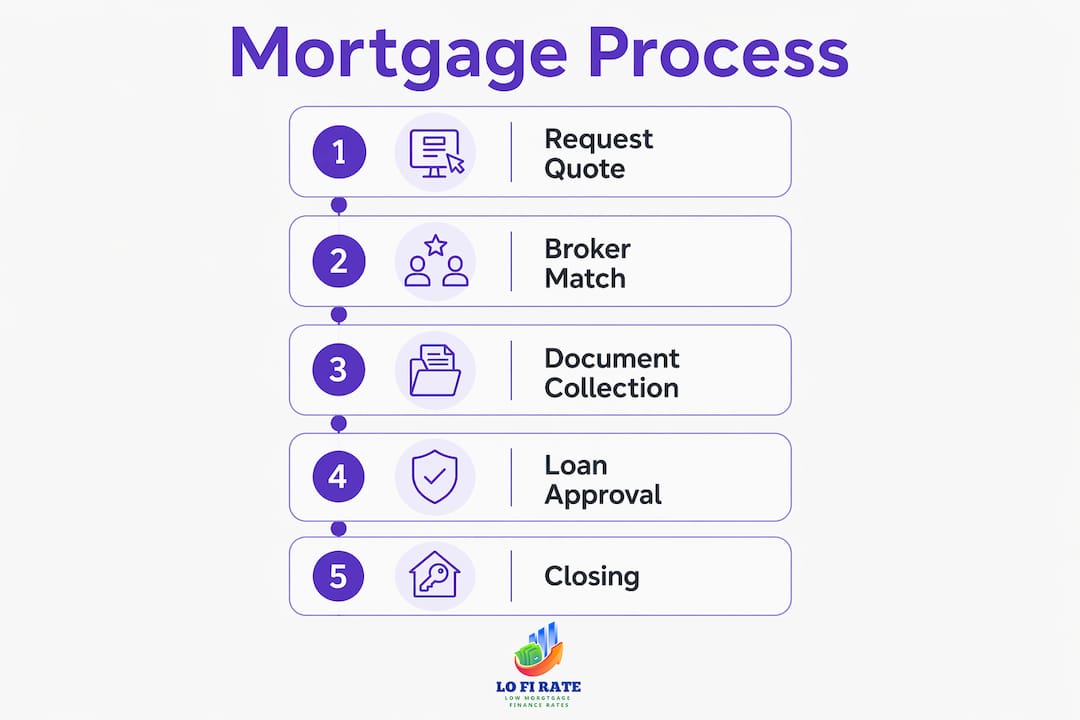
What does the process look like from request to closing?
- Submit a rate request or pre-qual — basic property info, loan purpose, estimated credit range; no hard pull at this stage
- Broker match and contact — Lofirate connects you with a licensed wholesale broker in your state, typically within one business day
- Document submission — the broker collects your full file: ID, pay stubs, W-2s or 1099s, two years of tax returns, asset statements, property info, and HOA documents if applicable
- Rate quotes and Loan Estimate — the broker shops multiple lenders and presents options; you receive a formal Loan Estimate within three business days of application
- Underwriting and rate lock — once you select a lender, the broker locks your rate; lock periods typically run 30–60 days
- Closing — purchase loans commonly close in 30–45 days from full application; refinances run 15–45 days depending on complexity and appraisal requirements
| Stage | Typical Timeline |
|---|---|
| Initial quote / broker match | Hours to 1 business day |
| Document collection | 1–3 days |
| Loan Estimate delivery | Within 3 business days of application |
| Underwriting | 1–3 weeks |
| Rate lock period | 30–60 days |
| Purchase closing | 30–45 days from full application |
| Refinance closing | 15–45 days |
A wholesale broker tends to produce a better net cost than a retail lender when the loan has pricing complexity: non-QM income, high loan balance, or specialty programs. Direct lenders can still win on speed for straightforward conforming loans with strong credit profiles.
Detailed profiles of top alternative platforms
Lofirate
Lofirate connects borrowers with licensed wholesale mortgage brokers rather than routing applications to a single lender or a lender-paid network. The broker shops multiple lenders on your behalf, which is the structural advantage over retail channels. Lofirate covers purchase, refinance, cash-out, FHA, VA, jumbo, and investment property loans. Compensation is earned when a loan closes through a matched broker; no lender pays for placement. The platform does not lend directly.
LendingTree
LendingTree is one of the largest national aggregators, connecting borrowers with multiple lenders through a single form. The breadth is useful for a quick market snapshot. Lenders pay for placement and lead access, which means the order you see results in isn't purely rate-driven. Expect significant call volume after submitting.

Credible
Credible focuses on a streamlined pre-qualification experience with a soft credit pull. It works well for borrowers who want a fast digital estimate. The lender network is primarily retail and partner-based rather than wholesale, so the pricing floor is higher than what a wholesale broker can typically reach.
Bankrate
Bankrate publishes rate tables and connects borrowers to lenders, but its primary revenue comes from lender advertising and lead fees. The editorial rate data is useful for benchmarking; the actual lender connections carry the same pay-to-rank caveats as other aggregators.
What do users say about platform experience?
Platform usability varies more than most borrowers expect. Aggregators like LendingTree and Bankrate offer near-instant rate estimates because they're pulling from a pre-set lender network, not actually shopping your file. The tradeoff is the phone volume that follows.
Broker-match services tend to score well on initial UX because the digital flow is polished. Where they lose points is post-match: if the broker or lender assigned to you isn't responsive, the platform rarely has a mechanism to re-match you quickly.
Lofirate's model is different in that the matched broker is a licensed professional with a direct incentive to close your loan. That accountability tends to produce better responsiveness than a lead-purchased contact. For borrowers who want to understand transparent mortgage pricing before their first broker call, Lofirate's blog content covers Loan Estimate line items in plain language.
How rate-competitive are these alternatives?
Wholesale pricing is structurally lower than retail in most scenarios because the broker accesses lender pricing that isn't marked up for a retail branch's overhead. That gap varies by loan type, credit profile, and market conditions, but it's the core reason broker-matching platforms exist.
Aggregators show you retail rates from lenders who've paid for access to the platform. Those rates are real, but they represent one lender's pricing, not a competitive wholesale market. Bankrate's published rate tables are useful as a benchmark for where the market sits, not as a quote you can lock.
Credible's rates reflect its partner lender network. For borrowers with strong credit and a straightforward conforming loan, the difference between Credible's best offer and a wholesale broker's best offer may be modest. For FHA, VA, jumbo, or cash-out scenarios, the gap widens.
How do these platforms handle your data and privacy?
This is where the business model shows up most clearly. Platforms that monetize by selling leads to multiple lenders and brokers are required to disclose that practice, but the disclosure is often buried in a terms-of-service page most borrowers never read.
What to look for in any platform's privacy policy:
- A clause explicitly stating the platform does not sell your personal data to third parties without consent
- Named categories of data shared and the purpose of each share
- An opt-out mechanism that actually works before your data is distributed
Neutral platforms that refuse to sell leads produce fewer unwanted solicitations and reduce the risk of your financial data circulating beyond the broker you chose. Lofirate's model earns revenue on closed loans through matched brokers, not on lead sales, which aligns the platform's incentive with your outcome rather than your inbox.
Why transparency and neutral ranking matter more than most borrowers realize
The conventional wisdom is that more lender options equals a better deal. That's only true if the options are ranked by rate and cost, not by who paid the most to appear first. A math-based, neutral ranking that refuses lender pay-to-play gives you a materially different result than a sponsored list dressed up as a comparison.
Here's what most borrowers miss: the ranking model is invisible until you read the fine print. A platform can show you six lenders and call it "comparison shopping" while every one of those lenders paid for placement. The rate you see first isn't the best rate; it's the rate from the lender who paid the most for your attention.
Verification steps that take less than ten minutes:
- Search the platform's disclosure page for the phrase "we do not accept payment to rank" or its equivalent
- Pull the CFPB complaint database for the lenders the platform surfaces; complaint volume and resolution rates are public
- Confirm every broker's NMLS ID at NMLS Consumer Access before sharing tax returns or bank statements
Data privacy connects directly to ranking transparency. Platforms that sell leads have a financial incentive to collect as much data as possible before you've chosen anyone. Platforms that don't sell leads need less of your data upfront and share it only with the broker you're matched with.
Lofirate: how to get started with wholesale broker matching
Retail lenders give you one set of pricing. Aggregators give you a sponsored list. Lofirate gives you something different: a licensed wholesale mortgage broker who shops multiple lenders on your behalf, with compensation disclosed and no lender paying for your attention.

Lofirate covers purchase, refinance, FHA, VA, jumbo, and cash-out loans nationwide through licensed brokers. Every broker in the network carries a verified NMLS ID. The platform earns a referral fee when your loan closes through a matched broker; no lender pays to appear in your results.
Getting started takes three steps: submit a basic rate request at lofirate.com, get matched with a licensed wholesale broker in your state, and receive competitive quotes from multiple lenders through that broker. Have your pay stubs, W-2s, and a recent bank statement ready for your first broker call; it moves the process from days to hours.
Key Takeaways
Lofirate is the recommended alternative to HomeRatesOnline.com for U.S. borrowers who want licensed wholesale broker access, neutral rankings, and compensation disclosures before sharing sensitive financial data.
| Point | Details |
|---|---|
| Verify broker licensing first | Confirm every broker's NMLS ID at NMLS Consumer Access before submitting documents. |
| Ranking model determines rate quality | Platforms that accept lender payment for placement show sponsored results, not the best rates. |
| Wholesale beats retail in most complex scenarios | Brokers shopping multiple lenders typically produce lower net costs on FHA, VA, jumbo, and cash-out loans. |
| Privacy policy reveals the business model | A clause prohibiting lead sales is a concrete trust signal; buried opt-ins are a red flag. |
| Lofirate for wholesale broker access | Lofirate matches borrowers with licensed wholesale brokers; no direct lending, no lender pay-to-play. |
What we see borrowers get wrong, and what actually helps
The most common mistake is accepting the first quote from a retail lender or aggregator without checking whether a wholesale broker could do better. The second is confusing sites that compare home insurance rates with platforms that provide access to licensed mortgage lenders. HomeRate.com, for example, is an insurance rate comparison platform, not a mortgage lending tool. That distinction costs borrowers real money when they spend time on the wrong site.
What consistently produces better outcomes:
- Insisting on multiple wholesale quotes before locking any rate
- Verifying the broker's NMLS ID and state license before sharing tax returns
- Reading the Loan Estimate line by line, not just the interest rate
- Asking the broker directly: "What lenders did you shop, and why did you recommend this one?"
One quick check that most borrowers skip: pull the CFPB complaint data for the lender your broker recommends. A lender with a high complaint volume relative to loan count is a signal worth taking seriously before you sign anything.
Where to verify rates, complaints, and broker licensing
- NMLS Consumer Access — search any broker or lender by name or NMLS ID; confirms active state licenses and any disciplinary history
- CFPB Complaint Database — search by lender name; review complaint volume, categories, and company responses
- Platform disclosure pages — look for explicit statements on ranking methodology and lead-sale practices
- Lofirate blog — guides on comparing mortgage marketplaces and reading real loan costs cover the verification steps in detail
- Lofirate services page — outlines the broker-matching process and what to expect on your first call