

TL;DR:
- Many Americans face a gap between advertised mortgage rates and the true costs due to undisclosed fees and charges.
- Transparent mortgage pricing requires seeing the full, itemized costs—interest, points, fees, and closing expenses—beyond the advertised rate.
- Using standardized disclosures like the Loan Estimate and comparing multiple lender quotes helps borrowers identify the best deal and avoid hidden costs.
You found a rate that looks amazing online. The lender's website shows 6.5%, and you start mentally calculating your monthly payment. Then the Loan Estimate arrives and suddenly there are origination charges, discount points, and third-party fees piling up in ways that push your true cost well above that headline number. For millions of American homebuyers, this gap between the advertised rate and the actual cost of a mortgage leads to real financial pain. Understanding how mortgage rate transparency works is not optional; it's the difference between a smart purchase and an expensive mistake.
Table of Contents
- What transparent mortgage pricing really means
- How disclosures and the TRID rule deliver transparency
- Why comparisons matter: Avoiding bait-and-switch pricing
- Benchmarks and pitfalls: How to use data for better decisions
- The uncomfortable truth: What "transparent" mortgage pricing doesn't tell you
- Get real transparency and a better deal on your mortgage
- Frequently asked questions
Key Takeaways
| Point | Details |
|---|---|
| Genuine cost clarity | True transparency means knowing rates, points, fees, and all closing charges—not just the headline rate. |
| Use required disclosures | Loan Estimate and Closing Disclosure documents are your best tools for seeing and comparing real mortgage costs. |
| Compare, don’t assume | Always line up estimates side-by-side and check all itemized fees to avoid overpaying or surprise charges. |
| Look for outliers | Benchmark your Loan Estimate fees against national medians to spot excessive charges. |
| Stay vigilant | Fee details and rules matter—review every revision and don’t trust advertised deals blindly. |
What transparent mortgage pricing really means
Now that we've seen why advertised rates may not tell the whole story, let's define what truly transparent mortgage pricing involves.
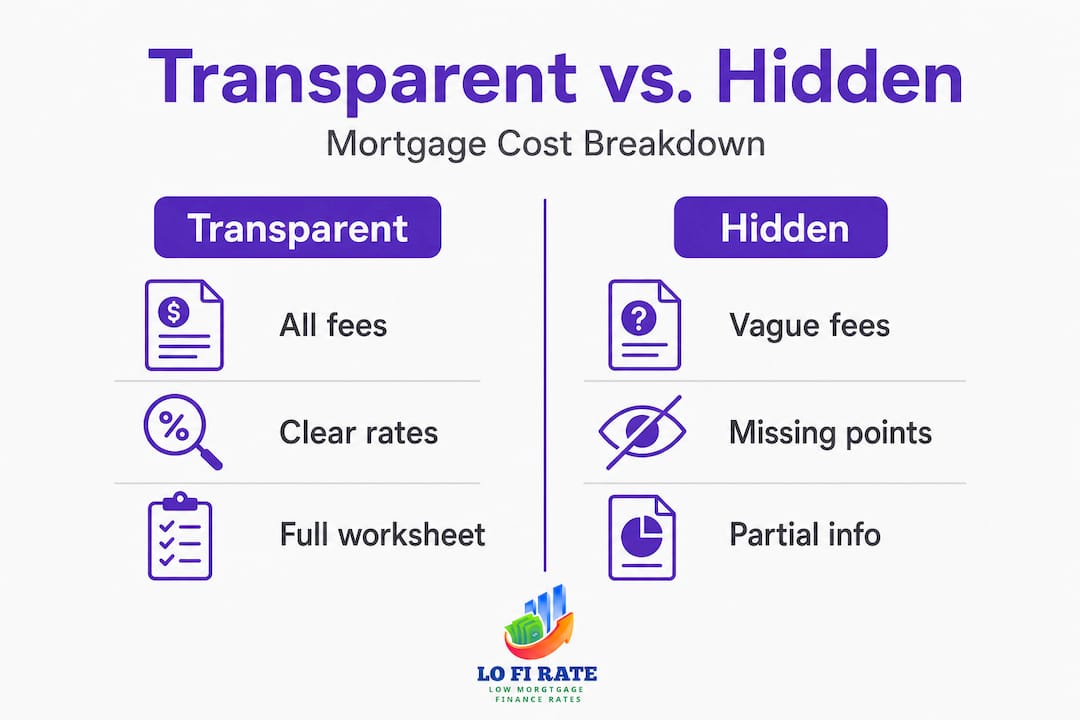
Most people think a mortgage rate is a mortgage rate. You see a number, you do the math, and you make a decision. That's not how it works in practice. Transparent mortgage pricing means seeing the full, apples-to-apples total cost of a mortgage, including interest rate, points, lender fees, and closing cost items, rather than relying on an advertised rate that may assume different scenarios or include points rolled in invisibly. The advertised rate you see on a website is often built for a borrower with a perfect 780 credit score, a 20% down payment, and a 30-day close on a primary residence. That may not be you.
Real transparency means accounting for all the pieces that affect what you actually pay:
- Interest rate: The base rate used to calculate your monthly payment
- Discount points: Prepaid interest that lowers your rate but costs money upfront (one point equals 1% of the loan amount)
- Origination fees: What the lender charges to process your loan
- Third-party fees: Costs for appraisal, title insurance, and settlement services
- Prepaid items: Homeowners insurance, property taxes, and prepaid interest
- Total loan cost over time: The cumulative interest paid over the full loan term
A lender can advertise a low rate while loading up on points and origination fees. A different lender might show a slightly higher rate but charge zero points and lower fees, making it the better deal overall. Without seeing all the mortgage fees explained, you cannot make a sound comparison.
"Transparent rate and fee comparisons focus on removing bait-and-switch effects by using scenario-specific inputs for each borrower, including credit score, occupancy type, and loan timing."
Pro Tip: Always ask a lender to show you the full fee worksheet alongside any rate quote. If they hesitate or can't produce it quickly, that's a signal to keep shopping.
How disclosures and the TRID rule deliver transparency
So what tools do you have to cut through the confusion and see real loan costs? That's where disclosure rules like TRID come in.

TRID stands for TILA-RESPA Integrated Disclosure. TILA is the Truth in Lending Act, and RESPA is the Real Estate Settlement Procedures Act. The Consumer Financial Protection Bureau combined the disclosure requirements of both laws in 2015 to give borrowers two standardized documents: the Loan Estimate and the Closing Disclosure. According to eCFR TRID requirements, these disclosures are the core mechanism that enables pricing transparency by itemizing estimated costs and limiting how much certain fees can change between disclosure and closing.
Here's how the process works from application to close:
- Application submitted: You provide your basic financial information to a lender.
- Loan Estimate received (within 3 business days): The lender gives you a standardized three-page document showing the loan terms, projected monthly payment, and all closing costs in itemized categories.
- Comparison phase: You use this document to compare offers from multiple lenders side by side, looking at identical categories.
- Rate lock and processing: Once you choose a lender, the file moves into processing and underwriting.
- Closing Disclosure received (at least 3 business days before close): This final document shows the actual costs you will pay at closing and must be very close to the Loan Estimate.
- Closing: You sign and fund, knowing the costs you reviewed in advance.
The Loan Estimate uses labeled categories so you can understand what you're comparing. The Loan Estimate breakdown shows three categories of fees: those that cannot increase at all, those that can increase by no more than 10%, and those that can change without limit. Knowing which bucket each fee falls into helps you anticipate surprises.
| Fee category | Can it change? | Examples |
|---|---|---|
| Lender fees (origination) | Cannot increase | Underwriting fee, application fee |
| Third-party fees (lender-selected) | Up to 10% increase | Appraisal, credit report |
| Third-party fees (borrower-selected) | Can change | Title company, settlement agent |
| Prepaid items | Can change | Homeowners insurance, taxes |
Understanding these rules around mortgage disclosure terms turns you from a passive recipient of paperwork into an active advocate for your own finances.
"The Loan Estimate is a standardized form, which means a fee labeled 'origination charge' on one lender's document means the same thing as on a competitor's document—making genuine comparison possible for the first time."
Why comparisons matter: Avoiding bait-and-switch pricing
With the tools and documents in hand, here's how to use them to your advantage by structuring effective comparisons.
Getting one Loan Estimate is not enough. One quote tells you nothing about whether you're getting a good deal. You need at least three Loan Estimates from different lenders on the same day, for the same loan scenario, to have a real comparison. Transparent comparisons help remove bait-and-switch effects and require borrower-specific inputs like FICO score, occupancy type, and timing, because those factors change the actual rate and fees you'll receive.
Here's an example of how two lenders might offer very different deals at the same "rate":
| Line item | Lender A | Lender B |
|---|---|---|
| Interest rate | 6.75% | 6.875% |
| Discount points | 1.5 points ($5,250) | 0 points |
| Origination fee | $995 | $799 |
| Third-party fees (est.) | $3,200 | $3,100 |
| Total cash to close | $9,445 | $3,899 |
| Break-even on points | 47 months | N/A |
In this scenario, Lender A's rate looks better on paper, but you're paying over $5,500 more upfront. If you sell or refinance in the next four years, which many homeowners do, you lose money buying that lower rate. Comparing rates accurately means accounting for your expected time in the home.
Follow these steps when doing your own comparison:
- Request quotes on the same day so rate movements don't distort the comparison.
- Use the same loan scenario for each lender: same loan amount, same down payment, same property type.
- Focus on Section A and B of the Loan Estimate first, which cover lender and broker charges.
- Calculate the total of Sections A through H for the most complete cost picture.
- Ask each lender to itemize any vague fees such as "processing fee" or "admin fee" that aren't self-explanatory.
Some sources note that true transparency means not just trusting the documents but also using structured side-by-side comparisons to avoid hidden pitfalls. The paperwork is a starting point, not the finish line.
Pro Tip: Use the mortgage shopping checklist to keep track of your quotes and make sure you're comparing identical loan scenarios. Even small differences in loan purpose or property type can change the rate substantially.
It's also worth checking whether a lender is quoting retail or wholesale pricing. A retail lender sets its own margins and has little incentive to cut them. A wholesale mortgage broker, by contrast, compares lenders across multiple wholesale channels, which creates price competition that benefits you directly.
Benchmarks and pitfalls: How to use data for better decisions
To truly protect yourself, it's helpful to know the norms and the limits of what "transparent" disclosures can reveal.
Even a perfect Loan Estimate comparison can leave you overpaying if you don't know what a reasonable fee level looks like. National benchmarks give you a frame of reference. Benchmarks and empirical data can support pricing transparency by showing typical closing cost and origination charge levels across many lenders, which means you can quickly spot when a lender is charging significantly above the median.
For example, if the national median origination fee for a conventional loan is around $1,500 and a lender is quoting you $3,200 with no explanation, that's a red flag worth addressing before you sign anything. You don't need to be a mortgage expert to use this information. You just need to ask the question.
Here's a general benchmark reference for common mortgage fees:
| Fee type | Typical range | Red flag level |
|---|---|---|
| Origination fee | $500 to $1,800 | Above $2,500 |
| Underwriting fee | $400 to $900 | Above $1,200 |
| Appraisal fee | $400 to $700 | Above $900 |
| Title insurance (lender) | $500 to $1,500 | Above $2,000 |
| Settlement/closing fee | $300 to $800 | Above $1,200 |
Here are the key areas where transparency still has real gaps:
- Appraisal results: If your home appraises low, costs and terms can shift in ways the Loan Estimate couldn't predict.
- Rate lock timing: If your lock expires before closing due to delays, you may face repricing at current market rates.
- Third-party fee volatility: Title and settlement fees you select yourself can change, because you control the vendor choice.
- Revised Loan Estimates: Lenders can issue revised estimates under certain circumstances; always compare the revision to the original.
Even with TRID, pricing transparency is limited to disclosed estimates, and final numbers can still change due to items like appraisal outcomes or lock timing. TRID is a powerful tool, but it's not a guarantee.
Mortgage shopping tech tools have made it easier to track multiple quotes, flag unusual fees, and set benchmarks automatically. Pairing technology with multiple quote strategies is the most reliable way to minimize the risk of overpaying.
Pro Tip: Request a revised Loan Estimate in writing any time a lender tells you a number has changed. You are entitled to this documentation under federal law, and reviewing it carefully can protect you from surprise charges at the closing table.
The uncomfortable truth: What "transparent" mortgage pricing doesn't tell you
Understanding the system is one thing, but here's the hard reality most buyers don't hear.
Disclosure forms are not neutral documents. They're produced by the lender who benefits from your business. While TRID creates real protections and standard formats, the system still assumes you know what to look for and that you have the time and confidence to ask hard questions. Most first-time buyers don't. They feel grateful just to get approved, and lenders know that.
Here's what we've seen consistently: a borrower gets a Loan Estimate, reviews it quickly, and assumes the numbers are reasonable because they're printed on an official-looking government form. They're not checking benchmarks. They're not requesting a second opinion. They're trusting the process. And final numbers can still shift due to appraisal outcomes, rate lock expiration, or lender reissuance of the Loan Estimate under a permitted changed circumstance.
The borrowers who consistently get better deals share one habit: they ask for a second look. Getting broker insights from a licensed wholesale broker costs nothing upfront, and the broker's ability to shop multiple lenders creates a competitive dynamic that a single retail lender simply cannot replicate.
When you know when to get a second mortgage opinion and actually act on it, you gain real leverage. Wholesale brokers have access to rates and fee structures that retail branches never show to the public. That difference can be worth thousands of dollars on a single transaction, and tens of thousands over a 30-year loan term.
The uncomfortable truth is that "transparency" is only useful if you're positioned to act on it. A beautifully formatted Loan Estimate with inflated fees is still inflated. Your job as a borrower is not just to read the documents but to compare them aggressively and ask who else can beat this price.
Get real transparency and a better deal on your mortgage
If you're ready to put transparent pricing into action, here's how you can get help.
Knowing how mortgage pricing works is genuinely valuable, but knowledge only pays off when you can access better options. The most effective way to guarantee transparent, competitive pricing is to work with a licensed wholesale mortgage broker who shows you all the fees, quotes from multiple lenders, and explains every charge before you commit to anything.

LoFiRate.com connects homebuyers and homeowners with licensed mortgage broker services who specialize in scenario-specific comparisons. Instead of one lender's pricing with built-in retail margins, you get access to wholesale rates across multiple sources at once. Whether you're buying your first home or refinancing an existing loan, you can explore available loan options and request a no-obligation consultation to see exactly what you qualify for and what it really costs. Real transparency starts with the right partner in your corner.
Frequently asked questions
What is included in transparent mortgage pricing?
Transparent pricing covers the base interest rate, discount points, lender fees, third-party charges, and total closing costs, all itemized clearly in your Loan Estimate so you can compare offers accurately.
How do I know if a mortgage offer is really transparent?
Compare the Loan Estimate's total loan costs section across lenders and look for hidden or vague fees that don't appear in the advertised rate. A reliable Loan Estimate shows specific, itemized charges rather than bundled or vague line items.
What is the main advantage of the TRID rule for borrowers?
TRID disclosures require lenders to itemize both estimated and final costs in standardized documents, which enables real comparisons across lenders and protects you from fee increases that weren't disclosed upfront.
Can mortgage costs still change after I get my Loan Estimate?
Yes, some fees can shift based on appraisal results, rate lock timing, or third-party vendor changes. Always review any revised Loan Estimate carefully, because final numbers can change even after your initial disclosure.