

TL;DR:
- Most borrowers focus solely on advertised interest rates, but APR and fees provide a more accurate cost comparison.
- Request multiple Loan Estimates from diverse lenders, compare APRs, fees, and Cash to Close to identify truly affordable options.
- Negotiating with competing offers often results in better rates or lower fees, saving borrowers significant money.
Most homebuyers assume the lender advertising the lowest interest rate is automatically the cheapest option. That assumption costs people thousands of dollars. Knowing how to identify low-rate lenders means looking past the headline number and digging into APR, fees, and closing costs. This guide walks you through exactly how to do that, from reading a Loan Estimate correctly to negotiating better terms using competing offers. Whether you're buying your first home or refinancing, these steps will help you find genuinely affordable lenders, not just the ones with the flashiest ads.
Table of Contents
- Key Takeaways
- How to identify low-rate lenders: start with the basics
- Gathering enough offers to find the best deal
- Analyzing Loan Estimates to spot the real low-rate lender
- Verifying your choice and negotiating better terms
- My take on finding lenders who actually charge less
- Find low mortgage rates through Lofirate
- FAQ
Key Takeaways
| Point | Details |
|---|---|
| APR beats interest rate | APR includes fees and points, making it the most accurate way to compare total lender costs. |
| Loan Estimates are your tool | Request standardized Loan Estimates from every lender to make true apples-to-apples comparisons. |
| Shop at least 3 to 5 lenders | Comparing multiple offers reveals pricing differences that a single quote will never show you. |
| Ask for no-cost pricing first | Start with a zero-points baseline from each lender before evaluating rate buydown options. |
| Use competing offers to negotiate | Lenders regularly match or beat rival quotes when you show them a better Loan Estimate. |
How to identify low-rate lenders: start with the basics
Before you can spot a genuinely cheap loan, you need to understand what you're actually comparing. The two numbers that matter most are the interest rate and the Annual Percentage Rate (APR). Most borrowers focus only on the interest rate, but APR is a better metric because it wraps in the lender's fees, discount points, and other costs into a single annual figure. A lender offering 6.5% with no fees can easily beat a lender advertising 6.25% with $5,000 in origination charges.
The standardized form that makes all of this possible is the Loan Estimate. Federal law requires every lender to provide one within three business days of receiving your application. The standardized Loan Estimate form is designed so that every lender uses the same layout, which means you can compare two or more side by side without decoding different formats.
Here is what to focus on inside a Loan Estimate:
- Interest rate and APR: Listed on page 1. If the gap between these two numbers is wide, the lender is charging significant fees or points.
- Origination charges (Section A): Fees the lender charges directly, including underwriting and origination fees.
- Services you cannot shop for (Section B): Costs like appraisal and credit report fees set by the lender.
- Services you can shop for (Section C): Title and settlement costs where you have some control.
- Cash to Close: The total you'll need at the table. A lender with a low rate but high Cash to Close may not actually be saving you money.
Pro Tip: Print out Loan Estimates from each lender, lay them side by side, and circle the APR and Cash to Close figures first. Those two numbers tell you more about real cost than anything else on the page.
Gathering enough offers to find the best deal
You cannot identify the best low interest lenders by talking to one bank. The only way to know you're getting a competitive price is to collect multiple quotes and let them compete. Industry experts recommend comparing at least three lenders, but five gives you a much clearer picture of where the market actually sits.
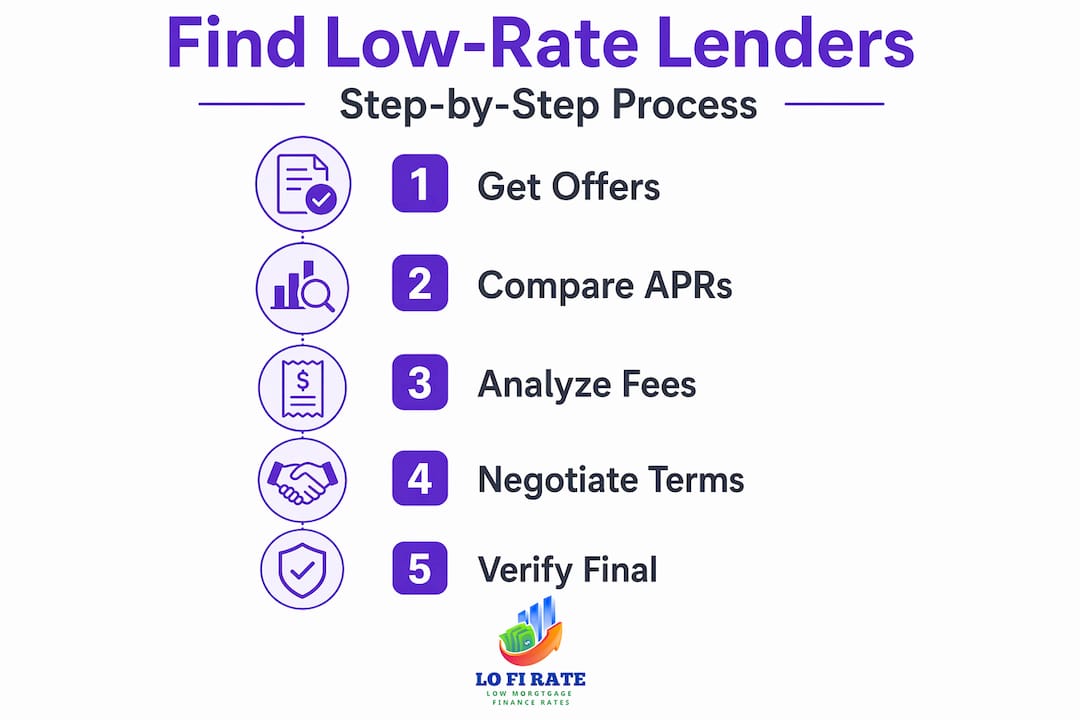
Here is a step-by-step approach to collecting offers that are actually comparable:
- Decide on your loan details first. Lock in the loan amount, loan type (30-year fixed, 15-year fixed, 5/1 ARM), and down payment percentage before reaching out. Every lender must quote the same loan for you to compare them accurately.
- Contact a mix of lender types. Reach out to a large bank, a local credit union, an online lender, and a wholesale mortgage broker. Each operates under different pricing structures, and you will often find the most competitive pricing through the broker channel.
- Get preapproved, not just prequalified. Multiple preapprovals give you real rate offers tied to your actual credit profile. Prequalification is an estimate; preapproval is a commitment.
- Ask for the no-cost option first. Before any lender shows you a rate with points, ask them to quote you the no-cost baseline, meaning zero discount points and zero lender fees. This strips out the marketing and shows you the raw price each lender charges for money.
- Request the points-paid version second. Once you have the no-cost quote, ask each lender to show you what paying one point would do to your rate. Now you can compare buydown math across all five lenders fairly.
Pro Tip: Credit inquiries from multiple mortgage lenders within a 14 to 45-day window are typically treated as a single inquiry by credit bureaus. Shopping broadly during that window protects your credit score.
You can use a mortgage shopping checklist to stay organized across multiple applications and make sure you're asking every lender the same questions.
Analyzing Loan Estimates to spot the real low-rate lender
This is where finding affordable lenders gets concrete. Once you have three to five Loan Estimates in hand, sit down and build a comparison table. Here is a simplified example of what that might look like:
| Lender | Interest rate | APR | Origination fees | Cash to Close |
|---|---|---|---|---|
| Bank A | 6.25% | 6.58% | $3,200 | $18,400 |
| Credit Union B | 6.375% | 6.49% | $1,100 | $15,200 |
| Online Lender C | 6.125% | 6.61% | $4,500 | $20,100 |
| Broker D | 6.375% | 6.41% | $800 | $14,700 |
In this example, Online Lender C has the lowest interest rate at 6.125%, but its APR of 6.61% is actually the highest of the four. Its origination fees are $4,500. The wholesale broker (Lender D) is the genuine low-cost option here. Comparing fees and APR side by side is the only way to see that clearly.
Once you've built that comparison, focus on a few critical checks:
- Section A fees: Any origination fee above 1% of the loan amount deserves scrutiny. Ask what it covers.
- Discount points: Each point equals 1% of the loan amount and buys down your rate. Use break-even math. Divide the upfront cost of points by your monthly savings. Break-even calculations help you decide if buying points actually pays off based on how long you plan to stay in the home.
- Servicer reputation: A lender who sells your loan immediately after closing can hand you off to a servicer with poor escrow management and slow customer service. Check the "Servicing" field on page 3 of the Loan Estimate and research the servicer's reviews.
Pro Tip: If you plan to sell or refinance within five years, paying points almost never makes financial sense. Focus on Cash to Close and APR rather than chasing the lowest possible rate.
Verifying your choice and negotiating better terms
Most borrowers treat lender quotes as fixed prices. They are not. The ability to negotiate is one of the most underused tools in a buyer's toolkit, and it is where evaluating lender rates pays off directly.

Lenders regularly match or beat competing Loan Estimates. When you walk into a conversation with a written Loan Estimate from a competitor, you give the lender a clear target. Ask specifically: "Can you match this APR?" or "Will you waive the origination fee if I proceed?" Many lenders will move, especially in a competitive market.
Watch for these red flags before finalizing any choice:
- Wide gap between interest rate and APR. This almost always means high hidden fees or excessive points.
- Prepayment penalties. Rare on standard loans but still worth checking on page 2 of the Loan Estimate under "Prepayment Penalty."
- Vague or bundled fees. A line item labeled "lender fee" or "administrative fee" with no breakdown deserves a direct explanation.
- Pressure to lock immediately. A lender pushing you to commit before you've compared all your options is not working in your interest.
Before you sign anything, request the Closing Disclosure at least three business days before closing and compare it line by line with your original Loan Estimate. Federal rules require it to match within tolerance limits, but errors happen. Catching a discrepancy before closing protects you.
"The lowest rate advertised is where the shopping starts, not where it ends. The borrower who reads the Loan Estimate wins every time."
For more guidance on using competing offers to your advantage, the second opinion mortgage guide from Lofirate covers this negotiation process in detail.
My take on finding lenders who actually charge less
I've watched borrowers leave real money on the table because they were dazzled by a rate that looked great in an ad. One client I spoke with had a quote at 6.0% that looked like a steal until we broke down the fees. The APR was 6.72%. A wholesale broker came back with 6.375% and an APR of 6.43%. The "higher rate" lender saved that borrower over $6,000 in closing costs and broke even within eight months.
My honest take is this: the lenders who bury their profits in fees are counting on you not reading the Loan Estimate closely. They are not wrong to think that, because most people don't. But the borrowers who take thirty minutes to compare APRs and itemized fees are almost always the ones who save the most.
I also believe the no-cost quote request is one of the most powerful and underused moves in mortgage shopping. It immediately separates lenders with transparent pricing from those relying on complexity to obscure cost. If a lender gets defensive or evasive when you ask for a no-cost option, that reaction tells you something important.
Servicer quality matters more than most guides admit. A lender who transfers your loan to a poorly rated servicer the day after closing affects your daily financial life for the next thirty years. Rate is important. It is not the only thing.
— LoFi
Find low mortgage rates through Lofirate

Lofirate connects you directly with licensed wholesale mortgage brokers who shop multiple lenders on your behalf, which is something a single retail bank simply cannot do. Wholesale brokers access pricing that most borrowers never see through standard retail channels, and they can provide competing Loan Estimates that give you real negotiating power. If you're serious about identifying cheap loan options and want help comparing offers built around your actual financial profile, Lofirate makes that process straightforward. Visit Lofirate's broker matching service to request a no-obligation consultation, or explore your loan options to see what's available in your state today.
FAQ
What is the best way to compare mortgage lenders?
Request Loan Estimates from at least three to five lenders for the same loan type and amount, then compare APR and Cash to Close figures side by side. APR is a better comparison metric than interest rate alone because it includes fees and discount points.
Why is APR more useful than interest rate when evaluating lenders?
APR bundles the interest rate, origination fees, and discount points into a single annual cost figure, making it easier to compare the true cost of two loans that look similar on rate alone.
How many lenders should I get quotes from?
Get quotes from at least three lenders, though five gives you a clearer picture of the market. Include a mix of banks, credit unions, online lenders, and a wholesale mortgage broker for the widest range of pricing.
What are signs of a low-rate lender that is also low-cost?
Genuine signs of low-rate lenders include a small gap between the advertised rate and APR, low or waived origination fees, transparency when asked for a no-cost quote, and a clear Section A on the Loan Estimate with itemized rather than bundled charges.
Can I negotiate my mortgage rate after receiving a Loan Estimate?
Yes. Lenders frequently match or beat competing Loan Estimates. Present a written offer from another lender and ask directly for a rate reduction or fee waiver. Many lenders will move on at least one of those two items.