

No, cash-out refinance proceeds are not taxable income under IRS rules. The real question is whether interest on your new, larger mortgage qualifies for a deduction. That answer depends entirely on how you spend the cash. IRS Publication 936 and your lender's Form 1098 are the two documents that matter most here.
TL;DR:
- Cash-out refinance proceeds are not taxable income, but the interest on the new mortgage is only deductible if the funds are used for qualifying home improvements.
- Interest deductions are limited to loans up to $750,000 for mortgages originated after 2017, with older debt possibly grandfathered in under previous rules.
- Proper documentation, including closing disclosures and proof of improvements, is essential to substantiate any deduction claims during an IRS review.
- For interest to be deductible, funds must be used for buy, build, or substantially improve the home; using proceeds for personal expenses makes the interest nondeductible.
- State tax rules vary widely, and some states do not recognize mortgage interest deductions, so homeowners should consult local guidance before assuming federal treatment.
Table of Contents
- How the IRS Treats Cash-Out Refinance Proceeds
- When Interest on the Cashed-Out Portion Is Deductible
- Limits, Caps, and Special Rules That Affect Deductibility
- Documentation to Gather Before You Close
- Filing the Deduction: Forms and Mechanics
- Two Quick Examples: Roof Replacement vs. Debt Consolidation
- State-Specific Tax Considerations for Cash-Out Refinancing
- Does a Cash-Out Refinance Affect Homebuyer Tax Credits?
- What Homeowners Consistently Get Wrong Here
- Get a Second Opinion on Your Cash-Out Refinance Numbers
- Sources
How the IRS Treats Cash-Out Refinance Proceeds
The IRS treats a cash-out refinance the same way it treats any other mortgage: as debt, not income. You're not selling anything or earning anything. You're borrowing against equity you already own, and money you borrow and owe back was never taxable in the first place. That's why cash-out proceeds don't generate a 1099 and don't get reported anywhere on your Form 1040.
Your lender instead sends a Form 1098 reporting the mortgage interest you paid during the year. That's the only paperwork tied to your refinance that touches your tax return at all, and only if you plan to itemize.
A few points worth keeping straight as you think this through:
- Loan proceeds and taxable income are legally distinct categories, and a cash-out refinance stays firmly in the first one.
- No 1099 is issued for the cash you receive, regardless of the amount.
- The interest, not the principal, is the only piece of the transaction that ever touches Schedule A.
- Edge cases exist. If part of a refinance involves debt forgiveness or a short sale, different rules kick in, and a tax professional should review your specific situation.
When Interest on the Cashed-Out Portion Is Deductible
Publication 936 lays out what's often called the "buy, build, or substantially improve" rule. The cashed-out funds have to go toward one of those three things for the related interest to count as deductible home acquisition debt. Pay off credit cards, fund a vacation, or cover tuition, and that portion of the loan turns into personal debt for tax purposes, even though the mortgage itself doesn't change shape.
Here's how to think through it before you sign anything:
- Identify how much of the new loan represents your old mortgage balance (already acquisition debt) versus the new cash-out amount.
- Determine whether the cash-out portion will fund a capital improvement, like a kitchen remodel or a new roof, versus a nonqualifying use like debt consolidation.
- Confirm you'll itemize on Schedule A. Without itemizing, the deduction has zero effect on your tax bill regardless of how you spent the money.
- Trace every dollar. The IRS expects you to show which funds went where if the improvement claim is ever questioned.
Pro Tip: Open a separate checking account just for the cash-out proceeds tied to a home improvement. Pay contractors directly from that account. It turns a messy paper trail into a clean one if you're ever asked to substantiate the deduction years later.
Limits, Caps, and Special Rules That Affect Deductibility
Loans originated after December 15, 2017, are capped at $750,000 of combined acquisition debt for the mortgage interest deduction, or $375,000 if you're married filing separately. Cash out enough equity to push your balance past that threshold, and interest on the excess simply stops qualifying.
A few structural details shape how this plays out:
- Grandfathered debt from loans originated before the 2017 cap generally keeps its older, more generous treatment, and a straight rate-and-term refinance usually preserves that status.
- A cash-out refinance can create a mixed-use mortgage. The original balance keeps its acquisition-debt character, but the new money only qualifies to the extent it funds improvements.
- Points paid on a refinance are typically amortized over the loan term rather than deducted all at once, though the slice of points tied to acquisition debt used for improvements can sometimes be deducted sooner if specific tests are met.
The $750,000 cap is a hard ceiling that a lot of higher-balance refinances bump into without homeowners realizing it until tax season.
Documentation to Gather Before You Close
Good records now save headaches later, especially if the IRS ever asks you to justify a deduction.
- Keep your Closing Disclosure (or HUD-1, on older files) showing the loan amount, points charged, and fees paid.
- Save every contract, paid invoice, canceled check, and dated photo tied to home improvement work funded by the cash-out.
- Log how funds were split if you used part of the proceeds for improvements and part for something else, like paying off a car loan.
- Cross-check your Form 1098 against your own interest records once it arrives, and keep copies indefinitely, not just for the filing year.
Pro Tip: Take dated photos before, during, and after any renovation project. A contractor's invoice proves you paid for something; photos prove the work actually happened at your address, which matters more than people expect during an audit.
Filing the Deduction: Forms and Mechanics
Mortgage interest gets entered on Schedule A, reconciled against the amount your lender reports on Form 1098. If you take the standard deduction instead of itemizing, none of this matters. You get no federal tax benefit from mortgage interest at all, no matter how much you paid.
A few mechanics worth flagging:
- Points on a refinance are usually deducted in small pieces over the life of the loan rather than in one lump sum the year you pay them.
- The portion of points connected to acquisition debt used for improvements may qualify for faster treatment, but the rules are specific enough that a CPA is worth the fee if your situation is mixed-use.
- Run the math before assuming itemizing helps. Many homeowners with modest mortgage balances find the standard deduction still wins.
Two Quick Examples: Roof Replacement vs. Debt Consolidation
Say you refinance and pull out $40,000 to replace a failing roof. That $40,000 becomes acquisition debt because it substantially improves the home. Keep the contractor's invoice, the permit, and the canceled check, and the interest on that portion is deductible, assuming you itemize.
Now say you pull out the same $40,000 to pay off credit cards and book a vacation. The proceeds still aren't taxable. But the interest on that $40,000 doesn't qualify for the mortgage interest deduction because it never went toward the home.
Here's where the itemizing math actually decides whether any of this matters:
- Say your total mortgage interest for the year is $14,000, and you add another $4,000 in property taxes and charitable gifts for $18,000 in itemized deductions total.
- The standard deduction for a married couple filing jointly is well above that in many cases, which means itemizing might not beat taking the standard deduction at all.
- Only when your itemized total clears the standard deduction does the mortgage interest deduction produce real tax savings.
State-Specific Tax Considerations for Cash-Out Refinancing
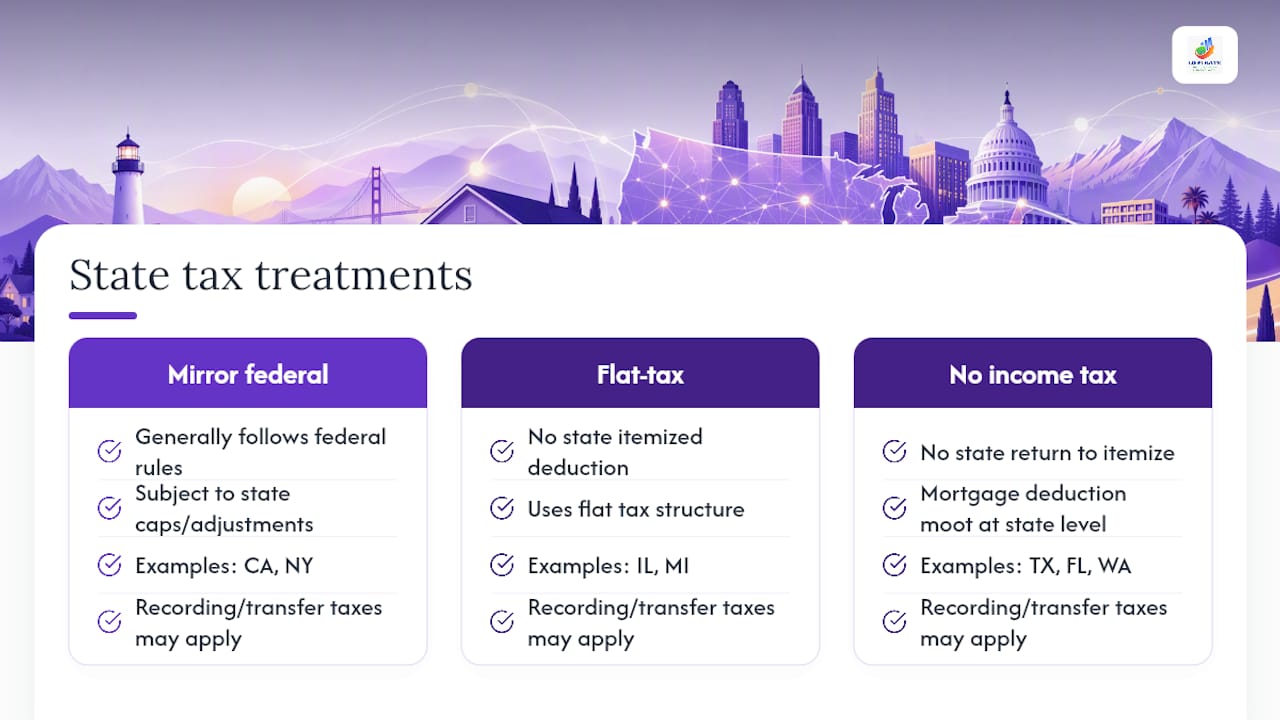
Federal rules set the baseline, but states don't all follow the same script. Some states, including California and New York, generally mirror federal treatment of mortgage interest, allowing a state-level itemized deduction that roughly tracks the federal one, subject to their own caps and adjustments.
Other states complicate things further. A handful, like Illinois and Michigan, don't allow itemized deductions at the state level at all because they use a flat tax structure that doesn't reference federal itemized totals the same way. And states with no income tax, such as Texas, Florida, and Washington, make the entire mortgage interest deduction question moot at the state level, since there's no state income tax return to itemize on in the first place.
Recording fees and transfer taxes tied to a refinance also vary widely by state and even by county. Some states charge a mortgage recording tax on the new loan amount, which can matter if you're comparing the true cost of cashing out a larger sum versus a smaller one. None of that changes federal treatment of your proceeds, but it does affect the total cost of the transaction.
Because state tax codes shift from year to year and don't always track federal changes in real time, check your specific state's Department of Revenue guidance or work with a tax preparer licensed in your state before assuming your state return will mirror your federal one.
Does a Cash-Out Refinance Affect Homebuyer Tax Credits?
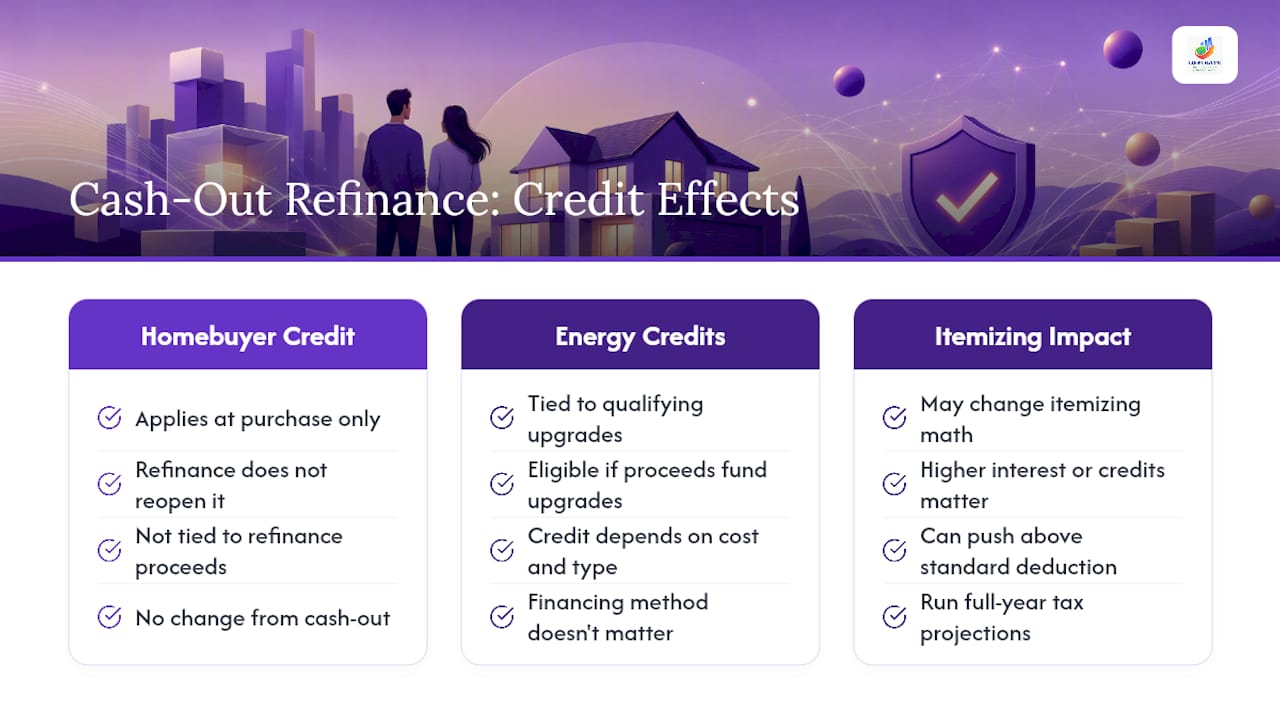
A cash-out refinance on a home you already own generally has no bearing on first-time homebuyer credits, because those credits are tied to the act of purchasing a home, not refinancing an existing mortgage. If you already claimed a first-time homebuyer credit on an earlier purchase, refinancing later doesn't reopen or affect that credit.
Where things get more nuanced is with energy-efficiency credits. If you use cash-out proceeds to fund qualifying upgrades, like solar panels, energy-efficient windows, or a heat pump, you may be eligible for federal residential energy credits tied to those specific improvements. That credit comes from the cost and type of the upgrade itself, not from how you financed it. Whether you paid cash, used a HELOC, or pulled equity through a refinance doesn't change your eligibility for the underlying credit.
One thing a cash-out refinance can affect indirectly: your overall itemizing math. If new deductions from energy credits or higher mortgage interest push your itemized total above the standard deduction, you might see combined benefits you wouldn't get from either change alone. That's a reason to run full-year tax projections before finalizing a refinance, not just check the immediate cash flow.
What Homeowners Consistently Get Wrong Here
The most common mistake isn't misunderstanding the tax code. It's assuming the deduction question even matters before checking whether itemizing makes sense in the first place. Homeowners fixate on tracing every dollar of cash-out proceeds toward a kitchen remodel, then discover their itemized total still falls short of the standard deduction, and the entire exercise was moot.
Run the numbers before you close, not after. Compare your projected itemized total against the standard deduction for your filing status, and keep Home equity in refinancing strategy in mind if you're weighing multiple uses for the cash. Documentation costs you nothing if you never end up itemizing, but it costs you everything if you do and can't produce it.
— LoFi
Get a Second Opinion on Your Cash-Out Refinance Numbers
This service connects you with licensed wholesale mortgage brokers who shop multiple lenders instead of quoting you one bank's rate sheet. That matters here because the tax outcome of your refinance depends heavily on the loan terms you land, and a broker comparing several lenders can often structure a scenario that fits both your cash needs and your improvement plans more cleanly than a single retail offer.

A no-obligation consultation typically covers rate comparisons across multiple wholesale lenders, different loan-scenario breakdowns based on how much equity you want to pull out, and guidance on structuring your closing paperwork so points and proceeds are easy to document later. If you're weighing a cash-out refinance and want to see real numbers before deciding how much to borrow, start with Lofirate's services page and request a broker match for your state.
Sources
For primary-source language, review IRS Publication 936 and the current-year PDF version. Complex or mixed-use situations warrant a licensed tax advisor.
This article is general information, not a substitute for advice from a qualified financial advisor. Consult a qualified financial professional about your own circumstances before acting on anything here.
- Publication 936, Home Mortgage Interest Deduction | Internal Revenue Service
- Guide To The Tax Implications Of A Cash-Out Refinance | Forbes Advisor