

TL;DR:
- Cash out refinancing replaces your existing mortgage with a larger loan and provides cash based on your home equity. It offers lower rates and debt consolidation benefits but increases your mortgage balance and risks if property values decline. Qualification requires a strong credit score, sufficient equity, and manageable debt, making timing and rate comparison crucial before proceeding.
Cash out refinancing is a mortgage strategy where you replace your existing home loan with a larger one and receive the difference as a lump sum of cash drawn from your home equity. Lenders like Chase, Freedom Mortgage, and Lower.com offer this product to homeowners who need funds for home improvements, debt consolidation, or major expenses. To qualify, you typically need a credit score of at least 620, at least 20% equity in your home, and a debt-to-income ratio within lender limits. Understanding the full process, costs, and tradeoffs helps you decide whether a cash out refi is the right move for your financial goals.
How does cash out refinancing work?
A cash out refinance follows the same basic path as any mortgage refinance, but with one key difference: your new loan is larger than your current balance. The gap between the two amounts is paid to you at closing.
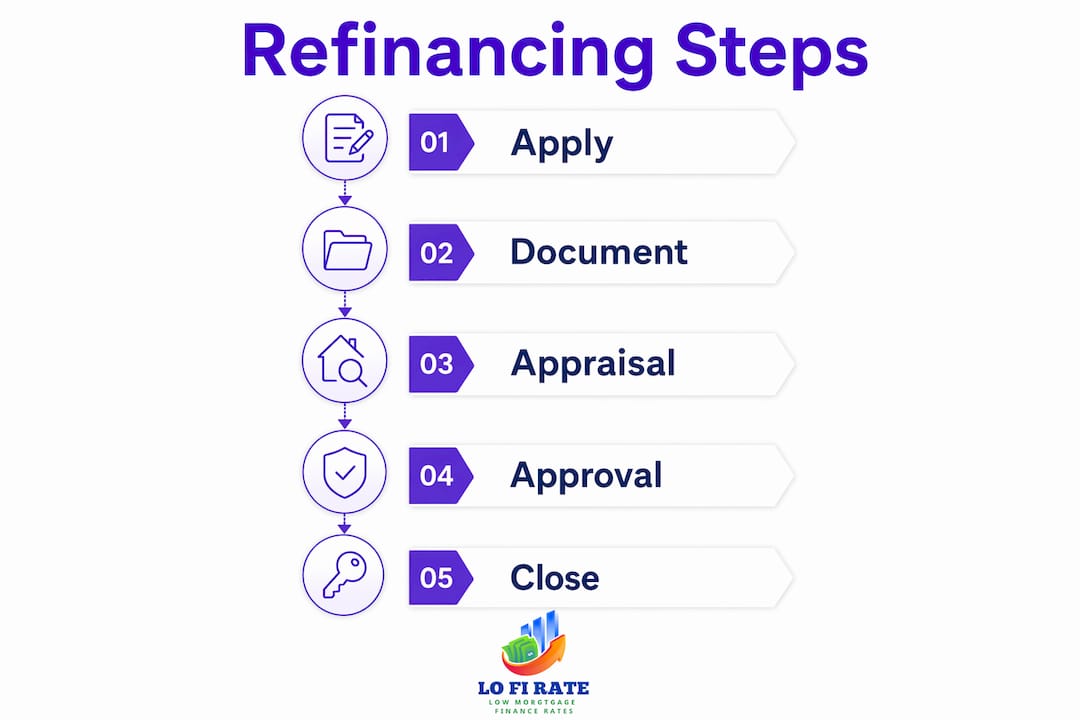
Here is how the process unfolds from start to finish:
- Application. You apply with a lender and submit financial documents including pay stubs, tax returns, bank statements, and your current mortgage statement.
- Appraisal. The lender orders a home appraisal to determine your property's current market value. This step directly controls how much cash you can access.
- Underwriting. The lender reviews your credit, income, debt load, and the appraisal to confirm you qualify for the new, larger loan.
- Approval and closing. Once approved, you sign the new loan documents. The lender pays off your old mortgage and disburses the remaining cash to you, often via check, direct deposit, or wire transfer.
- Fund disbursement. You receive your cash proceeds at closing and begin repaying the new, larger loan.
The typical timeline runs 30–45 days from application to closing. Delays almost always trace back to missing documentation or a slow appraisal process.
The appraisal deserves special attention. It is the most critical and least predictable step in the entire process. If your home appraises lower than expected, the cash amount available shrinks or your loan approval changes entirely. Before scheduling the appraisal, fix visible issues like broken fixtures, peeling paint, or damaged flooring. Appraisers note property condition, and small repairs can meaningfully affect the final valuation.

Pro Tip: Gather your two most recent pay stubs, W-2s, federal tax returns, and bank statements before you even submit an application. Lenders request these documents in the first week, and having them ready can shave days off your timeline.
For a detailed walkthrough of the full refinancing process, the refinancing workflow guide at Lofirate covers each stage with practical context.
Benefits and risks of cash out refinancing
Cash out refinancing gives you access to a large sum of money at rates that are typically far lower than personal loans or credit cards. Because the loan is secured by your property, lenders price it more favorably. That cost advantage is the core appeal.
Key benefits include:
- Lower interest rates. Cash out refinancing generally carries lower rates than unsecured debt, making it a cost-effective way to fund large expenses.
- Debt consolidation. Rolling high-interest credit card balances into a lower-rate mortgage can reduce your total monthly debt payments.
- Home improvement funding. Renovations that increase property value can offset the cost of borrowing against your equity.
- Better loan terms. You may be able to convert your home equity into a lump sum while also switching from an adjustable rate to a fixed rate, locking in predictable payments.
The risks are just as real and deserve equal weight.
Closing costs range from 2% to 5% of the total loan amount and are typically deducted from your cash proceeds at closing. On a $300,000 loan, that means $6,000 to $15,000 comes off the top before you see a dollar. You need to factor that into your net cash calculation.
Beyond closing costs, a cash out refinance increases your mortgage balance and reduces your equity cushion. If home values drop after you close, you could owe more than your home is worth. Your monthly payment also rises because you are now repaying a larger loan. These are not reasons to avoid the product, but they are reasons to go in with clear numbers and a specific plan for the funds.
Cash out refinancing vs home equity loan vs HELOC
All three products let you tap home equity, but they work differently and suit different financial situations. Understanding the structure of each helps you pick the right tool.
A cash out refinance differs from HELOCs and home equity loans in timing, loan structure, and how cash becomes available. Here is a direct comparison:
| Feature | Cash Out Refinance | Home Equity Loan | HELOC |
|---|---|---|---|
| Loan structure | Replaces your mortgage | Second loan on top of mortgage | Revolving credit line |
| Cash delivery | Lump sum at closing | Lump sum at closing | Draw as needed |
| Interest rate | Usually fixed, often lower | Fixed, slightly higher | Variable |
| Closing costs | 2%–5% of loan amount | 2%–5% of loan amount | Lower or none |
| Best for | Large, one-time needs | Known, fixed expenses | Ongoing or uncertain costs |
| Monthly payment | Replaces existing mortgage | Added on top of mortgage | Added on top of mortgage |
The cash out refinance tends to offer the lowest interest rate of the three because it is a first-lien loan. The tradeoff is that it resets your entire mortgage, which can extend your payoff timeline or change your rate if you refinance out of a low-rate loan into a higher one.
A HELOC works better when you do not know the exact amount you need upfront, such as a multi-phase renovation. A home equity loan suits borrowers who want a fixed payment and a defined payoff date without touching their primary mortgage.
Pro Tip: If your current mortgage rate is significantly lower than today's rates, a home equity loan or HELOC may cost you less overall. Replacing a 3% mortgage with a 7% cash out refinance to access equity can be expensive. Run the full numbers before committing.
For a broader look at home equity strategies in 2026, Lofirate's resource covers how market conditions affect each option.
Who qualifies for cash out refinancing?
Lender requirements for a cash out refinance are specific and consistent across most conventional loan programs. Knowing where you stand before applying saves time and prevents surprises.
Standard qualification criteria include:
- Credit score. Lenders generally require a minimum score of 620 for conventional cash out refinances. Higher scores unlock better rates.
- Loan-to-value ratio. Most conventional lenders cap the new loan at 80% of your home's appraised value. If your home is worth $400,000, the maximum new loan is $320,000.
- Debt-to-income ratio. Lenders typically cap DTI at 36%, meaning your total monthly debt payments should not exceed 36% of your gross monthly income.
- Equity requirement. You need at least 20% equity remaining after the refinance. Borrowing up to 80% LTV preserves that cushion.
- Property type. Investment properties face stricter LTV limits than primary residences. Expect lower maximums and higher rates on non-owner-occupied homes.
One notable exception applies to veterans. VA loans allow refinancing up to 100% of home value under certain conditions, which gives eligible service members access to more equity than conventional borrowers.
If your credit score sits below 620 or your DTI runs above 36%, focus on improving those numbers before applying. A higher score not only determines approval but also directly affects the interest rate you receive. Even a 40-point improvement can save thousands over the life of the loan. The refinance evaluation guide at Lofirate walks through how lenders score your application and where to focus your preparation.
Key takeaways
Cash out refinancing is worth pursuing when you have substantial equity, a clear use for the funds, and a rate environment that does not significantly increase your mortgage cost.
| Point | Details |
|---|---|
| Core definition | A cash out refinance replaces your mortgage with a larger loan and pays you the difference in cash. |
| Appraisal is critical | A low appraisal reduces your available cash or can disqualify your application entirely. |
| Closing costs reduce net cash | Expect 2%–5% of the loan amount deducted from proceeds before you receive funds. |
| Qualification benchmarks | You need a 620+ credit score, 80% max LTV, and a DTI at or below 36% for most conventional loans. |
| Compare all three options | Cash out refinance, home equity loans, and HELOCs each suit different financial goals and timelines. |
The rate environment changes everything
Most articles on cash out refinancing focus on the mechanics. Few talk honestly about timing, and timing is where most homeowners make expensive mistakes.
The single biggest factor I see overlooked is the rate differential between your current mortgage and the new one. If you locked in a 3% or 3.5% rate in 2020 or 2021, a cash out refinance at today's rates means you are trading a low rate on your entire balance for a higher rate on a larger balance. The math on that trade can be brutal. I have seen homeowners add $600 or more per month to their payment to access $50,000 in cash. That is a 12-year payback period just on the rate difference, before you even account for closing costs.
The cases where cash out refinancing genuinely makes sense right now are specific. You are funding a renovation that adds measurable value to the home. You are eliminating high-interest debt at a rate that still beats your new mortgage rate by a wide margin. Or your current rate is already close to market rates and the refinance does not cost you much on the existing balance.
Overborrowing is the other trap. Lenders will approve you up to 80% LTV, but that does not mean you should take the maximum. Every dollar you pull out is a dollar you owe interest on for potentially 30 years. Take what you need for a specific purpose and leave the rest as equity.
The appraisal contingency planning piece also gets ignored. Go into the process with a number you need and a lower number you can work with. If the appraisal comes in short, you want to know in advance whether the deal still makes sense at a reduced cash amount.
— LoFi
Find competitive cash out refinance rates through Lofirate
Retail lenders quote you one rate: their rate. Wholesale mortgage brokers shop multiple lenders to find the most competitive pricing for your specific situation. That difference matters most on a cash out refinance, where even a 0.25% rate improvement translates to thousands of dollars over the life of the loan.

Lofirate connects you with licensed wholesale mortgage brokers in your state who can compare cash out refinance options across multiple lenders. There is no obligation and no pressure. You get a clear picture of what rates are actually available to you before you commit to anything. If you are ready to explore your refinancing options or want to review available loan products, Lofirate makes it straightforward to get a second opinion on your mortgage.
FAQ
What is cash out refinancing in simple terms?
Cash out refinancing replaces your current mortgage with a larger loan, and you receive the difference between the two loan amounts as cash. The funds come from the equity you have built up in your home.
How much cash can i get from a cash out refinance?
Most conventional lenders cap the new loan at 80% of your home's appraised value, so the cash you receive equals 80% of your home value minus your current mortgage balance and closing costs.
Is cash out refinancing worth it if rates are higher now?
A cash out refi makes financial sense when the rate increase on your full balance is outweighed by the benefit of the funds, such as eliminating high-interest debt or funding a value-adding renovation. Run a full cost comparison before deciding.
How long does a cash out refinance take to close?
The process typically takes 30–45 days from application to closing, assuming documentation is complete and the appraisal comes in on schedule.
Does a cash out refinance affect my credit score?
Yes. Applying triggers a hard credit inquiry, and the new loan replaces your existing mortgage, which can temporarily lower your score. The impact is usually minor and recovers within a few months of on-time payments.