

Before you submit a mortgage application, complete four things: order your three bureau reports, verify every trade line and piece of personal data on them, fix or document any errors, and assemble the core paperwork lenders require (pay stubs, W-2s, tax returns, bank statements, and proof of your down payment). Skip any one of these and you risk a stalled underwriting file, a lower "decision credit score," or a request for documents you could have had ready on day one.
Here's the fast version. Print it, check it off, then read the sections below for the how-to on each item.
- Pull your Experian, TransUnion, and Equifax reports at Annualcreditreport.
- Confirm your name, Social Security number, addresses, and employment history match across all three.
- Review every trade line for accurate balances, payment history, and account status.
- Check public records and collections for anything past its reporting window.
- Dispute any error in writing, with evidence, and track the response deadline.
- Gather your income, asset, and identity documents into one organized folder.
The rest of this guide walks through each step in the order a lender actually reviews it.
Key Takeaways
Reviewing your credit report and organizing your documents before applying reduces the chance of underwriting delays or a denied mortgage application.
| Point | Details |
|---|---|
| Order all three reports | Pull Experian, TransUnion, and Equifax reports from AnnualCreditReport.com before applying. |
| Review section by section | Check personal info, trade lines, public records, and inquiries in that order. |
| Dispute early | File disputes months ahead since bureaus can take 30 to 45 days to investigate. |
| Assemble a full document packet | Gather pay stubs, W-2s, tax returns, bank statements, and down payment proof in advance. |
| Hold steady for 90 days | Avoid new credit, large deposits, or job changes in the months before applying. |
| Get matched with a broker | Lofirate connects you with licensed wholesale brokers who shop your file across multiple lenders. |
Table of Contents
- How Do Lenders Pull Your Credit Report for a Mortgage?
- What Should You Check on Each Section of Your Credit Report?
- How Do You Dispute an Error on Your Credit Report?
- What Documents Do Lenders Require for a Mortgage?
- How Long Before Applying Should You Stop Using Credit?
- What Extra Documents Do Self-Employed or Thin-File Borrowers Need?
- What Credit Score Do You Need for a Mortgage?
- How Do You Write a Letter of Explanation for Underwriting?
- The One-Page Checklist to Print Before You Apply
- Why Organized Documentation Speeds Up Underwriting
- Six Mistakes That Slow Down Nearly Every Mortgage File
- Get Help Organizing Your File Before You Apply
- Where to Verify These Rules Yourself
- Frequently Asked Questions
- Sources
How Do Lenders Pull Your Credit Report for a Mortgage?
You should order your own reports at AnnualCreditReport.com, but understand that your lender will pull a different, more detailed version once you apply. Federal law entitles you to one free copy from each of the three bureaus, Experian, TransUnion, and Equifax, every 12 months through that single authorized site. Check all three, not just one. A judgment or a duplicate collection account sometimes shows on only one bureau's file, and you won't catch it if you only glance at the score your credit card app displays.
Lenders don't rely on that same consumer-facing report. Most pull a tri-merged credit report, sometimes called a TRMCR, or in some cases a Residential Mortgage Credit Report (RMCR). HUD's underwriting guidance requires lenders to obtain a report for every borrower on the loan and specifies the demographic and account detail that report must contain, which is more granular than what you see on a free consumer pull, according to HUD's 4155.1 guidance. The tri-merge format combines all three bureau files into one document so an underwriter isn't cross-referencing three separate PDFs while calculating your debt-to-income ratio.
Here's the practical sequence for ordering your own copies:
- Go to AnnualCreditReport.com directly. Third-party sites that promise "free credit reports" often push a paid monitoring subscription instead.
- Request all three bureaus at once rather than staggering them across the year. You want a single-day snapshot to compare against each other.
- Save each report as a full-page PDF rather than a screenshot. Lenders and dispute processors want to see the URL and date stamp in the footer.
- Print or save every page, including any marked "intentionally left blank." Missing pages are one of the more common reasons a lender sends a follow-up request, based on Fannie Mae's homebuyer documentation guidance.
You typically won't need to hand your lender a copy of your own report. Experian's own guidance to mortgage applicants notes that lenders pull credit directly rather than accepting a borrower-submitted PDF. Order your copies anyway. Reviewing them yourself, weeks before a lender pulls theirs, is the only way to catch and fix a problem before it shows up in someone else's underwriting file.
What Should You Check on Each Section of Your Credit Report?
Work through your credit report in the same order an underwriter would: personal information first, then trade lines, then public records, then inquiries. Each section carries a different kind of risk if it's wrong, and catching an error here is far cheaper than catching it after your loan is already in underwriting.
Personal information
Start with the basics: your legal name, all listed name variations, your Social Security number or ITIN, current and former addresses, and employment history. A misspelled name or an address you never lived at might seem harmless, but it can indicate mixed credit files, where another consumer's account activity has bled into your report. Lenders flag these mismatches because they raise identity verification questions that can delay or derail an application entirely.
Trade lines
This is where most of the real work happens. For every account listed, confirm:
- Whether the account is actually open or closed, and whether the report reflects that correctly.
- The current balance and "high credit" figure match your own records.
- Payment history is accurate, especially any mark of late payment.
- Authorized-user accounts are correctly labeled as such, not reported as accounts you're primarily responsible for.
- No duplicate listings exist for the same debt, which sometimes happens after a collection account is sold to a new agency.
- Any account discharged in bankruptcy shows a zero balance, not the pre-discharge amount.
Public records and collections
Look for judgments, tax liens, bankruptcies, and collection accounts. Many negative items are legally required to fall off your report after a set period, often seven years for most negative marks, though bankruptcies can remain listed longer. If you see an item that should have aged off and hasn't, that's a strong dispute candidate.
Inquiries
Separate hard inquiries (from your own credit applications) from soft inquiries (from promotional pulls or your own monitoring, which don't affect your score). A cluster of hard inquiries from the past few months, especially for store cards or personal loans, is exactly the kind of pattern an underwriter reads as new financial risk, even if you know each one was harmless.
| Section | What to check | Notes column |
|---|---|---|
| Personal info | Name variations, SSN/ITIN, addresses, employment | Flag any entry you don't recognize |
| Trade lines | Balances, payment history, open/closed status, authorized users | Note duplicate or post-discharge balances |
| Public records | Judgments, liens, bankruptcies, reporting age | Confirm items haven't exceeded reporting limits |
| Inquiries | Hard vs. soft, date, and purpose | List anything from the past 6 months |
Pro Tip: Highlight every suspected error directly on a printed copy of your report, then photocopy that marked page before you send anything to a bureau. Keeping your own annotated originals gives you a running audit trail if underwriting later asks why a dispute was filed.
The CFPB's credit report review checklist walks through this same section-by-section structure and is worth using as a companion worksheet while you go through your own reports. If you'd rather work from a guide built specifically around raising your numbers before you apply, these mortgage credit improvement steps cover the actions that tend to move a score the most in a short window.
How Do You Dispute an Error on Your Credit Report?
File a dispute with every bureau that lists the error, attach concise supporting evidence, and track the date you filed so you know when to follow up. Bureaus and creditors typically have 30 to 45 days to investigate a dispute, according to the CFPB's dispute checklist, so build that window into your mortgage timeline rather than assuming a fix will land overnight.
The process, step by step:
- Gather your evidence first. Bank statements, cleared checks, payment confirmations, or discharge paperwork all count.
- Write a short, factual dispute letter. State what's wrong and what the correct information should be. Skip the narrative.
- Send copies of your evidence, never originals. You want your proof back if the bureau's process is slow.
- Submit through the bureau's dispute portal or by certified mail, whichever gives you a paper trail.
- Record the submission date somewhere you'll actually check it. Set a reminder for day 30.
- If the response is incomplete or the error persists, follow up in writing and reference your original submission date.
A note on timing: that 30 to 45 day window means a dispute filed the week before you apply for a mortgage almost never resolves before your loan needs to close. File disputes as early as possible, ideally months before you plan to apply.
Attach the right kind of evidence for the kind of error:
- Account statements showing correct balances
- Cleared checks or payment confirmations for disputed late payments
- Discharge paperwork for accounts that should show a zero balance
- Written correspondence from a creditor acknowledging an error
If a creditor is reporting information you believe is inaccurate and the bureau's investigation doesn't resolve it, you can escalate with a direct dispute to the creditor itself. If neither the bureau nor the creditor corrects a clear factual error, a complaint to the Consumer Financial Protection Bureau or your state's financial regulator is a legitimate next step, not a last resort.
What Documents Do Lenders Require for a Mortgage?
Assemble pay stubs, W-2s, signed tax returns, bank statements, asset and investment statements, a government-issued ID, and documentation for your down payment before you start shopping for a loan. The CFPB recommends building this into a single loan application packet ahead of time and points to Fannie Mae's Form 1003 as a useful starting checklist for what a lender will eventually ask for.
The standard list, and what each item is actually verifying:
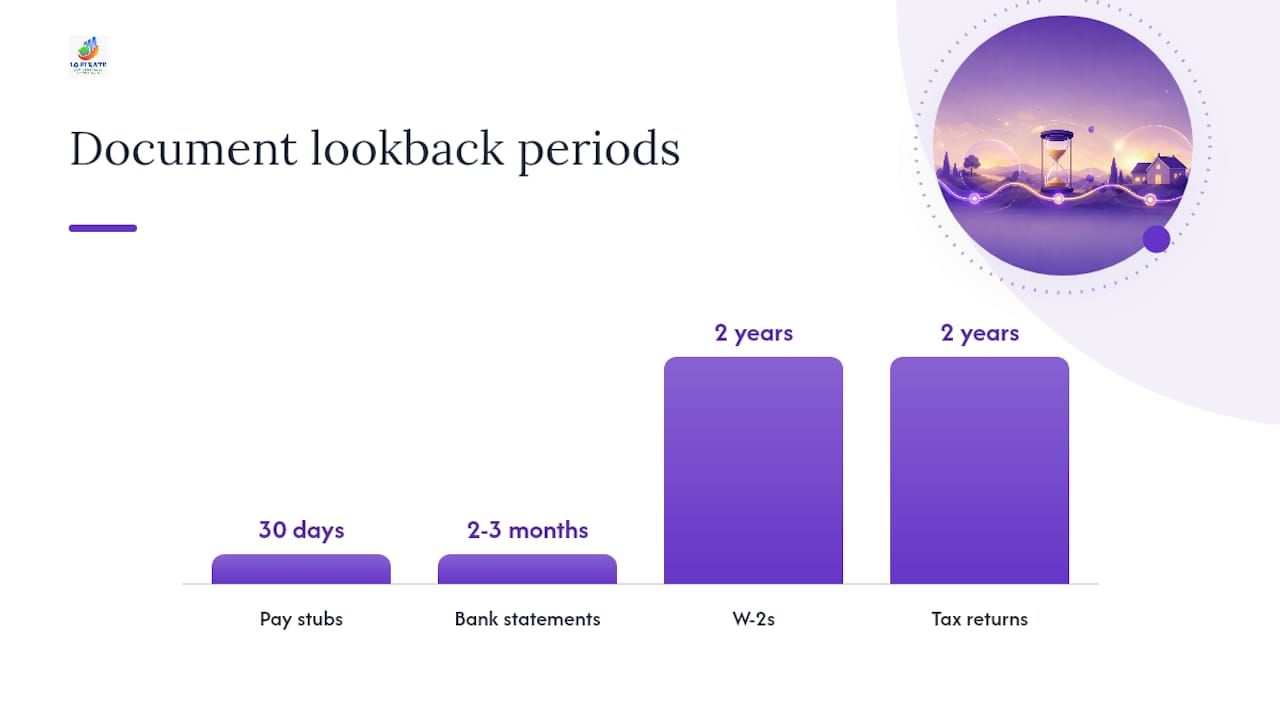
- Pay stubs covering the most recent 30 days, confirming current income.
- W-2s for the past two years, confirming income consistency.
- Federal tax returns, signed, for the past two years, especially if you have variable or commission income.
- Bank statements for the past two to three months across every account you'll draw funds from.
- Asset and investment statements, including retirement accounts if you're using them for reserves.
- Government-issued ID and Social Security documentation.
- Down payment source documentation, showing exactly where that money came from and how long it's been in your account.
U.S. News's mortgage documents checklist makes a point worth repeating: lenders want the most recent version of every document, not whatever you happened to save six months ago. An outdated pay stub is functionally the same as a missing one.
Three borrower situations need extra paperwork:
Self-employed borrowers should prepare a profit and loss statement, two years of business tax returns, and any 1099s received.
Gift funds require a signed gift letter stating the money doesn't need to be repaid, plus the donor's bank statement showing the funds leaving their account.
Divorce or bankruptcy situations call for discharge papers, separation agreements, or a divorce decree that specifies who's responsible for which debts.
Once you have the documents, organize them in this order:
- Create one labeled folder per document category (income, assets, identity, explanations).
- Scan or photograph every page, including cover pages and any blank pages in the original.
- Keep a duplicate set for yourself before sending anything to a lender.
How Long Before Applying Should You Stop Using Credit?
Plan on a 90-day financial holding pattern before you apply. No new credit accounts, no large unexplained deposits, no co-signing for anyone else's loan. Underwriters read recent changes as new risk, even when the change is something you'd consider harmless, like financing a couch or picking up a store card for a discount.
Here's why it matters mechanically. A new hard inquiry can shave points off your score right when a lender is about to pull it. A new trade line changes your debt-to-income ratio, sometimes enough to push you out of the range a program requires. And a large deposit that isn't clearly documented forces an underwriter to ask where it came from, which slows the file down even if the money is completely legitimate, like a bonus or a tax refund.
Do not, in the 90 days before applying:
- Open a new credit card or store financing account
- Co-sign a loan for a family member or friend
- Make a large purchase that requires financing
- Move large sums between accounts without a documented paper trail
- Change jobs, if it can be avoided, especially into a different pay structure
A rough timeline that keeps you clean:
- 90 days out: freeze new credit applications, stop moving large sums without documentation.
- 30 days out: gather final pay stubs and bank statements, confirm no new inquiries have appeared.
- 7 days out: do a final pull of your reports to confirm nothing changed since your last review.
Credit card balances specifically deserve early attention, since utilization affects your score faster than almost any other factor. If you're carrying revolving debt, these strategies for reducing credit card balances are worth working through well before your 90-day window starts.
What Extra Documents Do Self-Employed or Thin-File Borrowers Need?
If you're self-employed, have a thin credit file, or are recovering from a bankruptcy or foreclosure, expect more paperwork and a longer underwriting timeline than a typical W-2 employee would face. Prepare these documents in advance rather than scrambling once a lender asks.
Self-employed borrowers should have ready: profit and loss statements, business bank statements, signed personal and business tax returns, any 1099s received, a copy of your business license, and recent invoices showing consistent income from your industry.
Thin-file borrowers, meaning those without much traditional credit history, can often substitute alternative payment data: rent payment history, utility payment records, and phone bill payment history. A letter from a landlord or utility provider confirming a consistent on-time payment pattern carries real weight here.
Borrowers with a recent bankruptcy or foreclosure face defined waiting periods that vary by loan program, and lenders will want discharge paperwork or, in a foreclosure case, documentation of the deed transfer. A short, factual letter explaining the circumstances, paired with proof of your current financial stability, helps more than a lengthy narrative.
Program requirements diverge here in ways that matter. Conventional loans, FHA loans, and VA loans each set different waiting periods and different documentation standards for these situations. Contact a lender or a HUD-approved housing counselor early if any of this applies to you. Waiting until you're mid-application to figure out your program's specific rule wastes weeks you don't need to lose.
What Credit Score Do You Need for a Mortgage?
Underwriters use your credit report to confirm your identity, verify your existing debts, calculate your debt-to-income ratio, and arrive at what's called a decision credit score. When all three bureaus return a score, lenders typically use the median of the three, not the average and not the highest, according to Fannie Mae's selling guide. That means a low score on just one bureau can become your decision score even if the other two are strong, which is exactly why checking all three reports individually matters more than checking your average.
If only one or two bureaus return a score, lenders generally use the lower of the two, or the single score available, depending on the program.
Score ranges shift eligibility, though every lender applies its own overlays on top of the baseline program minimums:
Fannie Mae's Eligibility Matrix ties minimum scores to specific loan-to-value ratios and reserve requirements, and those thresholds move depending on property type and occupancy. Treat any score number here as a planning benchmark, not a guarantee. One lender's overlay can be stricter than another's for the identical loan program.
Beyond the number itself, underwriters weigh your credit utilization, how recently any delinquency occurred, and whether any derogatory public record remains on file. A 680 score with a recent 30-day late payment and high utilization reads very differently to an underwriter than the same 680 with a clean recent history.
How Do You Write a Letter of Explanation for Underwriting?
Keep any letter of explanation factual, short, and backed by documentation. A clear, well-structured letter can prevent an underwriter from issuing a formal condition that delays your closing, while a vague or emotional one tends to invite more questions rather than fewer.
Structure it around four things:
- What happened. One or two sentences, stated plainly.
- When it happened. Specific dates, not "a while back" or "recently."
- Evidence attached. Reference exactly which document supports your explanation.
- Current status. Confirm the situation is resolved or explain where it stands now.
Pair your letter with whatever documentation backs it up: bank statements for a large deposit, settlement paperwork for a legal matter, or discharge paperwork for a prior bankruptcy. Skip speculation or lengthy backstory. Underwriters are looking for facts they can check against a document, not context about why something happened.
Before you submit, confirm your packet includes:
- The letter itself, dated and signed
- Every supporting document referenced in the letter
- Copies, not originals, of anything financial
The One-Page Checklist to Print Before You Apply
Use this as your final control list before submitting anything to a lender.
- Ordered reports from all three bureaus at AnnualCreditReport.com (date: ______)
- Reviewed personal information for accuracy
- Reviewed all trade lines for balance and payment accuracy
- Checked public records and collections for reporting-window errors
- Filed any needed disputes (date filed: ______, response due: ______)
- Gathered most recent pay stubs (last 30 days)
- Gathered W-2s (past two years)
- Gathered signed federal tax returns (past two years)
- Gathered bank and asset statements (past two to three months)
- Prepared special items if applicable: gift letter, business tax returns, discharge papers
Keep your originals somewhere secure and provide copies to your lender. This list is meant to be your pre-submission check, not a substitute for whatever specific items your lender ultimately requests.
Why Organized Documentation Speeds Up Underwriting
Lenders read a well-organized loan packet as a lower-risk file before an underwriter reads a single number on it. When every page is labeled, every statement is complete, and nothing is missing a page, there's simply less for an underwriter to ask about, and fewer questions mean fewer days sitting in a queue.
A simple filing habit makes a real difference here:
- Label every document by category (income, assets, identity, explanations) as you collect it.
- Include every page of every statement, even ones marked "intentionally left blank."
- Add a one-page contents list at the front of your packet so a reviewer can see everything at a glance.
One of the more common delays in underwriting traces back to something small: a two-month bank statement submitted with page 2 of 3 missing, because the borrower didn't realize a low balance summary page continued onto the next sheet. That single missing page can trigger a formal underwriting condition and add days to a closing timeline that otherwise would have gone smoothly. Fannie Mae's own guidance on multi-page documents makes the same point: capture the whole document, not just the parts that look relevant.
Working with a broker who shops your file across multiple wholesale lenders, rather than resubmitting the same documents to several retail lenders one at a time, also cuts down on how many times you're asked for the same paperwork. Every additional lender you approach separately usually means re-explaining the same gift letter or the same employment gap. For more on how underwriting actually processes your file once it's submitted, this guide to home loan underwriting breaks down what happens after your documents land on someone's desk.
Six Mistakes That Slow Down Nearly Every Mortgage File
Most underwriting delays come down to the same handful of preventable mistakes, over and over.
Missing pages in a submitted statement. Fix: scan the entire document, front and back, every page, before you submit anything.
Large deposits with no explanation. Fix: write a one-paragraph explanation and attach proof the moment you see an unusual deposit, don't wait for a lender to ask.
New credit inquiries in the weeks before applying. Fix: freeze new credit applications the moment you decide to buy, not the moment you formally apply.

Not keeping pay stubs organized. Fix: save every pay stub digitally the day you receive it, rather than hunting for them later.
Undocumented gift funds. Fix: get the signed gift letter and the donor's bank statement before the money moves, not after.
Ignoring a small reporting error because it seems minor. Fix: dispute it anyway. A small error today can become a bigger delay once it's sitting in an underwriter's queue.
If your situation involves more than one of these at once, self-employment plus a recent large deposit, for example, reach out to a housing counselor or a mortgage broker early. A complex file benefits far more from an early conversation than a last-minute scramble.
Get Help Organizing Your File Before You Apply
Reviewing three credit reports, disputing errors, and assembling a full document packet is a lot to manage alone, especially if your situation involves self-employment, a recent gift fund, or a past credit event that needs explaining. Lofirate connects you with licensed wholesale mortgage brokers who shop your file across multiple lenders instead of pricing you against a single retail rate sheet.

That matters here specifically: a broker who works across several wholesale lenders can often tell you upfront which lender's overlays fit your credit profile, so you're not resubmitting the same pay stubs and letters of explanation to three different retail loan officers one at a time. Lofirate isn't a direct lender and doesn't set rates itself. It's a matching service that puts you in front of a licensed broker for a no-obligation conversation about your specific file.
If you want a second opinion on your credit profile before you formally apply, get matched with a broker and ask what documentation they'd want to see first. You can also browse loan options by program if you're still deciding between conventional, FHA, or VA financing.
Where to Verify These Rules Yourself
Every guideline in this checklist traces back to a public source you can read directly.
- The CFPB's credit report review checklist covers the section-by-section review process and the dispute timeline referenced throughout this guide.
- The CFPB's loan application packet guidance explains how to assemble your documents and points to Form 1003 as a starting checklist.
- HUD's 4155.1 guidance defines the tri-merged and RMCR report formats lenders use during underwriting.
- Fannie Mae's homebuyer documentation page lists standard required documents and the importance of complete, multi-page statements.
- Fannie Mae's Eligibility Matrix ties credit score thresholds and reserve requirements to specific loan programs.
- Annualcreditreport is the only federally authorized site for free annual credit reports from all three bureaus.
Frequently Asked Questions
Do I need to give my lender a copy of my own credit report?
Usually not. Lenders pull their own tri-merged report directly from the bureaus once you apply. Order your own copies beforehand anyway so you can catch and fix errors before they show up in the version your lender sees.
How far back do lenders look at my credit history?
Most negative items fall off after roughly seven years, though bankruptcies can remain listed longer. Lenders generally focus most heavily on your activity from the past 12 to 24 months when calculating your decision credit score and reviewing recent payment patterns.
Will checking my own credit report hurt my score?
No. Pulling your own report through AnnualCreditReport.com counts as a soft inquiry, which has no effect on your score. Only hard inquiries, generated when you apply for new credit, can affect it.
What if I find an error but I'm about to apply for a mortgage?
File the dispute anyway, but understand it may not resolve before you need to close. Talk to your broker or loan officer about writing a letter of explanation for the disputed item in the meantime, since a documented, in-process dispute is easier to explain than an unaddressed one.
Does my score need to be the same across all three bureaus?
No, and it rarely is. Lenders typically use the median of your three scores when all three are available, so a lower score on one bureau doesn't automatically disqualify you, but it can become your decision score if the other two are close.
Sources
- Credit report review checklist
- Create a loan application packet | Consumer Financial Protection Bureau
- HUD 4155.1