

Lower your revolving balances and keep every payment current. Those two moves control the largest share of your FICO score and produce the fastest gains before a mortgage application. FICO weights payment history at roughly 35% and amounts owed (credit utilization) at roughly 30%, so attacking both simultaneously is the highest-leverage play available. Pull your tri-merge reports free at AnnualCreditReport.com to see exactly where you stand, then add qualifying bills through Experian Boost for a quick supplemental lift.
Prioritized steps and typical timing:
- Within 7 days: Pull all three bureau reports, identify errors, request credit limit increases (soft pull only), and time your next card payment before the statement closing date.
- Within 30 days: Pay down high-utilization cards to below recommended utilization thresholds per card. File disputes on any material errors. Set up autopay to protect payment history.
- Within 60–90 days: Confirm disputes resolved, check that balances are reporting correctly, and verify score movement across all three bureaus.
- Within 6–12 months: Rebuild payment history with a clean streak, let authorized-user accounts season, and avoid new credit applications.
Score callout: A 40-point score difference can materially change your mortgage rate and the total interest you pay over the life of the loan.
Table of Contents
- What are the mortgage credit improvement steps to follow first?
- Why payment history hits hardest in mortgage underwriting
- How do you pull credit reports and dispute errors?
- Does credit mix or account age actually matter for a mortgage?
- When should you stop applying for new credit before a mortgage?
- What does credit repair actually cost, and when should you get help?
- The credit-prep step most buyers skip
- Your improved credit deserves a competitive mortgage rate
- Useful sources for credit reports and scoring guidance
What are the mortgage credit improvement steps to follow first?
The order matters as much as the actions themselves. Here is the sequence, ranked by speed and impact.
- Pull and review all three reports — Mortgage lenders pull tri-merge reports from Equifax, Experian, and TransUnion, often using your middle score for underwriting. One bad entry on one bureau can cost you a rate tier.
| Step | Action | Typical reporting window |
|---|---|---|
| Pay down balances | Reduce per-card utilization to below 30%, aiming for 10% if possible | Next billing cycle (~30 days) |
| Dispute errors | Submit with documentation | 30–45 days |
| Bring accounts current | Pay any past-due balances | 30–60 days |
| Authorized user add | Join a clean, aged account | 30–60 days |
| Rebuild payment history | 6–12 months of on-time payments | 6–12 months |
Pro Tip: Pay your card balance a few days before the statement closing date, not just before the due date. Issuers report your balance to bureaus at statement close, so a lower balance on that date is what actually shows up on your credit report.
Why payment history hits hardest in mortgage underwriting
Payment history accounts for roughly 35% of your FICO score, making it the single largest factor. But mortgage underwriters look beyond the number. A 30-day late from six months ago raises a red flag even when your score is otherwise solid. Recent delinquencies, open collections, and charge-offs all get scrutinized individually during manual underwriting review.
Steps to remediate payment problems:
- Bring every past-due account current before anything else.
- Contact creditors about pay-for-delete agreements in writing. Not all creditors honor them, but some will remove a collection upon full payment.
- Get any settlement terms in writing before you pay.
- Keep copies of payoff letters and confirmation emails. You will need them for disputes or rapid rescoring.
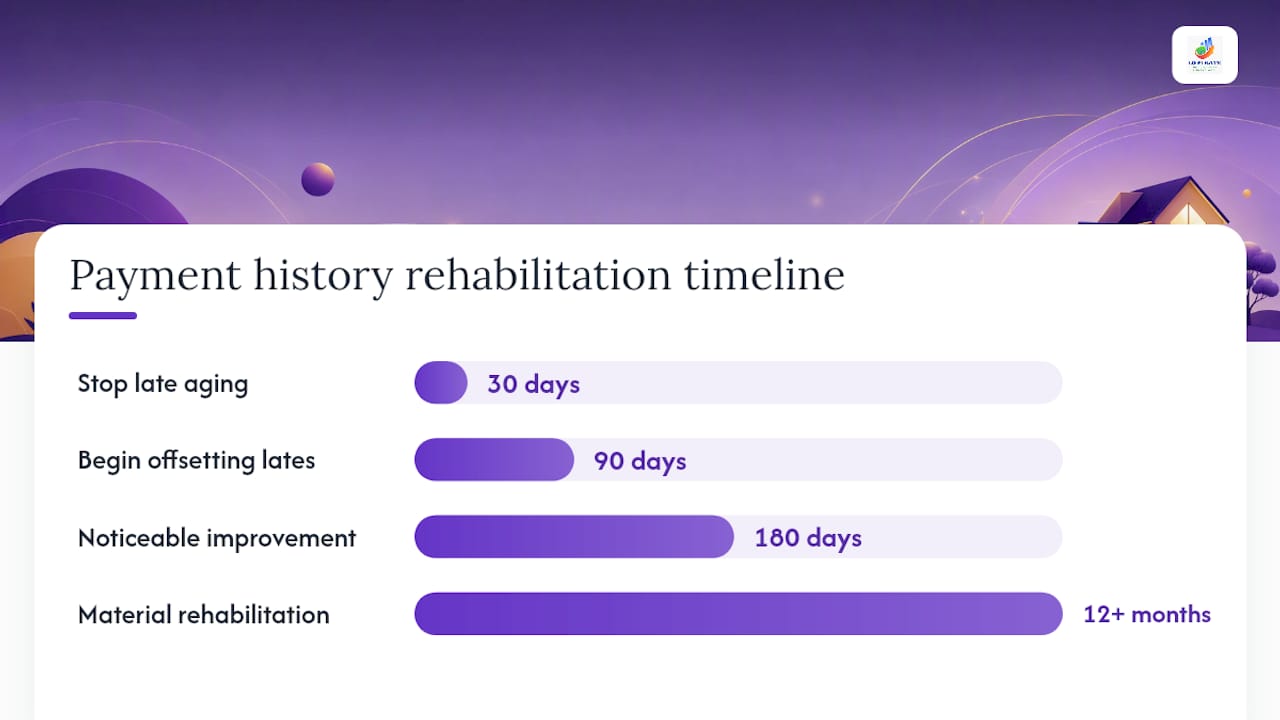
Timeline for payment history rehabilitation:
- 30 days: Bringing a past-due account current stops the bleeding and prevents the late from aging further.
- 90 days: Three months of clean payments begins to offset recent lates in scoring models.
- 180 days: Six months of on-time payments noticeably improves how underwriters read your file.
- 12+ months: A full year of clean history materially rehabilitates most files, even those with prior collections.
Pro Tip: If you are within 30–60 days of applying, ask your mortgage broker about rapid rescoring. When you provide documentation of a paid balance or removed item, a lender can submit it for a file update in 3–5 business days rather than waiting a full billing cycle.
Underwriting reality: Lenders care about the pattern, not just the number. Two years of perfect payments followed by one recent 30-day late reads worse than a lower score with no recent delinquencies.
How do you pull credit reports and dispute errors?
Start at AnnualCreditReport.com, the official free portal for all three bureau reports. You can also pull directly from Experian, Equifax, and TransUnion for additional monitoring.
Step-by-step dispute process:
- Download all three reports and compare them side by side.
- Flag any account you do not recognize, any incorrect balance, any wrong late payment, or any duplicate entry.
- Gather documentation: billing statements, payoff letters, identity verification, and any correspondence with the creditor.
- Submit your dispute online, by mail, or by phone directly to the bureau reporting the error.
- Follow up with the original creditor simultaneously — bureaus contact creditors during investigation.
- Keep records of every submission, confirmation number, and response.
| Document type | When you need it |
|---|---|
| Billing statement | Proves a balance was paid or incorrect |
| Payoff letter | Confirms a debt was settled or paid in full |
| Government-issued ID | Required for identity verification |
| Dispute confirmation | Tracks your submission and bureau response |
| Creditor correspondence | Supports pay-for-delete or settlement claims |
Bureaus have 30–45 days to investigate. If a bureau fails to respond or dismisses a valid dispute, file a complaint with the Consumer Financial Protection Bureau. The CFPB has authority to escalate unresolved disputes and is your primary consumer protection channel.
Does credit mix or account age actually matter for a mortgage?
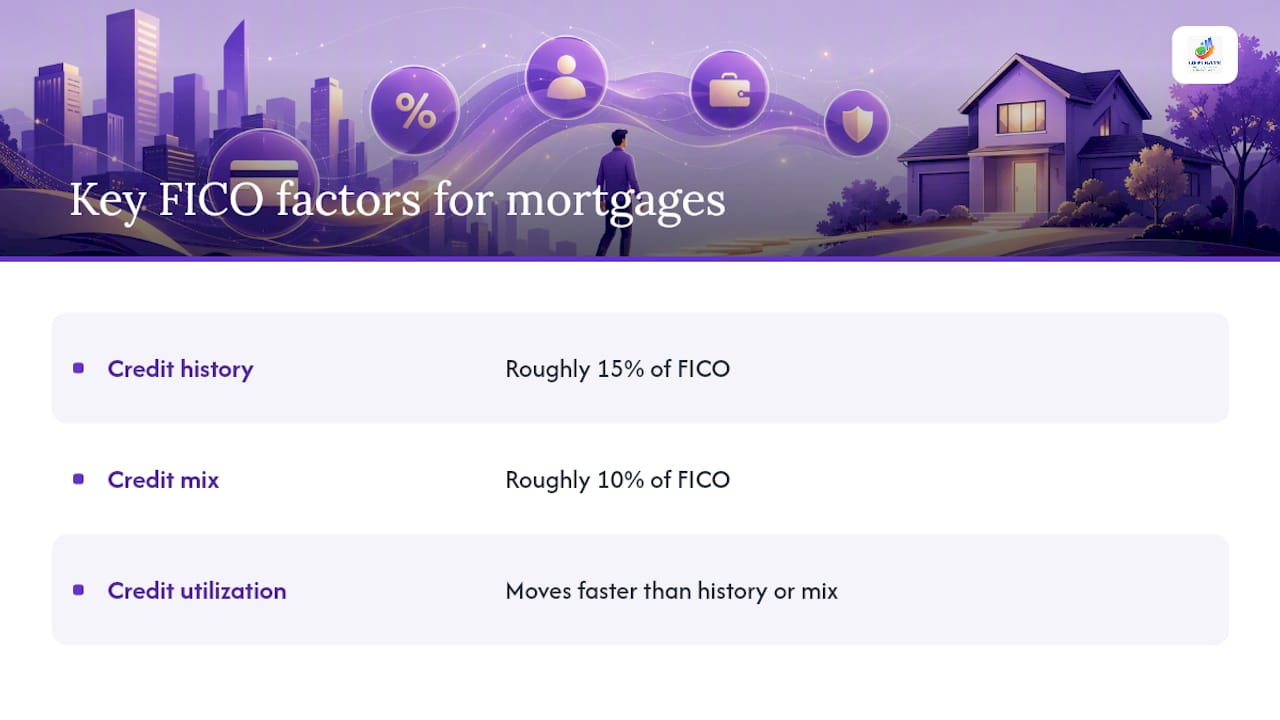
Length of credit history carries roughly 15% of your FICO score, and credit mix accounts for roughly 10%. Neither moves as fast as utilization, but both matter to mortgage underwriters who want to see a seasoned, diverse file.
Authorized user: Being added to someone else's old, low-utilization card can add years of positive history to your file. Before accepting, verify the account has no lates, stays below 30% utilization, and reports to all three bureaus.
Secured cards and credit-builder loans: Both build positive payment history from scratch. Secured cards require a deposit (typically $200–$500) that becomes your credit limit. Credit-builder loans hold funds in a savings account while you make monthly payments. The key requirement for either: the product must report to all three bureaus, not just one.
Rent reporting and Experian Boost: These tools add alternative payment data to your Experian file. They can help some borrowers, but Experian documents that coverage varies across mortgage scoring models. Verify with your broker whether the specific FICO version your lender uses will pick up the boost before relying on it.
Pro Tip: Do not open a secured card or credit-builder loan within 60 days of applying for a mortgage. The new account creates a hard inquiry and lowers your average account age, both of which can temporarily reduce your score.
When should you stop applying for new credit before a mortgage?
Hard inquiries from new credit applications typically drop scores by roughly 3–5 points temporarily. That is manageable in isolation, but multiple inquiries in a short window signal risk to lenders. Stop all new credit applications at least 30–90 days before your mortgage application, and maintain that freeze from preapproval through closing.
The exception is rate shopping. Most FICO models treat multiple mortgage inquiries within a 14–45 day window as a single inquiry, so comparing lenders does not compound the damage. Use that window deliberately when you are ready to shop.
| Action | When scores typically reflect it |
|---|---|
| Utilization reduction | Next billing cycle (~30 days) |
| Dispute resolution | 30–45 days after bureau confirms |
| Hard inquiry impact fades | 12 months (removed after 2 years) |
| New account seasoning | 6–12 months |
| Payment history rebuild | 6–12 months of clean payments |
- Avoid new auto loans, personal loans, or credit cards once you are in the mortgage pipeline.
- Do not co-sign for anyone else's debt during this period.
- Keep existing accounts open and active with small, paid-in-full charges.
What does credit repair actually cost, and when should you get help?
Most of the highest-impact steps cost nothing. Pulling reports at AnnualCreditReport.com is free. Filing disputes directly with bureaus is free. The costs come when you add tools to build credit.
| Tool | Typical cost |
|---|---|
| Secured credit card | $200–$500 deposit (refundable) |
| Credit-builder loan | $15–$30/month in fees (varies by lender) |
| Bureau dispute filing | Free |
| CFPB complaint | Free |
| Nonprofit credit counseling | Free to low-cost |
Watch for these red flags in credit-repair offers: Any company that guarantees a specific score increase, demands upfront payment before doing any work, or advises you to create a new credit identity using an Employer Identification Number is running a scam. These tactics are illegal and can expose you to fraud charges. The CFPB complaint process is your recourse if a company violates your rights.
When professional help makes sense:
- A nonprofit credit counselor is worth engaging if you have multiple delinquencies and need a structured repayment plan.
- A mortgage broker review makes sense once your score reaches the 680+ range, when rate differences between tiers become significant. Understanding how your credit score impacts mortgage rates helps you know exactly which tier to target.
- Rapid rescoring through a lender is the right move when you are within 30–60 days of closing and have documentation of recent payoffs.
The credit-prep step most buyers skip
Most guides tell you to improve your score before applying. What they underemphasize is the gap between a better score and a better rate. A score improvement means nothing if you apply through a retail lender who only has access to their own pricing. Wholesale mortgage brokers shop multiple lenders simultaneously, which means the same 720 score can land a materially different rate depending on who is doing the shopping.
The practical implication: time your broker outreach to coincide with your credit improvements, not after you have already committed to a lender. A pre-application broker review at Lofirate costs nothing and gives you a real market read on what your improved profile is actually worth. Check refinance approval strategies if you are working toward a refi rather than a purchase.
Your improved credit deserves a competitive mortgage rate
Once your score crosses 680, the difference between retail and wholesale mortgage pricing becomes real money. Lofirate connects you with licensed wholesale mortgage brokers who shop multiple lenders on your behalf — no direct lending, no obligation, no retail markup baked in.

Borrowers at 720+ typically access the strongest rate tiers. Those in the 680–720 range still see significant gains over single-lender retail quotes. Either way, a broker review before you formally apply costs nothing and shows you exactly what your credit work has earned. Start a free broker consultation at Lofirate and find out what wholesale pricing looks like for your profile today.
Useful sources for credit reports and scoring guidance
- Discover How to Improve Your Credit Score Effectively | myFICO
- How to improve your credit score | Experian
- Which credit scores are used for mortgage lending | myFICO
- How to Improve Your Credit Score for Mortgage | Capstag
- How to Improve Your Credit Score for a Mortgage: Fast Tips
- Ways to improve credit | Experian
- Understand, get, and improve your credit score | USAGov