

A non‑QM loan is a fully underwritten U.S. mortgage that qualifies you using alternative documentation, such as bank deposits or rental income, instead of W‑2s and tax returns. It's the right move if your real cash flow doesn't match your tax return, but it usually costs more than an agency loan, so it's worth ruling out conventional financing first.
TL;DR:
- Non‑QM loans use alternative documentation like bank deposits or rent income, making them suitable for self‑employed, contractors, or investors with complex income proof.
- These loans can feature interest‑only periods, balloon payments, and higher debt‑to‑income ratios, with qualification relying on different proof methods.
- Typical requirements include 620–640 FICO scores, larger down payments for investment properties, and substantial reserves, depending on the specific program.
- Non‑QM costs are higher due to perceived risk and limited secondary market liquidity, with loan-to-value, credit score, and property type significantly influencing rates.
- Comparing multiple wholesale lenders via a licensed broker is crucial to securing optimal terms, as program-specific pricing varies widely across lenders.
Table of Contents
- What Non‑QM Actually Means Under U.S. Mortgage Rules
- Who Actually Needs a Non‑QM Loan
- Bank Statement, DSCR, and Other Non‑QM Program Types
- Credit, Down Payment, and Reserve Expectations
- Why Non‑QM Costs More, and What Actually Drives the Price
- Choosing a Non‑QM Lender or Broker Without Getting Burned
- What to Have Ready Before You Apply
- Common Myths and Real Risks Worth Knowing
- How a Non‑QM Loan Affects Your Credit and Financial Profile
- The Regulatory Environment Behind Non‑QM Lending in 2026
- The Non‑QM Application Process, Start to Finish
- How Long Non‑QM Loans Take to Close
- Why Shopping Wholesale Beats Taking the First Quote
- Get a Consultation Before You Commit to One Lender's Terms
- Sources
What Non‑QM Actually Means Under U.S. Mortgage Rules
The Consumer Financial Protection Bureau defines a Qualified Mortgage as a loan that meets specific rules on fees, terms, and the lender's obligation to verify a borrower's ability to repay. Any loan that doesn't fit that box gets labeled non‑QM. That's it. It's a documentation classification, not a verdict on risk.
The Ability‑to‑Repay rule still applies. Lenders offering non‑QM loans must verify you can afford the payment; they just use different evidence to prove it. A self‑employed contractor might show 24 months of bank deposits instead of two years of tax returns showing depreciated, write‑off‑heavy income that looks nothing like what actually hits the checking account.
Non‑QM programs allow loan features that Qualified Mortgages restrict or ban outright, like interest‑only payment periods and, in limited cases, balloon payments. Some programs also permit debt‑to‑income ratios above the 43% threshold that historically defined QM eligibility. Business Insider's breakdown of non‑QM loans notes these loans are fully underwritten with alternative paperwork, not the "no‑doc" products that fueled the 2008 crash. The underwriting is real. The paper trail just looks different.
Who Actually Needs a Non‑QM Loan
Non‑QM isn't a fallback for people with bad credit. It's a tool for people whose income is real but doesn't show up cleanly on a tax return. HousingWire's overview of non‑QM borrower profiles points to several recurring types:
- Self‑employed business owners whose deductions shrink their taxable income well below actual earnings.
- 1099 contractors with income that fluctuates or comes from multiple clients.
- Real estate investors buying rental property where the property's rent, not personal income, should qualify the loan.
- Retirees with substantial investment or retirement accounts but little monthly W‑2 income.
- ITIN holders and foreign nationals who lack a Social Security number or U.S. credit history but can document income and assets.
Non‑QM exists for the borrowers agency guidelines weren't built to see.
Bank Statement, DSCR, and Other Non‑QM Program Types
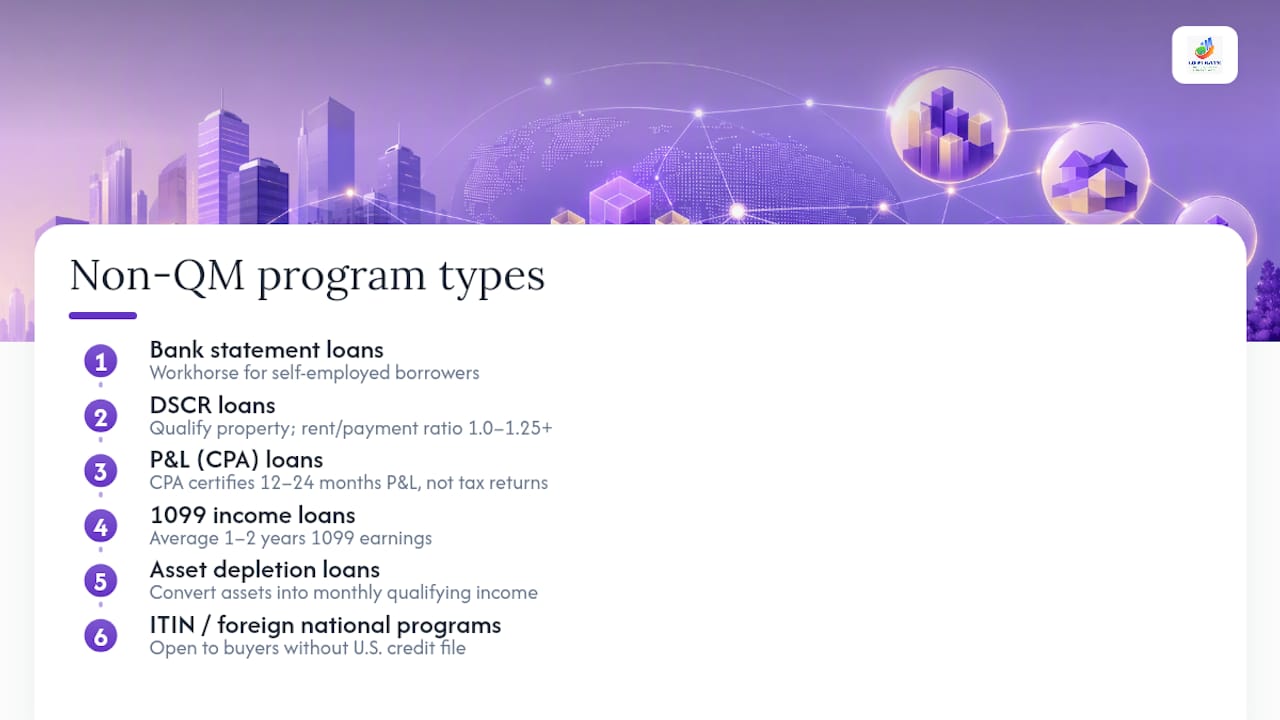
Non‑QM isn't one product. It's a family of programs, each built around a different way of proving you can pay.
Bank statement loans are the workhorse for self‑employed borrowers. This is one of the two program types driving the bulk of non‑QM volume today, alongside DSCR loans.
DSCR loans (debt service coverage ratio) qualify the property, not the person. Lenders divide the property's rental income by the proposed mortgage payment; a ratio of 1.0 means rent exactly covers the payment, and most lenders want to see 1.0 to 1.25 or higher. No personal income documents required in many cases, which makes DSCR loans popular with investors scaling a rental portfolio.

P&L (CPA) loans let a borrower's accountant certify profit and loss statements, often 12 to 24 months of them, in place of tax returns. This suits business owners whose CPA can vouch for numbers that returns don't reflect cleanly.
1099 income loans average one to two years of 1099 earnings, sometimes paired with a signed letter or contract history, for contractors and gig‑economy workers.
Asset depletion (or asset utilization) loans convert liquid assets, brokerage accounts, retirement funds, into a monthly qualifying income figure, useful for retirees or high‑net‑worth borrowers who are asset rich but income light on paper.
ITIN and foreign national programs, often paired with a Written Verification of Employment (WVOE) from a foreign employer, open the door to buyers without a U.S. credit file.
Each program verifies repayment ability differently, but all of them are fully documented alternatives to traditional underwriting, not shortcuts around it. If you're weighing which path fits, a broader look at non‑traditional mortgage options can help you map your paperwork to the right program before you talk to a lender.
Credit, Down Payment, and Reserve Expectations
Non‑QM eligibility varies by lender and program, but some patterns hold across the market. Minimum FICO scores commonly fall in the 620 to 640 range, though scores above 700 usually unlock meaningfully better pricing.
Down payment and loan‑to‑value limits shift based on occupancy and program:
- Owner‑occupied bank statement loans often allow relatively high loan-to-value ratios, corresponding to moderate down payments.
- DSCR investment loans typically cap loan-to-value at moderately high levels, requiring a substantial down payment.
- Reserve requirements, liquid funds left over after closing, often span a wide range of months of the future payment, with investor and higher‑LTV files generally requiring more reserves.
Documentation requests follow the program: bank statement borrowers supply the actual statements plus a business license or profile; DSCR borrowers supply leases and rent rolls; P&L borrowers supply CPA‑prepared statements; asset depletion borrowers supply current account statements. Every path also needs standard items: a government ID, the purchase contract, and existing mortgage statements if you're refinancing. Before signing with any originator, verify their license through NMLS Consumer Access, the free federal database that shows licensing status and disciplinary history.
Why Non‑QM Costs More, and What Actually Drives the Price
Non‑QM loans generally carry higher rates than agency products because alternative documentation carries more perceived risk for lenders and less liquidity in the secondary market. The gap can be modest to significant, depending heavily on your file.
The real pricing drivers are loan‑to‑value, credit score, property type, documentation path, and occupancy. An investor DSCR loan on a condo with an interest‑only feature will price differently than an owner‑occupied bank statement loan on a single‑family home with strong reserves. Compare the full APR, points, and fee structure across quotes, not just the headline rate; a lower rate loaded with points can cost more over five years than a slightly higher rate with none. Reading how APR and points actually work before you shop saves you from comparing apples to oranges.
To narrow the premium: reduce your LTV with a larger down payment, push your credit score up before applying, and get quotes from brokers who regularly place non‑QM loans rather than lenders who dabble in it. Watch for prepayment penalties, common on investor DSCR products, which can undercut the flexibility that drew you to non‑QM in the first place.
Choosing a Non‑QM Lender or Broker Without Getting Burned
Not every originator who claims to "do non‑QM" actually places these loans often enough to know the programs well. Run through this before you commit:
- Ask what non‑QM programs they placed in the last 90 days. A vague answer means limited experience.
- Ask about pricing transparency. Request an itemized breakdown of rate, points, and fees, not just a monthly payment number.
- Ask about prepayment penalties. Get the exact terms in writing, especially on DSCR loans.
- Ask about reserve and documentation requirements upfront. A lender who can't answer specifically probably hasn't underwritten many of these files.
- Ask about typical turn times from application to clear‑to‑close for your specific program.
Red flags include pressure to sign before seeing full pricing, reluctance to disclose licensing, and vague answers about which wholesale lenders they actually work with. Cross‑check any originator through NMLS Consumer Access and your state's licensing board or the Better Business Bureau for complaint history.
Pro Tip: Ask the broker to walk through an anonymized example file similar to yours, same income type, similar credit and LTV, and show you the pricing and requirements it generated. If they can't produce one, they probably haven't closed enough of these to know the terrain.
What to Have Ready Before You Apply
Every non‑QM application starts with the basics: a government‑issued ID, the signed purchase contract (or current mortgage statement if refinancing), and proof of funds for closing. Beyond that, your document list depends on your program.
- Bank statement path: 12 to 24 months of personal or business bank statements, a written explanation for any large or unusual deposits, and basic business documentation like a license or website.
- DSCR path: existing leases or a market rent estimate, rent rolls if you already own the property, and a breakdown of property expenses (taxes, insurance, HOA).
- P&L/CPA path: 12 to 24 months of CPA‑prepared profit and loss statements, backed by corresponding bank statements that support the figures.
- Asset depletion path: current statements from brokerage, retirement, or savings accounts, showing enough liquidity to support the calculated qualifying income.
Gathering these before you contact a broker cuts real time off your approval, since most delays in non‑QM underwriting come from chasing paperwork after the fact.
Common Myths and Real Risks Worth Knowing
The biggest myth is that non‑QM equals subprime or "no‑doc." It doesn't. Modern non‑QM loans are fully documented and fully underwritten; they just accept different proof of income than tax returns require.
The real risks are practical, not reputational: higher rates, occasional interest‑only or balloon structures that require planning ahead, and prepayment penalties on some investor products that punish an early refinance or sale. Watch for originators who push you toward a loan feature you didn't ask for, or who can't explain, in plain terms, why your file needs a particular program. If a broker can't clearly justify a recommendation or won't put pricing in writing, get a second opinion before signing anything.
How a Non‑QM Loan Affects Your Credit and Financial Profile
Applying for a non‑QM loan triggers a hard credit inquiry the same way any mortgage application does, and the loan itself reports to the credit bureaus once it closes, just like a conventional mortgage. Making consistent, on‑time payments builds payment history the same way, which is the single largest factor in most credit scoring models.
Where non‑QM diverges is in what happens before you apply. Bank statement and asset depletion programs don't require you to lower your debt‑to‑income ratio through tax‑return tricks, so some borrowers find their credit utilization and existing debt load matter more heavily in the approval decision than they would for a W‑2 employee. High credit card balances or several open lines of credit can hurt a non‑QM application more visibly, since the underwriter is already weighing income presented outside the standard framework.
Interest‑only features, where offered, don't build home equity through principal paydown during the interest‑only period. That doesn't hurt your credit score directly, but it does affect your long‑term financial position, and it's worth factoring into any decision to choose that structure over a fully amortizing loan.
One underrated point: closing a non‑QM loan doesn't put a mark on your record that lenders can see later. A future lender reviewing your credit report sees a mortgage with a payment history, not a flag indicating the loan was non‑QM. Your next refinance or purchase gets judged on how you paid, not on which documentation path got you there.
The Regulatory Environment Behind Non‑QM Lending in 2026
Non‑QM lending operates within the framework the CFPB built after the 2008 mortgage crisis, centered on the Ability‑to‑Repay rule and the Qualified Mortgage definition. That framework hasn't been repealed; non‑QM loans still have to satisfy ATR requirements, lenders just document repayment ability differently than the QM safe harbor requires.
What has shifted is investor appetite and lender guideline detail. As bank statement and DSCR volume has grown, wholesale lenders have published increasingly specific eligibility matrices covering credit tiers, loan‑to‑value caps by occupancy, and reserve requirements, the kind of detail found in lender guideline documents like AD Mortgage's published eligibility guidelines. These matrices function as the real rulebook for any given program, more precise than general industry commentary, and they get updated as lenders adjust risk appetite.
Because guidelines vary by lender and change over time, the safest approach is to request the current guideline sheet for any program you're considering rather than relying on last year's numbers from a blog post, including this one. A program that allowed 90% LTV last year might cap at 85% this year depending on how that lender's portfolio is performing.
The Non‑QM Application Process, Start to Finish
The process resembles a conventional mortgage application with different documentation checkpoints. It starts with a conversation, either with a direct lender or a broker who shops multiple wholesale non‑QM lenders, about your income type and goals.
From there, the originator identifies which program fits: bank statement, DSCR, P&L, asset depletion, or another path, based on your documentation and property type. You submit the program‑specific paperwork covered earlier, and the lender issues a preliminary pricing scenario. This is the point to compare rate, points, and fees across at least two quotes, since pricing on non‑QM files is highly specific to your exact numbers rather than a published rate sheet.
Once you accept terms, the file moves to underwriting, where the deposit history, rental income, or CPA statements get analyzed against the program's specific formulas. Underwriters may request clarification on deposits or additional bank statements; responding quickly here is the single biggest factor in keeping the timeline on track. An appraisal gets ordered for the property. Once underwriting issues a clear‑to‑close, you review final closing disclosures and schedule the signing.
Throughout, verify that whoever is guiding you holds an active license through NMLS Consumer Access; the tool also shows you which states and companies they're authorized to originate loans for.
How Long Non‑QM Loans Take to Close
Non‑QM closings often run a bit longer than a straightforward conventional purchase, mainly because the documentation review is more involved. A clean bank statement or DSCR file with a responsive borrower can close in three to five weeks. Files requiring extensive deposit explanations, CPA letter clarifications, or foreign national documentation can stretch to six weeks or more.
The biggest timeline variable isn't the lender; it's how fast you respond to document requests. Underwriters reviewing 24 months of bank statements frequently flag large or irregular deposits and ask for a written explanation and paper trail. Borrowers who have that explanation ready, rather than scrambling to reconstruct it, shave real days off the process.
Appraisal scheduling and DSCR‑specific items like rent rolls or lease verification add their own lead time, particularly in markets with appraiser backlogs. Building in a week of buffer beyond your lender's stated estimate, especially on a purchase with a firm closing date, avoids a last‑minute scramble on rate locks or seller deadlines.
Why Shopping Wholesale Beats Taking the First Quote
Most of the frustration with non‑QM lending doesn't come from the underwriting itself. It comes from borrowers accepting the first quote they get, without realizing how much file‑specific pricing swings from one lender to the next on programs like bank statement and DSCR loans.
Wholesale brokers who place these loans regularly see pricing across multiple lenders for the same file profile, which is precisely why comparing at least two clean quotes matters more here than on a plain‑vanilla conventional loan. A borrower who takes the only quote they're offered has no way to know whether the points and reserves demanded are typical for their file or simply what one lender's current risk appetite happens to require. That gap is where a lot of unnecessary cost quietly gets paid.
— LoFi
Get a Consultation Before You Commit to One Lender's Terms
Lofirate connects you with licensed wholesale mortgage brokers who shop your non‑QM file across multiple lenders instead of handing you a single retail quote. That matters here specifically because non‑QM pricing swings so much from one lender's risk appetite to the next.

Lofirate doesn't lend money or set rates directly. It matches you with a licensed broker in your state for a free, no‑obligation consultation, then that broker shops your bank statement, DSCR, P&L, asset depletion, or ITIN file across their lender network to find competitive terms for your exact situation.
Before you request a consultation, have ready:
- Two years of bank statements or CPA P&L statements (whichever applies to your program)
- Recent asset or retirement account statements
- A signed purchase contract, if you're under contract
- Government‑issued ID
Start the process on the Lofirate services page, where you can request a broker match and get a second opinion on pricing before you sign anything with a single lender.
This article is general information, not a substitute for advice from a qualified financial advisor. Consult a qualified financial professional about your own circumstances before acting on anything here.
Sources
- What is a qualified mortgage? — CFPB
- What Are Non‑QM Loans? — Business Insider
- Non‑QM Loan Requirements (2026) — Defy Mortgage