

A rate lock float-down lets you keep your locked rate while claiming a one-time drop if market rates fall before closing. It usually pays for itself when the fee is small (or free), your closing is 30 to 45 days out, and rates are trending down. If your loan closes fast or the fee eats up most of the savings, skip it and check your lender's exact trigger rules first.
TL;DR:
- A float-down typically costs between 0 and 1 point of the loan amount, with breakeven periods ranging from about two to three years depending on the size of the fee and rate drop.
- Exercising a float-down depends on a strict timing window, usually within 30 to 60 days of lock expiration, and requires active request confirmation before closing.
- The trigger for a float-down is based on lender-specific wholesale pricing, not news headlines, and many programs cap the benefit at a 0.25% to 0.5% reduction.
- Availability and terms of float-downs vary with market conditions, being more common and generous in falling-rate environments and often more restrictive when rates are stable or rising.
- Comparing float-down offers through wholesale brokers can often reveal lower fees and better thresholds than single retail lenders, making shopping a critical step before committing.
Table of Contents
- What Is a Rate Lock Float Down?
- How Do Float-Down Triggers and Timing Windows Work?
- What Does a Float-Down Cost, and When Does It Break Even?
- Is a Float-Down Worth Paying For?
- How Do You Request and Document a Float-Down?
- How Does a Float-Down Affect Your Mortgage Application?
- Does a Float-Down Affect Your Credit Score or Loan Terms?
- Why Are Float-Downs More Common in Some Rate Environments?
- Do Float-Downs Work the Same on Fixed and Adjustable Rate Loans?
- Compare Float-Down Terms Across Wholesale Lenders With Lofirate
- A Pragmatic Take on Float-Downs
- Sources
What Is a Rate Lock Float Down?
A rate lock float-down is an add-on to a standard mortgage rate lock that lets you capture a lower rate if the market moves in your favor after you've already locked. Normally, once you lock a rate, you're stuck with it, even if rates drop the next week. A float-down carves out an exception: one chance to adjust your rate downward before closing, provided the drop meets your lender's minimum threshold.
This is different from two things borrowers often confuse it with:
- Floating the rate means you never locked in the first place. You're exposed to market swings in both directions, with no protection if rates rise.
- Re-locking happens when a lock expires and you negotiate a brand new lock, often at current market pricing, sometimes with a fee if the original lock lapsed.
A float-down keeps your original lock intact and simply adjusts the rate downward, one time, if conditions are met. Availability isn't universal. Some retail lenders don't offer float-downs at all, while others build them into premium lock packages. Wholesale rate sheets show how pricing shifts by lock term and date, which is part of why float-down terms vary so much from one lender to the next.
How Do Float-Down Triggers and Timing Windows Work?
Float-downs run on strict mechanics, and missing a deadline or misunderstanding the trigger is the most common way borrowers lose the benefit entirely.
- The timing window is short. Most float-down provisions live inside a 30 to 60 day rate lock and typically must be exercised before the lock expires, according to Investopedia.
- You usually have to ask. Lenders are not obligated to notify you when rates drop enough to qualify. The SDFCU notes borrowers need to actively request the float-down and confirm they meet the lender's threshold.
- The trigger is internal pricing, not headlines. A news story saying "mortgage rates fell" doesn't automatically mean your float-down kicks in. Lenders base the adjustment on their own wholesale pricing sheets, and those can move differently than the average rate you see quoted in the media.
- There's usually a cap. Many programs cap the benefit (say, a maximum 0.25% to 0.5% reduction) and allow only one exercise per loan.
Pro Tip: Ask your loan officer for the exact minimum rate-decrease percentage that triggers the float-down, in writing, before you pay any fee for it. "A meaningful drop" is not a number you can hold anyone to.
Loan status matters too. Most lenders require your file to still be in underwriting, not yet cleared to close, when you exercise the option.
What Does a Float-Down Cost, and When Does It Break Even?
Float-down pricing splits into three common structures, and the difference between them determines whether the option is worth having at all.
- No fee, strict triggers. Some lenders bundle a float-down into the lock with no separate charge, but require a larger rate drop to qualify.
- Upfront points. Others charge somewhere between 0.25 and 1.0 point of the loan amount, according to CBS News, payable regardless of whether you end up using it.
- Baked-in pricing. A few lenders simply price the lock slightly higher across the board to include float-down eligibility.
Breakeven math: Divide the total dollar fee by your monthly savings from the reduced rate. That gives you the number of months needed to recoup the cost.
Here's how that plays out on a $400,000 loan. A 0.5 point fee costs $2,000 upfront. That's a breakeven of about 31 months, close to three years. If you plan to keep this loan (not refinance again) for at least that long, the math works. If you expect to refinance within a year or two anyway, the fee likely isn't worth paying.
Run the same calculation on a larger loan and a moderate rate drop, and the savings improve, shortening the breakeven period to under two years. Loan size and the size of the rate drop both swing this number hard, so plug in your own numbers rather than trusting a rule of thumb from someone else's mortgage.
Is a Float-Down Worth Paying For?
The upside of a float-down is real: you get downside protection from a locked rate plus upside if the market improves, without having to gamble by floating unprotected. That combination is genuinely hard to get elsewhere in a mortgage transaction. The catch is that the fee is paid whether or not you ever use it, and the trigger thresholds can be strict enough that a "meaningful" rate drop in the news doesn't actually qualify.
Use this checklist before you commit:
- Fee size relative to loan amount. Under roughly 0.25 point on a typical loan is usually low risk to accept even if you never use it.
- Closing timeline. A 45 to 60 day close gives the float-down more room to matter than a rushed two week close.
- Rate environment. If forecasters and bond markets are signaling further rate cuts, the odds of triggering the float-down improve.
- Refinance plans. If you're already planning to refinance within a year regardless, a float-down fee is often money you didn't need to spend.
Pro Tip: If a lender offers a float-down at no cost, take it. There's no real downside to a free option, only in fee-based versions do you need to run the breakeven math seriously.
How Do You Request and Document a Float-Down?
Getting a float-down approved requires you to be the one pushing, since most lenders won't proactively flag it for you.
- Ask before you lock, not after. Find out the minimum drop percentage required, whether there's a cap, the exact calculation method, and any fee, all in writing.
- Confirm the deadline. Get the exact date your float-down window closes, not just "before closing."
- Shop the fee. Ask if the float-down can be included at no cost, or negotiate the fee down, especially if you're comparing offers from more than one lender.
- Get the new terms in writing before you sign closing documents. A verbal confirmation from a loan officer isn't enough; you want a revised Loan Estimate or Closing Disclosure reflecting the new rate.
- Verify who you're dealing with. Before signing anything, confirm your lender or broker's license through NMLS Consumer Access, a free public lookup tool.
Keep copies of every rate sheet, email, and disclosure related to the float-down. If a dispute comes up near closing, that paper trail is what protects you.
How Does a Float-Down Affect Your Mortgage Application?
Exercising a float-down doesn't restart your mortgage application. It's a pricing adjustment layered onto a loan that's already moving through underwriting, not a new loan request. Your file keeps its place in the process, your documentation stays the same, and your closing date generally doesn't move.
What can shift is the paperwork. When the rate changes, your lender has to reissue disclosures reflecting the new terms, typically an updated Loan Estimate or a revised Closing Disclosure. That triggers standard timing rules: certain disclosure changes require a new waiting period before you can sign at closing, which can push your date back by a few days if you exercise the float-down late in the process.
This is exactly why timing matters more than borrowers expect. Requesting a float-down two weeks before your scheduled closing is far less risky than requesting one two days before, when there may not be enough time to reissue documents and still close on schedule. Ask your loan officer directly whether exercising the float-down at your current stage in underwriting could delay closing, and get a specific answer, not a general reassurance.
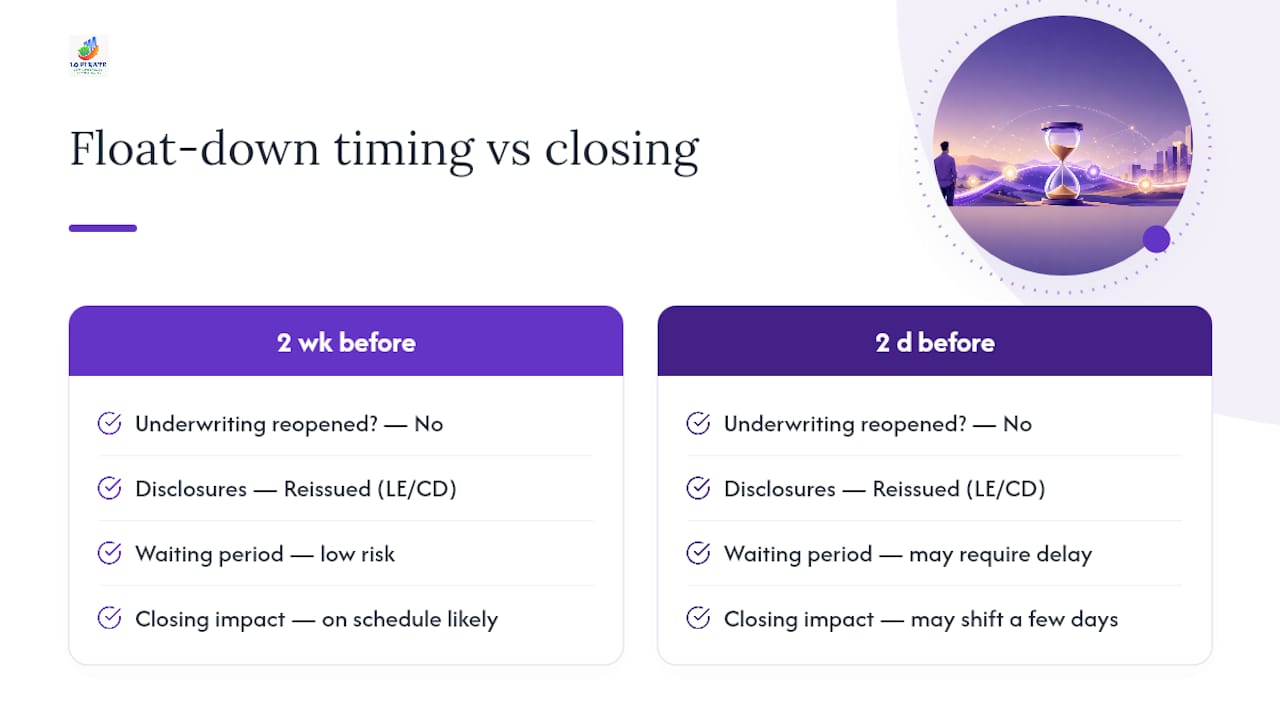
The float-down also doesn't reopen underwriting on your income, assets, or credit. Your approval stands on the terms it was already approved under, just at a lower rate.
Does a Float-Down Affect Your Credit Score or Loan Terms?
Exercising a float-down does not trigger a new hard credit pull in most cases, since your loan file and credit profile were already established when you applied and locked. The rate change is a pricing adjustment, not a new underwriting decision, so it shouldn't show up on your credit report as a new inquiry.
Where it can touch your loan terms is in the numbers that flow from the rate itself. A lower rate reduces your monthly principal and interest payment, which can shift your debt-to-income ratio slightly in your favor. In rare cases, a large enough shift could affect how a lender calculates certain qualifying ratios, but this rarely changes an already-approved loan's eligibility.
What float-downs don't touch: your loan term (a 30-year fixed stays a 30-year fixed), your loan-to-value ratio, and your closing costs outside of the float-down fee itself. The one exception is if your lender adjusts other pricing add-ons tied to a specific rate tier. That's rare but worth confirming when you get your revised disclosure.
If you're financing points or fees into the loan, double-check how the float-down fee is being paid. Some lenders let you pay it upfront in cash; others roll it into closing costs. Rolling it in slightly increases your loan amount, which is a minor but real trade-off against the monthly savings you're gaining.
Why Are Float-Downs More Common in Some Rate Environments?
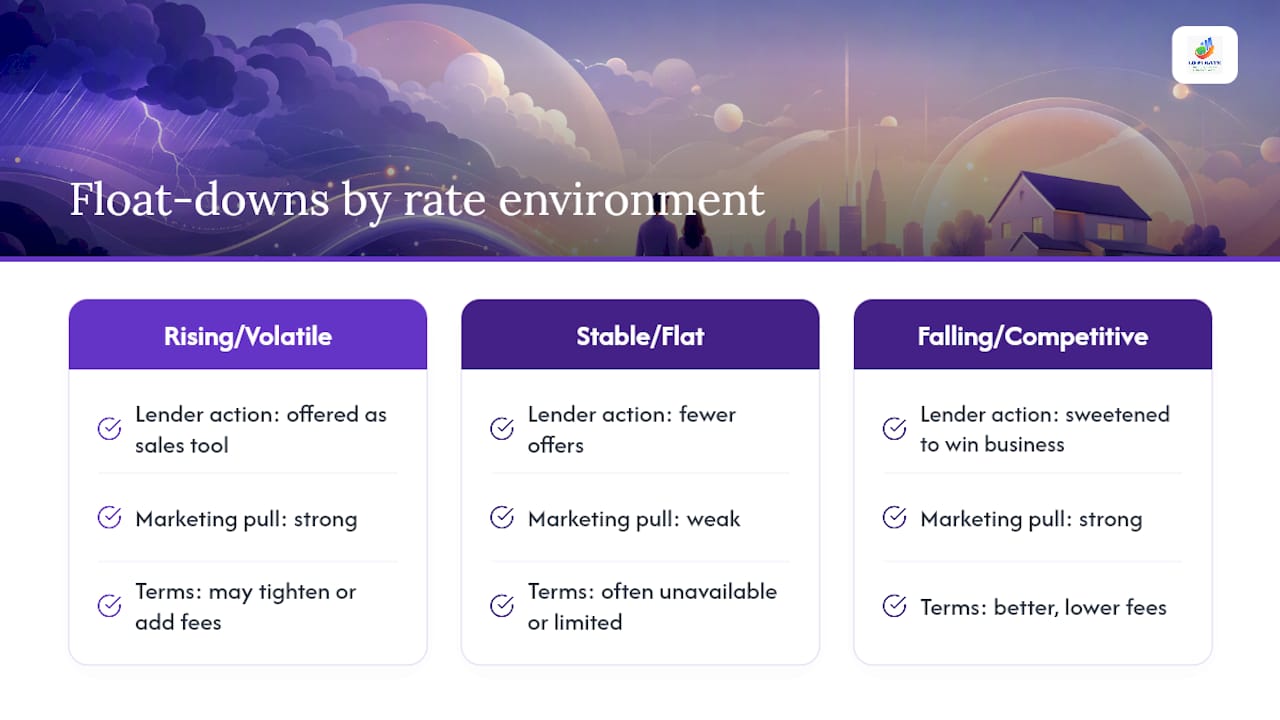
Float-down options aren't a fixed feature of the mortgage market. Lenders add or restrict them depending on how volatile rates are and how much competitive pressure they're under. When mortgage rates are climbing quickly or bouncing around week to week, lenders lean on float-downs as a sales tool, a way to get hesitant buyers to lock now instead of waiting.
When rates are stable, fewer lenders bother offering float-downs, since the odds of a meaningful drop happening within a 30 to 60 day window are lower and the option has less marketing pull. This cyclical pattern explains why the float-down you find advertised heavily one year might be quietly discontinued or restricted the next.
Wholesale lender pricing sheets reflect this in real time, because internal pricing moves based on lock term and daily market shifts, a lender's willingness to offer a generous, low-fee float-down often tracks how much room they have in their own margins that week. In a competitive, falling-rate environment, some lenders sweeten float-down terms to win business. In a rising or flat environment, the same lenders often tighten thresholds or add fees.
The practical takeaway: don't assume the float-down terms you read about online, or the ones a friend got last year, will match what's on offer today. Ask what's currently available and treat it as a snapshot of the current environment, not a fixed industry standard.
Do Float-Downs Work the Same on Fixed and Adjustable Rate Loans?
Float-down provisions are built almost exclusively around fixed-rate mortgages, and the logic makes sense once you think about it. A fixed rate is locked for the life of the loan, so a float-down is your only mechanism to benefit from a rate drop without refinancing. On an adjustable-rate mortgage (ARM), your rate is already scheduled to reset periodically based on an index, so a lock float-down provision typically only applies during the initial fixed period, if it's offered at all.
For jumbo loans, float-downs exist but often carry stricter terms. Because jumbo pricing is more sensitive to investor demand, some lenders either skip float-down offers entirely on jumbo products or charge a higher fee to offset their own pricing risk.
FHA and VA loans generally follow the same float-down structure as conventional fixed loans, but availability depends heavily on the individual lender's program rather than any government requirement. Neither FHA nor VA mandates float-down availability, so it comes down to whichever lender or broker is originating your loan.
If you're deciding between loan types partly based on float-down access, that's a reasonable factor, but it shouldn't be the deciding one. A refinance later remains available across all loan types if rates drop significantly after closing and a float-down wasn't offered or wasn't worth the fee.
Compare Float-Down Terms Across Wholesale Lenders With Lofirate
Retail lenders quote you one float-down structure, take it or leave it. That's the real limitation of shopping with a single bank or broker: you have no way to know if the fee they're charging is competitive or just what they've decided to charge. Lofirate works differently. It connects you with licensed wholesale mortgage brokers who can pull pricing across multiple lenders, which means comparing float-down fees, caps, and trigger thresholds side by side instead of taking one quote at face value.

A consultation through Lofirate carries no obligation. You talk with a licensed broker in your state, get a second opinion on your current lock terms or float-down offer, and see whether wholesale pricing beats what a retail lender quoted you. Because brokers shop multiple lenders rather than pushing one institution's rate sheet, you're more likely to find a lower fee, or a no-fee float-down, than you would locking with a single retail bank.
If you're deciding whether to lock, float, or negotiate float-down terms on a purchase or refinance, start a consultation with Lofirate and compare your options before you commit to a fee.
A Pragmatic Take on Float-Downs
Most borrowers overthink float-downs or ignore them entirely; both are mistakes. We generally recommend paying for one only when the fee is under roughly a quarter point and your closing window gives the trigger room to actually hit. Outside that, shopping multiple wholesale lenders for a better rate up front usually beats betting on a future drop. Refinancing later remains the honest fallback when a float-down isn't offered or isn't worth its price.
— LoFi
This article is general information, not a substitute for advice from a qualified financial advisor. Consult a qualified financial professional about your own circumstances before acting on anything here.
Sources
- What is a mortgage rate float down and is it worth it? - CBS News
- Mortgage Rate Lock Float Down: Overview, Examples - Investopedia
- What is a Mortgage Rate Float Down? - San Diego County Credit Union (SDFCU)
- NMLS Consumer Access
- View dynamic pricing and all eligible programs in our wholesale experience: