

Mortgage lenders approve loans when a borrower shows sufficient creditworthiness, enough repayment capacity, adequate equity, and complete documentation. That's it. Underwriters translate this into six checkpoints: credit history and score, debt-to-income (DTI) ratio, down payment or loan-to-value (LTV) ratio, verified income and employment, liquid assets and reserves, and a property that appraises and fits the loan program's occupancy rules. Fannie Mae's Eligibility Matrix and Desktop Underwriter (DU) set the baseline most lenders build from, though a conservative DTI benchmark sits around 36%.
Here's the fast version:
- Credit score and clean payment history for the recent past
- DTI ratio, ideally under 36%, but often allowed higher with strong compensating factors
- Down payment or equity meeting the loan program's loan-to-value criteria
- Income and employment documentation covering a typical required period
- Cash reserves covering multiple months of mortgage payments
- A property appraisal that supports the loan amount and aligns with the stated occupancy
Pro Tip: Run your file past more than one lender through a wholesale mortgage broker. Different lenders apply different overlays on top of the same agency rules, so a "no" from one shop is often a "yes" somewhere else.
Key Takeaways
Loan approval comes down to matching your credit, income, assets, and property against a program's thresholds, and lender overlays make shopping around worth real money.
| Point | Details |
|---|---|
| Six core checkpoints | Credit, DTI, LTV, income verification, reserves, and property appraisal drive every approval decision. |
| DU doesn't require a fixed score | Automated underwriting weighs your full risk profile, so a lower score alone won't disqualify you. |
| Compensating factors matter | Extra reserves or stronger credit can offset a DTI above the 36% conservative benchmark. |
| Documentation gaps cause most delays | Missing VOE forms or outdated asset statements are the most common file stalls. |
| Lofirate matches you to brokers | Lofirate connects borrowers to licensed wholesale brokers who shop your file across multiple lenders' overlays. |
Where to Verify These Rules Yourself
- Fannie Mae's Eligibility Matrix lists exact LTV, DTI, and reserve thresholds by transaction type.
- Fannie Mae's Risk Factors Evaluated by DU page explains what automated underwriting actually checks.
- Radian's underwriting guidelines show manual-underwrite minimums and mortgage insurance overlays.
This article is general information, not a substitute for advice from a qualified financial advisor. Consult a qualified financial professional about your own circumstances before acting on anything here.
Table of Contents
- How Underwriters Decide Whether to Approve Your Loan
- What Are the Core Requirements for Loan Approval?
- How Do Requirements Change by Loan Program?
- What Documents Do You Need for a Mortgage Loan?
- Why a Wholesale Mortgage Broker Improves Your Approval Odds
- How Long Does Mortgage Approval Take?
- Get Matched With a Broker Before You Apply
- Sources
How Underwriters Decide Whether to Approve Your Loan
Underwriting evaluates your total risk profile, not a single number. That's the part most borrowers misunderstand when they fixate on their credit score and ignore everything else in the file.
Most loans today run through an automated underwriting system (AUS), and the two big ones are Fannie Mae's Desktop Underwriter (DU) and Freddie Mac's AIM. These systems pull your credit report, LTV, reserves, DTI, occupancy, and loan term and weigh them together. Notably, DU does not enforce a single rigid minimum credit score for most transactions. A borrower with a lower score but strong reserves and a low DTI can still get an Approve/Eligible recommendation, while someone with a decent score but thin assets might get flagged for manual review.
Manual underwriting is different. It applies when a loan can't be run through an AUS, or when the AUS refers the file for a human look. Manual files carry firmer minimum score thresholds and stricter LTV and reserve limits, since there's no automated risk blend to lean on.
Here's what both DU/AIM and manual reviewers check:
- Credit history and payment patterns
- Loan-to-value ratio
- Reserve levels
- Debt-to-income ratio
- Asset documentation
- Property type and occupancy
Lender overlays explain why identical files get different answers at different shops. One lender might reject a file that another approves without blinking, since lender-specific practices account for a meaningful share of denial-rate variation nationally. Understanding the steps in home loan underwriting helps you see where your file could get stuck before it happens.
Pro Tip: Ask for the AUS Findings/Feedback Report on any file that's been run. It spells out exactly which risk factors triggered the recommendation, and a broker can use it to steer you toward lenders that don't flinch at your specific weak spot.
What Are the Core Requirements for Loan Approval?
These six elements control both whether you get approved and what rate you're offered. Miss on one, and the others have to work harder to compensate.
| Factor | Typical Benchmark |
|---|---|
| Credit score (manual underwrite, 1 to 2 units) | Often around the minimum credit score typical for conventional FRM |
| DTI ratio | A conservative benchmark is recognized around 36%; some programs permit higher with compensating factors |
| Reserves (manual underwrite) | Commonly 2+ months of payments; more for higher DTI or investment property |
| Cash-out refinance reserves | Six months when DTI exceeds 45% on DU casefiles |
| LTV / down payment | Varies by program; high-LTV purchases often require DU approval specifically |
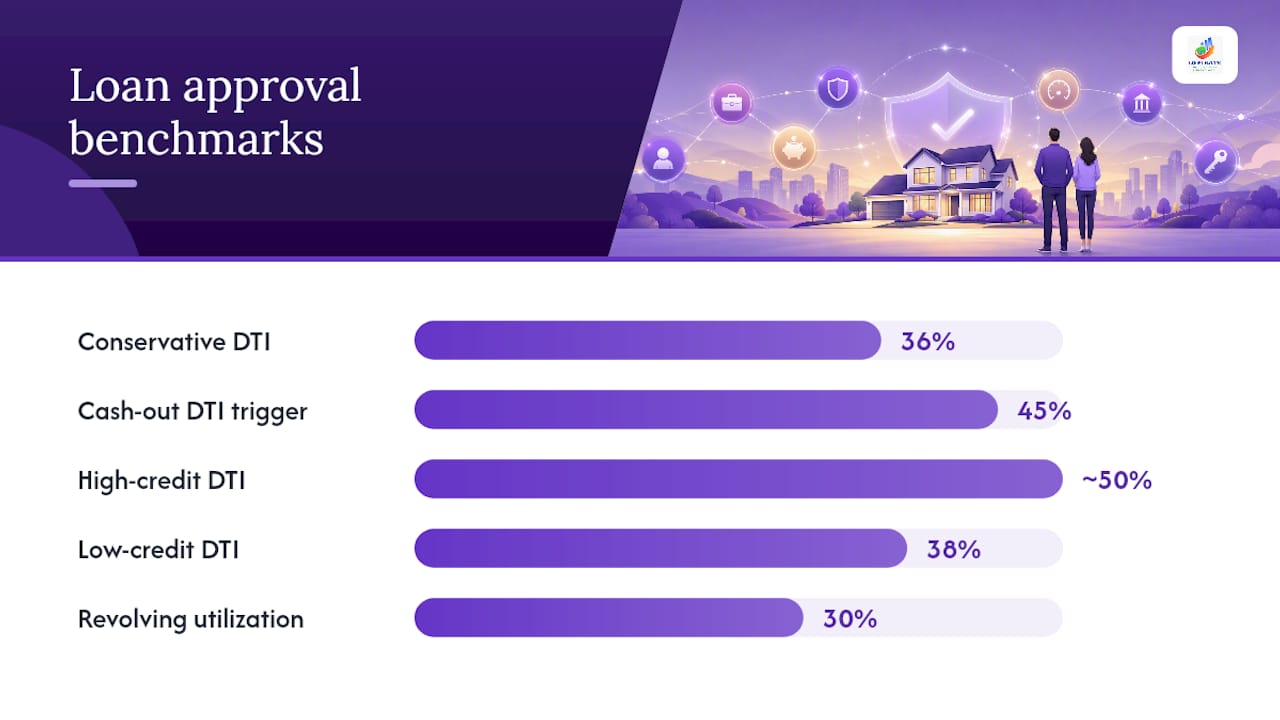
Numbers on a chart don't tell the whole story, though. A borrower with a 760 credit score and six months of reserves can often carry a DTI closer to 50% and still get an Approve/Eligible finding. Someone with a 640 score and thin savings will get squeezed even at 38% DTI. This is the trade-off system that Radian's underwriting matrices lay out in detail, and it's why two borrowers with the same score can get different terms.
A few things worth knowing about how the numbers actually interact:
- Stronger credit can offset a higher DTI, sometimes by several points.
- Extra reserves matter more once your DTI crosses the 45% line.
- DU-eligible loans skip the rigid score floors that manual underwriting applies.
- High-LTV purchase transactions frequently require DU approval specifically rather than manual sign-off.
If you're unsure how your own debt-to-income ratio is calculated, work that number out before you assume you're in trouble. Lenders count minimum payments on revolving debt, not balances.
Pro Tip: If you need one quick win, drop your revolving credit utilization below 30% before you apply. It often moves your score faster than paying down an installment loan, and the effect can show up within a single billing cycle.
How Do Requirements Change by Loan Program?
Your loan program picks the rulebook. Conventional, FHA, VA, and jumbo loans each set their own floor for credit, LTV, and reserves, so the same borrower can qualify for one and get declined for another.
- Conventional loans run through DU or manual underwriting under Fannie Mae or Freddie Mac guidelines, with high-LTV purchases often restricted to DU-only approval paths.
- FHA loans allow lower credit-score floors than conventional financing but require mortgage insurance premiums that apply for the life of the loan in many cases.
- VA loans need a certificate of eligibility and generally require the property to be the borrower's primary residence.
- Jumbo loans carry higher credit-score and reserve expectations since they exceed conforming loan limits and can't be sold to the GSEs.
- Adjustable-rate mortgages (ARMs) sometimes apply different LTV or credit thresholds than fixed-rate products within the same program.
- Cash-out refinances carry seasoning requirements and can require six months of reserves when DTI runs above 45%.
Check the fine print for your specific scenario before you assume a program will work:
- Confirm your property type qualifies (condos, multi-unit, and manufactured homes all carry extra restrictions).
- Ask whether your down payment source is acceptable under that program's rules.
- Verify occupancy plans match what the loan program requires.
What Documents Do You Need for a Mortgage Loan?
Have these documents ready before you apply. A missing item is the single biggest reason files stall in underwriting.
- Government-issued photo ID and Social Security number
- Pay stubs covering the most recent 30 days
- W-2s from the past two years
- Federal tax returns for the past two years, especially if self-employed
- Bank and asset statements from the past two to three months
- Recent mortgage statement if you're refinancing
- Divorce decree or child support documentation, if applicable
- Gift letters and paper trail for any gifted down payment funds
- Written explanation for any large, unexplained deposits
- Signed authorization allowing the lender to pull your credit
A few things lenders flag more often than borrowers expect:
- A missing verification of employment (VOE) can stall a file for days.
- Asset statements older than 60 days often get bounced back for a fresh copy.
- Unexplained deposits without a clear paper trail trigger extra scrutiny every time.
Organizing your files well before submission genuinely speeds things up. Submitting your file correctly the first time, with labeled PDFs and a short cover note explaining anything unusual on your credit report, saves a week or more compared to a disorganized drop.
Why a Wholesale Mortgage Broker Improves Your Approval Odds
A wholesale broker increases your odds of approval by matching your file to lenders whose overlays and program menus actually fit your situation, instead of asking one retail lender to make an exception.
Brokers bring a few concrete advantages to the table:
- Access to multiple lenders with different risk appetites and overlay policies
- Ability to use your AUS Findings/Feedback Report to target lenders likely to approve your specific file
- Experience filling documentation gaps before they become underwriting stalls
- Knowledge of which lenders are flexible on manual-underwrite files versus which stick rigidly to DU output
Lofirate connects borrowers to licensed wholesale mortgage brokers who shop your file across multiple lenders rather than pricing it against a single rate sheet. Since lender-specific practices meaningfully affect denial rates, where you apply matters as much as your qualifications do.
Pro Tip: Bring your AUS Findings/Feedback Report to your first broker conversation. It cuts the back-and-forth and gets you matched to lenders that fit your file on the first pass.

How Long Does Mortgage Approval Take?
Most files move from pre-approval to clear-to-close in four to six weeks, assuming no major hiccups. Pre-approval itself usually takes a day or two once your documents are in; the appraisal and underwriting stretch typically eats up the bulk of the timeline.
The usual suspects behind delays, and the quick fix for each:
- Missing documents — gather everything from the checklist above before you submit.
- Appraisal disputes — have comparable sales ready if the value comes in low.
- Credit report surprises — dispute errors immediately or write a short explanation letter.
- Employment verification gaps — confirm your employer will respond promptly to a VOE request.
- Large last-minute deposits — document the source before it becomes a question.
- DTI shifts mid-process — avoid new credit and large purchases until after closing.
Pro Tip: Submit documents in batches as your loan officer requests them rather than waiting to send one giant file. Staged submission keeps the underwriter's queue moving instead of stacking everything at the deadline.
What I'd Do This Week If I Were Applying
If I were prepping a file right now, the first move would be pulling a three-bureau credit report to catch errors early, not after a lender already has. From there:
- Pay down high-utilization cards within 30 days and skip new credit applications entirely.
- Gather two months of asset statements now, since older ones get rejected anyway.
- Ask for an AUS run before you commit to a specific lender's rate sheet.
- Write a one-paragraph explanation for anything odd on your credit or bank statements.
None of this guarantees approval. It just removes the excuses an underwriter might use to say no.
Get Matched With a Broker Before You Apply
If you want multiple lender responses without doing the shopping yourself, a wholesale mortgage broker match does that work for you. Instead of applying retail lender by retail lender and comparing rate sheets on your own, one broker can run your file against several lenders that specialize in different overlays and programs.

Lofirate connects you with licensed wholesale mortgage brokers in your state for a no-obligation consultation. Brokers are typically compensated by the lender when a loan closes, so there's no cost to you for the comparison itself. Bring your AUS Findings/Feedback Report if you have one; it helps the broker target lenders more likely to approve your specific file on the first try. If you're weighing purchase, refinance, FHA, or VA options, start your broker match request today and see what a second opinion turns up.
Sources
- Underwriting Guidelines and Eligibility Matrices | Radian
- Determinants of Mortgage Denial | Federal Reserve Bank of St. Louis