

Some of that moves the needle within a single billing cycle. Other pieces, like raising a damaged credit score or building six months of business revenue history, take longer. Here's the order that actually works, ranked by how fast each step pays off.
- Pull reports from all three bureaus and dispute any errors (days to weeks)
- Pay down revolving balances to keep utilization low, ideally well below the credit limits (one billing cycle)
- Bring any past-due accounts current immediately (immediate to weeks)
- Calculate your debt-to-income ratio and start reducing it (weeks to months)
- Gather pay stubs, tax returns, and bank statements now (days)
- Get prequalified with soft-pull tools from two or three lenders (same day)
- Consider a secured loan or cosigner if your file is thin or marginal (immediate)
- Pick a lender that fits your loan type and documentation strength (weeks)
You're generally in a strong position to apply once your credit score is good, your utilization is low, and your debt-to-income ratio is at a manageable level for most conventional products.
Key Takeaways
Improving loan eligibility works fastest when you fix credit report errors and lower utilization immediately, then reduce DTI and document income over the following months before applying.
| Point | Details |
|---|---|
| Fix reports first | Dispute credit report errors across all three bureaus before doing anything else. |
| Utilization drives fast gains | Paying balances under 30%, ideally under 10%, can lift your score within one billing cycle. |
| DTI needs weeks, not days | Target under 43% for mortgages by paying down debt or documenting added income. |
| Prequalify before applying | Use soft-pull tools with several lenders, then submit one formal application. |
| Compare wholesale pricing | Lofirate matches eligible borrowers with licensed brokers who shop rates across lenders. |
Table of Contents
- What Lenders Actually Check When Deciding Loan Eligibility
- How Do You Improve Your Credit Score Before Applying?
- How Do You Lower Your Debt-to-Income Ratio?
- What Documents Do Lenders Want to See?
- Should You Use a Secured Loan or a Cosigner?
- Prequalification vs. Formal Application: What's the Difference?
- What Changes by Loan Type: Mortgage, Personal, or Business?
- How Long Does It Actually Take to Improve Loan Eligibility?
- Your Pre-Application Readiness Checklist
- How LoFi Rate Helps Once You're Ready to Apply
- Frequently Asked Questions
- Sources
What Lenders Actually Check When Deciding Loan Eligibility
Every lender evaluates the same handful of factors, they just weight them differently depending on the product. Understanding the criteria for loan eligibility tells you exactly where to spend your energy instead of guessing.
- Credit score and history — your track record of on-time payments and how long you've managed credit responsibly.
- Debt-to-income ratio — how much of your gross monthly income already goes toward debt payments.
- Income stability — whether your earnings are steady, documented, and likely to continue.
- Collateral or loan structure — what's securing the loan, if anything, and how that affects the lender's risk.
- Documentation quality — how easily an underwriter can verify what you claim on the application.
- Recent credit events — late payments, collections, or bankruptcies within the last two to seven years.
Personal loans from many lenders start around 600, though the best rates go to borrowers well above 700. Business lenders care less about a single score and more about revenue consistency and cash flow, a point Bank of America's guidance on loan decisions makes directly.
How Do You Improve Your Credit Score Before Applying?
Improving your credit history starts with your credit reports, not your credit score. Pull your reports from Equifax, Experian, and TransUnion, and look for accounts you don't recognize, balances reported incorrectly, or late payments that shouldn't be there. Usa walks through how to dispute those errors directly with each bureau, and a successful dispute can lift your score within a few weeks. If you find accounts you never opened, Identitytheft has a structured recovery plan to get them removed.
- Pull all three credit reports and dispute inaccuracies.
- Bring any past-due accounts current, since payment history is the single biggest factor in your FICO score.
- Pay down revolving balances, targeting utilization under 30% and ideally under 10%.
- Ask existing card issuers for a credit-line increase without a hard inquiry, which lowers your utilization ratio instantly.
- Keep old accounts open even if you don't use them; length of credit history counts.
- If your file is thin, add a secured card or credit-builder loan that reports to all three bureaus.
Payment history makes up roughly 35% of a FICO score, and utilization is the next-largest factor, according to myFICO's own scoring breakdown. That's why balance paydown outperforms almost anything else you can do in a short window.
Pro Tip: Pay down your card balance a few days before the statement closing date, not just before the due date. Issuers typically report the balance as of the closing date, so an early payment can lower your reported utilization before your score is even calculated for the next cycle.

How Do You Lower Your Debt-to-Income Ratio?
Your DTI is every monthly debt payment divided by your gross monthly income. Lowering your credit score's cousin metric, debt-to-income, is often faster than rebuilding a damaged score.
- Pay off or pay down high-interest revolving debt first; it does double duty by lowering both DTI and utilization.
- Consolidate several revolving balances into one fixed installment loan if the math lowers your total monthly obligation.
- Hold off on new spending, even small purchases, while your application is pending.
- Document any additional income, bonuses, freelance work, rental income, so it counts toward your gross figure.
A $200 monthly cut in debt payments on that same $6,000 income moves your DTI from 30% to 26.7%, often enough to shift you into a better pricing tier. Improving your credit history and lowering DTI together are the two levers Experian identifies as most reliable for boosting personal loan approval odds.
What Documents Do Lenders Want to See?
Strong documentation turns a borderline file into an approvable one, especially when your income doesn't come from a single steady paycheck. Lenders want proof, not promises.
- Two years of tax returns, especially if you're self-employed or a gig worker.
- 30 to 60 days of recent pay stubs for W2 employees.
- Two to three months of bank statements showing consistent deposits and reserves.
- Business financials, profit-and-loss statements, and bank records if you own a business.
If your income varies month to month, lenders will typically average it over 12 to 24 months rather than count your best month. Reserves matter too. Cash on hand equal to two or three months of payments signals to underwriters that a rough patch won't sink the loan. A detailed refinance documentation checklist covers exactly what mortgage underwriters ask for, and most of it applies to personal and business files too.
Should You Use a Secured Loan or a Cosigner?
Adding collateral or a cosigner is often the quickest way to get approved when your file is otherwise marginal, but it shifts risk in ways worth understanding before you sign anything.
- Secured loans, backed by a car, savings account, or home equity, usually come with lower rates because the lender's risk drops.
- A cosigner with strong credit can push a denial into an approval, but their score and DTI absorb the impact of every missed payment you make.
- Watch for lenders who push secured products aggressively without explaining the payoff terms; that's a red flag.
A cosigner isn't a formality. If you default, it shows up on their credit report exactly the same as it would on yours, and it can strain the relationship long after the loan is paid off or written off.
Always get the terms in writing, and make sure everyone involved understands exactly what's being pledged.
Prequalification vs. Formal Application: What's the Difference?
Prequalification and preapproval typically use a soft credit pull, which doesn't affect your score at all. A formal application triggers a hard inquiry, which can knock a few points off your score temporarily. That distinction is exactly why prequalifying with two or three lenders costs you nothing.
- Prequalify broadly using soft-pull tools to compare estimated rates and terms.
- Most scoring models group multiple inquiries for the same loan type within a 14 to 45 day window into a single inquiry, so rate-shopping in a tight window is safe.
- Once you've picked the best-fit offer, submit one complete, formal application rather than several scattered ones.
Experian's guidance on new credit approval recommends this exact sequence: shop soft, commit hard, once. If you're comparing early-check options for a mortgage, it helps to know the different types of prequalification before you start filling out forms.
What Changes by Loan Type: Mortgage, Personal, or Business?
The core principles are the same across products, but the thresholds and paperwork shift depending on what you're borrowing for.
- Mortgages typically want a down payment of 3% to 20%, two to six months of reserves, and a DTI under 43%. Underwriters also scrutinize employment gaps and large, unexplained deposits closely.
- Personal loans split into secured and unsecured. Unsecured loans lean harder on your score, often starting near 600, while secured options accept weaker files in exchange for collateral. Borrow only the amount you need; larger requests raise your DTI and your risk profile in the same motion.
- Business loans hinge on separate business credit and revenue documentation. Lenders often want roughly $1.25 of income for every $1 of debt, and they'll accept an explained dip in revenue if you back it with an accountant-prepared narrative and supporting bank records.
Mortgage applicants specifically benefit from a structured pre-approval process that clarifies accurate preapproval amounts, showing exactly what a lender will and won't count toward your qualifying income.
How Long Does It Actually Take to Improve Loan Eligibility?
Set your expectations by tier, not by wishful thinking.
- Days to weeks: dispute errors, pay down a card before statement close, gather documents.
- 1 to 3 months: meaningful DTI reduction, a credit-line increase reflected in your utilization.
- 3 to 12 months: rebuilding a damaged score, establishing a track record with a secured card.
- 12+ months: recovering from a bankruptcy or a string of late payments enough to qualify for prime pricing.
There's no reliable shortcut for a badly damaged score. Sustained improvement usually takes six to twelve months of consistent behavior, even though some individual tactics show up in a single billing cycle. Budget for real costs too, appraisal fees, origination charges, and rate-lock fees are normal. Paid credit repair services, on the other hand, often charge for disputes you can file yourself for free.
What Do Credit Experts and Lenders Actually Prioritize?
Credit bureaus and lender guidance converge on the same short list, which is worth trusting over generic advice you'll find elsewhere.
- Payment history and utilization dominate score calculations, per myFICO, so fix those before anything else.
- Disputing report errors is a free, foundational move USA.gov recommends before you even think about applying.
- Business lenders reward a documented explanation for revenue swings over raw numbers alone, a point Bank of America emphasizes for owners with seasonal or uneven income.
Your Pre-Application Readiness Checklist
Run through this before you submit anything formal.
Documents ready:
- Government ID, recent pay stubs, two years of tax returns, two to three months of bank statements, and business financials if self-employed.
Credit readiness:
- Confirm your score band and that utilization sits under 30%.
- Verify no new hard inquiries are pending from other applications.
- Check your DTI against the target range for your loan type.
Do not, in the 30 days before applying: make large purchases, open or close credit accounts, or deposit large unexplained sums into your bank account.
A Quick Note From the Lending Side
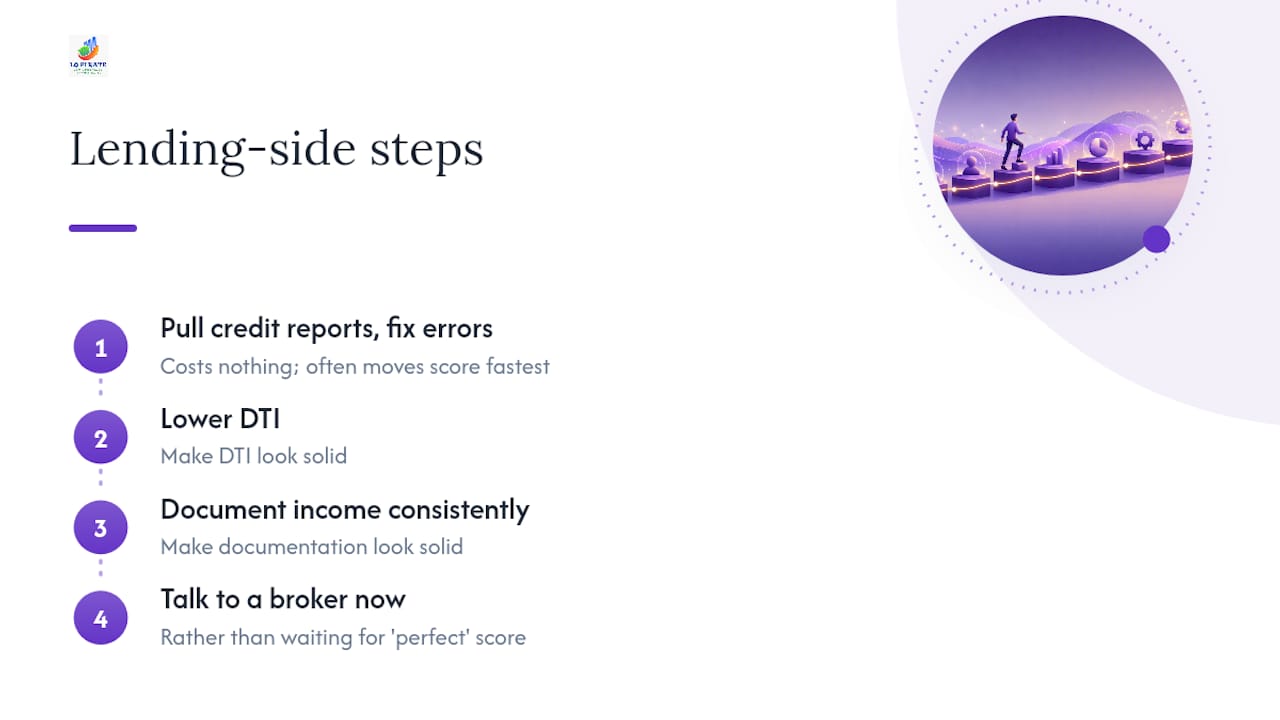
If you take one action first, make it pulling your credit reports and fixing errors. That single step costs nothing and often moves your score faster than anything else on this list. Beyond that, if your DTI and documentation already look solid, talk to a broker now rather than waiting for a "perfect" score that may never arrive; brokers can often work with the file you have today.
How LoFi Rate Helps Once You're Ready to Apply
Once your credit and DTI are in better shape, the next bottleneck is usually rate shopping itself, and that's exactly where Lofirate fits in. Instead of applying with one retail lender and hoping for the best, Lofirate connects you with licensed wholesale mortgage brokers who shop your file across multiple lenders at once, which means you see competitive pricing without submitting a stack of separate applications.

That matters most for borrowers who've just spent months improving their eligibility and don't want to lose ground to a lender quoting retail-only pricing. Lofirate's prequalification tools use the same soft-pull approach covered above, so you can compare wholesale options with no impact on your score and no obligation to move forward. If you're weighing your options, browsing available loan types is a reasonable next step, and you can also see how the matching process works before requesting a no-obligation consultation with a broker in your state.
Frequently Asked Questions
How long does it take to see steps to improve loan eligibility actually work? Some actions, like paying down a card balance before the statement closes, can show up within one billing cycle. Rebuilding a damaged score or establishing business revenue history typically takes six to twelve months.
Will prequalifying with multiple lenders hurt my credit score? No. Prequalification generally uses a soft credit pull, which doesn't affect your score, unlike the hard inquiry triggered by a formal application.
What's a good debt-to-income ratio for a mortgage?
Should I close old credit cards to look less risky? Generally no. Closing old accounts shortens your credit history and can raise your utilization ratio, both of which tend to lower your score rather than help it.
Can a cosigner really improve my approval odds? Yes, a cosigner with strong credit and income can offset a weak file, but missed payments affect their credit report exactly as they affect yours.
This article is general information, not a substitute for advice from a qualified financial advisor. Consult a qualified financial professional about your own circumstances before acting on anything here.
Sources
- How to boost odds of personal loan approval | Experian
- Usa
- Improve your credit score | myFICO
- Factors that impact loan decisions and how to increase your approval odds | Bank of America Business
- Your 2026 credit score playbook: What scoring models actually reward now - Avant Blog