

A vacation home is the right call if you want a place your family will actually use and you can accept modest tax breaks in exchange for easier financing. An investment property fits if income and long-term wealth building matter more than personal use, and you're prepared for a bigger down payment, tighter underwriting, and stricter IRS rules. The four things that decide which path works for you are financing terms, tax treatment, how many days you personally use the place, and how much hands-on management you're willing to take on.
TL;DR:
- A property used more than 14 days or 10% of rented days is taxed as a personal residence, limiting rental deductions and depreciation benefits.
- Financing for vacation homes typically requires a lower down payment and interest rate premium compared to investment properties, with reserve requirements varying widely.
- Tax advantages differ significantly: rental properties qualify for full expense write-offs and depreciation, while vacation homes have limited deductions and no 1031 exchange options.
- Short-term rental insurance often excludes platform-hosted activity, necessitating specialized coverage and awareness of local restrictions and HOA rules.
- Appreciation potential depends more on location than classification, with vacation homes in resort areas vulnerable to market swings, and investment properties in stable growth markets offering steadier long-term value.
Table of Contents
- Vacation Home vs Investment Property: How the IRS and Lenders Actually Draw the Line
- How Do Financing Terms Differ Between the Two?
- What Are the Tax Implications of Each Property Type?
- Does Your Insurance Policy Actually Cover a Rental?
- Short-Term vs Long-Term Rental: Which Numbers Actually Hold Up?
- How Do You Decide? A Practical Checklist
- Which Property Type Appreciates Faster?
- How Do Zoning and HOA Rules Affect Each Property Type?
- What Happens When You're Ready to Sell?
- What Does It Actually Cost to Maintain Each One?
- How LoFiRate Fits Into the Financing Decision
- Compare Your Financing Options Before You Make an Offer
- Where to Read More Before You Decide
- Sources
Vacation Home vs Investment Property: How the IRS and Lenders Actually Draw the Line
The IRS doesn't care what you call the place. It cares how many days you use it versus how many days you rent it out. Under Publication 527, a property counts as a personal residence if your own use exceeds the greater of 14 days or 10% of the days it's rented at fair market value. Cross that line and you get to deduct mortgage interest and property taxes like a homeowner, but your rental-loss deductions get capped. Stay under it, and the IRS treats the property as a rental, opening the door to fuller expense deductions and depreciation.
There's a quirky exception worth knowing: the Augusta rule lets you rent out your home for fewer than 15 days a year and skip reporting that income entirely, regardless of how much you charged. Mixed-use properties, say a beach house you use six weeks a year and rent out the rest, get allocated proportionally between personal and rental days, and Topic No. 415 walks through how that split affects what you can write off.
How Do Financing Terms Differ Between the Two?
Lenders price risk, and a property you don't live in most of the year is riskier to them than the home you sleep in every night. That gap shows up everywhere in the loan terms.
- Down payments: Second homes typically require a lower down payment often between about 10% to 20%, while investment properties generally need a larger down payment, commonly starting around 20% or higher, according to Redfin's financing breakdown.
- Interest rates: Investment loans carry a rate premium over second-home loans, and lenders often add extra fees on top.
- Cash reserves: Investor loans frequently require several months of mortgage payments held in reserve. Buyers running thin on liquidity often qualify more easily for a second-home product than an investor loan, since Redfin notes that reserve requirements weigh heavily in underwriting.
- Whether rental income counts: Debt-service coverage ratio (DSCR) loans and other investor programs will factor in projected rental income when qualifying you. FHA and VA loans generally won't, and neither program supports true investment purchases in the first place.
None of these numbers are fixed. Rate and down payment requirements shift by lender, credit profile, and property type, which is exactly why getting several quotes before writing an offer matters more here than in a standard home purchase. A second-home loan and an investor loan can come from entirely different underwriting playbooks, even at the same bank.
What Are the Tax Implications of Each Property Type?
Classification under the personal-use test doesn't just affect financing. It rewrites your entire tax return.
A property taxed as a residence lets you deduct mortgage interest and property taxes on Schedule A, subject to the usual itemized-deduction limits, but rental losses above your personal-use allocation generally can't offset other income. A property taxed as a rental opens up a fuller set of deductions: mortgage interest, property taxes, insurance, maintenance, management fees, and depreciation on the building's value over 27.5 years.
- Depreciation lowers your taxable rental income every year you own the property.
- It also creates depreciation recapture, a tax bill triggered when you sell, taxed at up to 25% on the amount you depreciated.
- Passive activity loss rules generally limit how much rental loss you can deduct against wages or other income unless you qualify as an active participant, and short-term rental hosts who materially participate in running the property can sometimes sidestep passive-loss limits entirely.
- A 1031 exchange lets investors defer capital gains tax by rolling sale proceeds into another investment property, but it's reserved for properties held for business or investment purposes. A vacation home you use regularly typically won't qualify.
Investopedia's rundown of rental ownership points out that the deductible-expense list is real, but so are the risks: vacancy, tenant turnover, and market swings that can wipe out a year's paper savings. Model conservatively, and don't treat depreciation as free money. It's a deferral, not a discount, and Investopedia's analysis is worth reading in full before you assume the tax math tips the decision in your favor.
Does Your Insurance Policy Actually Cover a Rental?
Standard second-home policies are written for owners who occasionally rent to friends, not for guests booked through a short-term rental platform. Run guests through Airbnb or Vrbo on a policy that excludes commercial rental activity, and a claim can get denied right when you need it most.
- Ask your carrier directly whether short-term rental activity is covered or excluded before you list the property.
- Budget for landlord or STR-specific insurance, which typically carries higher premiums than a standard homeowner policy, plus consider a vacant-home rider if the property sits empty part of the year.
- Check local short-term rental permits, occupancy or lodging taxes, and HOA restrictions. Some HOAs ban rentals under 30 days outright, which can void your plans before you list a single night.
- Layer on umbrella liability coverage if you're hosting paying guests regularly.
Short-Term vs Long-Term Rental: Which Numbers Actually Hold Up?
Short-term rentals promise a higher nightly rate, but that number only matters once you subtract everything that eats into it. Long-term leases trade upside for predictability: one tenant, one rent check, minimal turnover cost.
The real comparison happens at the unit-economics level, not the headline rate.
- Average daily rate (ADR) and occupancy drive short-term revenue, but both swing with season and local competition.
- Platform fees, cleaning, and management typically run a meaningful cut-off gross STR revenue before you see net income.
- Long-term leases trade a lower monthly number for far less volatility and no turnover costs between guests.
- Mortgage cost and reserves need to survive slow months, not just peak season.
Truvi's market analysis puts typical U.S. short-term rental host earnings around $2,408 a month, with a clear caution that the easy-money era of STR investing has cooled. Coastal and resort markets tend to post higher ADRs with more seasonal swings, while urban markets run steadier but lower.
Pro Tip: Build three scenarios before you buy: pessimistic, realistic, and optimistic occupancy. If your mortgage still gets paid under the pessimistic case, you've got a property that can survive a bad summer, not just a good one.
How Do You Decide? A Practical Checklist
Run through this before you make an offer, not after.
- Define your goal first. Lifestyle use points toward a vacation home; income and appreciation point toward an investment property.
- Check your cash reserves. Investor loans often demand months of reserves on top of the down payment. If reserves are thin, a second-home loan may be the more realistic path.
- Ask lenders three specific questions: what down payment applies to this property type, whether they'll count projected rental income, and how much reserve cash they require.
- Ask a CPA how depreciation recapture and passive-loss limits apply to your situation before assuming the tax deductions will offset the purchase cost.
- Ask a property manager about fees and services if you don't plan to self-manage, and build that cost into your pro forma before you run the numbers, not after.
- Watch for red flags: local STR bans, HOA rental restrictions, insurance exclusions, or occupancy assumptions that look better on a listing sheet than in Truvi's actual market data.
- Get preapproved for both loan types if you're genuinely undecided. Comparing real offers beats guessing which one you'll qualify for.
Which Property Type Appreciates Faster?
Neither vacation homes nor investment properties have a built-in appreciation edge. What drives value is location, and the two categories tend to cluster in different kinds of locations, which is where the real difference shows up.
Vacation homes concentrate in resort and coastal markets where supply is naturally constrained by geography, coastline, ski terrain, lakefront. That scarcity can support strong long-term appreciation, but it also means these markets swing harder in downturns since demand depends heavily on discretionary travel and remote-work flexibility. A recession that cuts vacation spending hits a mountain town's home values faster than it hits a mid-size city's.
Investment properties, especially long-term rentals, tend to sit in markets valued for job growth, population inflows, and rental demand fundamentals rather than scenery. That often means steadier, less dramatic appreciation, but also less exposure to the boom-and-bust cycles that hit vacation destinations when travel patterns shift.
The honest answer is that appreciation potential in either category depends far more on the specific market you buy into than on whether the property is classified as a second home or an investment property. A vacation condo in a saturated coastal market can underperform a rental house in a growing metro, and the reverse happens just as often. Buyers chasing appreciation should underwrite the local market's job base, inventory levels, and demand drivers before they underwrite the property itself.
How Do Zoning and HOA Rules Affect Each Property Type?
Local rules can override your financial plan entirely, and this is where a lot of buyers get blindsided after closing rather than before.
Zoning ordinances in many resort towns and coastal cities now cap or outright ban short-term rentals in certain residential zones, sometimes requiring a permit, a local business license, or a cap on the number of STR permits issued citywide. Buy in a zone that's already at its permit cap, and you may end up with a vacation home that legally can't be rented short-term at all, even if you planned your entire financing around rental income covering part of the mortgage.
HOAs add another layer on top of zoning. Plenty of HOAs prohibit rentals under 30 days regardless of what the city allows, and some require board approval for any rental, or limit the total number of units in a community that can be leased at one time. These restrictions apply to vacation homes and investment properties equally. A condo association doesn't care whether you call the unit your second home or your investment. If the bylaws say no short-term guests, that rule applies to you.
Before you make an offer on either property type, pull the HOA's governing documents and call the local planning department directly. Listing agents don't always know current permit caps, and an HOA's rental policy can change between when a listing goes live and when you close.
What Happens When You're Ready to Sell?
Exit planning starts well before you list, because the two property types face different tax exposure at the finish line.
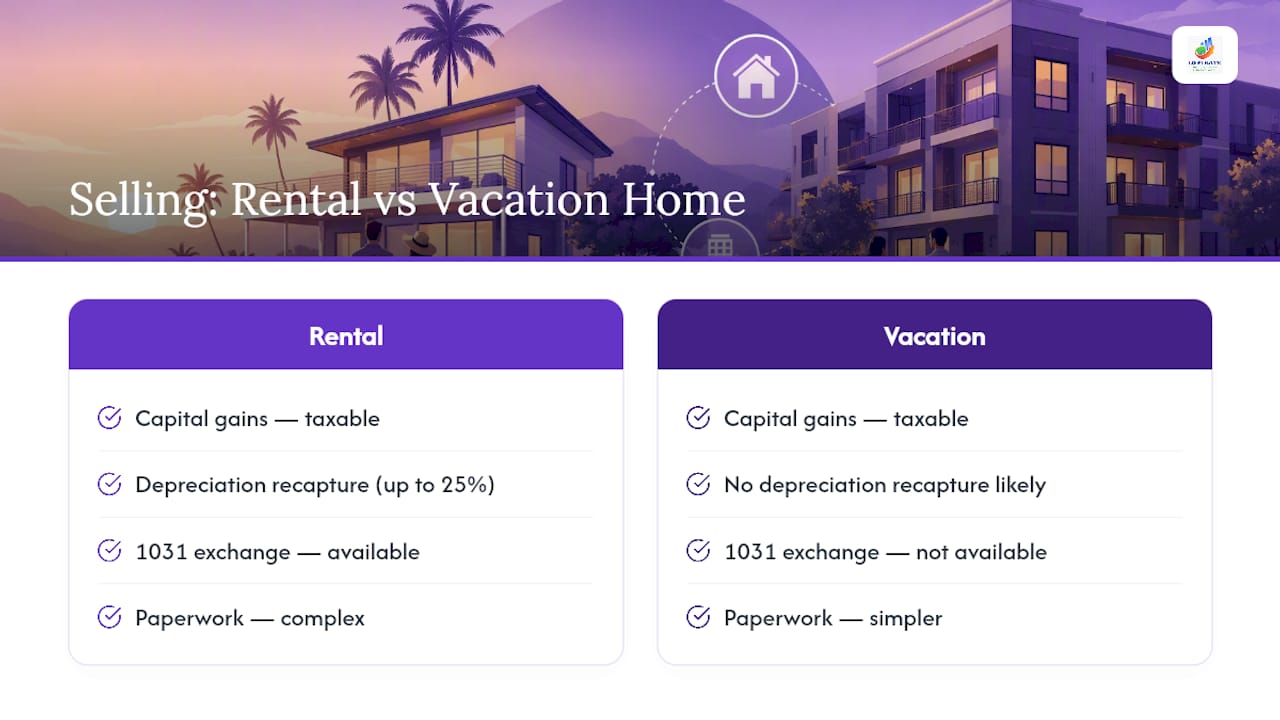
Sell a property that's been classified as a rental, and depreciation recapture comes due on the depreciation you claimed, taxed at up to 25%, on top of regular capital gains tax on the appreciation. Investment property owners have one advantage vacation homeowners generally don't: a 1031 exchange lets you defer that entire gain by rolling proceeds into another investment property, provided you meet strict timing rules and use a qualified intermediary.
Vacation homes don't get that deferral option since they're not held primarily for business or investment use. Sell one after years of appreciation, and you'll owe capital gains tax on the gain above your cost basis, with no like-kind exchange to push the bill down the road. The upside is simpler paperwork. There's no recapture to calculate because you likely never claimed depreciation in the first place.
Resale value also hinges on who's buying. A rental property with strong occupancy history and clean financial records appeals to investor buyers who want to underwrite your actual numbers. A vacation home's resale case rests more on the property and the destination than on a rent roll. Keep both angles in mind, especially if you might switch a property's use classification down the road. Buying as a second home today doesn't lock you out of renting it seriously later, but it does mean revisiting the personal-use test before you make that shift.
What Does It Actually Cost to Maintain Each One?
The mortgage is rarely the number that breaks a buyer's budget. It's the ongoing costs nobody quotes you upfront.
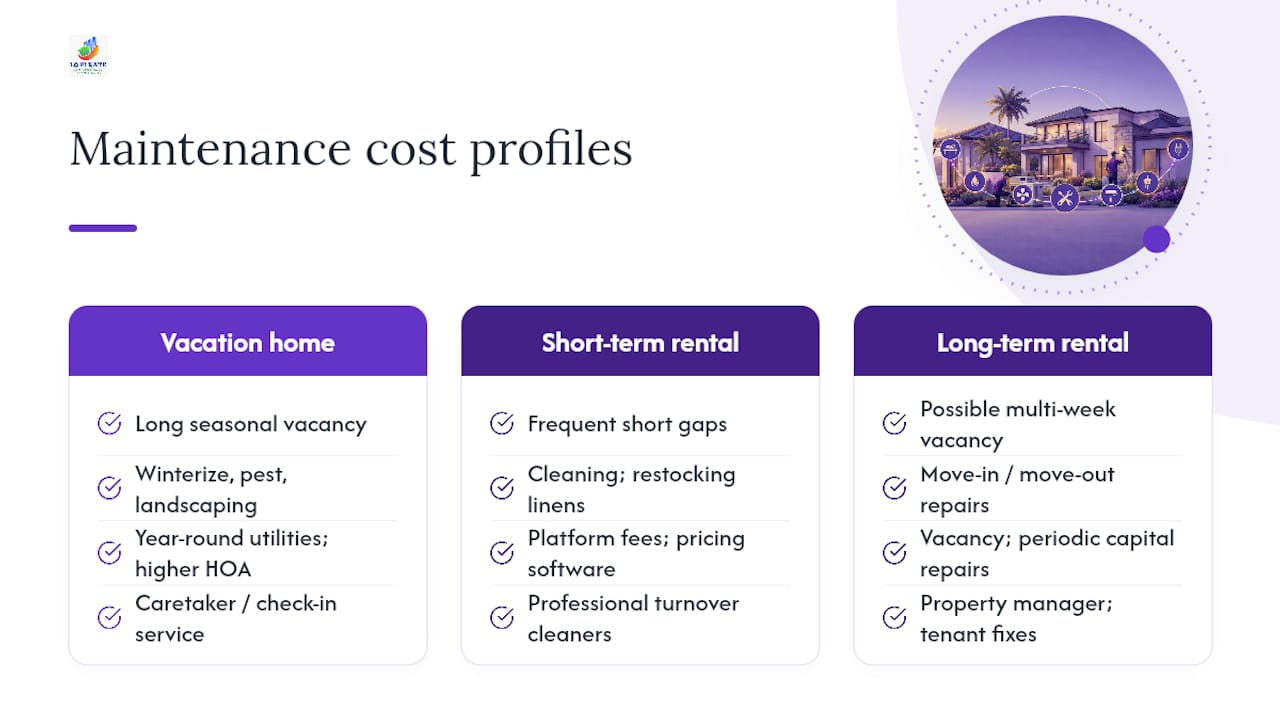
Vacation homes carry costs tied to being empty part of the year: winterization in cold climates, pest control, landscaping in your absence, and a caretaker or check-in service if you're not local. Utilities often run year-round even when nobody's staying there, since pipes need heat and systems need monitoring. HOA dues in resort communities also tend to run higher than typical residential HOAs, since they fund amenities like pools, golf courses, or ski shuttles that vacation buyers pay a premium for.
Investment properties, especially short-term rentals, carry a different cost profile built around turnover. Cleaning between every guest stay, restocking linens and toiletries, platform fees on booking sites, and dynamic-pricing software subscriptions all eat into revenue that never touches your bank account as gross income. Long-term rentals swap that churn for tenant-related costs instead: move-in and move-out repairs, occasional vacancy between leases, and periodic capital expenses like a new water heater or roof that a tenant will expect you to handle promptly.
Both property types need a maintenance reserve, but the size and shape of that reserve differ. A vacation home reserve should cover the property sitting vacant for months without generating a dime. An investment property reserve should cover vacancy between tenants or a slow booking season, plus the wear-and-tear costs that come from constant turnover. Underestimate either one, and the property that looked profitable on a spreadsheet starts eating your savings by year two.
How LoFiRate Fits Into the Financing Decision
Financing terms often decide this choice before taxes or usage ever do. LoFiRate connects you with licensed wholesale mortgage brokers who shop multiple lenders instead of quoting one bank's rate sheet, which matters most when you're on the edge of qualifying for an investor loan or comparing second-home terms against DSCR programs. Loop in tax advice early, before the offer, not after closing.
— LoFi
Compare Your Financing Options Before You Make an Offer
Whether you're leaning toward a vacation home or building toward a rental portfolio, the financing terms you land on will shape the entire deal, and shopping one lender's quote against another's is where real savings show up. Consumers can access licensed wholesale mortgage brokers who compare rates across multiple lenders instead of pushing a single retail price.

That matters most for readers stuck between a second-home loan and an investor product, since the down payment gap and rate premium between the two can run into thousands of dollars a year. If you're weighing a DSCR or investor loan against a conventional second-home mortgage, or you just want to see what loan options actually fit your numbers, request a broker match through LoFiRate's services page and get a real side-by-side comparison before you sign anything.
Where to Read More Before You Decide
The IRS's Publication 527 is the definitive source on the personal-use test and rental-property tax rules. Redfin's financing comparison breaks down down payments and rates by property type. Truvi's short-term rental market analysis covers realistic revenue expectations, and Investopedia's rental ownership overview rounds out the operational risks worth planning around. For a look at vacation property markets outside the U.S., Enberg's vacation home listings in Finland offer an international comparison point.
This article is general information, not a substitute for advice from a qualified financial advisor. Consult a qualified financial professional about your own circumstances before acting on anything here.
Sources
- Publication 527 (Residential Rental Property) — IRS
- Second Home vs Investment Property | Redfin
- Are short-term rentals profitable & should you invest in 2026? — Truvi
- Pros and cons of owning rental property — Investopedia