

The right financing lane depends almost entirely on your investor profile. For most W-2 earners buying their first or second rental, a conventional investment mortgage backed by Fannie Mae guidelines is the lowest-cost starting point. Self-employed investors or anyone scaling past four properties should look at DSCR and portfolio loans first. Flippers and fast-close buyers need hard-money or bridge capital. And when capital is tight or a seller is motivated, private money and seller financing can win deals that banks won't touch.
Here is how those four lanes break down by investor type:
- Conventional / portfolio: Best for W-2 borrowers with strong credit, few existing loans, and time to document income the traditional way.
- DSCR / bank-statement: Best for self-employed investors or anyone whose rental income qualifies the deal better than their personal tax returns do.
- Hard-money / bridge: Best for flips, rehabs, or any deal where speed matters more than rate, and you have a clear exit within 6–24 months.
- Private money / seller financing / creative structures: Best when institutional underwriting blocks the deal or the seller has equity and motivation to negotiate terms directly.
Freddie Mac adds a layer of complexity here: investment property mortgages carry extra underwriting rules, reserve requirements, and specific mortgage credit fees that don't apply to owner-occupied loans. Knowing which lane fits your profile before you talk to a lender saves weeks.
Key Takeaways
Matching your financing lane to your investor profile and exit plan is the single decision that determines whether a deal closes on time and cash-flows as modeled.
| Point | Details |
|---|---|
| Match loan to profile | W-2 investors use conventional; self-employed or scaling investors use DSCR or portfolio loans. |
| Down payment ranges | Conventional requires a standard to moderately high down payment; 20% is the common threshold to avoid PMI per Fannie Mae. |
| DSCR threshold | A DSCR of 1.25 or higher qualifies for best terms; 2026 fixed rates run in the mid single-digit percentage range. |
| Hard money requires an exit plan | Hard-money and bridge loans are 6–24 month tools; stress-test your refinance at current rates plus a buffer. |
| Lofirate for program discovery | Lofirate matches investors with licensed wholesale brokers who can compare DSCR, portfolio, and conventional programs on real pricing. |
This article is general information, not a substitute for advice from a qualified financial advisor. Consult a qualified financial professional about your own circumstances before acting on anything here.
Table of Contents
- What are the main investment property financing options at a glance?
- How do conventional and portfolio investment mortgages work?
- How do DSCR and bank-statement loans qualify investors differently?
- Can you use existing equity to fund your next investment property?
- When do hard-money and bridge loans make sense for investors?
- What are private money, seller financing, and other creative structures?
- How do you choose the right financing option for your situation?
- What are the real costs and qualification thresholds investors face?
- What documents do you need and how long does closing take?
- Why is alternative financing growing in the current lending climate?
- Lofirate connects investors with the right mortgage broker faster
- Sources
What are the main investment property financing options at a glance?
The table below covers the core loan options investors use, organized by use-case, down payment, documentation, and speed.
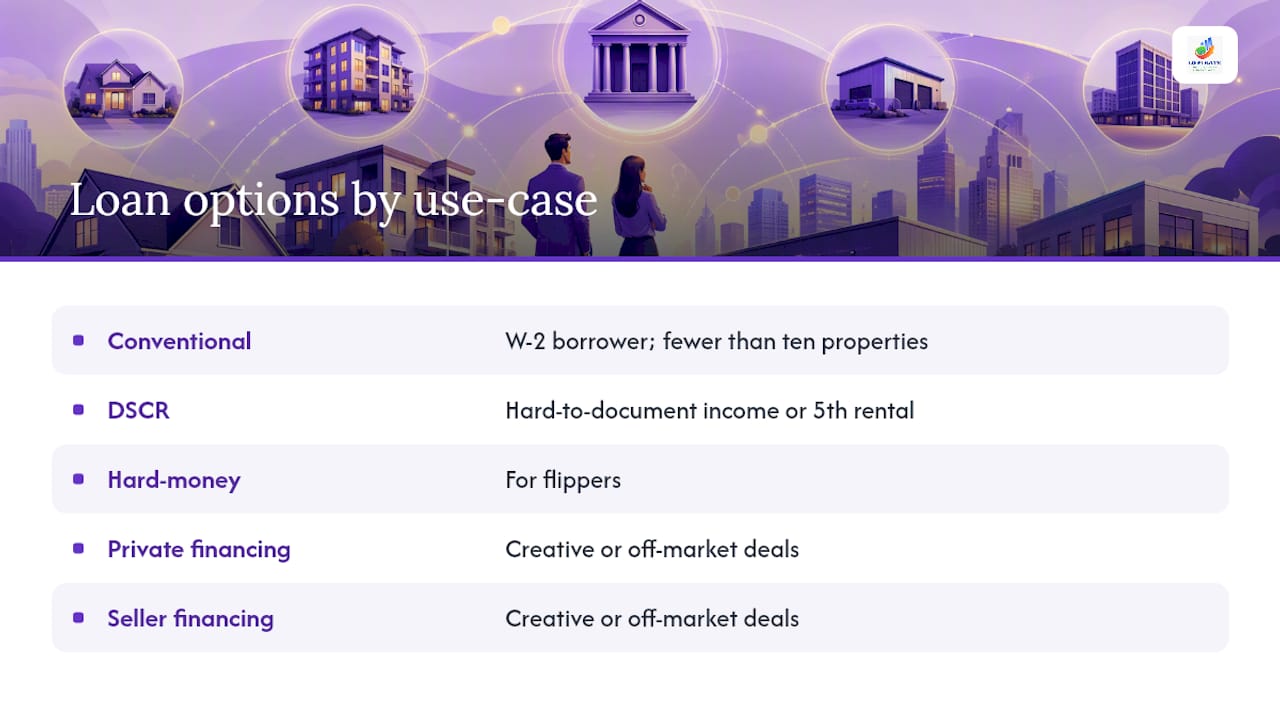
A few quick navigation notes: if you're a W-2 borrower with fewer than ten financed properties, start with the conventional section. If your income is hard to document or you're buying your fifth rental, jump to DSCR. Flippers should read the hard-money section first. Anyone working a creative deal or off-market situation should go straight to private and seller financing.
How do conventional and portfolio investment mortgages work?
Conventional investment mortgages follow agency guidelines set by Fannie Mae and Freddie Mac. That conformity is what keeps rates lower than most alternatives, but it also means the underwriting box is rigid. Lenders verify W-2 income, tax returns, and debt-to-income ratios. They also cap the number of financed properties a single borrower can hold under agency guidelines, typically at ten.
Investopedia notes that investment property loans carry higher rates and stricter requirements than owner-occupied mortgages, and that lenders may count up to 75% of anticipated rental income when qualifying borrowers. That rental income credit helps, but it rarely offsets the documentation burden for investors with complex tax returns.
Portfolio loans are the escape hatch. A portfolio lender keeps the loan on its own books instead of selling it to Fannie or Freddie, which means it sets its own rules. Qualification criteria are more flexible, loan counts aren't capped at ten, and some portfolio lenders will underwrite on asset value or cash flow rather than personal income.
Pros of conventional loans:
- Lower interest rates than almost every alternative
- Predictable 30-year fixed terms available
- PMI can be avoided with 20% down
Cons of conventional loans:
- Hard cap on financed properties under agency guidelines
- Full income documentation required (W-2s, two years of tax returns)
- Freddie Mac's investment property mortgage rules include extra fees and reserve requirements that add to closing costs
Portfolio loans make sense when you've hit the agency loan count ceiling, when your income structure doesn't fit the W-2 mold, or when you need a lender to count commercial or mixed-use properties that Fannie won't touch.
How do DSCR and bank-statement loans qualify investors differently?
DSCR stands for Debt Service Coverage Ratio. The math is straightforward: divide the property's monthly gross rental income by the total monthly mortgage payment (principal, interest, taxes, insurance, and HOA if applicable). A DSCR of 1.0 means rent exactly covers the payment. Most lenders want 1.25 or higher for the best terms.

Example: A rental property generates $2,500 per month in rent. The total monthly mortgage payment is $2,000. DSCR = $2,500 / $2,000 = 1.25. That clears the threshold most lenders prefer.
According to Awning's 2026 investment property loan guide, DSCR loans qualify entirely on the property's rental income, not the borrower's personal income. That's higher than a conventional 30-year, but for a self-employed investor whose tax returns show minimal net income after deductions, DSCR is often the only path to approval.
The practical advantage of DSCR: A real estate investor who owns six rentals and writes off most of their income through depreciation and expenses may show $40,000 in taxable income on paper. A conventional lender sees a DTI problem. A DSCR lender sees a portfolio generating $18,000 per month in rent and approves the deal on that basis alone.
Bank-statement loans work differently. Instead of a DSCR calculation, the lender averages 12–24 months of business or personal bank deposits to establish income. This suits investors who are self-employed in a non-real-estate business and want to use that income stream to qualify. Documentation is lighter than W-2 underwriting but heavier than DSCR, and rates tend to sit in a similar range.
The payoff is that neither product requires a W-2, and DSCR in particular can scale across a large portfolio without the borrower's personal income becoming a bottleneck.
Can you use existing equity to fund your next investment property?
Yes, and many experienced investors do exactly this. The three main tools are cash-out refinancing, a home equity line of credit (HELOC), and a home equity loan.

A cash-out refinance replaces your existing mortgage with a new, larger one and delivers the difference in cash. On a primary residence, the LTV ceiling is typically a bit higher, which is why some investors refinance their primary home to fund a rental purchase.
A HELOC works like a credit card secured by your home equity. The rate is variable, tied to the prime rate, and you draw only what you need. That flexibility makes it useful for rehab capital where costs are unpredictable. A home equity loan gives you a lump sum at a fixed rate, which is better when you know exactly how much you need and want payment certainty.
Risk you cannot ignore: Using your primary residence as collateral for an investment property means a deal that goes wrong can put your home at risk. That's not a reason to avoid these tools, but it is a reason to stress-test the investment before you pull the trigger.
When equity financing makes sense:
- You need a down payment for a second purchase and have substantial equity in an existing property
- You're funding a rehab and want to draw capital in stages (HELOC)
- Rates on the equity product are competitive with a standalone investment loan
- You have a clear repayment plan that doesn't depend on the new property's immediate cash flow
When it doesn't:
- Your primary residence equity is your only financial cushion
- The investment property's cash flow won't cover both the new mortgage and the equity product payment
- You're in a rising-rate environment and the HELOC's variable rate could spike mid-project
For investors who want to refinance an existing rental rather than tap primary-home equity, the mechanics and timing considerations are covered in detail in this guide on how to refinance investment property.
When do hard-money and bridge loans make sense for investors?
Hard-money lenders underwrite on the asset, not the borrower. They want to know what the property is worth today, what it will be worth after repairs (the after-repair value, or ARV), and how you plan to exit the loan. Your W-2 income is largely irrelevant to them.
Typical terms: 6–24 months, interest-only payments, and rates that generally run meaningfully higher than conventional financing. The cost is real, but for a flip that closes in 90 days and generates a $40,000 profit, the math still works.
The discipline most beginners skip: Hard money is a bridge, not a hold strategy. Before you sign a hard-money commitment, you need a verified exit plan, either a confirmed refinance path or a realistic sale timeline. Assuming rates will drop by the time you need to refinance is not an exit plan. Stress-test your refinance scenario against current rates plus a buffer.
Practical checklist when vetting a hard-money lender:
- Confirm they lend in your state and on your property type (residential vs. commercial, SFR vs. multifamily)
- Ask for the full fee schedule upfront: origination points, extension fees, draw fees for rehab escrows
- Verify their typical close time with a reference from a recent borrower
- Confirm whether the loan is recourse or non-recourse
- Ask what triggers a default and what the cure period is
The most common beginner mistake is treating a 12-month hard-money loan as a 12-month runway to figure out the exit. Lenders who extend loans charge extension fees, and those fees compound quickly. Build your exit plan before you close, not after.
What are private money, seller financing, and other creative structures?
When institutional underwriting blocks a deal or capital is tight, creative financing covers a range of structures that can get a transaction done. The main ones investors use:
- Private money: Capital from an individual, often a high-net-worth contact, family member, or private investor network. Terms are negotiated directly. Rates and LTVs vary widely. Speed is the main advantage.
- Seller financing: The seller acts as the lender, accepting monthly payments instead of a lump sum at closing. Works best when the seller owns the property free and clear or has high equity. Structuring the deal as an installment sale can spread the seller's capital gains tax liability over time, which is often a genuine incentive for sellers to agree.
- Subject-to: The buyer takes over the seller's existing mortgage payments without formally assuming the loan. The deed transfers; the mortgage stays in the seller's name. Useful when the seller has a low-rate loan worth preserving, but it carries legal and due-diligence complexity.
- Master lease option: The investor leases the property with an option to purchase at a set price. Cash flow starts immediately; the purchase can happen later. Useful for properties with deferred maintenance or title issues.
- Joint ventures: Two parties combine capital and expertise. One brings the deal; the other brings the money. Equity splits are negotiated. This is how many investors scale without needing institutional financing for every deal.
Legal and documentation requirements you cannot skip:
- All private loans should be documented with a promissory note and a recorded mortgage or deed of trust. An unrecorded private loan leaves the lender unprotected and the borrower exposed.
- Seller financing agreements need a purchase contract, promissory note, and deed of trust. Consult a real estate attorney in your state before closing any seller-financed deal.
- Subject-to transactions carry a due-on-sale clause risk: the original lender can technically call the loan due when the property transfers. Most don't, but it's a real risk to document and disclose.
- Joint ventures should be structured with a written operating agreement that covers profit splits, decision rights, and exit provisions.
For a deeper look at alternative financing structures and how they compare to conventional paths, Lofirate's blog covers the mechanics in detail.
How do you choose the right financing option for your situation?
The decision comes down to five variables: your investment horizon, your documentation availability, your portfolio size, your reserve position, and your exit strategy. Work through them in order.
Decision checklist:
- Horizon: Flip or short-term hold? Hard money or bridge. Long-term rental? Conventional, DSCR, or portfolio.
- Documentation: Can you show W-2 income and two years of tax returns? Conventional is likely cheapest. Self-employed or complex returns? DSCR or bank-statement.
- Portfolio size: Fewer than ten financed properties? Agency loans are available. More than ten? Portfolio lender or DSCR.
- Reserves: Most lenders require 3–12 months of mortgage payments in liquid reserves after closing. Know your number before you apply.
- Exit strategy: If you're using short-term financing, your exit plan needs to be verified, not assumed.
Questions to ask every lender before you commit:
- What is your DSCR calculation method? (Some lenders use gross rent; others use net operating income.)
- Does this loan carry a prepayment penalty, and if so, what is the structure?
- Is the loan recourse or non-recourse?
- What are the reserve requirements, and what assets qualify?
- How do you handle PMI, and at what LTV does it drop off?
- What is your rate-lock policy and fee?
Red flags to walk away from:
- A lender who can't explain their DSCR calculation method clearly
- No written rate lock before you order an appraisal
- A private lender who resists recording the mortgage
- Any lender who tells you to assume rates will drop as your refinance plan
If the deal only works at today's rate, it's a fragile deal. Build in the buffer before you commit.*
Working with a state-licensed mortgage broker who can shop multiple programs simultaneously is one of the fastest ways to surface the right lane without spending weeks calling individual lenders.
What are the real costs and qualification thresholds investors face?
The numbers here are the ones that actually determine whether a deal pencils.
Down payment ranges by loan type:
- Conventional: a standard to moderately high down payment; Fannie Mae guidelines set 20% as the common threshold to avoid PMI
- DSCR and bank-statement: typically 20%–25%
- Portfolio: 20%–30%, lender-dependent
- Hard money: 10%–30% of ARV, depending on the lender and deal quality
Credit score thresholds:
- 620: minimum for some DSCR products
- 660: floor for most conventional investment loans
- 680+: where pricing improves meaningfully on most products
- 740+: best-tier pricing on conventional and DSCR
Reserve requirements: Most lenders require 3–6 months of PITI (principal, interest, taxes, insurance) in liquid reserves after closing. Some portfolio and DSCR lenders require up to 12 months, especially for larger loan amounts.
Typical fee items to budget at closing:
- Origination fee: 0.5%–2% of loan amount (higher on hard money and DSCR)
- Appraisal: $400–$700 for SFR; more for multifamily
- Inspection: $300–$600
- Freddie Mac's investment property mortgage credit fee: varies by LTV and credit score, documented in their underwriting guidelines
- Title insurance, escrow, and recording fees: vary by state
That $100 monthly difference is $1,200 per year in cash flow, which compounds across a portfolio. Higher down payments also improve DSCR, which can unlock better rate tiers on future loans.
For a full breakdown of loan program minimums and PMI rules, Lofirate's investor loan programs guide covers the current thresholds by product type.
What documents do you need and how long does closing take?
Getting financing delayed because of missing paperwork is one of the most preventable deal-killers in real estate. Here's what each lane requires and how long you should realistically plan for.
| Loan Type | Key Documents | Typical Timeline to Close |
|---|---|---|
| Conventional | W-2s (2 years), tax returns (2 years), bank statements (2–3 months), pay stubs | 30 days |
| DSCR | Lease agreement or rent comps, property appraisal, entity docs if LLC | 30 days |
| Bank-statement | 12–24 months personal or business bank statements, P&L (some lenders) | 30 days |
| Hard money / bridge | Purchase contract, scope of work, ARV appraisal, exit plan documentation | 5 days |
| Private money | Government-issued ID, proof of funds, purchase contract, promissory note | 3–10 days |
| Seller financing | Purchase contract, promissory note, deed of trust, title search | Varies (up to 30 days) |
Actions that shorten each stage:
- Order the appraisal the same day you go under contract, not after you receive the commitment letter
- Pre-verify your exit plan for any short-term loan before you apply, not during underwriting
- Have your entity documents (LLC operating agreement, EIN letter) ready if you're buying in an entity
- For DSCR loans, pull rent comps from a local property manager before you apply so the lender's appraiser isn't the first person to estimate market rent
Pro Tip: Lofirate's broker-matching platform connects you with licensed wholesale brokers who already know which lenders are moving fastest on DSCR and bank-statement programs in your state. That program-discovery step alone can cut days off your timeline by skipping lenders who aren't actively pricing your loan type.
For investors who want a deeper look at mortgage broker services and how they navigate multiple lender relationships simultaneously, that partner guide covers the mechanics clearly.
Why is alternative financing growing in the current lending climate?
Bank and agency lending tightened significantly after the rate increases of the past few years. Stricter debt-to-income requirements, higher reserve thresholds, and more conservative appraisals have pushed a meaningful share of investors toward private, seller, and DSCR financing because those channels can close faster and are more flexible on documentation.
CNBC Select's analysis of investment property lenders notes that tighter bank underwriting and higher rates have made alternative financing more attractive for investors who can't or don't want to wait for conventional approval. That trend is visible in the growth of DSCR originations and in the increasing use of seller financing on off-market deals.
What this means practically:
- A deal that would have sailed through conventional underwriting in 2021 may now require a DSCR or portfolio product because the borrower's DTI is stretched by higher rates
- Sellers who bought at low rates and have high equity are more open to seller financing because it gives them installment-sale tax benefits and a steady income stream
- Private money networks are more active because institutional capital has pulled back from some deal types
A concrete example: An investor finds a duplex off-market. The seller owns it free and clear and is in no rush. Conventional financing would take 35 days and require full income documentation the investor can't easily produce. The seller gets monthly income and defers capital gains. Both sides win.
The right call is to pursue agency financing when your profile fits the box and the rate savings are material. When the box doesn't fit, or when speed is the competitive edge, creative financing structures are a legitimate tool, not a last resort.
What's the right approach to investment property financing?
Most investors spend too much time searching for the perfect loan and not enough time matching the loan to the deal. The financing choice that wins isn't always the cheapest one. It's the one that closes on time, fits the property's cash flow, and aligns with a realistic exit.
DSCR and creative financing are growing not because conventional loans got worse, but because the investor population has diversified. More self-employed buyers, more scaling portfolios, more off-market deals. The financing menu had to expand to match. Lofirate's broker-matching model exists precisely because no single lender covers every lane. A wholesale broker who works across multiple lenders can surface a DSCR program, a portfolio product, and a bank-statement option in the same conversation, and compare them on real pricing rather than retail rate sheets.
The investors who move fastest aren't the ones who know the most about loan products. They're the ones who know their own profile well enough to walk into a broker conversation with their documents ready and their exit plan already modeled.
Lofirate connects investors with the right mortgage broker faster
Searching for investment property financing options across dozens of lenders is slow and expensive at retail pricing. Lofirate is a broker-matching platform that connects real estate investors with licensed wholesale mortgage brokers who shop multiple lenders simultaneously, including DSCR, bank-statement, portfolio, and conventional programs.

Wholesale brokers access pricing that retail bank branches don't publish. For investors comparing DSCR versus conventional or trying to find a lender who will count rental income on a bank-statement loan, that access matters. Lofirate doesn't lend directly and doesn't quote rates. It matches you with a licensed broker in your state for a no-obligation consultation, so you get real program options instead of a single lender's menu.
What investors get through Lofirate:
- Faster program discovery across DSCR, bank-statement, portfolio, and conventional products
- Access to wholesale pricing not available through retail channels
- A broker who can compare multiple lenders on your specific profile
- Help navigating nontraditional programs for self-employed or scaling investors
Ready to find the right loan for your next rental or flip? Explore Lofirate's broker-matching services and get matched with a licensed wholesale broker today.
Sources
- Fannie Mae
- Investment property mortgages (Freddie Mac)
- The Complete Guide to Financing an Investment Property (Investopedia)
- Creative Financing in Real Estate: 2026 Investor Guide (Rod Khleif)
- Investment Property Loans: 2026 Guide to Rates & Types (Awning)