

It's built for creditworthy first-time buyers who want PMI they can eventually cancel rather than the insurance FHA charges for life in most cases. Approval runs through automated underwriting, and lenders still check credit, income, and debt ratios closely.
TL;DR:
- Borrowers with a 760 credit score pay significantly lower LLPAs and PMI costs than those with a 640 score, affecting overall monthly payments.
- Combining a 97% LTV with a lower credit score can push monthly costs close to or above FHA mortgage insurance expenses.
- Down payment sources can include gifted funds, community seconds, employer grants, and borrower savings, but proper documentation is critical.
- Applying through lenders unfamiliar with the program increases risk of delays, especially if large deposits are not pre-sourced.
- Shopping across multiple lenders or wholesale brokers can reveal more competitive PMI rates and LLPA costs than relying on a single bank.
Table of Contents
- What Is a Conventional 97 Loan and How Does It Work?
- Who Qualifies for a Conventional 97 Loan?
- Where Does the 3% Down Payment Come From?
- How Much Does PMI Really Add to a Conventional 97 Loan?
- Fannie Mae Standard 97 vs. HomeReady vs. Freddie Mac Options
- How Do You Actually Apply for a Conventional 97 Loan?
- Conventional 97 vs. FHA: Which Low Down Payment Loan Wins?
- What Recent Rule Changes Affect Conventional 97 Borrowers?
- What Does the Homeownership Education Requirement Involve?
- What Mistakes Sink a Conventional 97 Application?
- Why Shopping Multiple Lenders Matters More Than Most Buyers Realize
- Get a Second Opinion on Your Conventional 97 Pricing
- Where to Verify Current Program Rules and Limits
- Sources
What Is a Conventional 97 Loan and How Does It Work?
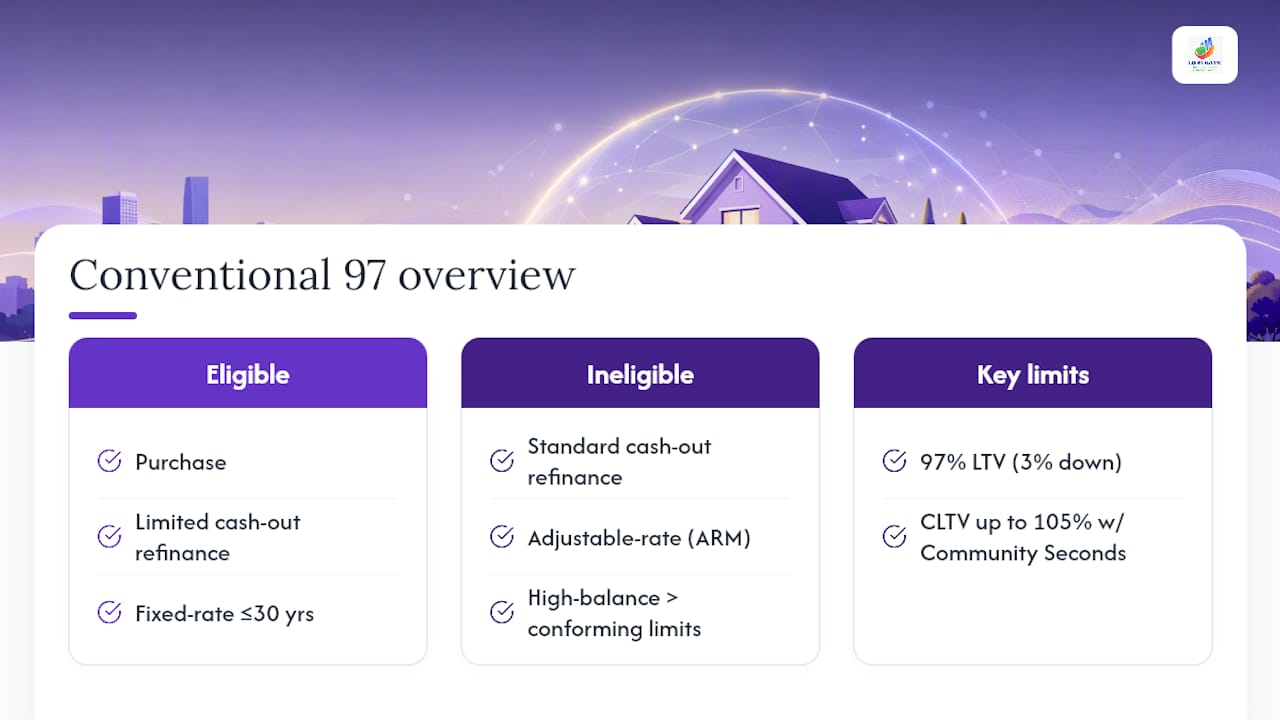
Fannie Mae calls its version the Standard 97 percent loan-to-value mortgage, and Freddie Mac offers comparable low-down-payment options.
The loan works for purchases and limited cash-out refinances, but not standard cash-out refinancing. It has to be a fixed-rate mortgage with a term of 30 years or less; adjustable-rate mortgages and high-balance loans above standard conforming limits don't qualify. One detail catches a lot of buyers off guard: combined loan-to-value can reach as high as 105% when a Community Seconds subordinate lien from an approved down payment assistance program covers part of the gap.
Who Qualifies for a Conventional 97 Loan?
Eligibility hinges on whether you're using Fannie Mae's standard product or a variant like HomeReady, and the two paths diverge in a few important ways.
- First-time buyer status: Fannie Mae's Standard 97 requires at least one borrower to be a first-time homebuyer (no ownership interest in a home in the past three years); HomeReady and Freddie Mac's HomeOne have their own borrower rules that don't always require first-time status.
- Credit score: Lenders commonly look for a minimum around 620, though pricing improves noticeably above that floor.
- Debt-to-income ratio: DTI limits vary by lender and by the strength of other factors in the file, so two borrowers with identical income can get different answers.
- Underwriting: Every 97% LTV loan runs through Desktop Underwriter (DU), and manual underwriting simply isn't an option at this LTV.
- Homeownership education: Required in some circumstances, especially when all borrowers are first-time buyers.
Where Does the 3% Down Payment Come From?
Fannie Mae allows several acceptable sources for the down payment, which gives buyers with limited savings more paths to the closing table than they usually expect.
- Borrower's own funds from a checking, savings, or retirement account.
- Gift funds from a relative or qualifying donor, backed by a signed gift letter.
- Grants from employer or nonprofit down payment assistance programs.
- Community Seconds subordinate liens, which can push combined LTV up to 105%.
Some of that can come from seller credits or gift funds too, but the paperwork trail matters.
Pro Tip: Get your gift letter signed and your funds sourced at least two months before you apply. Desktop Underwriter flags large, unexplained deposits, and a rushed gift letter is one of the most common reasons closings get delayed.
How Much Does PMI Really Add to a Conventional 97 Loan?
Private mortgage insurance is mandatory on any Conventional 97 loan, since the down payment sits well below the 20% threshold that would otherwise waive it. The upside is that conventional PMI cancels once you build enough equity, typically at 20%, unlike FHA mortgage insurance, which sticks around for the life of most loans originated today.
What surprises a lot of buyers is how much credit score moves the number. Fannie Mae prices these loans using loan-level price adjustments, fees layered onto the interest rate or closing costs based on credit score and the LTV bracket you fall into.
- A borrower with a 760 credit score pays meaningfully less in LLPAs and PMI than a borrower at 640, even at the identical loan amount.
- Combine a lower credit score with 97% LTV, and total monthly cost can climb close to or past what FHA would charge for the same borrower.
- PMI rates also shift based on the coverage level the lender selects, which isn't always visible on a rate sheet at first glance.
Ask any lender you're considering for a full monthly payment breakdown that includes PMI and LLPA-adjusted rate, not just a headline interest rate. The LLPA structure is where a lot of the real cost difference between lenders actually lives.
Fannie Mae Standard 97 vs. HomeReady vs. Freddie Mac Options
- Fannie Mae Standard 97 requires a first-time buyer but carries no income limit.
- HomeReady drops the first-time buyer requirement but caps borrower income at 80% of area median income, and it often qualifies for LLPA credits that lower costs versus the standard product.
- Freddie Mac's HomeOne and Home Possible mirror these structures on the Freddie Mac side, with their own income and occupancy rules laid out in Freddie Mac's program fact sheets.
- Loan amount ceilings follow the conforming loan limits the Federal Housing Finance Agency sets each year, which vary by county and property type, so always confirm the current number for your area before assuming a purchase price qualifies.
- Property type limits apply too. Most manufactured housing and some condo types face tighter restrictions or aren't eligible at all under these specific programs.
How Do You Actually Apply for a Conventional 97 Loan?
Getting from "interested" to "approved" comes down to paperwork, timing, and picking a lender who knows this loan type well.
- Gather documents early: recent pay stubs, two years of W-2s, two months of bank statements, and tax returns if you're self-employed or have variable income.
- Get pre-qualified through Desktop Underwriter, which evaluates your credit, income, assets, and debt together and flags whether you need compensating factors like reserves or a lower DTI to get an Approve recommendation.
- Shop more than one lender or broker channel. Since LLPAs and PMI pricing vary by investor and coverage selection, wholesale broker access can surface pricing a single retail lender never shows you.
- Lock your rate and move through underwriting, typically 30 to 45 days from application to closing when documentation comes in clean and quickly.
Pro Tip: Ask a prospective lender directly how many Conventional 97 loans they closed in the past year. Some retail loan officers rarely touch this product and miss compensating-factor opportunities that an experienced originator catches automatically.
Conventional 97 vs. FHA: Which Low Down Payment Loan Wins?
Neither option is universally cheaper. It depends heavily on your credit score and how long you plan to stay in the home.
- FHA charges an upfront mortgage insurance premium plus a monthly premium that usually lasts the life of the loan; Conventional 97 has no upfront premium and PMI that cancels at 20% equity.
- Borrowers with scores in the high 600s and above generally do better with Conventional 97 once LLPAs and PMI are factored in.
- Borrowers with lower scores, thinner credit files, or higher DTI often find FHA more forgiving and, in some cases, cheaper overall.
- Sellers in competitive markets sometimes favor conventional financing offers over FHA, since conventional underwriting has fewer property condition requirements attached.
Run the numbers for both loan types side by side before committing. A quarter-point difference in credit score can flip which program actually costs less.
What Recent Rule Changes Affect Conventional 97 Borrowers?
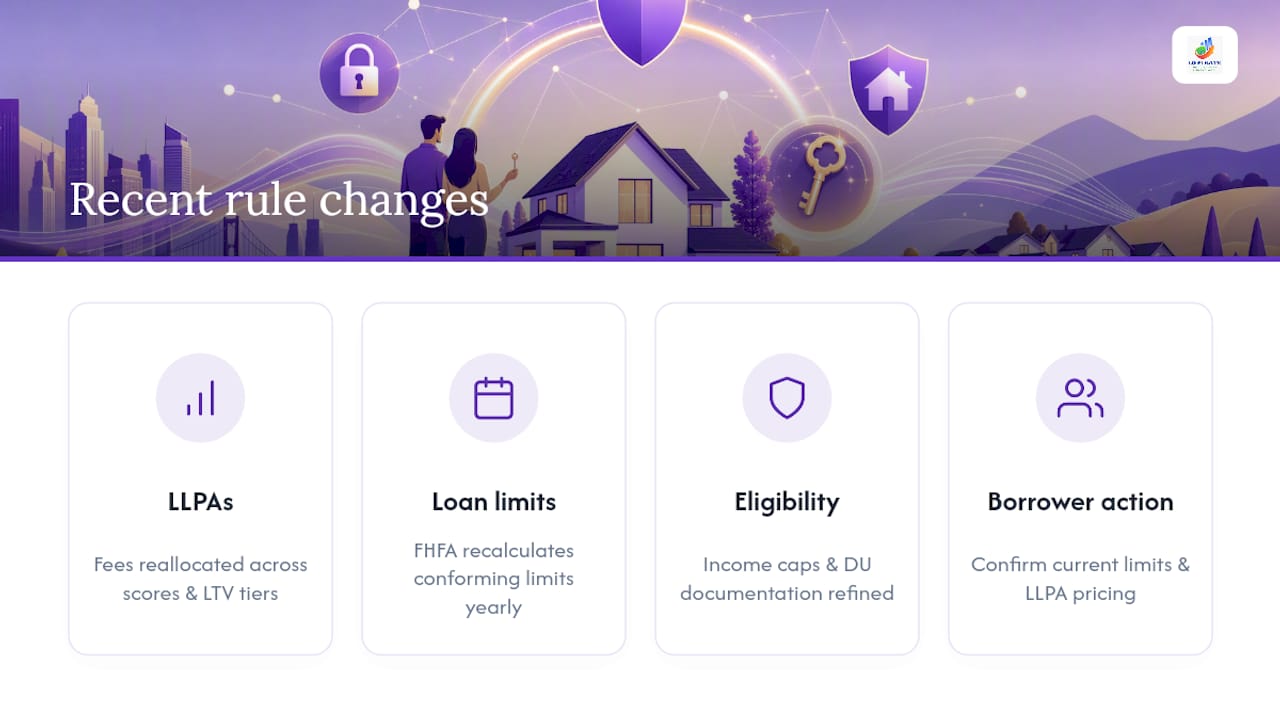
The biggest shift borrowers should watch for is how LLPAs get reallocated across credit score bands and LTV tiers. When the agencies adjust the grid, a borrower at 680 might see a smaller fee increase while a borrower at 620 sees a larger one, or vice versa, depending on how the agencies are managing risk exposure that particular year. That's not cosmetic. It changes the real monthly payment difference between Conventional 97 and FHA for entire swaths of borrowers overnight.
Conforming loan limits also move annually, since the FHFA recalculates them based on national home price trends. A higher limit in your county can mean a purchase price that didn't qualify for conventional financing last year suddenly does, or it can shift a jumbo-adjacent purchase back into conforming territory with meaningfully better pricing.
Program eligibility criteria, like income caps for HomeReady or documentation standards run through Desktop Underwriter, also get refined from time to time as the agencies respond to loan performance data. None of these changes tend to make headlines, which is exactly why working with a lender who tracks agency guideline updates closely, rather than one relying on outdated program sheets, protects you from applying under assumptions that no longer hold. Always confirm current limits and LLPA pricing directly with your lender rather than trusting a number from an older article or a rate quote you saw months ago.
What Does the Homeownership Education Requirement Involve?
Fannie Mae requires homeownership education for Standard 97 loans when all borrowers on the loan are first-time homebuyers, though the specific trigger can vary depending on the loan program and whether other risk factors are present in the file. HomeReady loans carry similar education requirements in many scenarios, particularly for borrowers relying on gift funds or grant money as part of their down payment.
The course itself typically runs a few hours online through a HUD-approved counseling agency or a Fannie Mae-recognized education provider. It covers budgeting for homeownership costs, understanding your mortgage terms, avoiding foreclosure, and managing ongoing expenses like maintenance and property tax increases. Most providers issue a completion certificate immediately after you finish the modules and pass a short quiz. That certificate goes into your loan file alongside your other underwriting documents.
Cost varies by provider, though many approved courses are free or charge a small fee, often under $100. The key practical point: complete it early. Waiting until the week before closing to discover you need a certificate is one of the more common, entirely avoidable delays in this loan process. Ask your loan officer at the very start of your application whether your specific scenario triggers the requirement, since the answer depends on borrower count, first-time status, and which specific program you're using.
What Mistakes Sink a Conventional 97 Application?
The single biggest mistake is applying for a Conventional 97 loan through a lender who rarely originates them.
Undocumented deposits cause more delays than almost anything else. A $2,000 deposit that shows up in your bank statement without a clear paper trail can stall underwriting for weeks while you track down the source. Get large or unusual deposits sourced and documented before you apply, not after DU asks for an explanation.
Borrowers also frequently misjudge how much a low credit score costs them at this LTV tier specifically. Check your credit report and dispute errors months before applying, not the week you find a house.
Finally, some buyers assume every low-down-payment conventional program works identically. Mixing up HomeReady's income limits with Standard 97's first-time buyer rule, or assuming Freddie Mac's HomeOne mirrors Fannie Mae's product exactly, leads to wasted time on pre-qualification for a program you don't actually qualify for. Confirm which specific program fits your situation before you start gathering documents.
Why Shopping Multiple Lenders Matters More Than Most Buyers Realize
A single loan officer at a single bank has no incentive to tell you their PMI coverage selection or rate lock costs more than a competitor's. Some mortgage connection platforms connect borrowers with licensed wholesale mortgage brokers who shop pricing across multiple lenders instead of quoting from just one shelf, which is important for a loan type sensitive to credit score and LTV pricing.
— LoFi
Get a Second Opinion on Your Conventional 97 Pricing
Some online mortgage platforms offer a way to compare Conventional 97 pricing across multiple wholesale lenders instead of settling for a single retail loan officer's quote.

A no-obligation consultation through certain mortgage platforms can connect you with a licensed broker in your state who can model your Conventional 97 costs against alternatives like HomeReady or FHA, using your actual credit profile instead of a generic rate sheet. If you're weighing a 3% down purchase against other paths, the loan options overview is a good starting point too. Start by requesting your free rate consultation and see what a shopped quote actually looks like before you lock anything in.
Where to Verify Current Program Rules and Limits
- Fannie Mae's 97% LTV program page for current guideline detail.
- FHFA for this year's conforming loan limits by county.
- The NMLS Consumer Access database to verify any broker's license before signing anything.
This article is general information, not a substitute for advice from a qualified financial advisor. Consult a qualified financial professional about your own circumstances before acting on anything here.
Sources
- 97% Loan to Value Options | Fannie Mae
- Standard 97 percent loan-to-value mortgage (Fannie Mae summary via FDIC)
- Freddie Mac HomePossible fact sheet
- Federal Housing Finance Agency (FHFA)
- Conventional loan requirements and guidance (The Mortgage Reports)