

TL;DR:
- A conventional loan is an unguaranteed mortgage originated by private lenders, with most borrowers starting here in the U.S. and facing stricter standards, including credit scores above 620 and lower DTIs. They are available as conforming or jumbo loans, with fixed or adjustable rates, offering benefits like automatic PMI removal at 78% LTV. Proper preparation, such as improving credit and saving for a larger down payment, can significantly enhance eligibility and loan terms.
A conventional loan is a mortgage not insured or guaranteed by any federal government agency, originated by private lenders under standards set by Fannie Mae and Freddie Mac. It is the most common home financing method in the United States, with 64% to 75% of homebuyers using one as of 2025. If you are buying your first home and trying to understand your mortgage options, conventional loans are where most borrowers start and where many end up. This guide breaks down how they work, what types exist, and whether you qualify.
What is a conventional loan and how does it work?
A conventional loan is originated by a private lender such as a bank, credit union, or mortgage company, without any government backing from agencies like the FHA, VA, or USDA. Because no federal guarantee protects the lender if you default, lenders apply stricter underwriting standards than they would for government-backed loans. That means your credit score, income, and debt levels all get scrutinized more carefully.

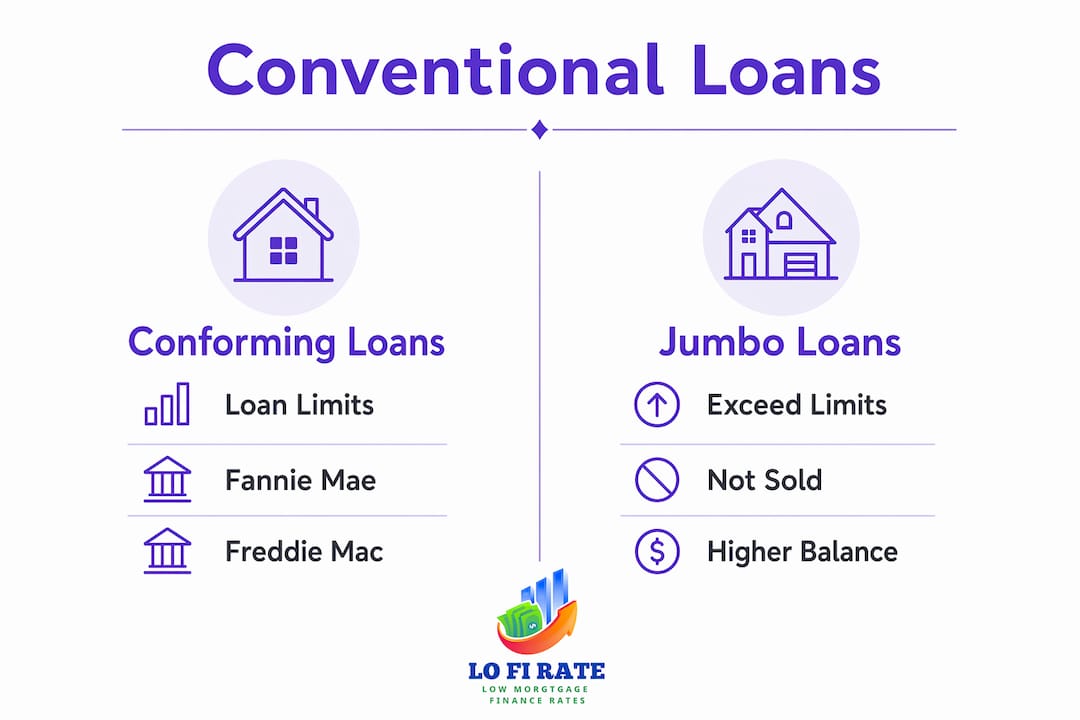
Most conventional loans fall into one of two categories: conforming or non-conforming. Conforming loans follow guidelines established by Fannie Mae and Freddie Mac, the two government-sponsored enterprises that buy mortgages from lenders and sell them on the secondary market. This secondary market system is what makes conforming loans faster to process and more predictably underwritten. Non-conforming loans, often called jumbo loans, exceed those guidelines and stay on the lender's own books.
Here is what drives your eligibility and rate on a conventional loan:
- Credit score: A minimum of 620 is required, but scores above 700 unlock meaningfully better rates
- Debt-to-income ratio (DTI): Most lenders cap this at 43%, though lower is better
- Down payment: As little as 3% is possible, but 20% eliminates Private Mortgage Insurance (PMI)
- Loan term: Most borrowers choose 15 or 30 years, though other terms exist
Pro Tip: Even a 20-point improvement in your credit score before applying can lower your interest rate by a quarter point or more, saving thousands over the life of the loan.
What are the different types of conventional loans?
Conventional loans are not a single product. They split into distinct categories based on loan size, rate structure, and underwriting standards. Understanding the differences helps you choose the right fit before you ever talk to a lender.
Conforming loans
Conforming loans meet the size and quality guidelines set by Fannie Mae and Freddie Mac. The 2026 conforming loan limit for a one-family home is $832,750 in most U.S. areas, though high-cost regions like San Francisco and New York City have higher ceilings. Because these loans can be packaged and sold to investors, lenders offer them at competitive rates with standardized terms. They are the most common type of conventional mortgage.
Jumbo (non-conforming) loans
Jumbo loans exceed the conforming limit and are kept on the lender's own balance sheet rather than sold to Fannie Mae or Freddie Mac. That retained risk means jumbo loans require higher down payments, typically 10% to 20% or more, stricter credit standards, and documented cash reserves. A borrower buying a $1.2 million home in a major metro will almost certainly need a jumbo loan.
Fixed-rate vs. adjustable-rate options
Both conforming and jumbo loans come in fixed-rate and adjustable-rate structures. Fixed and adjustable-rate terms commonly range from 15 to 30 years, giving you flexibility to match your payment timeline to your financial goals. A fixed rate locks your payment for the life of the loan. An adjustable-rate mortgage (ARM) starts lower but resets periodically based on a market index, which introduces payment uncertainty after the initial fixed period.
| Loan type | Loan size | Typical down payment | Key feature |
|---|---|---|---|
| Conforming fixed-rate | Up to $832,750 | 3% to 20% | Stable payment, sold to GSEs |
| Conforming ARM | Up to $832,750 | 3% to 20% | Lower initial rate, resets later |
| Jumbo fixed-rate | Above $832,750 | 10% to 20%+ | Higher credit and reserve requirements |
| Jumbo ARM | Above $832,750 | 10% to 20%+ | Flexible rate on large loan amounts |
For a broader look at how these products compare to other mortgage types, the mortgage loan types guide at Lofirate covers the full spectrum.
What advantages do conventional loans offer compared to government-backed loans?
Conventional loans carry real advantages for borrowers who meet the qualification bar. The comparison with FHA, VA, and USDA loans comes down to cost, flexibility, and long-term financial impact.
-
Lower total cost for qualified borrowers. Conventional loans typically cost less than FHA loans for borrowers with solid credit, largely because FHA loans charge both an upfront mortgage insurance premium and an annual premium regardless of your equity position.
-
PMI that actually goes away. With a conventional loan, PMI is automatically removed at 78% loan-to-value, meaning once your loan balance drops to 78% of the original purchase price, the charge disappears. FHA mortgage insurance often persists for the life of the loan if you put down less than 10%.
-
Higher loan limits. Conventional conforming loans go up to $832,750 in standard markets, well above the FHA loan limit in many areas. Buyers in higher-priced markets have more room to work with.
-
Faster processing and fewer property restrictions. Because conforming loans follow standardized Fannie Mae and Freddie Mac guidelines, lenders move through underwriting efficiently. FHA loans require a government appraisal that can flag property condition issues and slow closings.
-
No occupancy restrictions for certain loan types. VA and USDA loans require the property to be a primary residence. Conventional loans can be used for primary homes, second homes, and investment properties.
Pro Tip: If you are deciding between a conventional loan and an FHA loan, run the numbers on total mortgage insurance costs over five years, not just the monthly payment. The FHA loan often looks cheaper upfront but costs more over time. The FHA and conventional loan comparison at Lofirate walks through this calculation in detail.
How to qualify and prepare for a conventional loan
Qualifying for a conventional loan requires meeting specific benchmarks across credit, income, and assets. The good news is that each benchmark is improvable with preparation.
- Credit score of at least 620. This is the floor, but scores above 700 are where you start seeing competitive rates. Borrowers with scores in the 760 to 800 range typically receive the best pricing available.
- DTI below 43%. Your total monthly debt payments, including the new mortgage, divided by your gross monthly income should stay under 43%. Some lenders allow up to 50% with compensating factors like large cash reserves.
- Down payment of 3% to 20%. A 3% down payment is possible through programs like Fannie Mae's HomeReady or Freddie Mac's Home Possible. Putting down 20% eliminates PMI entirely and reduces your monthly payment.
- Stable employment and income documentation. Lenders want two years of W-2s or tax returns, recent pay stubs, and bank statements. Self-employed borrowers need to show consistent income across two tax years.
- Cash reserves. Many lenders require two to six months of mortgage payments in savings after closing, particularly for jumbo loans.
The mortgage qualification guide at Lofirate covers each of these steps with specific timelines and actions you can take before applying.
Common misconceptions about conventional loans
The biggest misconception is that all conventional loans are essentially the same product. They are not. A conforming loan from a retail bank and a jumbo loan from a portfolio lender have entirely different risk profiles, underwriting processes, and pricing logic.
"Because there is no government guarantee behind a conventional loan, the lender absorbs the full loss if a borrower defaults. That risk is priced into your rate and your qualification requirements."
A few other points that borrowers frequently get wrong:
- PMI is not permanent. Many first-time buyers assume mortgage insurance is a fixed cost for the life of the loan. On a conventional loan, you can request PMI removal once you reach 20% equity, and it is automatically canceled at 78%.
- A lower rate does not always mean a lower cost. A 30-year loan at a slightly lower rate can cost more in total interest than a 15-year loan at a higher rate. Total cost matters more than the rate alone.
- Conventional does not mean easy. The lack of government backing means lenders set their own overlays on top of Fannie Mae and Freddie Mac minimums. One lender may require a 640 credit score while another accepts 620 for the same loan type.
For buyers comparing all their home financing options for 2026, understanding these distinctions prevents costly assumptions.
Key takeaways
A conventional loan is the most widely used mortgage in the U.S. because it offers competitive costs, flexible terms, and removable PMI for borrowers who meet the credit and income standards set by Fannie Mae and Freddie Mac.
| Point | Details |
|---|---|
| Definition and prevalence | A conventional loan is a private mortgage with no government backing, used by 64% to 75% of homebuyers. |
| Conforming loan limit | The 2026 baseline limit is $832,750; loans above this become jumbo loans with stricter requirements. |
| PMI removal advantage | PMI cancels automatically at 78% loan-to-value, unlike FHA insurance which can last the loan's full term. |
| Qualification baseline | A credit score of at least 620 and a DTI below 43% are the standard entry points for eligibility. |
| Rate structure flexibility | Conventional loans come in fixed and adjustable-rate options with terms from 15 to 30 years. |
What I actually tell first-time buyers about conventional loans
Most first-time buyers come to me focused entirely on the interest rate. That is understandable, but it is the wrong starting point. The rate is a symptom of your financial profile, not a number you negotiate in isolation.
What I have seen repeatedly is buyers who qualify for a conventional loan on paper but are not truly prepared for what the underwriting process reveals. A credit score of 625 will get you in the door, but it will also get you a rate that costs tens of thousands more over 30 years compared to a borrower at 760. The gap between "qualifying" and "qualifying well" is enormous.
The other thing most articles skip over is the PMI removal benefit. Borrowers who put down 10% on a conventional loan and then aggressively pay down principal can eliminate PMI in under seven years. On an FHA loan with the same down payment, that insurance often stays for the life of the loan. Over a 30-year horizon, that difference can exceed $20,000 in total payments.
My honest advice: do not apply for a conventional loan the moment you decide to buy. Spend three to six months improving your credit score, paying down revolving debt to lower your DTI, and building your down payment. The loan you qualify for after that preparation will look very different from the one you would get today.
— LoFi
Find your best conventional loan rate through Lofirate

Most borrowers accept the first rate a retail lender offers without knowing that wholesale mortgage brokers routinely access lower pricing for the same loan product. Lofirate connects you with licensed wholesale brokers in your state who shop multiple lenders to find competitive conventional loan rates, with no obligation and no pressure. Whether you are buying your first home or refinancing an existing mortgage, a second opinion costs nothing and can save you significantly. Visit Lofirate to get matched with a broker and explore your loan options based on your actual financial profile.
FAQ
What is the minimum credit score for a conventional loan?
The minimum credit score for most conventional loans is 620, though scores above 700 are needed to access the most competitive interest rates and terms.
How is a conventional loan different from an FHA loan?
A conventional loan has no government backing and stricter credit requirements, but offers removable PMI and typically lower long-term costs for borrowers with good credit. FHA loans are government-insured and easier to qualify for, but mortgage insurance often lasts the full loan term.
What are the conventional loan limits in 2026?
The baseline conforming loan limit for a single-family home in 2026 is $832,750 in most U.S. markets. Loans above this threshold are classified as jumbo loans and carry stricter underwriting requirements.
Can you remove PMI on a conventional loan?
PMI on a conventional loan is automatically canceled once your loan balance reaches 78% of the original home value. You can also request removal at 80% equity, which is not an option available on most FHA loans.
Who qualifies for a conventional loan?
Borrowers with a credit score of at least 620, a DTI below 43%, and a down payment of 3% or more are the baseline profile. Stronger credit, lower debt, and larger down payments improve both approval odds and the rate you receive.