

These are the mortgage mistakes that quietly add thousands to what you pay. Here are the top pitfalls and one-line ways to avoid each before you read further.
The highest-impact mistakes, fast:
- Skipping pre-approval: You lose negotiating power and may discover disqualifying issues too late. Fix: get pre-approved before you tour homes.
- Focusing only on the interest rate: A lower rate with points can cost more than a higher rate without them. Fix: run breakeven math on every quote.
- Accepting a no-closing-cost offer without checking: The lender rolls those costs into a higher rate. Fix: ask for the total loan cost over your expected hold period.
- Underestimating closing costs: Closing costs run 2%–5% of the purchase price, which can blindside buyers who only saved for the down payment. Fix: budget for the full range from day one.
- Not shopping multiple lenders: One Loan Estimate tells you nothing. Fix: collect at least three and compare line by line.
- Changing your financial profile during underwriting: A new car loan or job change can kill your approval. Fix: freeze all major financial moves until after closing.
- Skipping the home inspection: A missed structural defect can cost far more than the inspection fee. Fix: never waive it, even in a competitive market.
- Ignoring total monthly housing cost: Taxes, insurance, and maintenance can push you into being house poor. Fix: calculate PITI (principal, interest, taxes, insurance) plus 1% of home value annually for maintenance.
- Misunderstanding adjustable-rate terms: Rate caps and adjustment schedules are buried in the contract. Fix: read the ARM disclosure and model the worst-case payment.
- Ignoring refinance timing and costs: Refinancing too soon or without running breakeven math can cost more than staying put. Fix: calculate months-to-breakeven before you sign.
Key Takeaways
Avoiding the costliest mortgage mistakes comes down to one discipline: treat every loan decision as a full-cost calculation, not a single-rate comparison.
| Point | Details |
|---|---|
| Shop at least three lenders | Collect Loan Estimates on the same day for the same loan to compare fees, points, and APR accurately. |
| Budget 2%–5% for closing costs | Closing costs run 2%–5% of the purchase price; save for this separately from your down payment. |
| Run breakeven math on points | Divide the upfront cost of any discount point by the monthly savings to find your breakeven month. |
| Freeze finances during underwriting | No new credit, job changes, or large purchases until after closing; lenders re-verify the day before funding. |
| Lofirate broker matching | Lofirate connects you with licensed wholesale brokers who can compare multiple Loan Estimates at no cost to you. |
Pro Tip: Before your first lender conversation, pull your credit report and calculate your DTI. Knowing your numbers before the lender does puts you in a stronger negotiating position from the first call.
Table of Contents
- The costly mortgage pitfalls list: detailed explanations and how to avoid each one
- How these mistakes add up: breakeven examples and quick math
- Safeguards checklist: step-by-step actions to avoid costly mortgage pitfalls
- What you should not tell your mortgage lender
- If your mortgage becomes unaffordable: immediate steps to take
- How "house poor" happens: total monthly housing cost
- What mortgage insurance actually costs you (and when LTV matters)
- Reading your mortgage contract: what to look for in the fine print
- Refinancing costs and timing: why the math matters more than the rate
- Mortgage interest deductions and property tax: what buyers often miss
- What we actually tell buyers who ask "how do I avoid overpaying?"
- Lofirate broker matching: your next practical step
- Sources
The costly mortgage pitfalls list: detailed explanations and how to avoid each one
1. Skipping pre-approval before house hunting
Without a pre-approval letter, sellers treat your offer as speculative. Worse, you might fall in love with a home you cannot qualify for. Experian's guidance on common mortgage mistakes flags this as one of the most avoidable errors: a lender may find a credit issue, a DTI problem, or a documentation gap that takes weeks to fix. Getting pre-approved first gives you a realistic price ceiling and a stronger negotiating position.
Red flag: An agent who says pre-qualification is "good enough." Pre-qualification is a soft estimate; pre-approval involves verified income, assets, and a credit pull.
2. Focusing on the rate instead of the total loan cost
Advertised rates are marketing. The rate you see often requires paying discount points to achieve, which means your upfront cost is higher even if your monthly payment looks lower. CBS News reporting on mortgage traps is direct: ask lenders for the total loan cost, not just the rate, and run breakeven math before accepting any offer with points attached.

Pro Tip: Always request two quotes from every lender: one at zero points and one at the rate they advertise. The difference in upfront cost versus monthly savings tells you exactly whether paying points makes sense for your timeline.
3. Accepting a no-closing-cost mortgage without checking the tradeoff
"No closing costs" sounds like free money. It is not. The lender either rolls those costs into the loan balance or raises your rate to cover them. If you keep the loan long enough, you pay more than you would have by paying closing costs upfront. The CBS News analysis of sneaky mortgage traps recommends asking for a side-by-side comparison of total loan cost for both options across your expected hold period.
Red flag: A lender who cannot or will not show you a total-cost comparison for both scenarios.
4. Paying discount points without running breakeven math
On a $400,000 loan, one point is $4,000 upfront. If that point saves you $40 per month, your breakeven is 100 months — over eight years. Move before then and you lost money. See the full breakdown of how discount points work before you agree to pay them.
5. Falling for builder buydown incentives without comparing total cost
Builders increasingly offer 2-1 buydowns or rate incentives to move inventory. That temporary relief can mask a higher purchase price or a rate that becomes unaffordable once the buydown expires. CBS News coverage of builder incentives recommends comparing total loan cost with and without the buydown before signing.
6. Not shopping multiple lenders or comparing Loan Estimates
One quote is not a market. Investopedia's analysis of top mortgage mistakes identifies failing to shop multiple lenders as one of the most expensive errors buyers make. Loan Estimates are standardized, so you can compare origination fees, points, rate, and APR on the same form across lenders. Three quotes minimum is the floor; five is better.
7. Ignoring closing costs and total cash to close
Buyers who save for a down payment and forget about closing costs often face a shortfall at the table. Closing costs cover lender fees, title insurance, prepaid interest, escrow setup, and more. Budget for the full 2%–5% range from the start, and read the closing costs guide so no line item surprises you.
8. Changing your financial profile during underwriting
Lenders verify your income, assets, and credit right before closing, not just at application. HSH's list of common mortgage mistakes includes becoming self-employed, financing a new car, opening new credit cards, or missing a payment as moves that can trigger a denial or a worse rate even after conditional approval. Freeze everything until the loan funds.
9. Skipping the home inspection or misreading appraisal results
Waiving an inspection to win a bidding war is a gamble with no upside. A foundation crack, faulty wiring, or a failing HVAC system can cost tens of thousands to fix. The appraisal is a separate issue: if the home appraises below the purchase price, you either renegotiate, cover the gap in cash, or walk. Know which outcome you can afford before you waive any contingency.
10. Misunderstanding adjustable-rate terms and prepayment penalties
A 5/1 ARM gives you a fixed rate for five years, then adjusts annually. Read the ARM disclosure document and model the worst-case scenario before you sign. Prepayment penalties, though less common on conventional loans today, can also trap you if you plan to sell or refinance within a few years.
How these mistakes add up: breakeven examples and quick math
The abstract risk of paying points or accepting a higher rate becomes concrete when you run the numbers.
Discount point breakeven example:
If you sell or refinance before month 60, paying that point cost you money. If you stay past five years, you come out ahead.
No-closing-cost tradeoff example:
In this example, the no-closing-cost option is actually cheaper at the seven-year mark because the higher monthly payment accumulates more slowly than the upfront $10,000 hit. The math flips if you hold the loan longer. This is why asking for a total-cost comparison across your specific hold period matters more than any rule of thumb.
Closing costs run 2%–5% of the purchase price on most U.S. home purchases, per Freddie Mac's homebuyer resources. On a $400,000 home, that is $8,000–$20,000 due at closing, separate from your down payment.
Safeguards checklist: step-by-step actions to avoid costly mortgage pitfalls
Before you apply:
- Pull your credit reports from all three bureaus (Equifax, Experian, TransUnion) and dispute any errors at least 60 days before applying.
- Calculate your DTI (debt-to-income ratio): total monthly debt payments divided by gross monthly income. Most conventional loans require DTI below 43%.
- Gather documentation: two years of W-2s or tax returns, 30 days of pay stubs, two months of bank statements, and any asset account statements.
- Get pre-approved (not just pre-qualified) with a lender before you tour homes.
While shopping loans:
- Request Loan Estimates from at least three lenders on the same day for the same loan amount and property type.
- Ask each lender for a zero-points quote alongside any advertised rate quote so you can compare apples to apples.
- Check each lender's license on NMLS Consumer Access before sharing personal information.
- Verify your rate lock in writing: confirm the lock period, the locked rate, and the cost of an extension if closing is delayed.
At closing:
- Compare your Closing Disclosure to your Loan Estimate line by line. Fees in Section A (origination charges) cannot increase; others have limits.
- Confirm any seller concessions and lender credits appear exactly as agreed.
- Verify escrow amounts for taxes and insurance match what you budgeted.
- Check that no prepayment penalty clause appears in the loan terms if you did not agree to one.
For a deeper look at spotting hidden mortgage fees before you close, that checklist covers the specific line items most buyers miss.
What you should not tell your mortgage lender
These are the moves and statements that trigger underwriting problems, even when they seem harmless.
- "I'm thinking about changing jobs." Income instability is a top denial trigger. Lenders verify employment the day before closing; a job change mid-process can void your approval.
- "I just financed a new car." A new auto loan raises your DTI immediately. Even if the payment seems small, it can push you over the qualifying threshold.
- "I co-signed a loan for a family member." Co-signed debt counts against your DTI as if it were your own. Disclose it upfront; do not add new co-signed obligations during processing.
- "I moved some cash from savings to a different account." Large, unexplained deposits or transfers require a paper trail. Undocumented cash sources are a documentation red flag that can delay or kill closing.
- "I opened a new credit card for the rewards." New credit lowers your average account age and adds a hard inquiry. Both can drop your score enough to change your rate tier.
HSH's breakdown of in-process mortgage mistakes covers the full list of actions that commonly cause denials after conditional approval.
If your mortgage becomes unaffordable: immediate steps to take
- Contact your loan servicer first. Call before you miss a payment. Servicers have loss-mitigation options, and your eligibility for most of them depends on acting early.
- Document your hardship in writing. A hardship letter explaining the cause (job loss, medical event, income reduction) is required for most forbearance or modification requests.
- Ask specifically about forbearance and loan modification. Forbearance pauses or reduces payments temporarily; modification permanently changes the loan terms. Know which you are requesting.
- Explore refinancing only if it lowers your long-term cost. Refinancing into a lower rate can help, but closing costs reset your breakeven clock. Run the math before you commit.
- Preserve your emergency fund. Halt nonessential spending and protect liquid reserves. A missed payment on a credit card is recoverable; a foreclosure is not.
- Verify your servicer's license on NMLS Consumer Access and review your rights on the CFPB's mortgage servicer resource pages.
If you need to shop for a better rate as part of a refinance strategy, Lofirate connects you with licensed wholesale brokers who can compare options across multiple lenders.
How "house poor" happens: total monthly housing cost
The mortgage payment is only one piece of what you owe each month. Property taxes, homeowners insurance, HOA fees, and maintenance stack on top of principal and interest. A buyer who qualifies for a $2,500 PITI payment can easily face $3,200 or more in total monthly housing costs once taxes and insurance are added in a high-cost county.
On a $450,000 home, that is $4,500 annually, or $375 per month, for repairs and upkeep. Skip that budget line and the first major repair (roof, HVAC, water heater) hits like an emergency.
Experian's mortgage mistake guidance specifically calls out failing to account for the full cost of homeownership as a top error. Before you commit to a purchase price, calculate PITI plus maintenance plus utilities and compare it to your take-home pay.
What mortgage insurance actually costs you (and when LTV matters)
The LTV ratio also affects your interest rate.
That is a meaningful long-term cost that many first-time buyers do not factor in when comparing FHA versus conventional options.
Reading your mortgage contract: what to look for in the fine print
Most buyers sign a stack of closing documents without reading the actual note and deed of trust. Two provisions deserve specific attention.
Prepayment penalties are clauses that charge you a fee for paying off the loan early, whether through a sale, refinance, or lump-sum payment. They are rare on conventional conforming loans but appear more often on non-QM (non-qualified mortgage) products and some portfolio loans. If your loan has one, know the penalty period and the fee structure before you sign.
Adjustable-rate change terms are governed by the ARM disclosure, which spells out the index (often SOFR), the margin, and the cap structure. The margin is added to the index to set your new rate at each adjustment. Model that scenario against your budget before you commit to an ARM.
Cash-out refinancing deserves the same scrutiny. Ritter Mortgage Group's analysis of mortgage decisions notes that equity decisions require a clear repayment plan: pulling equity without one often increases long-term cost even when the immediate cash flow looks attractive.
Refinancing costs and timing: why the math matters more than the rate
A lower rate does not automatically mean refinancing makes sense. That breakeven is 79 months. Sell or refinance again before month 79 and you lost money on the transaction.
The breakeven calculation is the same as for discount points: divide total closing costs by monthly savings. If the result exceeds your expected remaining time in the home, the refinance does not pay. Rolling closing costs into the loan balance extends the breakeven further because you are now paying interest on those costs for the life of the loan.
Mortgage interest deductions and property tax: what buyers often miss
The mortgage interest deduction (MID) allows homeowners who itemize to deduct interest paid on up to $750,000 of mortgage debt (for loans originated after December 15, 2017). The catch: you only benefit if your total itemized deductions exceed the standard deduction, which for 2025 was $14,600 for single filers and $29,200 for married filing jointly.
Many buyers assume the mortgage interest deduction will meaningfully reduce their tax bill. For buyers with modest loan balances or those who take the standard deduction, the benefit is zero. Property taxes are deductible up to $10,000 per year under the SALT cap, which further limits the tax advantage for buyers in high-tax states.
Consult a tax professional to model your actual after-tax housing cost before assuming the deduction changes your affordability calculation. This is general information, not tax advice; verify current rules with the IRS or a qualified tax advisor.
What we actually tell buyers who ask "how do I avoid overpaying?"
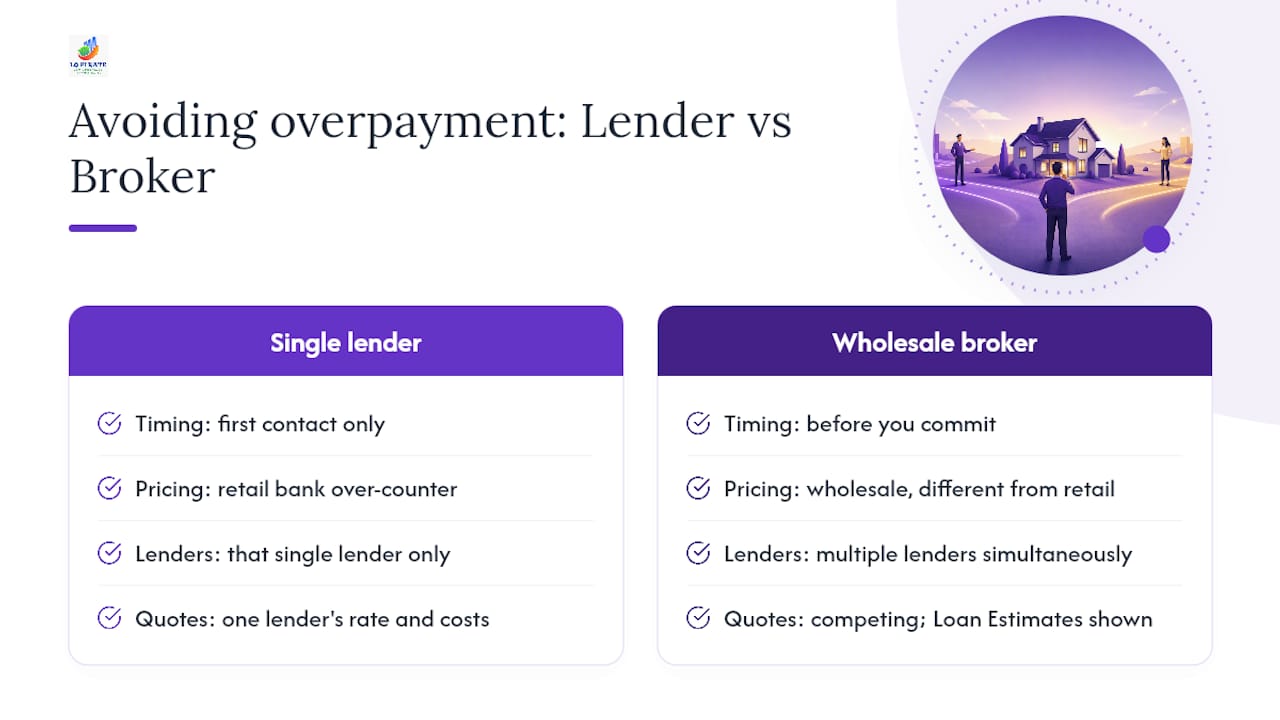
The honest answer is that most overpayment happens before the buyer realizes it, in the first conversation with a single lender. That lender sets the frame: here is your rate, here are your costs, here is your payment. Without a second opinion, you have no way to know whether that frame is competitive.
Wholesale mortgage brokers shop your loan across multiple lenders simultaneously. The pricing they access is not the same as what a retail bank offers over the counter. Lofirate connects buyers with licensed wholesale brokers in their state, which means the comparison happens before you commit, not after. One broker-matched consultation has shifted a buyer's offer from a rate with two points baked in to a zero-point rate at a comparable rate, saving thousands upfront. Lofirate does not lend directly; it matches you with a licensed broker who can pull competing quotes and show you the Loan Estimates side by side.
If you want to understand the full mechanics of how broker shopping changes the economics, consulting a mortgage expert before you apply is the single highest-return step most buyers skip.
Lofirate broker matching: your next practical step
Retail lenders quote from their own menu. Wholesale brokers shop across lenders to find pricing retail banks do not offer directly. Lofirate matches you with a licensed wholesale mortgage broker in your state at no cost to you, so you can collect multiple Loan Estimates, request zero-point rate quotes, and compare total loan costs before you commit to anything.

The service covers purchase loans, refinances, FHA, VA, jumbo, and investment property. Lofirate does not lend money or quote rates directly; it connects you with a licensed broker for a no-obligation consultation. Get matched with a broker and ask for competing Loan Estimates on the same loan amount so you can run the breakeven math yourself.
Sources
- Freddie Mac: MyHome
- CBS News: 3 sneaky mortgage loan traps to avoid this spring, according to experts
- Experian: Common mortgage mistakes to avoid
- Investopedia: Top mortgage mistakes
This article is general information, not a substitute for advice from a qualified financial advisor. Consult a qualified financial professional about your own circumstances before acting on anything here.