

TL;DR:
- Many homebuyers are surprised by the additional fees, taxes, and charges due at closing beyond the down payment.
- Closing costs are mandatory, one-time expenses paid at closing to cover lenders, title, and government fees, significantly impacting the total cash needed.
Most homebuyers walk into the process knowing they need a down payment. What catches many off guard is the additional stack of fees, taxes, and charges due at the same closing table. According to the CFPB, closing costs are the upfront costs charged to get the loan and transfer ownership, paid at closing in addition to your down payment. They can add thousands of dollars to what you need on closing day. This guide breaks down exactly what closing costs are, what drives the total, and how to plan so nothing catches you off guard.
Table of Contents
- What are closing costs and why do they matter?
- What's included in closing costs? Common fees and charges explained
- How much are closing costs? Benchmarks, factors, and state differences
- Who pays closing costs? Understanding buyer, seller, and lender roles
- How lenders disclose closing costs: Your Loan Estimate and Closing Disclosure
- A fresh perspective on closing costs: What most guides miss
- Next steps: Simplify your mortgage process with LoFiRate
- Frequently asked questions
Key Takeaways
| Point | Details |
|---|---|
| Closing costs are separate | They are one-time fees paid at closing, in addition to your down payment. |
| Typical cost range | Expect to pay 2% to 5% of your home price, though this varies by state and deal. |
| Compare and negotiate | Shopping lenders and negotiating credits can lower what you pay. |
| Disclosure documents matter | Read your Loan Estimate and Closing Disclosure carefully to avoid last-minute surprises. |
| Plan for cash to close | Budget the total needed upfront—down payment and closing costs, minus deposits and credits. |
What are closing costs and why do they matter?
Closing costs are the mandatory, one-time fees paid at the end of a mortgage transaction, whether you're buying a home or refinancing one you already own. They are not optional. Every mortgage comes with them. The only variables are the total amount, who pays which portion, and whether any credits reduce what you owe out of pocket.
Think of them this way: your down payment buys your share of the home's equity on day one, while closing costs pay everyone who made the transaction happen. That includes the lender, the title company, the government, the appraiser, and several other parties.
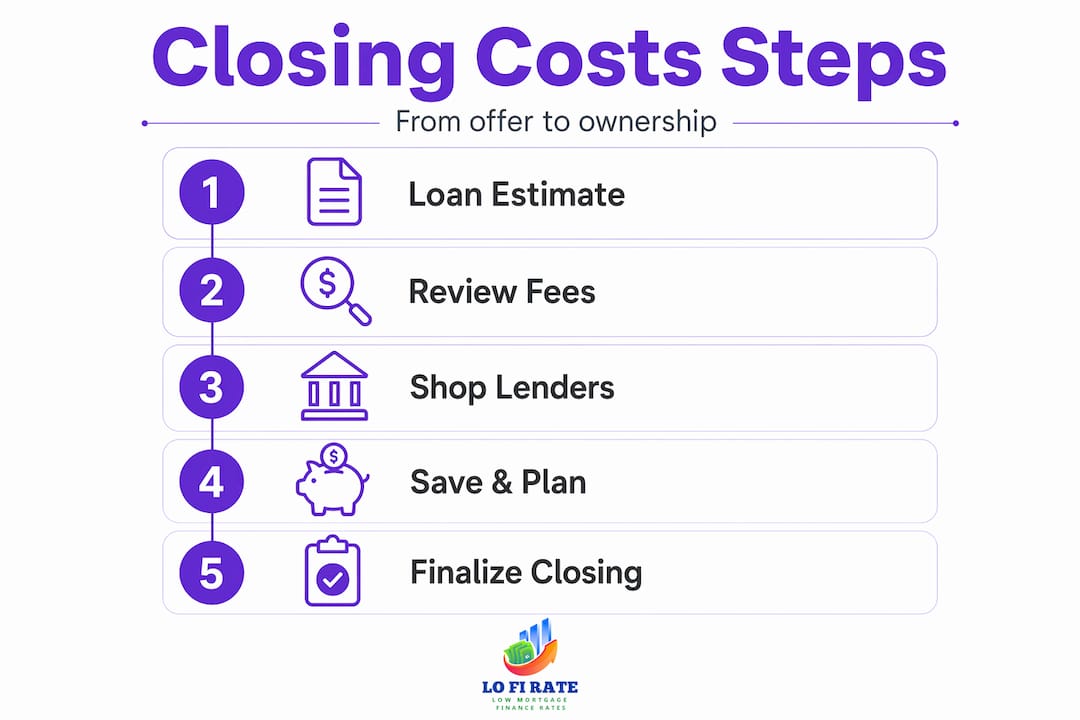
The CFPB describes closing costs as "settlement costs" that cover the upfront charges to get the loan and legally transfer ownership. Those two categories, lender fees and ownership transfer costs, are the foundation of nearly every closing cost line item you'll see.
Here's why this matters for your budget:
- The total you need at closing is called cash to close, which equals your down payment plus closing costs, minus any credits or deposits already paid.
- If you only save for the down payment, you may be thousands short on closing day.
- Closing costs affect whether a loan or lender is truly affordable, not just the interest rate.
- Knowing what's included helps you question junk fees and negotiate more effectively.
The single biggest planning mistake homebuyers make is treating the down payment as the only major upfront expense. Closing costs are real money due the same day, and they deserve equal attention.
Understanding the steps to buying a home from the start means building closing costs into your savings plan early, not scrambling for cash weeks before you sign.
What's included in closing costs? Common fees and charges explained
Closing costs are not one fee. They're a collection of individual charges from multiple parties. Each one covers a specific service or requirement. Here's a breakdown of the most common items you'll see on your Loan Estimate.
| Fee type | Who charges it | Typical range |
|---|---|---|
| Loan origination fee | Lender | 0.5% to 1% of loan amount |
| Appraisal fee | Licensed appraiser | $400 to $700 |
| Title search and insurance | Title company | $500 to $1,500 |
| Attorney or settlement fee | Closing attorney | $500 to $1,200 |
| Recording fees | Local government | $50 to $250 |
| Transfer taxes | State or county | Varies widely |
| Credit report fee | Lender/credit bureau | $25 to $75 |
| Prepaid interest | Lender | Depends on close date |
| Homeowner's insurance (upfront) | Your insurer | Varies |
| Property tax escrow | Lender escrow account | 2 to 6 months of taxes |
| HOA transfer fee (if applicable) | HOA management | $100 to $500 |
Some of these fees are paid to the lender directly. Others go to third parties the lender requires you to use, like an appraiser or title company. Some, like prepaid interest and escrow deposits, are not really "fees" at all. They're advance payments on costs you'd pay anyway, just collected upfront at closing.
Pro Tip: Always review the full list of examples of closing cost fees and ask your lender to explain any line item that isn't clear. Lenders are required to provide clear explanations. If a fee looks vague or duplicated, push back.
The CFPB estimates that closing costs typically range from 2% to 5% of the home purchase price, not including the down payment. On a $350,000 home, that's $7,000 to $17,500 in closing costs alone. That range is wide because your loan type, location, lender, and negotiated terms all affect the final number.
Different loan types also bring different required fees. FHA loans require an upfront mortgage insurance premium. VA loans come with a funding fee but typically no private mortgage insurance. Conventional loans may have private mortgage insurance (PMI) if your down payment is under 20%. Each structure changes what appears on your closing cost sheet.
How much are closing costs? Benchmarks, factors, and state differences
The 2% to 5% benchmark is a starting point, not a promise. Your actual closing costs depend on several moving parts, and the state you buy in is one of the biggest factors. Transfer taxes and recording fees vary dramatically by location, and they can swing your total by thousands of dollars.

Here's a simple example of how closing costs change based on home price:
| Home price | Low estimate (2%) | High estimate (5%) |
|---|---|---|
| $200,000 | $4,000 | $10,000 |
| $350,000 | $7,000 | $17,500 |
| $500,000 | $10,000 | $25,000 |
| $750,000 | $15,000 | $37,500 |
Beyond home price, several other factors influence your total:
- Loan type: FHA, VA, USDA, and conventional loans each have different required fees and insurance structures.
- Lender fees: Origination charges, underwriting fees, and processing costs vary from lender to lender, sometimes by thousands of dollars on the same loan.
- Location: States like New York, Maryland, and Pennsylvania have high transfer taxes. States like Texas or Indiana tend to have lower transfer tax burdens.
- Closing date: Closing near the end of the month reduces your prepaid interest charge because you pay less interest for the remaining days of that month.
- Seller credits: In a buyer-friendly market, sellers may agree to cover a portion of your closing costs as a concession.
Pro Tip: If you close on the 28th instead of the 5th, you only prepay two or three days of interest instead of 25 days. On a $400,000 loan at a 7% rate, that's a difference of roughly $1,900 in prepaid interest. Timing your closing date is a simple way to reduce cash needed at closing.
Understanding how to plan for saving for closing costs as early as possible makes a real difference in your financial readiness. And because loan type and cost differences are so significant, choosing the right mortgage product from the start matters just as much as negotiating fees later.
Who pays closing costs? Understanding buyer, seller, and lender roles
One of the most misunderstood parts of closing costs is who's actually responsible for paying them. The short answer: it depends on state law, market conditions, your contract, and what you negotiate.
As a general rule, buyers and sellers split different categories of closing costs. Here's a typical breakdown:
| Cost category | Typically paid by |
|---|---|
| Loan origination fee | Buyer |
| Appraisal fee | Buyer |
| Lender's title insurance | Buyer |
| Owner's title insurance | Negotiable (varies by state) |
| Transfer taxes | Buyer, seller, or split (varies by state) |
| Recording fees | Buyer |
| Real estate agent commissions | Seller |
| Property tax proration | Negotiated between parties |
| Seller credits toward buyer costs | Seller (by agreement) |
The good news: closing costs are negotiable to a significant degree. Here's a simple process to approach it:
- Get your Loan Estimate first. You need the numbers in writing before you can negotiate anything.
- Request seller concessions in your offer. In a buyer-friendly market, asking the seller to cover 2% to 3% of closing costs is common and often accepted.
- Ask your lender about lender credits. A lender can offer credits that offset closing costs in exchange for a slightly higher interest rate. This makes sense if you plan to sell or refinance within a few years.
- Compare at least three lenders. Fees vary widely. The difference in buyer vs. seller fees matters, but the difference between lender A and lender B can be just as significant.
- Revisit the Closing Disclosure before you sign. If any fee jumped from your Loan Estimate without explanation, ask why and whether it can be corrected.
Timing your negotiation to softer market conditions also matters. In a competitive market where sellers have multiple offers, concessions are harder to get. In a slower market, sellers are far more likely to contribute. Your real estate agent should help you read the room and structure your offer accordingly.
If you want to understand how comparing lender fees can save you real money, the difference is often more significant than most buyers realize.
How lenders disclose closing costs: Your Loan Estimate and Closing Disclosure
Federal law requires lenders to give you two key documents that detail your closing costs. These are not just paperwork. They're your primary tools for cost transparency and comparison.
Here's the timeline and how to use them:
- Apply for the loan. Your lender has three business days to send your Loan Estimate.
- Review the Loan Estimate carefully. It shows your estimated cash to close, broken down by category. This is the number to compare across lenders.
- Compare Loan Estimates side by side if you've applied with multiple lenders. Look at Section A (origination charges) closely, as those are lender-controlled fees.
- Receive your Closing Disclosure. You must get this at least three business days before your closing date. It shows the final, actual numbers.
- Compare the Disclosure to your Estimate. Most fees cannot increase more than 10% from the Loan Estimate to the Closing Disclosure. If you see larger jumps, ask for a written explanation before you close.
Pro Tip: Don't wait until three days before closing to review your Closing Disclosure. Request a preview draft from your loan officer earlier so you have time to ask questions without the pressure of an imminent closing date.
Getting familiar with mortgage disclosure terms before you apply puts you in a much stronger position to catch errors and understand what you're agreeing to. If you're refinancing, the refinance closing cost steps follow a similar disclosure process, and the same careful review applies. Mortgage rate transparency goes hand in hand with fee transparency, and both matter when you're making a decision this large.
A fresh perspective on closing costs: What most guides miss
Most closing cost guides give you averages and a checklist. That's useful, but it misses the nuance that actually costs buyers money.
Here's what we've seen consistently that typical articles don't address directly: lenders vary more on fees than on rates. Most buyers spend hours comparing interest rates and almost no time comparing origination fees, underwriting charges, or administrative costs. A lender offering a rate that's 0.125% lower might charge $2,500 more in fees than a competitor. Depending on how long you keep the loan, the "cheaper rate" lender may actually cost you more.
The second blind spot is the cash to close calculation. Buyers often budget for down payment plus a rough estimate of closing costs, but they forget to account for prepaid expenses, escrow deposits, and any rate lock extension fees that pop up if a closing is delayed. Always add a buffer of at least $1,000 to $2,000 above your estimated cash to close.
Timing also gets overlooked. Closing at month's end reduces prepaid interest. Closing before a rate lock expires avoids extension fees. Closing before property taxes are due can shift a large escrow deposit to the next cycle. None of these tricks are secrets, but most buyers never think about them because they're focused on the rate, not the total cost structure.
Understanding the importance of comparing lenders and how to shop for mortgages properly is the real skill that separates buyers who overpay from those who don't. Transparency is your best tool. Ask for itemized explanations. Question anything that wasn't on your Loan Estimate. A good lender will answer clearly. A lender who gets defensive about fee questions is telling you something important.
Next steps: Simplify your mortgage process with LoFiRate
Now that you understand closing costs, the next move is to put that knowledge to work with the right resources by your side.

At LoFiRate.com, we connect homebuyers and homeowners with licensed wholesale mortgage brokers who can shop multiple lenders on your behalf. That means you get real cost comparisons, not just a single lender's quote presented as your only option. Wholesale brokers have access to pricing and loan products that retail lenders don't offer directly to consumers. When you're ready to explore mortgage products or simply want a second opinion on your current loan offer, LoFiRate makes the process straightforward, transparent, and obligation-free. You did the work to understand closing costs. Now work with someone who will help you minimize them.
Frequently asked questions
Are closing costs the same as a down payment?
No, closing costs are separate one-time fees paid at closing in addition to your down payment. Both are due on the same day, so budget for both independently.
Can closing costs be rolled into the mortgage?
Sometimes yes, especially when refinancing, but rolling them into the loan increases your total loan balance and the interest you pay over the life of the loan. It reduces your upfront cash need but raises your long-term cost.
How can I reduce my closing costs?
Compare multiple lenders, negotiate seller credits or concessions, and ask about lender credits. Some state-level programs or grants also help first-time buyers cover part of their closing costs.
When are closing costs due?
Closing costs are due at your loan closing appointment, before you receive keys or loan funds. You'll know the exact amount at least three business days before closing from your Closing Disclosure.