

Seller financing, subject-to deals, private money, lease-options, equity partnerships, and HELOC-funded acquisitions are six creative real estate financing options worth knowing cold. Each solves a different problem: seller financing buys you flexible terms when a bank says no; subject-to lets you inherit a low-rate mortgage without qualifying for a new one; private and hard money close in days when speed is the deal; lease-options let you control a property before you own it; partnerships let you scale without your own capital; and a HELOC or cash-out refinance converts existing equity into acquisition fuel. The Federal Reserve's Senior Loan Officer Survey has documented repeated rounds of tightened residential underwriting, and every time bank credit retreats, these lanes fill the gap.
Quick "what to try first" by objective:
- Buy fast (under 14 days): Hard money or private money
- Minimize cash out of pocket: Seller financing, subject-to, or lease-option
- Scale a portfolio: BRRRR with private/hard money into DSCR refinance, or JV/syndication
Pro Tip: *Before committing to any creative route, pull a conventional wholesale rate quote. If a bank loan pencils out, it is almost always cheaper long-term. Use creative financing when conventional financing is unavailable, too slow, or structurally wrong for the deal.
Key Takeaways
Creative financing works best when conventional lending is unavailable, too slow, or structurally wrong for the deal — and every method requires documented paperwork, a clear exit plan, and legal review before closing.
| Point | Details |
|---|---|
| Match method to constraint | Credit, cash, speed, and seller motivation each point to a different financing lane. |
| Document and record everything | Every creative deal needs a recorded note, security instrument, and title insurance. |
| Due-on-sale is a real risk | Subject-to and wrap deals trigger the lender's right to call the loan; keep payments current and have a refinance contingency. |
| Consult a CPA and attorney | Installment-sale tax treatment, IRA prohibited transactions, and syndication securities law require professional review. |
| Check conventional pricing first | Lofirate's wholesale broker network lets you compare conventional rates before committing to a higher-cost creative structure. |
Table of Contents
- What creative financing is and when it actually makes sense
- 13 creative financing methods, broken down one by one
- How to choose the right method for your specific deal
- Structuring, documentation, and the legal traps that kill deals
- Three worked examples with real deal math
- When creative financing goes wrong: risks and how to avoid them
- When creative financing is the right call and when it is not
- Check conventional mortgage pricing before you commit to a creative deal
- Sources
What creative financing is and when it actually makes sense
Creative financing is not a single product. It is a collection of non-bank capital structures and deal mechanics that replace or supplement a conventional mortgage. The buyer may borrow from the seller, take over an existing loan, partner with a capital source, or tap retirement accounts, but in every case the defining feature is the same: the deal does not depend solely on a bank underwriting the buyer from scratch.
The situations that call for it are specific:
- Underwriting failure: The buyer's credit, income documentation, or property condition fails conventional guidelines.
- Speed requirement: A distressed seller or auction deadline demands a close in days, not weeks.
- Seller motivation: A seller with high equity prefers installment payments over a lump-sum capital gain, which can spread their tax liability under IRS installment-sale rules.
- Portfolio leverage: An investor has equity in existing properties but limited liquid cash and needs to recycle capital without selling.
- Rate arbitrage: An existing low-rate assumable mortgage (FHA, VA, USDA) is worth more than current market rates.
- Tax-driven structures: A 1031 exchange, self-directed IRA, or JV operating agreement creates a financing structure that a standard bank loan cannot accommodate.
The tradeoff is real: BiggerPockets notes that creative options are best used when bank loans are unavailable or rates are elevated, but they require careful structuring to avoid legal pitfalls. Every creative deal should be reviewed by a real estate attorney and a CPA before closing. That is not a disclaimer; it is a deal-survival step.
13 creative financing methods, broken down one by one
The table below maps each method to its cost range, typical close time, and best use case. Detailed mechanics follow.
Typical private-money rates of 8–12% and hard-money rates of 9–13%, with closes in 7–14 days, reflect the speed premium these lenders charge.
Seller financing
The seller acts as the bank. The buyer makes monthly payments directly to the seller under a promissory note secured by a mortgage or deed of trust. Terms are fully negotiable: interest rate, amortization period, balloon date, and prepayment rights are all on the table.

Sellers with high equity are often motivated because installment-sale treatment under IRS rules lets them spread capital-gains recognition across the payment years rather than absorbing the full gain in year one. That tax benefit is a legitimate negotiating lever for buyers.
Pros: Flexible qualification, faster close than a bank, negotiable terms. Cons: Seller must own the property free-and-clear or get their lender's consent; balloon payments create refinance risk. Legal/tax note: Record the mortgage or deed of trust immediately. Confirm the seller's existing lender does not have a due-on-sale clause that would accelerate their loan.
Negotiation tip: Offer a slightly above-market interest rate in exchange for a lower purchase price or a longer balloon term. Sellers often value income certainty over rate.
Subject-to (taking over existing payments)
The buyer takes title to the property while the seller's existing mortgage stays in place, in the seller's name. The buyer makes the payments. This lets the buyer inherit whatever rate the seller locked in, which can be a significant advantage when market rates are high.
The central legal risk is the due-on-sale clause, a standard mortgage provision that gives the lender the right to call the full loan balance due when title transfers. In practice, lenders rarely enforce it on performing loans, but the risk is real and must be disclosed to all parties.
Pros: No new loan qualification, potentially inherits a low rate, fast close. Cons: Lender can accelerate the loan; seller's credit is exposed if the buyer misses payments. Legal/tax note: Use a title company, record the deed, and set up a third-party payment servicer so the seller can verify payments are being made.
Wraparound mortgage
A wrap is a seller-financed structure layered over an existing mortgage. The seller charges the buyer a higher rate on the full purchase price, collects that payment, and continues paying their underlying loan. The spread is the seller's profit.
Pros: Seller earns a rate spread; buyer gets financing without bank qualification. Cons: Same due-on-sale exposure as subject-to; complex documentation required. Legal/tax note: Requires a skilled real estate attorney. The underlying lender's consent is the cleanest path.
Lease-option and master lease
A lease-option gives the buyer the right, but not the obligation, to purchase the property at a set price within a defined window.
A master lease goes further: the buyer leases the entire property, often a multi-unit, and subleases individual units. This creates cash flow and operational control without ownership, and the master lease can include a purchase option.
Pros: Controls the asset before ownership, time to improve credit or raise capital, low upfront cost. Cons: Option fee is typically non-refundable; seller can default on their own mortgage during the option period. Legal/tax note: Record a memorandum of option at the county recorder to protect your interest against third-party claims.
Private money loans
Private money comes from individuals, family offices, or small funds that lend based on the deal and the relationship rather than a credit score.
Pros: Speed, relationship-driven flexibility, no agency guidelines. Cons: Higher cost than bank debt; lender may pull capital if their own situation changes. Legal/tax note: Always secure private loans with a recorded promissory note and mortgage or deed of trust. Verify the lender's licensing status at NMLS Consumer Access if they are operating as a business lender.
Hard money loans
Closes happen in 10–14 days. These loans are designed as short-term bridges for fix-and-flip or BRRRR strategies (Buy, Rehab, Rent, Refinance, Repeat).
Pros: Fast, property-condition-tolerant, high leverage on distressed assets. Cons: Expensive; a missed refinance exit is costly. Legal/tax note: Pre-verify your refinance exit before drawing the hard-money loan.
Negotiation tip: Offer a larger origination fee in exchange for a lower rate or an extended term. Hard-money lenders often prefer upfront yield.
HELOC, home equity loan, and cash-out refinance
These three methods tap equity in a property you already own. A HELOC is a revolving credit line, typically at prime plus a margin, useful for short-term acquisition capital. A home equity loan is a fixed second mortgage. A cash-out refinance replaces your existing first mortgage with a larger one and puts the difference in your pocket.
Cash-out refinances are best for larger equity extractions; HELOCs work well as a revolving acquisition fund for investors who buy, improve, and sell repeatedly. See types of real estate loans for a full breakdown of how these products compare.
Pros: Lower rates than private or hard money; interest may be tax-deductible. Cons: Puts your primary residence or existing investment at risk; cash-out refis reset your amortization clock. Legal/tax note: Consult a CPA on deductibility; rules differ for investment vs. primary-residence equity.
Self-directed IRA and Solo 401(k)
Self-directed IRAs and Solo 401(k) accounts can hold real estate, but IRS prohibited-transaction rules are strict. The account holder cannot personally use the property, cannot self-deal (buy from or sell to a disqualified person), and all expenses and income must flow through the account. A single prohibited transaction can disqualify the entire account, triggering taxes and penalties on the full balance.
Pros: Tax-deferred or tax-free growth on rental income and appreciation. Cons: Complex custody requirements; no personal use; financing inside an IRA (non-recourse loans only) is limited. Legal/tax note: Work with a self-directed IRA custodian and a CPA who specializes in retirement-account real estate before structuring any deal this way.
Partnerships, joint ventures, and syndications
A joint venture pairs a capital partner with an operator. The operator finds and manages the deal; the capital partner funds it. Equity splits vary but 50/50 to 70/30 (operator/capital) are common starting points. Syndications scale this to multiple passive investors under a formal securities structure, typically a Regulation D 506(b) or 506(c) offering.
Pros: Capital-light entry for operators; passive income for capital partners. Cons: Profit-sharing reduces per-deal returns; syndications require a Private Placement Memorandum (PPM) and securities-law compliance. Legal/tax note: Any syndication offering securities to investors requires a securities attorney and a PPM. Skipping this step is a federal violation.
Real estate crowdfunding
Crowdfunding platforms pool capital from multiple investors into a single deal or fund. Investors can participate with relatively small minimums, either as debt investors (fixed return) or equity investors (profit share). This is largely a passive strategy.
Pros: Low minimum, diversification, passive. Cons: Illiquid; platform risk; returns depend on sponsor execution. Legal/tax note: Verify the platform's regulatory filings and the sponsor's track record before committing capital.
Personal loans and 401(k) loans
A personal loan or a 401(k) loan (up to 50% of the vested balance or $50,000, whichever is less, under IRS rules) can bridge a small funding gap. These are short-term tools, not acquisition strategies.
Pros: Fast, no property collateral required. Cons: Personal loans carry high rates; 401(k) loans become taxable distributions if you leave your employer before repayment. Legal/tax note: Use these only as a last-resort bridge with a clear repayment plan. Consult a financial advisor before touching retirement funds.
Assumable loans (FHA, VA, USDA)
FHA, VA, and USDA loans are assumable, meaning a qualified buyer can take over the seller's existing loan at its original rate. When market rates are significantly above the seller's locked-in rate, the assumption is worth real money. VA assumptions require lender approval and, for veterans, a substitution of entitlement to restore the seller's VA benefit.
Pros: Inherits below-market rate; no new origination costs on the assumed balance. Cons: Long approval timeline (45–90 days); buyer must cover the equity gap between the loan balance and purchase price, often with a second mortgage or cash. Legal/tax note: The seller remains liable on a VA loan until the lender formally releases them. Get that release in writing.
Cross-collateralization
Cross-collateralization uses equity in one or more existing properties as additional security for a new loan, allowing the lender to extend more credit than the new property alone would support. Investors with a portfolio use this to acquire properties with little or no new cash down.
Pros: Leverages existing equity without a cash-out refinance; can reduce the down payment on a new acquisition. Cons: Multiple properties are pledged; a default on one deal can trigger action across the collateral pool. Legal/tax note: Review the cross-default provisions carefully. See mortgage implications for investors for a detailed look at how lenders structure these arrangements.
How to choose the right method for your specific deal
Match the financing lane to the deal's facts, not to what sounds interesting. Work through this sequence:
- Define the constraint. Is the problem credit, cash, speed, property condition, or seller motivation? Each constraint points to a different lane.
- Assess the seller's position. High equity and a desire for income? Seller financing or a wrap. Distressed and motivated to close fast? Subject-to or cash offer funded by hard money.
- Audit your capital and credit. Strong equity in existing properties? HELOC or cross-collateralization. No equity, limited credit? Lease-option, JV, or private money.
- Set the timeline. Under two weeks? Private or hard money only. One to three months? Seller financing, assumable loan, or HELOC.
- Map the exit. Every short-term creative structure needs a defined exit: refinance into a conventional or DSCR loan, sell, or convert to long-term seller financing. No exit plan means no deal.
Due diligence checklist before closing any creative deal:
- Title search confirming clear ownership and no undisclosed liens
- Lien search on the seller's existing mortgage (balance, rate, payment status)
- Verify the seller's mortgage servicer and confirm payment history for the past 12 months
- Confirm escrow or third-party payment servicer arrangement for subject-to and wrap deals
- Record a memorandum of option or contract for deed at the county recorder
- Confirm insurance coverage names the correct insured parties
- Verify private or hard-money lender licensing at NMLS Consumer Access
- Obtain a title insurance commitment before closing
Red flags that should stop a deal:
- Seller cannot produce a current mortgage statement or payoff letter
- Private lender refuses to document the loan with a recorded security instrument
- ARV estimate comes only from the seller or the hard-money lender (get an independent appraisal or BPO)
- Option agreement is unrecorded and the seller has other creditors
- Balloon payment due in less than 12 months with no confirmed refinance path
- Any party pressuring you to skip the attorney review
Structuring, documentation, and the legal traps that kill deals
Every creative deal lives or dies on its paperwork. The documents required vary by method, but the core set is consistent:
- Promissory note: States the loan amount, rate, payment schedule, and default terms. Required for every debt-based structure.
- Mortgage or deed of trust: Secures the note against the property. Must be recorded to protect the lender's (or seller's) interest.
- Purchase contract addenda: Spell out any seller-financing terms, option rights, or contingencies not in the standard contract.
- Option agreement: For lease-options, must state the option price, expiration date, and credit terms clearly.
- JV operating agreement: For partnerships, defines capital contributions, profit splits, decision rights, and exit mechanics.
- PPM (Private Placement Memorandum): Required for any syndication that raises capital from investors under Regulation D.
The due-on-sale clause: practical vs. theoretical risk
The due-on-sale clause is a standard provision in virtually every conventional mortgage. It gives the lender the right to demand full repayment when title transfers without their consent. Subject-to and wraparound deals trigger this clause by definition.
In practice, lenders rarely call performing loans. The risk rises when the loan is underwater, the lender is aggressive, or the transfer becomes visible through a title search or insurance change. Mitigation steps: keep the loan current, avoid changing the insurance policy name abruptly, and use a land trust to hold title in some states. None of these eliminate the risk; they reduce its probability. Disclose the risk fully to all parties and document that disclosure.
Pro Tip: Always get a title insurance policy that covers the subject-to structure. Some title companies will not insure these deals; find one that will before you close.
Tax checkpoints
- Installment-sale treatment: Sellers who carry financing can spread capital-gains recognition across payment years under IRS installment-sale rules. Buyers should confirm the seller has consulted a CPA, because a seller who later regrets the structure can create deal complications.
- Self-directed IRA prohibited transactions: Any self-dealing, personal use, or transaction with a disqualified person can disqualify the entire account. The IRS rules here are unforgiving.
- 1031 exchange timing: If the seller is doing a 1031 exchange, the timeline and identification rules are strict. A creative financing structure that delays closing can blow the exchange window.
- Depreciation and basis: In a JV or partnership, basis allocation affects each partner's depreciation deduction. Get this documented in the operating agreement.
Consult a CPA and a real estate attorney before closing any creative deal. The cost of that consultation is trivial compared to the cost of a disqualified IRA or an unenforceable note.
Three worked examples with real deal math
Example 1: Seller financing on a single-family rental
If the property rents for $1,600/month and operating expenses run $500/month, net cash flow before debt service is $1,100. After the $975 payment, monthly cash flow is $125. Thin, but the buyer preserved $160,000 in capital for other deals.
At the balloon in year 5, the buyer refinances into a conventional or DSCR loan.
Underwrite to that scenario before you sign.
Example 2: Hard money acquisition into BRRRR refinance
Origination cost: $2,800.
After rehab (4 months), property rents for $1,500/month. The refinance pays off the hard-money loan and returns $10,000 of the investor's capital.
This is the BRRRR cycle in practice. See types of investor loan programs for DSCR refinance qualification details.
Always stress-test ARV before drawing the loan.
Example 3: Subject-to acquisition
Purchase price $185,000. Buyer pays seller $25,000 cash (the equity), takes title subject-to the existing loan.
The buyer saves $368/month by inheriting the existing debt.
Risk: the lender can call the loan under the due-on-sale clause. The buyer must keep payments current and have a contingency plan (refinance or sell) if the lender enforces.
When creative financing goes wrong: risks and how to avoid them
Creative deals fail in predictable ways. Knowing the failure modes in advance is the most practical risk management available.
Top risks and mitigations:
- Lender/seller fraud: Seller misrepresents the loan balance, lien status, or property condition. Mitigation: order a title search and a payoff letter from the servicer directly, not through the seller.
- Due-on-sale enforcement: Lender calls the loan after a subject-to transfer. Mitigation: keep the loan current, use a land trust where appropriate, and have a refinance pre-approved as a contingency.
- Missing lien searches: A mechanic's lien or tax lien surfaces after closing. Mitigation: title insurance and a full lien search before closing, every time.
- Unrecorded options: A lease-option that is not recorded at the county recorder is invisible to third parties. If the seller's creditors file a judgment, your option can be wiped out. Mitigation: record a memorandum of option immediately.
- Overstated ARV in rehab deals: The hard-money lender's in-house valuation is optimistic. Mitigation: get an independent appraisal or broker price opinion (BPO) from a source with no financial interest in the deal.
- Private-lender capital runs: A private lender calls their capital back mid-project due to their own financial pressure. Mitigation: use a formal promissory note with a fixed term and no early-call provision; never rely on a handshake arrangement.
- Unlicensed lenders: Some private lenders operating as businesses are required to hold a state mortgage license. Verify at NMLS Consumer Access before funding.
Escalation path when a red flag appears: Stop the transaction. Call your real estate attorney before proceeding. If fraud is suspected, contact your state's real estate regulatory agency and, for federally related transactions, the Consumer Financial Protection Bureau (CFPB).
When creative financing is the right call and when it is not
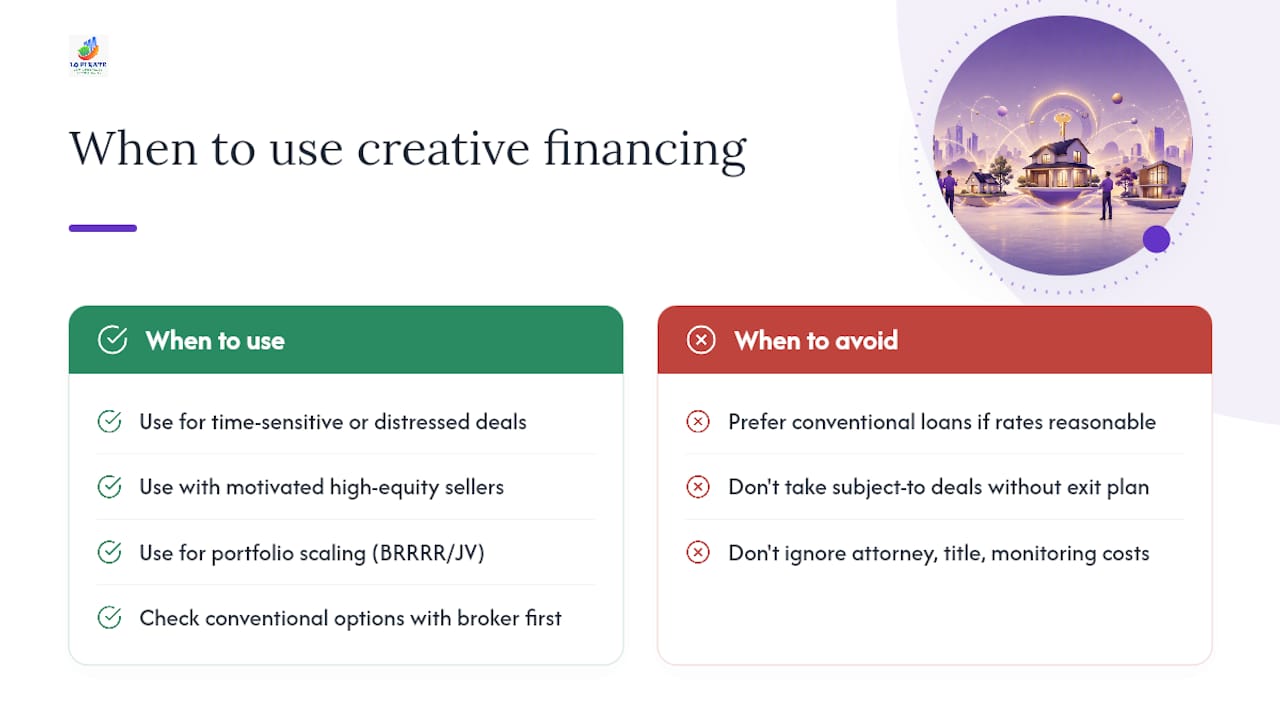
The case for creative financing is strongest in three scenarios: a distressed or time-sensitive deal where conventional underwriting cannot move fast enough; a seller with high equity who is motivated by installment income or tax deferral; and a portfolio-scaling strategy where recycling equity through BRRRR or JV structures is more efficient than waiting for bank approvals.
The case against it is equally clear. If a conventional mortgage is available at a reasonable rate, use it. The lower long-term cost, the consumer protections, and the simpler documentation almost always outweigh the flexibility premium of a creative structure. An inexperienced investor who takes on a subject-to deal without a clear exit plan is not being creative; they are taking on a liability they may not be able to manage.
One thing that gets underestimated: the cost of the creative structure is not just the interest rate. It includes attorney fees, title insurance on a non-standard deal, the time cost of negotiating bespoke terms, and the ongoing monitoring required for subject-to and wrap deals. That math only works if the deal's returns justify it.
Lofirate's role in this process is straightforward: before you commit to a creative route, check what a licensed wholesale mortgage broker can offer on a conventional loan. If the gap between the creative structure's cost and a conventional rate is small, the conventional loan wins. If the gap is large or the deal simply cannot qualify conventionally, you have your answer. That comparison takes one consultation and costs nothing.
Check conventional mortgage pricing before you commit to a creative deal
Most investors who pursue creative financing have never gotten a real wholesale mortgage quote. Retail bank pricing and creative-deal costs are the only two data points they compare, and retail bank pricing is almost never the best conventional option available.

Lofirate connects homebuyers and investors with licensed wholesale mortgage brokers who shop multiple lenders simultaneously, the same pricing channel institutional buyers use. The result is a transparent, no-obligation rate comparison that tells you exactly where the conventional market sits before you decide whether a creative structure is worth the added complexity and cost. Lofirate covers purchase, refinance, cash-out, FHA, VA, jumbo, and investment property loans, and every broker in the network is licensed and verifiable. Get a wholesale rate quote at Lofirate and use it as your baseline before signing any creative deal. You can also review the full range of loan options to see which conventional products might fit your situation.
Sources
Use these resources to verify facts, check licensing, and confirm legal and tax rules before closing any creative deal:
- Creative Financing in Real Estate: 2026 Investor Guide
- Creative Real Estate Financing Strategies 2026: 12 Methods | Home Pros
- Board of Governors of the Federal Reserve System
- Due-on-sale clause — Cornell Law School LII
- Creative financing for real estate — BiggerPockets
- NMLS Consumer Access
This article is general information, not legal, tax, or financial advice. Confirm current rules with the IRS, your state's real estate regulatory agency, and a qualified real estate attorney or CPA before structuring any transaction.
This article is general information, not a substitute for advice from a qualified financial advisor. Consult a qualified financial professional about your own circumstances before acting on anything here.