

Real estate loans fall into five main categories: conventional (conforming and jumbo), government-backed (FHA, VA, USDA), home equity products, construction and bridge financing, and investor-focused loans like DSCR and portfolio loans. According to the Consumer Financial Protection Bureau, every mortgage has three elements: loan type, loan term, and interest rate structure. Getting those three right for your situation is the whole game.
Here is a quick-scan summary before you dig in:
- Conventional loans: typically require a down payment and a credit score usually above the lower 600s, best for buyers with solid credit who want flexibility on property type
- FHA loans: require a low down payment and accept lower credit scores, best for first-time or lower-credit buyers
- VA loans: offer no-down-payment options and flexible credit requirements, available to eligible veterans and active-duty service members only
- USDA loans: provide no-down-payment options with flexible credit, restricted to qualifying rural areas and income limits
- Jumbo/non-conforming: require higher down payments and credit scores, for loan amounts above conforming limits
- Other financing (HELOC, construction, bridge, hard-money): situational, typically higher rates or shorter terms, used for specific purchase or renovation scenarios
Owner-occupied purchases qualify for the most favorable terms across every category. Investment properties face higher rates, larger down payment requirements, and stricter reserve rules.
Key Takeaways
The most important decision in mortgage shopping is matching the loan type to your credit profile, down payment, and intended use before you talk to a single lender.
| Point | Details |
|---|---|
| Five main loan categories | Conventional, FHA, VA, USDA, and specialty/investor loans each have distinct down payment and credit requirements. |
| Government-backed loans offer the lowest entry barriers | VA and USDA allow 0% down; FHA requires 3.5% at 580+ credit score. |
| Loan term drives total interest cost | A 15-year loan saves nearly $297,000 in interest over a 30-year term. |
| Rate structure should match your timeline | ARMs save money for short holds; fixed rates protect long-term buyers from payment increases. |
| Lofirate matches you with wholesale brokers | One application connects you to licensed brokers who shop multiple lenders across all major loan types. |
Table of Contents
- What are the main types of real estate loans?
- Other real estate financing options worth knowing
- How loan term length affects your total cost
- Fixed-rate vs. adjustable-rate mortgages: which fits your plan?
- How to choose the right loan: a practical checklist
- What investors need to know about financing rental properties
- What most borrowers get wrong (and how to fix it)
- Lofirate connects you to wholesale mortgage brokers
- Sources
What are the main types of real estate loans?
Every mortgage starts with the same question: is it government-backed or conventional? That split determines your down payment floor, your mortgage insurance situation, and which lenders will even look at your file.
Conventional loans: conforming vs. jumbo
A conventional loan carries no government guarantee. That means lenders take on the full default risk, which is why they typically want a stronger credit profile. The CFPB notes that conventional loans can actually cost less than FHA loans over time, but they are harder to qualify for.
Conforming loans meet the purchase limits set by Fannie Mae and Freddie Mac. For 2026, the baseline conforming loan limits are set regionally and vary based on county median home prices, generally around standard limits published annually. If your loan amount stays under that ceiling and you meet credit standards, you get access to the broadest pool of lenders and the most competitive rates.
Non-conforming (jumbo) loans exceed those limits. Lenders hold them on their own books, which means underwriting standards vary more widely. Rates run slightly higher than conforming loans, though the gap narrows when you have a strong financial profile.
Private mortgage insurance often applies to conventional loans with down payments below a set threshold, and may be cancellable once sufficient equity is reached, which can be advantageous compared to FHA mortgage insurance.
FHA loans
FHA loans are insured by the Federal Housing Administration and allow down payments as low as 3.5% with a 580 credit score. That flexibility makes FHA the go-to for first-time buyers or anyone rebuilding credit.
The trade-off is mortgage insurance. Buyers who plan to stay long-term and eventually refinance into a conventional loan once they build equity often find FHA a smart entry point. For a side-by-side look at how FHA stacks up against conventional for first-time buyers, the FHA and conventional loan comparison guide on Lofirate's blog breaks it down clearly.
VA loans
VA loans are available to eligible veterans, active-duty service members, and some surviving spouses. The headline benefit is zero down payment with no PMI requirement. Credit standards are flexible, and rates are typically competitive with or below conventional rates.
The one cost to plan for is the VA funding fee, a one-time charge that ranges based on down payment amount and whether it is a first or subsequent use. Borrowers with service-connected disabilities are generally exempt. If you qualify for VA, it is almost always worth using.
USDA loans
USDA guaranteed loans offer zero-down financing for buyers purchasing in USDA-eligible rural and suburban areas. Income limits apply and vary by county and household size. The property must be in an eligible location, which you can verify on the USDA's eligibility map.
USDA loans carry a guarantee fee (upfront and annual) similar in structure to FHA's mortgage insurance, though the rates are generally lower. For buyers who qualify on location and income, USDA is one of the most affordable entry points into homeownership available.
State and local programs
State housing finance agencies and local housing authorities often layer down payment assistance, reduced-rate second mortgages, or grant programs on top of conventional and government-backed loans. The CFPB points out that these programs can meaningfully change the effective cost of a loan for eligible borrowers. Special purpose credit programs (SPCPs) are another category worth asking about, particularly in underserved communities. Lofirate's guide to first-time homebuyer programs covers the major state and local options in detail.
Quick comparison: primary loan types
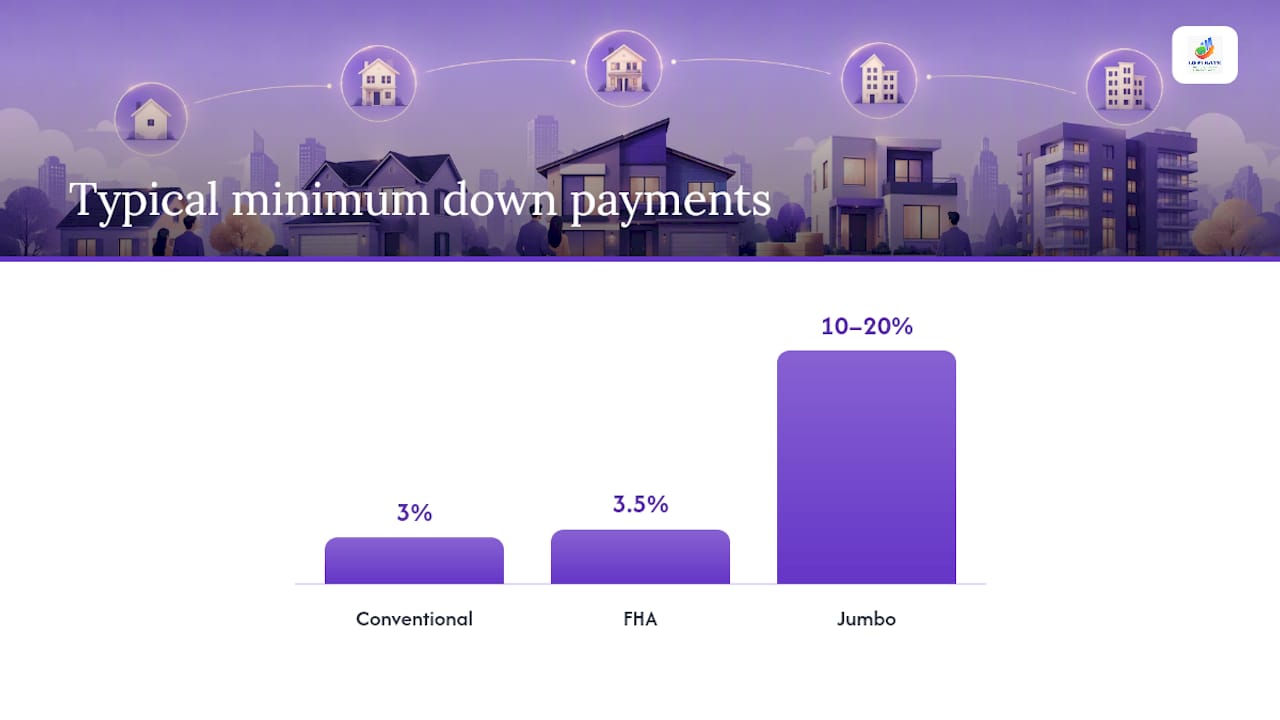
Typical down payment and credit ranges across the main loan categories:
| Loan Type | Typical Min. Down Payment | Typical Min. Credit Score | Best For |
|---|---|---|---|
| Conventional (conforming) | 3% | 620+ | Buyers with solid credit, flexible property needs |
| FHA | 3.5% | 580+ | First-time buyers, lower credit scores |
| VA | 0% | Flexible | Eligible veterans and service members |
| USDA | 0% | Flexible | Rural/suburban buyers within income limits |
| Jumbo | 10–20% | Above lower 600s | High-value home purchases above conforming limits |
Pro Tip: If your loan amount sits just above the conforming limit, ask a broker whether a slightly larger down payment could bring you back under the limit. Conforming rates are almost always better than jumbo rates, and the math often favors the bigger down payment.
Other real estate financing options worth knowing
Primary mortgages are not the only tools on the table. Depending on what you are trying to accomplish, one of these alternatives may be the more practical path.
Home equity loan vs. HELOC vs. cash-out refinance
All three let you tap existing home equity, but they work differently.
- Home equity loan: A lump-sum second mortgage at a fixed rate. Best for a single large expense, like a roof replacement or a defined renovation budget, where you know the total cost upfront.
- HELOC (home equity line of credit): A revolving credit line secured by your home, typically with a variable rate. Useful when costs are spread out over time or uncertain in total, like a phased remodel.
- Cash-out refinance: Replaces your existing mortgage with a new, larger one and gives you the difference in cash. Makes sense when current rates are favorable and you want to consolidate into one payment.
Qualification for all three generally requires sufficient home equity, a reasonable credit score, and a manageable debt-to-income ratio.
Construction loans and construction-to-permanent financing
Construction loans are short-term and fund the building of a new home in draws as work is completed. They require detailed plans, a licensed contractor, and more documentation than a standard purchase mortgage. Interest is usually charged only on the amount drawn.
Construction-to-permanent loans convert automatically to a standard mortgage once the build is complete, saving you a second closing. Standalone construction loans require a separate permanent financing close at completion.
Bridge loans and seller financing
A bridge loan is short-term financing that lets you buy a new home before your current one sells. Rates are higher than standard mortgages, terms are typically 6–12 months, and lenders usually require substantial equity in the departing property. They solve a specific timing problem but carry real cost.
Seller financing (also called owner financing) cuts the bank out entirely. The seller acts as the lender, and you make payments directly to them under a negotiated note. Terms are flexible, qualification is easier, and closing can happen fast. The catch: sellers who offer this usually want a higher price or a balloon payment within a few years, and you need a real estate attorney to structure it properly.
Hard-money and portfolio loans
Hard-money loans come from private lenders and are secured primarily by the property value rather than your creditworthiness. They close fast, sometimes in days, but rates typically run well above conventional financing and terms are short. They are used for fix-and-flip projects, distressed properties, or situations where speed matters more than cost.
Portfolio loans are held by the lender rather than sold on the secondary market. That gives the lender flexibility to underwrite outside standard guidelines, making them useful for non-warrantable condos, self-employed borrowers with complex income, or properties that do not fit Fannie/Freddie boxes.
For buyers considering non-traditional routes, the key question is always: what is the exit? A bridge loan or hard-money loan without a clear payoff plan becomes expensive fast. Know your timeline before you commit to short-term financing.
Lofirate's guide to non-traditional mortgage options covers seller financing, bridge loans, and portfolio lending in more depth.
How loan term length affects your total cost
The loan term is how long you have to repay the mortgage. Common options are 10, 15, 20, and 30 years, with 15 and 30 being by far the most common.

A longer term means a lower monthly payment but significantly more total interest paid over the life of the loan. A shorter term does the opposite: higher monthly payment, but you build equity faster and pay far less interest overall.
Here is a concrete illustration.
- 30-year term: Monthly principal and interest payment of approximately $2,594. Total interest paid over 30 years: roughly $534,000.
- 15-year term: Monthly payment of approximately $3,541. Total interest paid: roughly $237,000.
The 15-year borrower pays about $947 more per month but saves nearly $297,000 in interest. Whether that trade-off makes sense depends entirely on your cash flow and other financial priorities.
The fixed-rate mortgage guide on Lofirate's blog walks through how term length interacts with rate type in more detail.
A 20-year term splits the difference and is worth asking about if you want a middle path. Some lenders also offer 10-year terms for borrowers who want to pay off a home quickly or are refinancing a loan with a short remaining balance.
Interest-only loans deserve a brief mention. During the interest-only period, your payment covers only the interest, not the principal. Monthly payments are lower, but you build no equity and the principal balance does not shrink. When the interest-only period ends, payments jump to cover both principal and interest on the remaining balance. These are used primarily by investors or high-income borrowers managing cash flow, not by typical homebuyers.
Pro Tip: If a 15-year payment feels too tight, ask your lender about a 30-year loan with a plan to make extra principal payments. You get the flexibility of the lower required payment but can still pay it off faster when cash flow allows.
Fixed-rate vs. adjustable-rate mortgages: which fits your plan?
The interest rate structure on your loan determines how your rate and payment behave over time.
Fixed-rate mortgages
A fixed rate locks in for the entire loan term. Your principal and interest payment never changes, which makes budgeting straightforward. Fixed rates are the right call when you plan to stay in the home long-term, when rates are historically reasonable, or when you simply want certainty over optimization.
Adjustable-rate mortgages (ARMs)
ARMs start with a fixed introductory rate, then adjust periodically based on a published index plus a margin. Common structures are 5/1, 7/1, and 10/1 ARMs, where the first number is the fixed-rate period in years and the second is how often the rate adjusts after that. A 7/1 ARM holds its rate for seven years, then adjusts annually.
The initial rate on an ARM is typically lower than a comparable fixed rate, sometimes meaningfully so. That makes ARMs attractive for buyers who know they will sell or refinance before the adjustment period begins. The risk is straightforward: if rates rise before you exit, your payment goes up.
ARM caps limit how much the rate can move at each adjustment and over the life of the loan. The CFPB's CHARM booklet explains ARM disclosures and adjustment protections in plain language and is worth reading before you sign any ARM note.
Practical checklist for choosing a rate structure
- How long do you plan to stay? Under 7 years, an ARM may save money. Over 10 years, a fixed rate usually wins.
- How stable is your income? Variable income makes payment uncertainty riskier.
- What is the rate environment? When rates are elevated, ARMs offer a bigger initial discount.
- Can you absorb a payment increase? Know your cap structure and model the worst-case adjustment.
For a deeper look at when ARMs make sense in the current rate environment, Lofirate's post on adjustable-rate mortgages in 2026 is a useful read.
Pro Tip: When comparing ARMs, ask the lender which index the loan uses (SOFR is now standard), what the margin is, and what the periodic and lifetime caps are. Two ARMs with the same initial rate can behave very differently after the first adjustment.
How to choose the right loan: a practical checklist
Choosing among mortgage loan varieties is easier when you work through a short set of screening questions before you talk to any lender.
Step-by-step screening checklist
- Estimate your target monthly payment. Work backward from your budget, not forward from a purchase price.
- Confirm your available down payment. This determines which loan types are even on the table.
- Pull your credit report. Check for errors before a lender does. Scores below 620 narrow your options significantly.
- Calculate your debt-to-income ratio. Add up monthly debt payments and divide by gross monthly income. Most conventional loans want DTI under 43–45%.
- Clarify occupancy and use. Primary residence, second home, and investment property each have different rate and down payment rules.
- Check loan limits for your county. If your loan amount exceeds the conforming limit, you are in jumbo territory.
- Identify your property type. Condos, multi-family, manufactured homes, and non-warrantable properties all have specific underwriting rules.
- Gather documents early. Two years of tax returns, recent pay stubs, bank statements, and W-2s are the baseline for most loan types.
What to ask every lender
- What is the interest rate and the APR? (The gap between them reveals fees.)
- Can I see the Loan Estimate? (Required by law within three business days of application.)
- What mortgage insurance applies, and when can it be removed?
- Are there prepayment penalties?
- What are the underwriting overlays beyond standard guidelines?
- Do you offer any state or local assistance programs for my situation?
Comparing APR vs. interest rate is one of the most important skills in mortgage shopping. The rate is what you pay on the principal; the APR folds in fees and gives you a truer cost comparison across lenders.
When to work with a broker
A mortgage broker shops your file across multiple lenders simultaneously, which is particularly valuable when your situation is not straightforward: self-employed income, a non-standard property, a credit score near a threshold, or a loan amount near the conforming limit. Wholesale brokers often access pricing that retail bank branches do not offer directly.
Pro Tip: Ask your broker to show you the Loan Estimate from at least three lenders side by side. The differences in origination fees and mortgage insurance can easily outweigh a small rate difference.
What investors need to know about financing rental properties
Investment property financing operates under different rules than owner-occupied mortgages, and the gap is wider than most first-time investors expect.
Lenders often require higher down payments, higher rates, and cash reserves for investment property conventional loans compared to owner-occupied loans. DTI calculations still apply, though rental income can sometimes offset the new payment.
DSCR and portfolio loans for investors
DSCR (debt service coverage ratio) loans underwrite to the property's cash flow rather than the borrower's personal income. The lender calculates whether the rental income covers the mortgage payment at a ratio of 1.0 or higher (many lenders prefer 1.2+). This makes DSCR loans useful for investors who have strong rental properties but complex or self-employed personal income that does not look clean on a tax return.
Portfolio loans give lenders flexibility to hold the loan on their own books and underwrite outside Fannie/Freddie guidelines. They are useful for investors building a portfolio of properties, financing non-warrantable condos, or acquiring properties that need work before they qualify for standard financing.
Key differences investors should expect compared to owner-occupied loans:
- Higher interest rates (typically 0.5–1%+ above primary residence pricing)
- Larger required down payments (15–25% minimum, often 20–25% for DSCR)
- Stricter reserve requirements (often 6–12 months of PITI per property)
- No access to VA or USDA programs (owner-occupancy required)
- Rental income documentation requirements vary by loan type
Lofirate's investor loan programs guide covers DSCR, portfolio, and other investor-specific options in depth.
Pro Tip: For a DSCR loan, get a rent schedule from a local appraiser or property manager before you apply. Lenders use market rent, not your projected rent, so knowing that number in advance tells you whether the deal will pencil out at the lender's ratio.
What most borrowers get wrong (and how to fix it)
The most common mistake is treating the mortgage process as something that starts when you find a house. By then, you have already lost leverage. Credit errors that take 30–60 days to fix are still sitting on your report. Your DTI has not been optimized. You have no pre-qualification to anchor a competitive offer.
The second most common mistake is comparing rates without comparing APRs. The Loan Estimate is the only document that lets you make a fair comparison, and you are entitled to one from every lender you apply with.
Borrowers also consistently underestimate closing costs. That is $8,000–$20,000 on a $400,000 loan, and it needs to be liquid, not tied up in investments.
Finally, using the wrong loan type for your hold period is an expensive error. A 30-year fixed rate on a property you plan to sell in four years means you paid a rate premium for certainty you did not need. A 7/1 ARM would have saved money. Conversely, an ARM on a home you end up staying in for 15 years can cost you significantly more after the adjustment period begins.
Running a quick pre-check with a broker before you start shopping solves most of these problems. Lofirate's broker-matching service is built for exactly this: surface your options across loan types before you are under contract and under pressure.
Lofirate connects you to wholesale mortgage brokers
Retail lenders show you their own rates. Wholesale brokers show you rates from multiple lenders at once, and that difference in access often translates to real savings.

Lofirate connects you with licensed wholesale mortgage brokers in your state who can shop conventional, FHA, VA, USDA, jumbo, and investor loan options across their lender networks. You fill out one application; your broker does the comparison work. There is no obligation and no cost to you as a borrower. Lofirate does not lend directly or quote rates. The platform exists to give you access to wholesale pricing and a broker who can explain which of the loan options actually fits your situation.
Whether you are buying your first home, refinancing an existing mortgage, or financing a rental property, start with a no-obligation broker match at Lofirate. Your data is handled securely, and the consultation costs you nothing.
Sources
These official sources are where program rules, eligibility requirements, and consumer protections actually live. When a lender or website tells you something about a program, verify it here.
- Understand the different kinds of loans available | Consumer Financial Protection Bureau
- Loan types | U.S. Department of Veterans Affairs
- Single-Family Housing Guaranteed Loan Program | USDA Rural Development
This article is general information, not a substitute for advice from a qualified financial advisor. Consult a qualified financial professional about your own circumstances before acting on anything here.