

If you're self-employed, an investor, or simply don't fit the W-2 box, alternative financing solutions are the nontraditional mortgage paths built for you: Non-QM loans, portfolio loans, bridge and hard-money lending, seller financing, private mortgages, and jumbo/FHA/VA loans accessed through wholesale brokers. The CFPB's Ability-to-Repay rule still governs all of these; "alternative" means different documentation, not no documentation. Your fastest next step is to get matched with a licensed wholesale mortgage broker who can shop multiple wholesale lenders at once and find the program that fits your actual financial picture.
Three quick eligibility signals that point toward these programs:
- Self-employed with 12–24 months of strong bank deposits but messy tax returns
- Investor property with solid rental cash flow but limited personal income on paper
- Asset-rich borrower with low current income (retirees, equity-heavy homeowners)
Lofirate connects you with licensed wholesale brokers in your state. It does not lend or quote rates directly.
Table of Contents
- What mortgage products count as alternative financing solutions?
- Why a wholesale mortgage broker beats going straight to a retail lender
- How Non-QM and portfolio underwriting actually works
- Bridge loans, hard-money, seller financing, and private lenders: when do they make sense?
- How to pick the right option and what to ask your broker
- How Lofirate connects you with licensed wholesale mortgage brokers
- Key Takeaways
- The case for transparency in mortgage matching
- Start your broker match with Lofirate today
- Useful sources and regulatory references
What mortgage products count as alternative financing solutions?
Not every nontraditional loan works the same way. The table below maps each product to the borrower it fits, what underwriting looks at, and the honest tradeoffs.
| Product | Best for | Typical credit | Documentation | Cost vs. conventional | Timeline | Primary risk |
|---|---|---|---|---|---|---|
| Bank-statement loan | Self-employed, 1099 earners | — | 12–24 months personal/business deposits | Rate premium ~0.5%–2.5% | 30–45 days | Deposit averaging can understate income |
| P&L loan | Business owners with CPA | 640+ | CPA-prepared profit & loss, 1–2 years | Similar to bank-statement | 30–45 days | Lender scrutiny of P&L methodology |
| DSCR loan | Real estate investors | — | Lease agreement, rent schedule, appraisal | Rate premium; no personal income docs needed | 30–45 days | Property vacancy risk |
| Asset depletion | Retirees, high-net-worth | 680+ | Asset statements (retirement, brokerage) | Moderate premium | 30–45 days | Asset drawdown assumptions vary by lender |
| Portfolio loan | Complex borrowers, multiple properties | Flexible | Full financial picture; lender-specific | Higher rate; lender sets terms | 30–45 days | Lender holds loan; terms less standardized |
| Bridge / hard-money | Time-sensitive purchase, rehab | — | Property value, exit plan | Highest cost (see Section 5) | 7–14 days | Short term; must refinance or sell |
| Seller financing | Negotiated purchase, niche markets | Flexible | Purchase contract, promissory note | Negotiated; often above market | Varies | Limited regulatory protections |
| Jumbo via wholesale broker | High-balance purchase | — | Full docs or bank-statement hybrid | Slightly above conforming | 30–45 days | Stricter reserves; larger down payment |
| FHA/VA via wholesale broker | First-time buyers, veterans | — | Standard government docs | Near-market; lower down payment | 30–45 days | MIP/funding fee adds cost |
Non-QM loan requirements typically include 10–25% down and 3–12 months of reserves depending on program and credit event seasoning.
Why a wholesale mortgage broker beats going straight to a retail lender
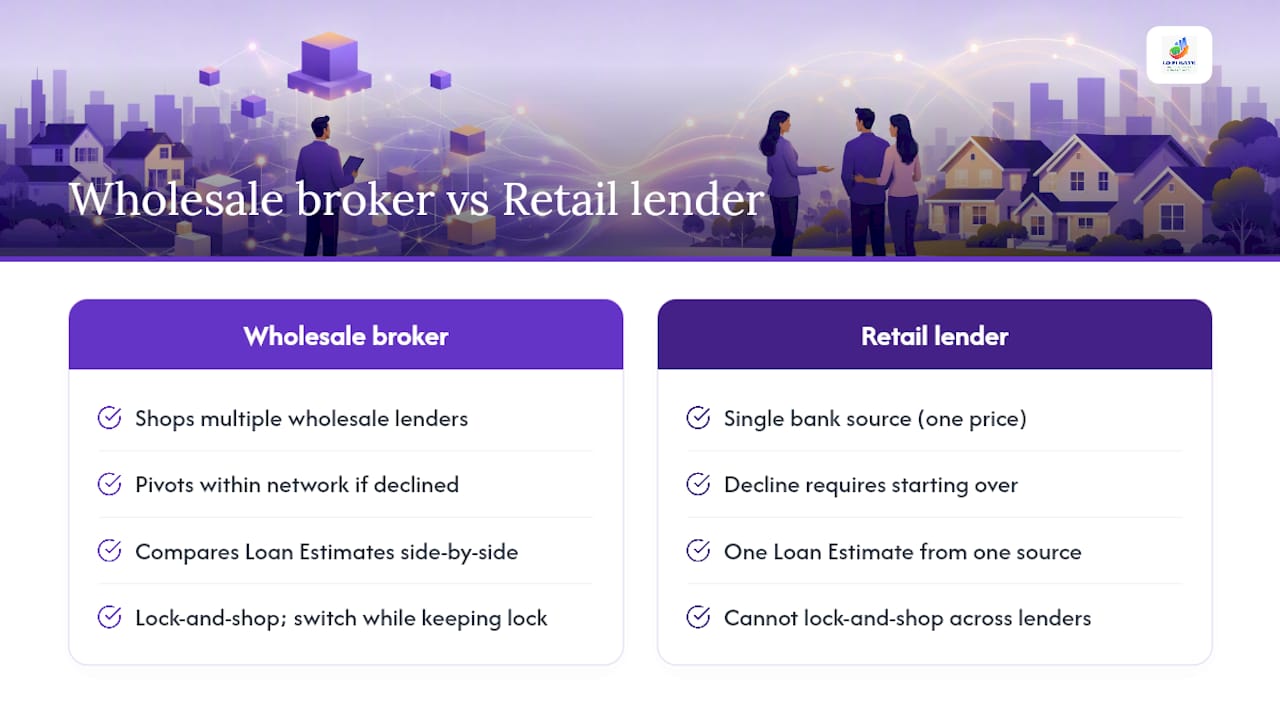
The core advantage is optionality. A licensed wholesale broker can shop your file across multiple wholesale lenders simultaneously, and if one lender declines, the broker pivots the file within the same network without forcing you to restart the entire application. At a retail bank, a decline means starting over from scratch somewhere else.
Here's how that plays out in practice. A broker submits your profile to several wholesale lenders at once, compares Loan Estimates side by side, and can use a lock-and-shop approach: lock a rate with one lender while continuing to solicit better pricing from others. If a sharper offer appears, the broker transitions the file while keeping the original lock as a fallback. Retail lenders can't do that; they offer one price from one source.
For Non-QM and portfolio borrowers specifically, this matters even more. Wholesale lenders often carry programs retail branches don't offer at all. A broker with a strong wholesale network may have access to a dozen Non-QM investors where a retail loan officer has one.
Pro Tip: When vetting a broker, ask for their NMLS license number, confirm it's active in your state at NMLS Consumer Access, and ask whether they act as a pure broker or a correspondent lender. The answer changes how their compensation is disclosed on your Loan Estimate.
Lofirate matches borrowers with state-licensed wholesale brokers and does not earn revenue from the loan itself. That separation keeps the matching process transparent.
How Non-QM and portfolio underwriting actually works
The biggest misconception about Non-QM is that it's a shortcut. It isn't. Non-QM loans are fully underwritten; they use different documentation, not less of it.
The four main program types each use a distinct income verification method:
- Bank-statement loans: 12–24 months of personal or business deposits, averaged to derive qualifying income
- P&L loans: CPA-prepared profit and loss statements covering one to two years
- DSCR loans: Property cash flow only; debt service coverage ratio = monthly rent ÷ monthly mortgage payment, with most lenders requiring a DSCR of 1.0–1.25 or higher
- Asset depletion: Eligible assets divided over a set term (often 360 months) to create a monthly income figure
Portfolio loans take a broader view still. Because the lender keeps the loan on its own books rather than selling it to investors, it can weigh compensating factors: significant cash reserves, a large investment portfolio, or a long track record of managing rental properties. Portfolio underwriting is custom, not subprime.
Non-QM market composition: Bank-statement loans represent about 33.7% and DSCR loans about 28.7% of the Non-QM securitization volume, together forming substantial segments of the alternative mortgage market.
On pricing, expect a rate premium versus conventional. The spread typically runs above a comparable conventional rate by a margin that varies depending on credit score, loan-to-value ratio, DSCR level, reserve depth, and whether there's a recent credit event. A borrower with a 740 credit score, 30% down, and 12 months of reserves will price much closer to conventional than someone with a 640 score and a recent late payment. See illustrative Non-QM rate ranges for current spread context.
Underwriting timelines for Non-QM run 30–45 days on average, similar to conventional, but appraisal requirements are often stricter and lenders may request additional documentation mid-file. Build in buffer time.
Bridge loans, hard-money, seller financing, and private lenders: when do they make sense?
These four options trade cost for speed or flexibility. They're rarely long-term solutions, but in the right situation they're the only tool that works.
Bridge loans cover the gap between buying a new property and selling an existing one. They're short-term (typically 6–12 months), carry higher rates than conventional, and require a clear exit: either the sale of the departing property or a refinance into permanent financing.
Hard-money loans are asset-based. The lender cares primarily about the property value and your exit plan, not your income or credit score. Closings can happen in 7–14 days, which is why fix-and-flip investors use them. The cost is real: points upfront (often 2–4 points) plus rates that can run significantly above conventional.

Seller financing means the seller acts as the lender. Terms are fully negotiated: interest rate, amortization, balloon payment date. It can work well in niche markets or when a seller wants installment-sale tax treatment. The risk is limited regulatory protection; both parties need independent legal counsel and a properly recorded promissory note and deed of trust.
Private mortgage lending is similar but the capital comes from an individual investor rather than the seller. Terms vary widely. Due diligence on the lender's legal standing and the loan documentation is non-negotiable.
Bridge and hard-money options close faster but typically at substantially higher cost than portfolio or Non-QM alternatives. Use them as planned short-term bridges, not permanent financing strategies.
| Option | Typical points/fees | Typical rate vs. conventional | Close time | Primary risk |
|---|---|---|---|---|
| Bridge loan | 1–3 points | Moderately higher | 14–30 days | Forced sale if exit fails |
| Hard-money | 2–4 points | Significantly higher | 7–14 days | High carrying cost |
| Seller financing | Negotiated | Negotiated | Varies | Limited legal protections |
| Private mortgage | Negotiated | Varies | Varies | Documentation and legal risk |
How to pick the right option and what to ask your broker
Start with your primary qualifying driver. That single factor should determine which program you pursue first:
- Rental property with strong cash flow → DSCR loan
- Self-employed with clean bank deposits → bank-statement loan
- Business owner with CPA-prepared financials → P&L loan
- High assets, low current income → asset depletion
- Complex financial picture, multiple properties → portfolio loan
- Time-sensitive purchase or rehab → bridge or hard-money as a bridge only
Before your first broker call, gather these documents based on your likely program:
- 12–24 months of personal and/or business bank statements
- CPA-prepared P&L (if applicable)
- Two years of business and personal tax returns (even if not the qualifying document)
- Signed leases and rent rolls for investment properties
- Asset statements: retirement accounts, brokerage, savings
- Current mortgage statements and property insurance for existing properties
Questions to ask every broker you speak with:
- Which wholesale lenders do you have active relationships with for Non-QM and portfolio programs?
- Do you underwrite in-house or broker to an investor market?
- What's the typical rate range for my profile and program?
- How do you handle rate locks, and what's your fallback if the primary lender declines?
- What's your average time from application to clear-to-close for this program type?
Red flags: opaque fee structures, unwillingness to name the loan investor or secondary market, and any promise of "no-doc" approval without an Ability-to-Repay discussion. A legitimate broker will walk you through ATR compliance, not around it.
Credit score affects both access and pricing. Moving from 640 to 680 on a DSCR loan can meaningfully narrow the rate spread. Increasing your down payment from 20% to 25–30% often does the same. Wholesale broker access amplifies those improvements because the broker can reprice across multiple lenders when your profile strengthens.
How Lofirate connects you with licensed wholesale mortgage brokers
Lofirate is a broker-matching marketplace. It connects you with licensed wholesale mortgage brokers who shop wholesale lenders on your behalf. Lofirate does not lend, does not quote rates, and does not charge borrowers a fee to use the platform.
The match process works in four steps:
- Complete a short online profile covering loan purpose, property type, estimated credit range, and income documentation type
- Lofirate matches you with a state-licensed wholesale broker suited to your scenario
- The broker contacts you for a no-obligation consultation and reviews your documentation
- The broker runs wholesale pricing and program comparisons across their lender network, presents options, and you choose whether to proceed
Pro Tip: Bring your last 12 months of bank statements and a rough estimate of your property's value or purchase price to the first broker call. Even rough numbers let the broker run a realistic pricing scenario rather than a generic range.
Typical time from completing your Lofirate profile to an initial broker contact is fast. From there, preapproval timelines depend on program: Non-QM and portfolio loans generally run 30–45 days to close once documentation is complete. Bridge and hard-money can move in under three weeks.
Lofirate maintains compliance through licensed broker partnerships only and handles borrower data with secure protocols. Every broker in the network holds an active state license, verifiable through NMLS Consumer Access.
Key Takeaways
Wholesale broker access is the single most practical lever for homebuyers who don't fit conventional underwriting, because one file reaches multiple lenders and one decline doesn't end the process.
| Point | Details |
|---|---|
| Alternative loans are fully underwritten | Non-QM and portfolio loans require rigorous documentation; only the document type differs from conventional. |
| Match program to qualifying driver | DSCR for investors, bank-statement for self-employed, asset depletion for asset-rich borrowers. |
| Expect a rate premium | Non-QM rate spreads are typically 0.5% to 2.5% above conventional rates, narrowed by stronger credit and larger down payments. |
| Broker optionality protects timelines | A wholesale broker can pivot your file within their network if one lender declines, avoiding a full restart. |
| Lofirate as your starting point | Lofirate matches you with state-licensed wholesale brokers at no borrower cost, covering purchase, refinance, jumbo, FHA, VA, and Non-QM loans. |
The case for transparency in mortgage matching
The mortgage industry has a long history of steering borrowers toward products that pay the highest commission rather than the best fit. That's the problem Lofirate was built to address. By connecting borrowers with licensed wholesale brokers rather than acting as a lender, Lofirate removes the conflict of interest that exists when the person quoting your rate is also the person earning from it.
Licensed brokers are required to disclose compensation on every Loan Estimate. Wholesale pricing is visible and comparable. And because brokers can shop multiple lenders, the borrower gets a real market picture rather than a single institution's best offer. For borrowers pursuing Non-QM or portfolio programs, where pricing variation across lenders is wider than in conventional lending, that transparency is worth more than it sounds.
Lofirate's blog covers Non-QM program mechanics, broker vetting, and wholesale rate dynamics in depth. The platform's national licensed broker coverage means borrowers in most states can access the same wholesale pricing advantages that were previously available only to borrowers who already knew a broker personally.
Start your broker match with Lofirate today
If conventional underwriting has left you without options, the practical next step is a no-obligation broker consultation through Lofirate. Complete a short profile on the platform, and a state-licensed wholesale broker will reach out to review your scenario, run program comparisons across their wholesale lender network, and give you a clear picture of what's available and at what cost.

Have your bank statements, a property value estimate, and a rough sense of your credit range ready. The initial consultation takes under 30 minutes and carries no commitment. Visit Lofirate's loan options page to see the full range of programs covered, including Non-QM, jumbo, FHA, VA, and investment property loans.
Useful sources and regulatory references
Regulatory standards and industry guidance used in this article:
- Wholesale vs. Retail Mortgage Lending — Chase — explains broker mechanics, Loan Estimate comparison, and channel differences
- Non-Traditional Mortgage Options — Lofirate Blog — Lofirate's survey of Non-QM categories and borrower eligibility
This article is general educational information, not legal, financial, or mortgage advice. Loan programs, rates, and eligibility requirements vary by lender and state. Confirm current program details and regulatory requirements with a licensed mortgage professional.