

TL;DR:
- Home equity options allow homeowners to access their property's value through loans, credit lines, or refinancing, with each product suited to different needs.
- Choosing the right product and lender involves comparing APRs, understanding qualification requirements, and preparing documents in advance to streamline approval.
The home equity options process is the structured method homeowners use to convert their property's built-up value into accessible funds through loans, credit lines, or refinancing products. Your home is likely your largest financial asset, and understanding how to access it correctly can mean the difference between a well-timed financial move and a costly mistake. This guide covers every stage of the process: from identifying which product fits your goals, to meeting lender qualifications, to closing and receiving funds. Whether you are considering a home equity loan, a HELOC, a cash-out refinance, or a renovation loan, the steps and criteria are more predictable than most homeowners expect.
What are the main home equity options and how do they work?
Understanding home equity starts with knowing the four primary products lenders offer. Each one draws on your home's equity differently, and choosing the wrong structure for your situation costs you money in interest, fees, or missed flexibility.

Home equity loans deliver a lump sum at a fixed interest rate with fixed monthly payments over terms ranging from 5 to 30 years. They are purpose-built for one-time, defined expenses: a kitchen remodel with a firm budget, debt consolidation, or a medical bill. Because the rate never changes, your payment is predictable from day one. Fixed rates and predictable payments make home equity loans the right call when you know exactly how much you need and want no surprises.
HELOCs (Home Equity Lines of Credit) work more like a credit card secured by your home. You draw funds as needed during a draw period, typically 10 years, and repay over a separate repayment period, also typically 10 years. The rate is variable, usually 0.5% to 1% above prime rate, which means your payment can shift as market rates move. Some lenders offer fixed-rate conversion options to lock in a portion of the balance.
Cash-out refinances replace your existing mortgage with a new, larger loan. You pocket the difference between the new loan amount and your current balance. This consolidates your mortgage and equity borrowing into one payment, which simplifies your finances but resets your loan term. The tradeoff is that you are refinancing your entire mortgage, so the rate on your new loan matters as much as the equity you extract.
Renovation loans, such as the FHA 203(k) or Fannie Mae HomeStyle, let you borrow against the projected value of your home after improvements are complete. This is the only product that lets you borrow more than your home is currently worth, based on a licensed appraiser's estimate of post-renovation value. Timelines are longer, but the borrowing power can be significantly higher.
| Product | Rate type | Best for | Typical term |
|---|---|---|---|
| Home equity loan | Fixed | One-time, defined expenses | 5 to 30 years |
| HELOC | Variable | Ongoing or uncertain costs | 10-year draw + 10-year repayment |
| Cash-out refinance | Fixed or adjustable | Consolidating mortgage + equity | 15 to 30 years |
| Renovation loan | Fixed | Purchase or refi plus improvements | 15 to 30 years |
Pro Tip: Choose your product based on certainty. If you know the exact amount you need, a home equity loan wins on simplicity. If your costs are unpredictable, a HELOC gives you the flexibility to draw only what you use.
What qualifications and documents do you need?
Lenders apply consistent eligibility standards across home equity products. Meeting these thresholds before you apply saves time and protects your credit score from unnecessary inquiries.
Most lenders require that you retain at least 15% to 20% equity after the loan closes. In practice, this means lenders cap borrowing at 80% to 85% CLTV (combined loan-to-value), calculated by adding your existing mortgage balance to the new loan amount and dividing by your home's appraised value. Well-qualified borrowers can sometimes access up to 90% to 95% CLTV depending on the lender and their credit profile.
Credit score requirements typically start at 620 to 660 for most lenders, though scores above 700 unlock better rates and terms. Your debt-to-income ratio (DTI), which compares your total monthly debt payments to your gross monthly income, should sit at or below 43%. Lenders also want to see stable employment history, usually two or more years with the same employer or in the same field.
Documents you will need to gather:
- Most recent mortgage statement showing current balance and payment history
- Two years of federal tax returns and W-2s (or 1099s if self-employed)
- Two to three months of recent pay stubs
- Two to three months of bank statements
- Homeowners insurance declarations page
- Government-issued photo ID
- Property tax statements
Pro Tip: Pull your credit reports from Equifax, Experian, and TransUnion at AnnualCreditReport.com before applying. Dispute any errors you find. A 20-point score improvement can move you into a better rate tier and save thousands over the loan term.
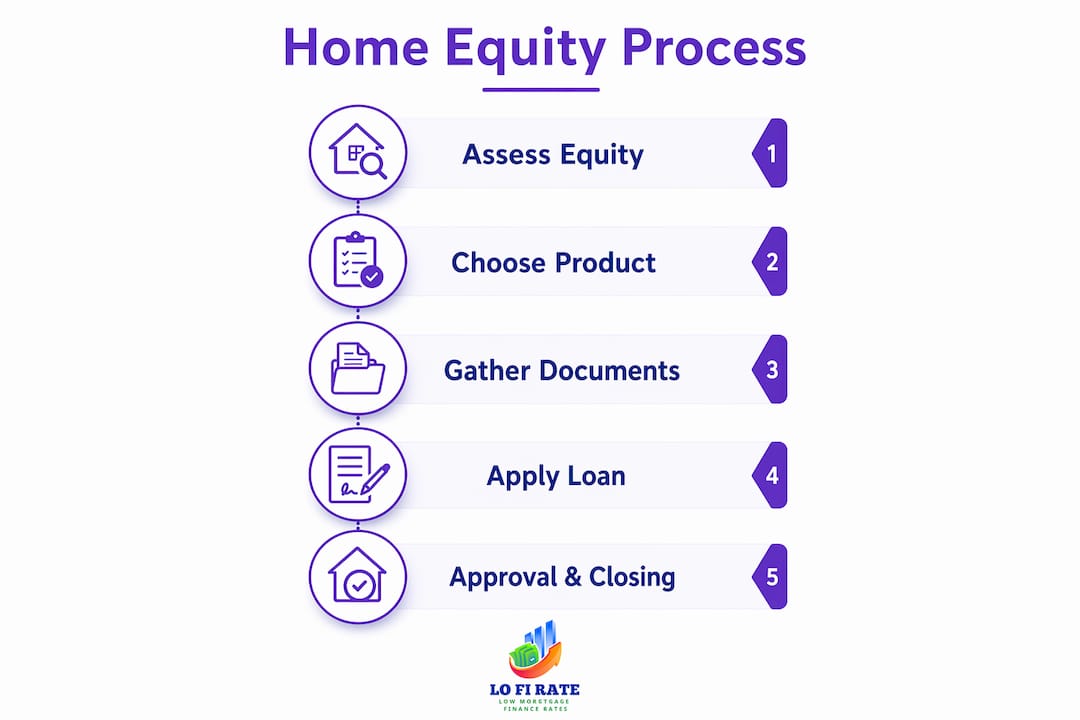
What is the step-by-step process for applying and getting approved?
The home equity loan process follows a predictable sequence. Knowing each stage in advance prevents surprises and keeps your timeline on track.
- Calculate your available equity. Subtract your current mortgage balance from your home's estimated market value. This gives you a rough equity figure before any lender runs a formal appraisal.
- Review your credit and DTI. Check your credit score and calculate your DTI before any lender does. Fix what you can before submitting an application.
- Gather your documents. Use the list above. Having everything ready before you apply cuts processing time significantly.
- Shop multiple lenders. Compare banks, credit unions, and online lenders. Applying within a 45-day window counts as a single credit inquiry, so rate shopping does not hurt your score.
- Submit your application. Complete the lender's application form and upload your documents. Most lenders now offer fully digital submission.
- Home appraisal. The lender orders an appraisal to confirm your home's current market value. Appraisals typically cost between $300 and $500 and take one to two weeks to schedule and complete.
- Underwriting review. The lender's underwriter verifies your income, credit, and property details. This is where delays most often occur. Responding promptly to document requests is the single most effective way to keep underwriting on schedule.
- Closing. You sign the loan documents. For home equity loans and HELOCs on a primary residence, federal law gives you a three-day right of rescission. You can cancel without penalty within that window.
- Funding. Funds are disbursed after the rescission period ends.
| Product | Typical timeline |
|---|---|
| Home equity loan | 2 to 4 weeks |
| HELOC | 2 to 4 weeks |
| Cash-out refinance | 3 to 5 weeks |
| Renovation loan | 30 to 60 days |
These timelines vary by product and by how quickly you respond to lender requests. Renovation loans take longer because they require contractor bids and a more detailed appraisal process.
Pro Tip: Compare APR, not just the interest rate. APR includes fees and gives you a true cost comparison across lenders. A loan with a lower rate but higher origination fees can cost more than a slightly higher-rate loan with minimal fees.
How to select the best home equity option and lender
Choosing the right product and lender requires a side-by-side comparison of real numbers, not just advertised rates. Costs and terms vary significantly between banks, credit unions, and online lenders, and the gap can be substantial over a 10 or 20-year repayment period.
What to compare across lenders:
- APR (not just the interest rate)
- Closing costs, which typically run 2% to 6% of the loan amount and cover appraisal, title services, and origination fees
- Repayment terms and whether early payoff penalties apply
- Draw period and repayment period structure for HELOCs
- Fixed-rate conversion options for variable-rate products
Matching product to need:
- Use a home equity loan for a defined, one-time expense where a fixed payment fits your budget.
- Use a HELOC for home improvements with uncertain costs, tuition payments spread over time, or any situation where you want to draw funds in stages.
- Use a cash-out refinance if current mortgage rates are lower than your existing rate, or if consolidating your payments into one simplifies your financial picture.
- Use a renovation loan if you are buying a fixer-upper or your current home needs improvements that will significantly increase its value.
For homeowners considering substantial improvements, consult a tax advisor. Interest on home equity borrowing used to buy, build, or substantially improve the home may be tax-deductible under current IRS rules, which adds a meaningful financial dimension to your product choice. For a deeper look at how equity-based refinancing strategies work in 2026, the timing and rate environment matter as much as the product itself.
Pro Tip: Apply to at least three lenders. The difference between the best and worst offer in a typical rate shopping exercise can exceed $10,000 in total interest over the life of the loan. A guide on comparing lenders effectively can sharpen your evaluation criteria before you start.
Key takeaways
The most effective way to navigate the home equity options process is to match your product choice to your specific funding need, prepare your documents in advance, and compare at least three lenders on APR before committing.
| Point | Details |
|---|---|
| Match product to need | Fixed expenses suit home equity loans; ongoing or uncertain costs suit HELOCs. |
| Meet lender thresholds first | Most lenders require 15% to 20% equity retained and a credit score of at least 620. |
| Shop within 45 days | Rate shopping multiple lenders in a 45-day window counts as one credit inquiry. |
| Closing costs are real | Budget 2% to 6% of the loan amount for appraisal, title, and origination fees. |
| Speed up underwriting | Respond to every lender document request within 24 hours to avoid timeline delays. |
What I have learned from watching homeowners navigate this process
Most homeowners who struggle with the home equity options process do not fail because of bad credit or low equity. They fail because they treat the process like a single transaction instead of a multi-stage evaluation. They pick the first lender who approves them, skip the APR comparison, and then spend years paying more than they needed to.
The three-day rescission period is one of the most underused protections in residential lending. I have seen homeowners reach closing, feel the pressure of the moment, and sign without fully reviewing the final loan disclosure. That three-day window exists precisely for that situation. Use it. Read the closing disclosure against the loan estimate you received at application and flag any fees that changed.
The other pattern I see repeatedly: homeowners who wait too long to gather documents. Underwriting stalls are almost always caused by the borrower, not the lender. The underwriter asks for a bank statement, the borrower takes five days to find it, and suddenly a two-week process becomes a five-week process. Build your document file before you apply, not after.
My honest recommendation for anyone comparing complex options across multiple lenders is to work with a licensed mortgage broker. Brokers have access to wholesale pricing that retail bank branches do not offer, and they can run the comparison across multiple lenders simultaneously. The savings are real, and the time investment is minimal.
— LoFi
How Lofirate connects you to better home equity financing

Lofirate is a mortgage connection platform built specifically to help homeowners like you avoid overpaying on home equity financing. Instead of walking into a single bank and accepting their retail pricing, Lofirate connects you with licensed wholesale mortgage brokers in your state who shop multiple lenders on your behalf. The result is a transparent, no-obligation consultation where you see competitive options side by side before committing to anything. Whether you are pursuing a home equity loan, a HELOC, or a cash-out refinance, the right broker can find terms that a single retail lender simply cannot match. Visit Lofirate's loan options to explore what is available, or go directly to lofirate.com to request your broker match today.
FAQ
What is the home equity options process?
The home equity options process is the sequence of steps homeowners follow to borrow against their property's value, including selecting a product, meeting lender qualifications, submitting an application, completing an appraisal, and closing the loan.
How long does it take to get a home equity loan or HELOC?
Home equity loans and HELOCs typically fund within 2 to 4 weeks from application, while cash-out refinances take 3 to 5 weeks and renovation loans can take 30 to 60 days depending on contractor documentation and appraisal complexity.
What credit score do you need for a home equity loan?
Most lenders require a minimum credit score between 620 and 660, though borrowers with scores above 700 qualify for better rates and higher CLTV limits, sometimes up to 90% to 95% for well-qualified applicants.
What is the difference between a HELOC and a home equity loan?
A home equity loan delivers a lump sum at a fixed rate with predictable payments, while a HELOC is a revolving credit line with a variable rate that lets you draw and repay funds repeatedly during the draw period.
How much does it cost to close a home equity loan?
Closing costs on home equity products typically range from 2% to 6% of the loan amount and cover appraisal fees of $300 to $500, title services, and loan origination charges. These costs vary by lender, so comparing full APR across offers is the most reliable way to evaluate total cost.