

More than a third of homebuyers settle for just one mortgage quote before buying a home, missing significant savings. Comparing lending options before committing can mean the difference between overpaying and securing a competitive rate. Small differences in interest rates compound to tens of thousands of dollars over the loan term. This guide explains why comparing lenders matters, how rates and fees vary, and practical steps to get the best mortgage deal in 2026.
Table of Contents
- How Comparing Lending Options Can Save You Thousands
- Why Lenders' Rates And Fees Vary So Much
- How Market And Lender Competition Impact The Mortgage Landscape In 2026
- Practical Steps To Compare Lending Options And Get The Best Deal
- Find Competitive Mortgage Rates And Loan Options At LoFiRate
Key takeaways
| Point | Details |
|---|---|
| Shopping saves money | Comparing lenders can save up to $44,000 over the life of a typical loan. |
| Rate differences matter | A 0.55% rate difference on a $300,000 mortgage saves over $40,000 in interest over 30 years. |
| Lenders price differently | Risk profiles, business models, and market factors create wide variability in rates and fees among lenders. |
| Multiple quotes give leverage | Getting 3 to 5 quotes lets you negotiate better terms and avoid overpaying retail pricing. |
How comparing lending options can save you thousands
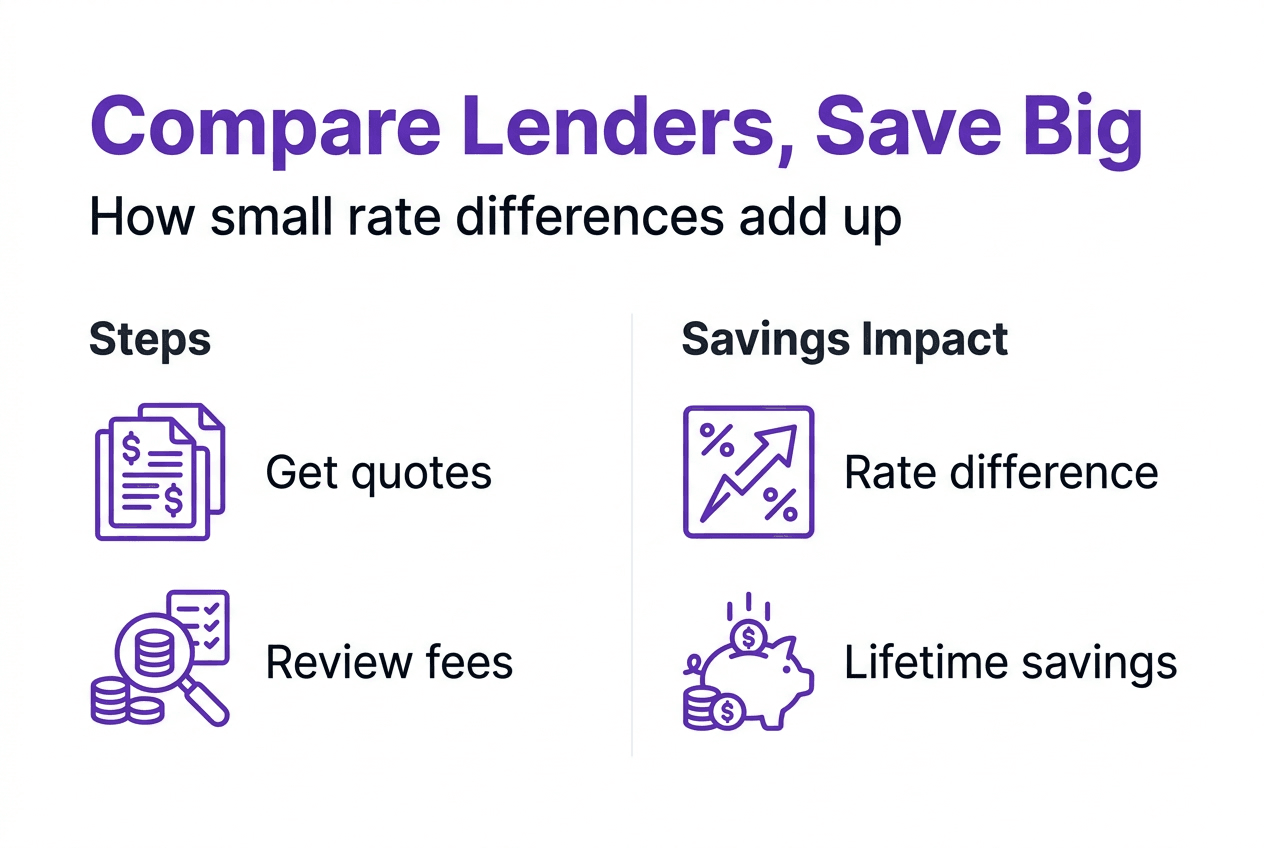
Borrowers who compare mortgage rates from multiple lenders save significantly over the life of their loan. Research consistently shows that getting additional quotes lowers the interest rate you ultimately pay. Even small rate differences compound to substantial lifetime savings.
Consider this example: on a $300,000 mortgage with a 30-year term, a 0.55% rate difference translates to over $40,000 in savings. That rate gap is common among competing lenders for the same borrower profile. Borrowers with strong credit profiles see even greater savings potential when they shop around, because lenders compete more aggressively for low-risk customers.
The impact becomes clear when you look at monthly payments. A borrower who secures 6.5% instead of 7.05% on that same $300,000 loan saves about $105 per month. Over 30 years, that adds up fast. Beyond the rate itself, comparing lenders also reveals differences in closing costs, origination fees, and discount points that affect your upfront investment.
Key benefits of comparing multiple lenders:
- Lower interest rates through competitive pressure
- Reduced closing costs and origination fees
- Better loan terms and flexible repayment options
- Transparency about total cost of borrowing
- Leverage to negotiate with preferred lenders
Pro Tip: Aim to get 3 to 5 quotes for the best leverage. Fewer than three quotes limits your ability to spot outliers or negotiate. More than five can create confusion without adding much benefit.
Understanding how mortgage brokers help you save gives you another tool for efficient comparison shopping. Brokers access multiple wholesale lenders simultaneously, streamlining the process of gathering competitive quotes.

Why lenders' rates and fees vary so much
Mortgage rates and fees vary widely among lenders because they price risk differently and operate under different business models. Purchase and refinance mortgages have different risk profiles, creating rate gaps that borrowers notice when comparing offers. Purchase loans typically carry lower rates because lenders view them as less risky than refinances.
Lender business models also drive pricing differences. Direct retail lenders offer only their own loan products and pricing, while wholesale brokers shop multiple lenders to find competitive options. Online lenders operate with lower overhead costs and may pass those savings to borrowers. Credit unions and community banks price based on member relationships rather than pure profit maximization.
The search for the "best mortgage rate" is futile because rates depend on individual lender business models and your specific borrower profile. What matters most is finding the best rate available to you by comparing multiple offers.
Fees and APR impact the real cost beyond the advertised interest rate. Two lenders might quote the same rate but charge dramatically different closing costs. One lender might offer a lower rate with higher origination fees, while another offers a slightly higher rate with minimal fees. The annual percentage rate captures both the interest rate and fees, giving you a more accurate picture of total borrowing cost.
Factors that create rate variability:
- Lender risk assessment models and underwriting standards
- Business model differences (retail vs wholesale vs online)
- Operational costs and profit margin targets
- Secondary market pricing and investor demand
- Geographic market competition and local regulations
Understanding these factors helps you set realistic expectations when comparing offers. You will not find one universal "best rate" that applies to everyone. Your goal is finding the best combination of rate, fees, and terms for your specific situation. Learning about mortgage refinance strategies helps you apply this knowledge whether you are buying or refinancing.
How market and lender competition impact the mortgage landscape in 2026
Housing activity remains highly sensitive to mortgage rates, affecting both home prices and lending volumes. In 2026, market dynamics create opportunities for borrowers who actively compare lending options. Rate fluctuations throughout the year mean timing your mortgage shopping matters, but comparing lenders matters even more.
Lender competition intensified in 2026 as purchase mortgage applications increased despite economic uncertainty. This competition benefits borrowers who shop multiple lenders. However, fee increases reduced mortgage originations by 8% in recent years, making lenders more selective and raising rejection rates for marginal borrowers. Stronger borrowers with good credit and documentation see more competitive offers.
Regulatory changes and secondary market conditions also influence what lenders can offer. When investor demand for mortgage-backed securities is strong, lenders can offer better rates. When demand weakens, rates rise. Understanding these market forces helps you recognize when you are getting a genuinely competitive offer versus being overcharged.
| Factor | Impact on Borrowers | What to Watch |
|---|---|---|
| Interest rate trends | Higher rates reduce affordability and slow purchases | Fed policy announcements and economic indicators |
| Lender competition | More lenders competing = better rates and terms for you | Number of lenders actively marketing in your area |
| Regulatory changes | New rules can increase or decrease costs and requirements | CFPB announcements and state mortgage regulations |
| Secondary market demand | Strong demand = lower rates; weak demand = higher rates | Mortgage-backed securities pricing and spreads |
Pro Tip: Stay current on mortgage rate trends in 2026 to time your application strategically. Locking a rate when the market is competitive gives you more negotiating power with individual lenders.
Market volatility creates opportunities for savvy borrowers. When rates drop, refinance applications surge and lenders compete harder. When rates stabilize, purchase market competition heats up. Understanding how lender competition affects rates helps you capitalize on these dynamics through strategic comparison shopping.
Practical steps to compare lending options and get the best deal
Effectively comparing mortgage offers requires a systematic approach. Follow these steps to maximize savings and transparency in your 2026 mortgage search.
1. Gather financial documents and know your credit profile
Pull your credit reports from all three bureaus and review your credit scores. Collect recent pay stubs, tax returns, bank statements, and documentation of assets and debts. Knowing your financial position helps you understand which rates you qualify for and prevents surprises during underwriting.
2. Get pre-approved to unlock accurate rate comparisons
Pre-approval involves a full credit check and document verification, giving you a reliable rate quote. Pre-qualification based only on self-reported information provides rough estimates that often change. Pre-approval letters carry weight when comparing lenders and negotiating.
3. Request multiple quotes including fees and APR
Don't focus on teaser rates alone. Request a Loan Estimate from each lender showing the interest rate, origination fees, discount points, closing costs, and APR. Getting 3 to 5 rate quotes gives you leverage to negotiate better terms. Request all quotes within a 14-day window to minimize credit score impact from multiple inquiries.
4. Use a side-by-side comparison table
Create a spreadsheet comparing rates, fees, terms, and lender reputation. Include these key elements:
| Lender | Interest Rate | APR | Origination Fee | Total Closing Costs | Loan Term | Monthly Payment | Lender Rating |
|---|---|---|---|---|---|---|---|
| Lender A | X.XX% | X.XX% | $X,XXX | $X,XXX | 30 years | $X,XXX | X/5 stars |
| Lender B | X.XX% | X.XX% | $X,XXX | $X,XXX | 30 years | $X,XXX | X/5 stars |
| Lender C | X.XX% | X.XX% | $X,XXX | $X,XXX | 30 years | $X,XXX | X/5 stars |
5. Negotiate with lenders using data from multiple offers
Once you have several quotes, contact your preferred lender with competing offers. Many lenders will match or beat a competitor's rate to win your business. Be direct: "Lender B offered me 6.25% with $2,000 in fees. Can you match or beat that?"
Common fees and terms to watch:
- Origination fees (typically 0.5% to 1% of loan amount)
- Discount points (optional upfront payment to lower rate)
- Application and underwriting fees
- Appraisal and inspection costs
- Title insurance and escrow fees
- Prepayment penalties and rate lock periods
Pro Tip: Use mortgage brokers to streamline comparison shopping. Brokers access multiple wholesale lenders simultaneously, doing the comparison work for you while often delivering lower rates than retail banks.
Exploring diverse loan options ensures you consider conventional loans, FHA, VA, USDA, and jumbo products. Different loan types carry different rate structures, so comparing across loan products as well as lenders maximizes your savings potential.
Find competitive mortgage rates and loan options at LoFiRate
After learning how to compare lending options effectively, you need a practical resource to simplify the process. LoFiRate connects homebuyers with licensed wholesale mortgage brokers who shop multiple lenders on your behalf.

Unlike retail lenders offering only their own pricing, wholesale brokers access competitive rate options from numerous lenders. Explore low mortgage rates at LoFiRate and compare diverse loan options through transparent, no-obligation consultations. Whether purchasing a home or refinancing in 2026, request a second opinion and discover potential savings through wholesale mortgage access.
Frequently asked questions
How many mortgage quotes should I get to compare effectively?
Get 3 to 5 quotes for optimal leverage and savings. This range gives you enough data to identify competitive rates without creating confusion. Fewer than three quotes risks overpaying because you lack perspective on market pricing. More than five quotes rarely adds value and can make decision-making harder.
What factors besides interest rate should I consider when comparing mortgage lenders?
Fees and APR often impact overall cost more than the advertised rate alone. Compare origination fees, closing costs, discount points, and prepayment penalties. Also evaluate loan terms, lender reliability, customer service reputation, and processing speed. The lowest rate means nothing if high fees or poor service create problems.
Can I negotiate mortgage rates and fees after getting multiple quotes?
Yes, comparing multiple offers gives you leverage to negotiate better terms. Lenders often match or beat competitors to win your business. Present competing Loan Estimates to your preferred lender and ask directly if they can improve their offer. Many lenders have rate-matching policies and discretion to reduce fees for qualified borrowers.