

TL;DR:
- A HomePath mortgage is no longer a specific loan product but refers to standard loans used for Fannie Mae-owned foreclosed homes listed on HomePath.com. Buyers should understand that these properties sell as-is, require thorough inspections, and benefit from higher seller concessions and a $500 appraisal credit if properly coded by the lender. Success depends on experienced lenders, careful preparation, and understanding the unique purchase process and benefits.
A HomePath mortgage is the term buyers use for financing a Fannie Mae-owned foreclosed home, but the dedicated HomePath loan product was officially discontinued in october 2014. Buyers today use standard conventional, FHA, VA, or USDA loans to purchase these properties. The process carries unique benefits, including higher seller concessions and a mandatory appraisal credit, that most buyers never claim because they do not know to ask. This guide explains exactly how HomePath financing works in 2026, what makes these properties different, and how to avoid the mistakes that cost buyers real money.
What is a HomePath mortgage in 2026?
The term "HomePath mortgage" no longer describes a specific loan product. Fannie Mae retired that product in 2014, and no replacement has launched since. What the phrase describes today is any standard loan used to buy a property listed on HomePath.com, Fannie Mae's dedicated marketplace for its real estate owned (REO) inventory.
Fannie Mae acquires these homes through foreclosure when borrowers default on loans it guarantees. The agency then lists them on HomePath.com and sells them to the public. The goal is to stabilize neighborhoods by returning vacant homes to active ownership, particularly by owner-occupants.
The financing itself comes from conventional loans backed by Fannie Mae guidelines, FHA loans insured by the Federal Housing Administration, VA loans for eligible veterans, and USDA loans for qualifying rural properties. Each loan type carries its own credit score minimums, down payment requirements, and property condition standards. Knowing which loan fits your situation before you make an offer saves significant time.
Pro Tip: Search HomePath.com directly for current listings. The site filters by location, price, and property type, and it shows whether a property is still in the First Look period reserved for owner-occupants.
How HomePath properties differ from traditional home purchases
HomePath properties carry conditions that standard home sales do not. Understanding these differences before you make an offer protects your financing and your budget.
As-is condition and limited disclosures
HomePath properties sell as-is with minimal seller disclosures. Fannie Mae typically has no direct knowledge of the property's history because it acquired the home through foreclosure, not by living in it. That means you will not receive the detailed disclosure forms a typical seller provides. You are responsible for uncovering every defect through your own inspection.
Budget for repairs before you make an offer. Properties that sat vacant often have deferred maintenance, water intrusion, or HVAC issues that do not appear until a thorough inspection. A home inspection is not optional on a HomePath purchase. It is the primary tool you have for understanding what you are buying.
The Fannie Mae purchase contract
Fannie Mae uses its own purchase contract, and it heavily favors the seller. The contract limits buyer remedies, sets strict timelines for earnest money deposits, and restricts contingencies in ways that differ from standard real estate agreements. Your real estate agent must read this contract carefully before you sign.
The deed you receive at closing is a special warranty deed, not a general warranty deed. A special warranty deed only guarantees that Fannie Mae did not create title problems during its ownership period. It does not cover issues from prior owners. Title insurance is the only way to protect yourself against those older claims.
The First Look Initiative
The First Look Initiative gives owner-occupant buyers an exclusive window, typically the first 30 days a property is listed, to submit offers before investors can compete. This policy exists to support community stability by prioritizing buyers who will actually live in the home.
Key differences from a standard home purchase:
- Properties sell as-is with no seller repairs or credits outside of negotiated concessions
- Fannie Mae's purchase contract replaces the standard state contract in most transactions
- Special warranty deeds require buyers to purchase title insurance for full protection
- Earnest money timelines and deposit procedures follow Fannie Mae's specific rules
- Investor offers are blocked during the First Look period
Pro Tip: Work with a real estate agent who has closed at least one HomePath transaction before. The contract differences and offer submission process through Fannie Mae's system are specific enough that experience matters.
What financing options are available for HomePath properties?
The dedicated HomePath loan no longer exists, so buyers choose from the same loan types used for any home purchase. The right choice depends on your credit profile, down payment, military status, and the condition of the property.
| Loan Type | Minimum Down Payment | Best For | Property Condition Requirement |
|---|---|---|---|
| Conventional | 3%–5% | Buyers with good credit | Must meet Fannie Mae standards |
| FHA | 3.5% | Lower credit scores | Must meet FHA minimum standards |
| VA | 0% | Eligible veterans and service members | Must meet VA minimum property requirements |
| USDA | 0% | Rural properties, income limits apply | Must meet USDA standards |
| Renovation loan | Varies | Properties needing significant repairs | Based on after-repair value |
| Non-QM loan | Varies | Properties that fail standard appraisals | Flexible, lender-specific |

Property condition determines which loans are available. A move-in-ready HomePath home qualifies for conventional, FHA, or VA financing without issue. A property with major structural damage, missing systems, or health and safety hazards may fail FHA or VA minimum standards, making those loans unavailable until repairs are made.
Renovation loans, such as the Fannie Mae HomeStyle Renovation loan or the FHA 203(k), let you finance the purchase price and repair costs in a single loan. These loans use the property's projected after-repair value for underwriting, which gives buyers more purchasing power on distressed homes. For properties that fail conventional appraisals entirely, non-QM alternatives exist but carry higher rates and stricter terms.
Get pre-approved before you search. A pre-approval that includes a review of property condition requirements tells you exactly which loan types are available to you and what property conditions could disqualify a home from your financing.
Pro Tip: Ask your lender specifically whether they have closed HomePath transactions before. Lenders unfamiliar with HomePath-specific coding requirements may miss benefits you are entitled to.
Special financing benefits that apply to HomePath purchases
Fannie Mae builds specific financial advantages into HomePath transactions that standard home purchases do not offer. Most buyers miss these benefits because they do not know to request them.
Higher seller concessions for primary residences
Fannie Mae allows seller concessions up to 6% of the purchase price for primary residence buyers with a loan-to-value ratio above 90%. The standard limit on conventional loans is 3%. That doubled ceiling gives buyers significantly more room to negotiate closing cost coverage from Fannie Mae as the seller.
For investment properties and second homes, the standard 3% concession limit applies. The 6% benefit is reserved for owner-occupants putting less than 10% down.
The $500 appraisal credit
Buyers purchasing a HomePath property as their primary residence receive a $500 appraisal credit passed through from the lender at closing. This credit offsets the cost of the appraisal, which buyers typically pay out of pocket. On a transaction where every dollar counts, $500 back at closing is meaningful.
How lenders must code these benefits
Lenders must use specific feature codes when delivering HomePath loans to Fannie Mae. SFC 679 applies to seller concession transactions, and SFC 871 applies to the appraisal credit. If your lender does not apply these codes correctly, the benefits do not flow through.
| Benefit | Amount | Who Qualifies | Lender Code Required |
|---|---|---|---|
| Seller concessions | Up to 6% | Primary residence, LTV above 90% | SFC 679 |
| Standard concessions | Up to 3% | Investment and second homes | SFC 679 |
| Appraisal credit | $500 | Primary residence buyers | SFC 871 |
Pro Tip: Tell your lender upfront that you are purchasing a HomePath property and ask them to confirm they will apply SFC 679 and SFC 871 where applicable. This one conversation protects thousands of dollars in potential benefits.
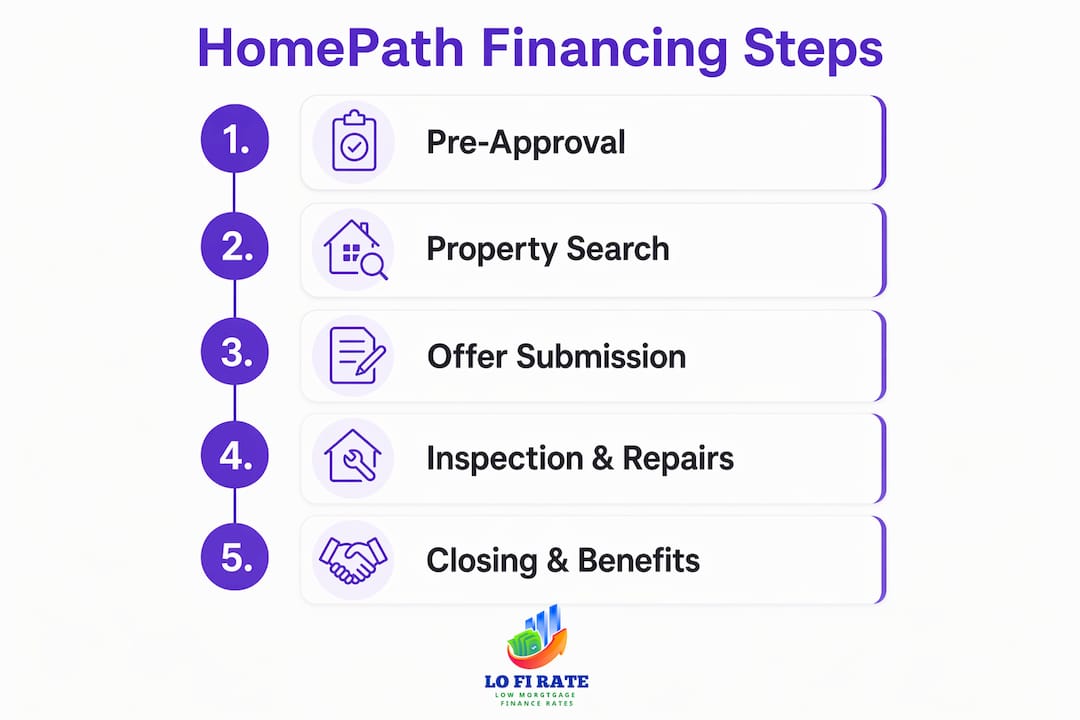
How to buy a HomePath property step by step
Buying a HomePath property follows a specific sequence. Skipping steps or assuming the process mirrors a standard home purchase creates delays and lost offers.
-
Search HomePath.com for active listings. Filter by location, price range, and property type. Note whether each listing is still in the First Look period. Properties in First Look are only available to owner-occupants, which reduces competition significantly.
-
Get pre-approved with a HomePath-experienced lender. Bring your income documents, tax returns, and bank statements. Ask the lender to review property condition requirements for your loan type so you know what to look for during showings.
-
Hire a real estate agent familiar with Fannie Mae contracts. The offer submission process and earnest money procedures differ from standard sales. An experienced agent prevents costly procedural errors.
-
Submit your offer through Fannie Mae's system. Your agent handles this through the HomePath platform. Fannie Mae reviews offers on a schedule, not in real time, so response times vary. Do not assume silence means rejection.
-
Order a home inspection immediately after acceptance. Because the property sells as-is, the inspection is your only opportunity to understand repair costs before closing. Budget for at least a general inspection, and add specialist inspections for roof, HVAC, or foundation if the property shows signs of those issues.
-
Confirm your lender applies HomePath-specific benefits. Before closing, verify that the 6% seller concession allowance and the $500 appraisal credit are reflected in your loan estimate. If they are not, ask your lender to correct the loan delivery coding.
-
Purchase title insurance at closing. The special warranty deed covers only Fannie Mae's ownership period. Title insurance covers claims from prior owners and protects your investment from the day you close.
Buyers who treat a HomePath purchase as a standard transaction often miss the financing benefits or get caught off guard by the contract terms. Preparation and the right team make the difference. For a broader look at how different loan scenarios play out in practice, reviewing real-world examples before you apply helps set accurate expectations.
Pro Tip: Factor repair costs into your offer price. If the inspection reveals $15,000 in needed repairs, your offer should reflect that. Fannie Mae will not reduce the price after acceptance based on inspection findings, but your initial offer can account for known risks.
Key Takeaways
HomePath financing requires standard loan types with HomePath-specific benefits applied correctly by a knowledgeable lender.
| Point | Details |
|---|---|
| No dedicated HomePath loan | The HomePath mortgage product was discontinued in 2014; buyers use conventional, FHA, VA, or USDA loans. |
| As-is condition is non-negotiable | Budget for repairs and order a thorough inspection before closing on any HomePath property. |
| Higher seller concessions available | Primary residence buyers with LTV above 90% can negotiate up to 6% in seller concessions. |
| Appraisal credit reduces closing costs | A $500 appraisal credit applies to primary residence purchases and must be coded correctly by the lender. |
| Lender experience matters | Lenders must apply SFC 679 and SFC 871 codes; without them, HomePath-specific benefits are lost. |
What I've learned from watching buyers navigate HomePath deals
Most buyers come into a HomePath transaction expecting a specialized loan product with a dedicated application process. That expectation sets them up for confusion from the start. The product does not exist anymore, and treating the purchase as a standard mortgage deal with seller-specific circumstances is the correct mental model.
The biggest mistake I see is buyers working with lenders who have never closed a HomePath transaction. Those lenders do not know to apply the special feature codes, and the buyer loses the appraisal credit and the higher concession allowance without ever knowing those benefits existed. That is a preventable loss.
The second mistake is underestimating repair costs. A home that looks cosmetically rough often has deeper issues. Buyers who budget only for paint and flooring end up surprised by plumbing or electrical work that costs multiples more. The as-is condition is not a negotiating tactic from Fannie Mae. It is a literal description of what you are buying.
Patience during the offer process also matters. Fannie Mae does not respond to offers the way individual sellers do. The review cycle takes time, and buyers who interpret silence as rejection sometimes withdraw strong offers unnecessarily. Stay in the process and let your agent manage the timeline.
HomePath properties represent real value for buyers willing to do the work. The First Look window reduces investor competition, the seller concession ceiling is genuinely higher than standard, and the appraisal credit is free money if your lender applies it correctly. The buyers who succeed are the ones who prepare, hire the right team, and understand exactly what they are buying before they sign.
— LoFi
Financing your HomePath purchase with Lofirate
Finding a lender who understands HomePath-specific benefits is the single most important step after identifying a property.

Lofirate connects buyers with licensed wholesale mortgage brokers who shop multiple lenders to find competitive rates on conventional, FHA, VA, and renovation loans. Wholesale brokers have access to pricing and products that retail lenders do not offer directly, and the brokers in Lofirate's network understand the coding requirements and financing exceptions that apply to HomePath transactions. Whether you are a first-time buyer or an experienced homeowner, you can explore loan options and request a no-obligation consultation to find the right fit for your HomePath purchase. Visit Lofirate to get started.
FAQ
What is a HomePath mortgage?
A HomePath mortgage refers to any standard loan used to purchase a Fannie Mae-owned foreclosed home listed on HomePath.com. The dedicated HomePath loan product was discontinued in october 2014.
Can I use an FHA loan to buy a HomePath property?
Yes, FHA loans work for HomePath properties that meet FHA minimum property standards. Properties with major structural or safety issues may not qualify until repairs are completed.
What is the First Look Initiative on HomePath?
The First Look Initiative gives owner-occupant buyers an exclusive period, typically 30 days, to submit offers before investors can compete. This reduces competition for buyers who plan to live in the home.
How do I get the $500 appraisal credit on a HomePath purchase?
The $500 appraisal credit applies to primary residence purchases and must be passed through by your lender using the SFC 871 code. Confirm with your lender before closing that this credit appears on your loan estimate.
Do I need title insurance when buying a HomePath property?
Title insurance is strongly recommended. HomePath properties convey with a special warranty deed that only covers Fannie Mae's ownership period, leaving buyers exposed to title claims from prior owners without insurance.