

TL;DR:
- Mortgage brokers leverage lender competition to negotiate better interest rates, fees, and loan terms for homebuyers. They protect clients through ongoing advocacy during underwriting, rate locks, and closing, reducing deal failures from 28% to 7%. Preparing thoroughly and understanding a broker’s approach can maximize savings and negotiating power in mortgage transactions.
A mortgage broker's role in rate negotiation is to act as a skilled intermediary who secures better financing terms by leveraging lender relationships, market data, and legal advocacy on your behalf. Unlike walking into a single bank and accepting whatever rate appears on the screen, working with a licensed wholesale mortgage broker means someone is actively competing lenders against each other to lower your cost of borrowing. The benefits of using brokers extend well beyond the interest rate itself. Brokers negotiate loan structure, fees, closing timelines, and terms that most homebuyers never think to question. Understanding how this process works gives you a real advantage, whether you use a broker directly or use their research to negotiate on your own.
How do brokers negotiate mortgage rates to benefit homebuyers?
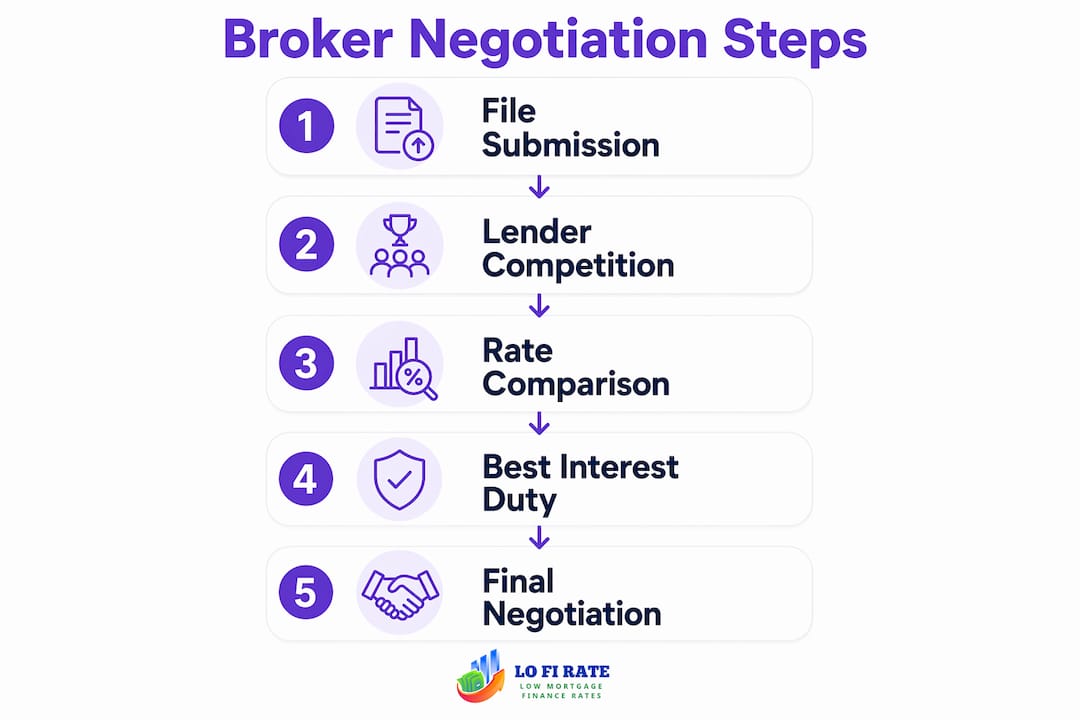
The core of how brokers negotiate rates comes down to one word: competition. A mortgage broker submits your financial profile to multiple lenders simultaneously, which forces those lenders to compete for your business. That competition produces better pricing than any single lender will offer you voluntarily.

Broker negotiation strategies go further than just collecting quotes. Skilled brokers use their knowledge of each lender's current appetite for specific loan types to target the right institutions at the right time. A lender that is actively trying to grow its jumbo loan portfolio, for example, will price those loans more aggressively than one that is not. Brokers know this because they work with these lenders every week.
What brokers negotiate on your behalf includes:
- Interest rate and annual percentage rate (APR): The headline number, but not the only one that matters.
- Origination fees and lender credits: Brokers can often trade a slightly higher rate for lender credits that reduce your closing costs, or vice versa.
- Loan structure: Fixed versus adjustable terms, interest-only periods, and prepayment penalties are all negotiable.
- Settlement timelines: A faster or more flexible closing date can be a bargaining chip with motivated sellers.
- Underwriting conditions: Brokers advocate for cleaner approvals by presenting your file strategically.
Since April 2021, Australian mortgage brokers operate under a Best Interests Duty that legally requires them to act in the client's favor rather than prioritizing lenders who pay higher commissions. While this specific regulation applies in Australia, it reflects a global shift toward broker accountability that U.S. regulators and industry bodies increasingly mirror through fiduciary standards and disclosure requirements.
Pro Tip: You can use a broker's market research to negotiate directly with your own bank without any obligation to proceed through the broker. This gives you free negotiating leverage with your existing lender while keeping all options open.
What negotiation skills from other broker fields benefit homeowners?
Mortgage brokers do not operate in isolation. The negotiation playbook they use draws from tactics proven across business brokerage and insurance brokerage, and understanding those parallels reveals just how much value a skilled broker brings to your financing deal.
Business brokers, for instance, secure 15 to 20% higher sale prices for their clients compared to owner-negotiated deals, even after accounting for their 10 to 12% commission fees. That gap exists because professional brokers negotiate complex structural terms that untrained buyers and sellers overlook entirely. They push on seller financing arrangements, transition assistance periods, and contingency structures that change the total economics of a deal without ever touching the headline price. Mortgage brokers apply the same logic: the rate you see on day one is rarely the final number, and the terms surrounding it matter just as much.
Insurance brokers demonstrate a different but equally relevant skill. They save clients an average of $500 or more annually by accessing multiple carriers and negotiating bundled policy rates. More importantly, they act as claims advocates after the policy is in place, escalating disputes to protect client entitlements. That ongoing advocacy role mirrors what a good mortgage broker does through closing and beyond, protecting agreed terms against late-stage lender changes.
The table below shows how negotiation skills transfer across broker types and what they mean for your mortgage deal.
| Broker type | Core negotiation skill | Mortgage equivalent |
|---|---|---|
| Business broker | Structural deal terms and contingencies | Loan structure, fees, and closing conditions |
| Insurance broker | Multi-carrier competition and claims advocacy | Multi-lender competition and rate lock protection |
| Mortgage broker | Rate, APR, and lender credit optimization | Total cost of financing over loan life |
Strategic compromise is the skill that ties all three together. Effective brokers do not burn lender relationships chasing marginal gains. They preserve goodwill so that the same lender will offer favorable terms on your next refinance or purchase. That long-term thinking is something a one-time borrower negotiating alone simply cannot replicate.
Pro Tip: When interviewing a mortgage broker, ask specifically how they handle lender pushback on fees. A broker who can describe a real example of [negotiating lender credits](https://blog.lofirate.com/blog/how brokers can help you save more on mortgages) or waived fees is demonstrating real negotiation experience, not just access to a rate sheet.
How do brokers protect your interests beyond the rate?
The importance of brokers in negotiations becomes clearest not at the moment of application but during the weeks between approval and closing. That period is where deals fall apart, terms shift, and borrowers who negotiated alone find themselves without anyone in their corner.
Broker-mediated negotiations reduce deal collapse from emotional reactions from 28% down to 7%. That is a dramatic difference, and it comes entirely from having a professional manage the communication between parties. When a lender comes back with a last-minute condition or a rate lock extension fee, a broker absorbs that friction, evaluates the options, and presents you with a clear path forward rather than a stressful ultimatum.
Brokers protect your interests in several concrete ways:
- Rate lock management: Brokers monitor lock expiration dates and negotiate extensions before they become costly surprises.
- Condition clearing: When underwriters request additional documentation, brokers know exactly what to provide and how to frame it.
- Fee auditing: Brokers review the final Closing Disclosure against the Loan Estimate to catch unauthorized fee increases before you sign.
- Lender coordination: Brokers manage communication among lenders, title companies, and real estate attorneys so nothing falls through the gaps.
The true value of broker involvement is realized during these post-agreement phases, where protecting terms, pace, and cash at close determines whether a good deal stays good. A borrower who locked a great rate but then paid unexpected fees at closing did not actually win the negotiation.
What steps can homebuyers take to leverage broker expertise?
Working with a broker effectively requires preparation on your end. The stronger your financial profile, the more leverage your broker has when presenting your file to lenders.
- Pull your credit report before you call a broker. Errors on your credit report reduce your negotiating position before the conversation even starts. Dispute any inaccuracies through Equifax, Experian, or TransUnion at least 60 days before applying.
- Gather documentation in advance. Two years of W-2s or tax returns, recent pay stubs, bank statements, and asset documentation let your broker present a complete, clean file. Lenders price risk, and a well-documented borrower looks like less of it.
- Ask the broker how many lenders they work with. A broker with access to 30 or more wholesale lenders has more competitive leverage than one working with five. More lender options means more genuine competition for your loan.
- Clarify the broker's compensation structure. Brokers are compensated either through lender-paid compensation or borrower-paid compensation. Understanding which model your broker uses helps you evaluate whether their incentives align with yours.
- State your priorities clearly. Tell your broker whether you want the lowest possible rate, the lowest closing costs, or the fastest closing. Different goals require different negotiation strategies, and your broker cannot optimize for a goal they do not know.
The role of agents in rate discussions extends to real estate transactions as well, where buyer's agents and mortgage brokers often coordinate to strengthen your overall offer. A lower rate can increase your purchasing power, which in turn improves your position in competitive markets.
Pro Tip: If you already have a relationship with a bank, ask your broker to get competing offers first. Then bring those offers to your bank and ask them to match or beat the best one. You get [broker-sourced leverage](https://blog.lofirate.com/blog/why mortgage brokers secure better rates homebuyers) without necessarily switching lenders.
Key takeaways
Mortgage brokers deliver measurable value in rate negotiations by combining lender competition, structural deal expertise, and ongoing advocacy that individual borrowers cannot replicate alone.
| Point | Details |
|---|---|
| Brokers create lender competition | Submitting your file to multiple lenders forces better pricing than any single bank will offer voluntarily. |
| Negotiation covers more than rate | Fees, loan structure, closing timelines, and lender credits are all negotiable through a skilled broker. |
| Emotional buffering reduces deal failures | Broker-mediated deals collapse at 7% versus 28% in direct negotiations, protecting your closing. |
| Legal duties protect your interests | Best Interests Duty standards require brokers to prioritize your benefit over lender commission incentives. |
| Preparation strengthens your position | Clean credit, complete documentation, and clear priorities give your broker the strongest possible negotiating file. |
Why I think most borrowers underestimate what a broker actually does
Most homebuyers think a mortgage broker's job ends when the rate is quoted. That misunderstanding costs people real money. The negotiation does not stop at the rate sheet. It continues through underwriting, through the rate lock period, through the Closing Disclosure review, and sometimes through last-minute lender requests that would derail an unprepared borrower.
What I have seen repeatedly is that borrowers who go directly to a retail bank often accept the first approval they receive because the process feels overwhelming and they do not know what is negotiable. A broker changes that dynamic entirely. They know which fees are standard and which are padded. They know when a lender is being inflexible because of policy versus because they think the borrower will not push back.
The cross-industry evidence makes this concrete. Business brokers consistently outperform owner negotiations by 15 to 20% on price. Insurance brokers save clients hundreds annually just through carrier access. Mortgage brokers operate with the same structural advantage: information asymmetry. They know things about lender pricing, appetite, and flexibility that you do not, and they use that knowledge on your behalf.
My honest view is that the borrowers who benefit most from broker involvement are not the ones with complicated financial situations. They are the ones who think their situation is simple enough that they do not need help. Those are exactly the borrowers who leave money on the table.
— LoFi
Find a broker who negotiates, not just quotes

Lofirate connects homebuyers and homeowners with licensed wholesale mortgage brokers who access multiple lenders to compete for your loan. These are not retail loan officers limited to one bank's pricing. They are independent brokers with the lender relationships and negotiation experience to secure better rates and terms than most borrowers find on their own. Whether you are purchasing your first home or refinancing an existing mortgage, a no-obligation consultation through Lofirate's broker matching service gives you a clear picture of what the wholesale market can offer. You can also explore available loan options to understand which financing structures your broker can negotiate on your behalf.
FAQ
What is the role of brokers in rate negotiation?
A mortgage broker negotiates interest rates, fees, loan structure, and closing terms with multiple lenders simultaneously to secure the most favorable financing package for the borrower. Their value comes from lender access, market knowledge, and the ability to create genuine competition for your loan.
How do brokers negotiate rates differently than borrowers going direct?
Brokers submit a borrower's file to multiple wholesale lenders at once, forcing those lenders to compete on price and terms. A borrower going directly to a single bank receives only that bank's standard pricing with no competitive pressure applied.
Are brokers legally required to act in my best interest?
In Australia, the Best Interests Duty enacted in April 2021 legally requires mortgage brokers to prioritize client benefit over lender commission. U.S. regulations vary by state and loan type, but licensed brokers are subject to disclosure requirements and fiduciary standards that align their incentives with yours.
Can I use a broker's research without committing to their loan?
Yes. You can use a mortgage broker's market research and competing lender quotes to negotiate directly with your own bank, with no obligation to proceed through the broker's recommended lender. This gives you real negotiating leverage at no cost.
What should I ask a mortgage broker before hiring them?
Ask how many wholesale lenders they work with, how they are compensated, and for a specific example of a fee or rate they negotiated down for a recent client. A broker who can answer all three clearly has the experience and transparency worth your time.