

TL;DR:
- A mortgage budget is the total monthly cost you can afford based on your income, debts, and savings.
- It includes principal, interest, taxes, insurance, PMI, HOA fees, and maintenance costs for a complete picture.
A mortgage budget is the total monthly housing cost you can afford based on your income, debts, and savings. Knowing how to calculate mortgage budget figures correctly keeps you from borrowing more than your finances can handle. Most first-time buyers focus on the purchase price, but lenders and financial planners focus on the monthly payment. This guide walks you through every cost component, the key ratios lenders use, and a step-by-step process to find a number that works for your real life, not just on paper.
What costs to include when calculating your mortgage budget
Your monthly mortgage payment is not just principal and interest. The full cost is known in the industry as PITI, which stands for Principal, Interest, Taxes, and Insurance. PITI plus PMI forms the complete monthly housing cost lenders evaluate when reviewing your application.
Here is what each component means:
- Principal: The portion of your payment that reduces your loan balance.
- Interest: The cost of borrowing, calculated on your remaining balance each month.
- Property taxes: Collected monthly through an escrow account and paid to your local government annually. Tax rates vary widely by county and city.
- Homeowners insurance: Required by every lender. Escrow bundles this with taxes so you pay one combined amount monthly.
- Private mortgage insurance (PMI): Required when your down payment is under 20%. PMI protects the lender, not you, and adds a meaningful cost to your monthly bill.
- HOA fees: If you buy in a community with a homeowners association, these fees are mandatory and non-negotiable.
- Maintenance and repairs: Not collected by your lender, but a real monthly cost you must plan for.
Pro Tip: Budget for all seven components above, not just principal and interest. Buyers who skip taxes, insurance, and maintenance often find their real monthly cost is hundreds of dollars higher than they expected.
Escrow accounts simplify payment by bundling taxes and insurance into one monthly transfer. The convenience is real, but it also means your payment can increase each year when tax assessments or insurance premiums rise.
How do income and debt ratios determine a safe mortgage budget?
Lenders use two ratios to decide how much they will lend you. Understanding both helps you set a budget that satisfies lenders and protects your lifestyle.
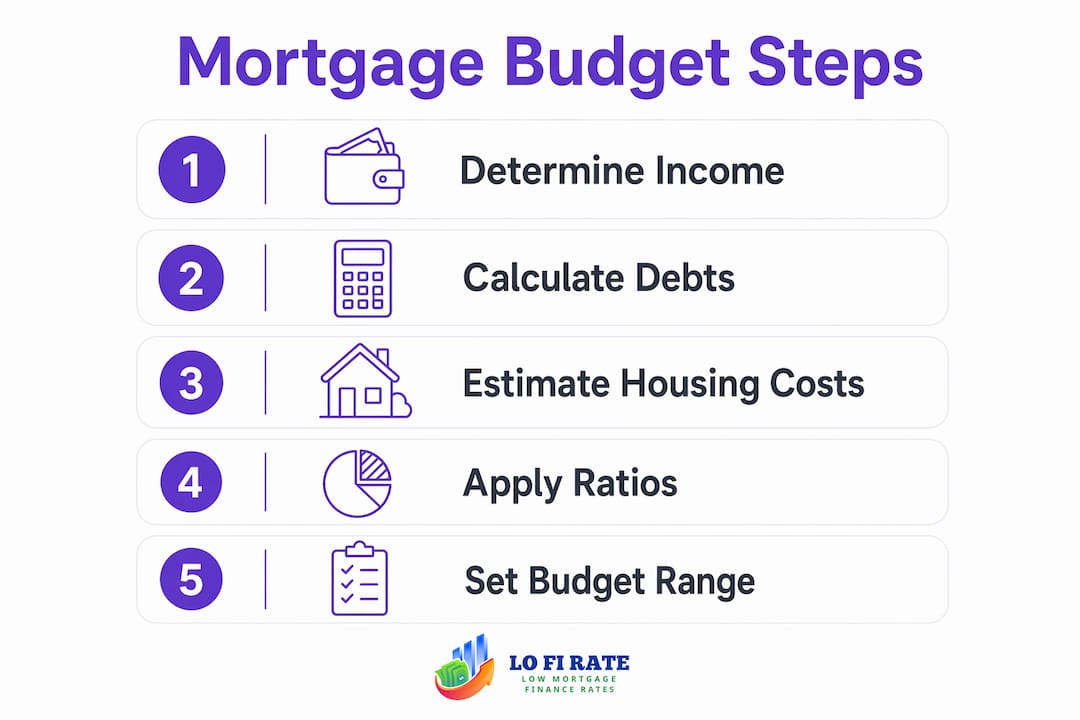
The 28/36 rule is the standard starting point. It states that your monthly housing costs should not exceed 28% of your gross monthly income, and your total monthly debts should not exceed 36%. For a household earning $120,000 per year, that means a maximum housing cost of $2,800 per month and total debts capped at $3,600 per month. Those are ceiling numbers, not targets.
Here is how to apply the ratios step by step:
- Calculate your gross monthly income. Divide your annual pre-tax salary by 12. If you earn $90,000 per year, your gross monthly income is $7,500.
- Find your front-end limit. Multiply gross monthly income by 0.28. For $7,500, that is $2,100 maximum for housing costs.
- Find your back-end limit. Multiply gross monthly income by 0.36. For $7,500, that is $2,700 maximum for all debts combined.
- Add up your existing monthly debts. Include credit cards, student loans, car payments, and any other recurring obligations.
- Subtract existing debts from your back-end limit. The remaining amount is the maximum housing payment your debt load allows.
- Take the lower of the two results. The front-end and back-end limits both apply. Use whichever number is smaller.
Some lenders approve loans up to a 43% back-end DTI, and certain government-backed programs go higher. A higher DTI approval does not mean a higher DTI is safe for your budget.
Pro Tip: Lenders calculate affordability using gross income, but you live on take-home pay. Run your numbers against your actual monthly take-home to avoid being house-poor. A lender-approved amount and a comfortable amount are often two very different figures.
How to use a mortgage budget calculator step by step
Starting with a monthly payment you can afford, then working backward to a home price, is more accurate than starting with a price and hoping the payment fits. A mortgage budget calculator makes this process fast and concrete.

Inputs you need before opening any calculator:
| Input | What to use |
|---|---|
| Gross monthly income | Pre-tax income for all borrowers |
| Monthly debts | Credit cards, loans, car payments |
| Down payment amount | Cash available after reserves |
| Interest rate | Current market rate or lender quote |
| Loan term | Typically 30 or 15 years |
| Property tax rate | Check your county assessor's website |
| Homeowners insurance estimate | Get a quote or use a local average |
| HOA fees | Listed in the property listing |
Step-by-step process:
- Enter your gross monthly income and all monthly debts. The calculator uses these to compute your DTI ratios automatically.
- Enter your down payment. A larger down payment lowers your loan amount and may eliminate PMI.
- Input the interest rate and loan term. Even a 0.5% rate difference changes your monthly payment by a meaningful amount on a $400,000 loan.
- Add property taxes, insurance, and HOA fees. Including HOA fees and PMI where applicable gives you a far more accurate affordability estimate than principal and interest alone.
- Read the output. Look at the maximum home price, estimated monthly payment, and your calculated DTI ratio.
- Run three scenarios: conservative (lower rate, smaller loan), expected (current rate, target price), and stretch (higher rate, larger loan). Scenario planning across variables like interest rates and down payments gives you a realistic range rather than a single fragile number.
- Compare your calculator output to any lender Loan Estimate you receive. Local tax and insurance variations mean calculator estimates and lender quotes will differ. The Loan Estimate is the more accurate document.
Keep your emergency fund separate from your down payment. Emergency reserves and down payment funds serve different purposes, and mixing them leaves you financially exposed after closing.
Common mistakes when budgeting for a home loan
Most first-time buyers make the same errors. Knowing them in advance saves real money.
- Ignoring maintenance costs. Industry guidance recommends budgeting 1% of home value annually for upkeep. On a $350,000 home, that is $3,500 per year, or roughly $292 per month.
- Forgetting utilities. A larger home costs more to heat, cool, and power. Utilities are not in any mortgage calculator by default.
- Trusting lender approval as a budget. Lenders approve based on gross income and do not account for your grocery bills, childcare, or retirement contributions. Affordability includes lifestyle costs that calculators cannot measure.
- Overlooking PMI. Buyers who put down less than 20% pay PMI every month until they reach sufficient equity. This cost is real and can exceed $100 to $200 per month on a mid-sized loan.
- Skipping closing costs. Closing costs typically run 2% to 5% of the loan amount. They must come from savings, not your down payment fund.
- Setting a single fixed budget number. A budget range is more reliable than one figure because rates, taxes, and insurance all shift before closing day.
Pro Tip: Build your mortgage budget as a range with a floor, a target, and a ceiling. If the ceiling payment would stress your monthly finances, the ceiling home price is too high.
How to adjust your mortgage budget for different scenarios
Your budget is not a one-time calculation. Rates move, income changes, and life happens between your first calculator session and your closing date.
- Model rate changes. Run your calculator at your current rate, then at a rate 0.5% and 1% higher. Know what your payment looks like if rates rise before you lock.
- Increase your down payment. A larger down payment reduces your loan balance, lowers your monthly payment, and can eliminate PMI entirely. Even an extra $10,000 down makes a measurable difference on a 30-year loan.
- Reduce existing debts before applying. Paying off a car loan or credit card balance improves your DTI ratio and may qualify you for a better rate.
- Plan for tax and insurance increases. Property taxes are reassessed regularly in most states. Budget for a modest annual increase rather than assuming your payment stays flat.
- Evaluate the stretch scenario honestly. A stretch budget might get you the home you want, but it leaves no room for job changes, medical costs, or economic shifts. Conservative budgeting protects long-term financial health far better than maximizing your approval amount.
Reviewing your mortgage qualification guidelines before you apply gives you a clear picture of where you stand and what adjustments will have the biggest impact.
Key Takeaways
Calculating your mortgage budget accurately requires totaling all housing costs, applying income and debt ratios, and stress-testing your numbers across multiple scenarios before you commit.
| Point | Details |
|---|---|
| Use PITI plus PMI | Include principal, interest, taxes, insurance, and PMI for a complete monthly cost picture. |
| Apply the 28/36 rule | Keep housing costs below 28% of gross income and total debts below 36%. |
| Start with monthly payment | Calculate an affordable monthly payment first, then work backward to a home price. |
| Run three scenarios | Model conservative, expected, and stretch inputs to build a reliable budget range. |
| Budget for maintenance | Set aside 1% of home value annually for repairs and upkeep beyond your mortgage payment. |
What I've learned from watching buyers trust lender numbers too much
The most common mistake I see is treating lender approval as a budget. A lender's job is to approve the maximum loan you qualify for based on your gross income and credit profile. Your job is to figure out what payment you can actually live with after taxes, groceries, childcare, and savings contributions come out of your paycheck.
I have seen buyers approved for $500,000 loans who were genuinely comfortable at $380,000. The difference was not income. It was lifestyle. They had gym memberships, travel habits, and retirement goals that a DTI ratio cannot see. When they bought at the top of their approval, they stopped doing the things that made their lives good.
The tools exist to do this right. A mortgage budget calculator, a realistic look at your take-home pay, and a conversation with a wholesale mortgage broker who shops multiple lenders will get you further than any single lender's pre-approval letter. Pre-approval tells you the ceiling. Your budget tells you the floor. Buy somewhere in between, and you will be fine.
Seek a second opinion before you finalize any number. Retail lenders quote one rate. Wholesale brokers access multiple lenders and often find pricing that changes the math on what you can comfortably afford. That difference in rate can shift your monthly payment enough to matter.
— LoFi
Lofirate connects you with wholesale mortgage rates
Calculating your budget is step one. Finding the rate that makes that budget work is step two.

Lofirate connects first-time buyers with licensed wholesale mortgage brokers who shop multiple lenders to find competitive pricing. Retail lenders offer only their own rates. Wholesale brokers access a wider market, and that difference often translates to a lower monthly payment on the same loan. Visit Lofirate for a no-obligation consultation, or review the full range of broker matching services to see how wholesale access works. There is no cost to connect, and the comparison could change your budget calculation entirely.
FAQ
What is a mortgage budget?
A mortgage budget is the maximum monthly housing cost you can afford based on your income, debts, and savings. It includes principal, interest, taxes, insurance, and PMI where applicable.
How do I calculate how much mortgage I can afford?
Multiply your gross monthly income by 0.28 to find your front-end housing limit, then subtract existing monthly debts from your back-end limit (gross income times 0.36) to confirm the number holds.
What is the 28/36 rule for mortgage budgeting?
The 28/36 rule states that monthly housing costs should not exceed 28% of gross income and total debts should not exceed 36%. Lenders use this as a baseline for approval decisions.
Should I use a mortgage budget calculator or a lender estimate?
Use both. A mortgage payment estimator gives you a fast starting range, but a lender Loan Estimate reflects actual local taxes, insurance, and fees. Compare the two before committing to a price.
What costs do most buyers forget when budgeting for a home loan?
Maintenance, utilities, and closing costs are the most commonly overlooked expenses. Budget 1% of home value annually for maintenance, and plan for closing costs of 2% to 5% of the loan amount on top of your down payment.