

TL;DR:
- Mortgage insurance enables homeownership with down payments as low as 3% to 5%.
- It increases monthly payments but can be removed once sufficient equity is built.
- Understanding and strategically managing mortgage insurance saves money and shortens the path to equity.
Most people assume you need a 20% down payment to buy a home. That belief keeps millions of potential buyers on the sidelines, saving for years while home prices climb. The reality is that mortgage insurance exists precisely to bridge that gap. It lets buyers enter the market with as little as 3% to 5% down, and while it adds to your monthly cost, it can also mean buying a home years earlier than you thought possible. This guide breaks down exactly what mortgage insurance is, when you'll need it, how it affects your payments, and how to get rid of it once you've built enough equity.
Table of Contents
- What is mortgage insurance and why does it exist?
- When is mortgage insurance required?
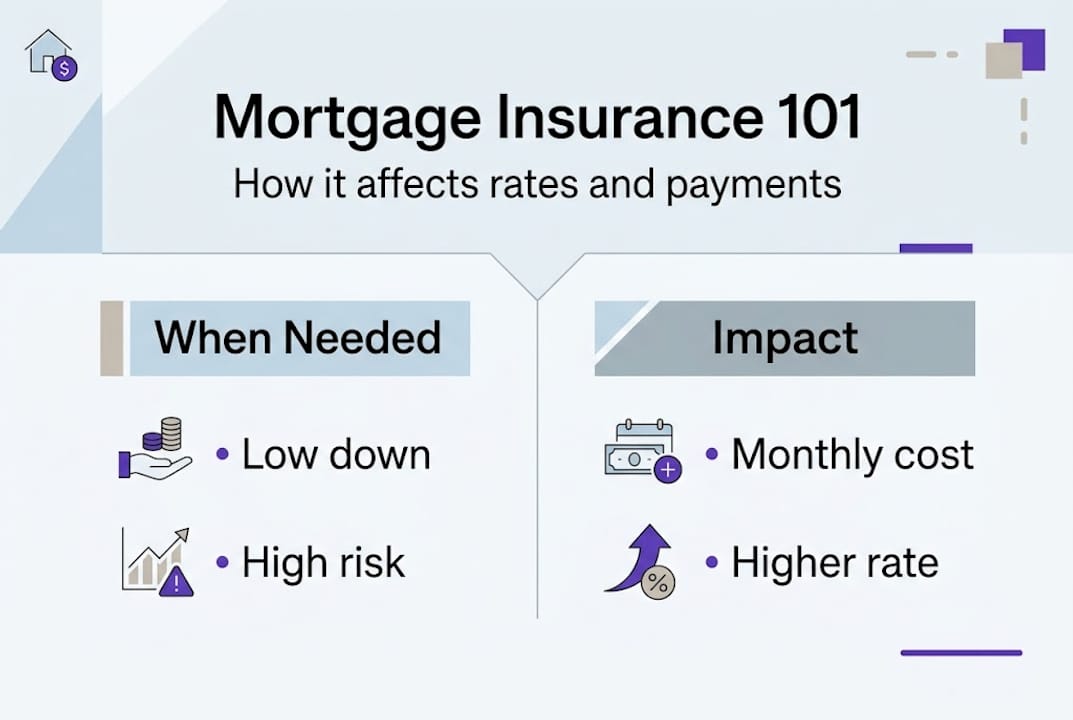
- How does mortgage insurance affect your payments?
- How and when can you remove mortgage insurance?
- The uncomfortable truth about mortgage insurance
- Explore your loan options with expert guidance
- Frequently asked questions
Key Takeaways
| Point | Details |
|---|---|
| Lenders require MI for risk | Mortgage insurance protects lenders when you put down less than 20%. |
| Adds to monthly costs | PMI will raise your monthly payments but allows for lower down payments. |
| Can be removed with equity | You can eliminate PMI by reaching 20% home equity or through refinancing. |
| Different loan types, different rules | MI rules and costs vary between conventional, FHA, VA, and USDA loans. |
What is mortgage insurance and why does it exist?
Mortgage insurance is a policy that protects your lender, not you, if you stop making payments and default on your loan. Think of it this way: when a lender gives you a mortgage with a small down payment, they're taking on more risk. If you default early in the loan, they haven't recouped enough to cover their losses. Mortgage insurance is how lenders manage that risk and still agree to lend.
Mortgage insurance protects lenders from borrower default on high-LTV loans, meaning loans where the down payment is less than 20% on a conventional mortgage.
This is the part that surprises most buyers. You pay the premiums, but the lender collects the benefit. It feels counterintuitive, but it's the trade-off that makes low-down-payment loans possible at all. Without it, most lenders simply wouldn't offer those products.
There are several types of mortgage insurance depending on the loan program:
- Private Mortgage Insurance (PMI): Used on conventional loans when your down payment is below 20%.
- FHA Mortgage Insurance Premium (MIP): Required on all FHA loans, regardless of down payment size.
- VA Funding Fee: Not traditional insurance, but a one-time fee on VA loans that serves a similar purpose.
- USDA Guarantee Fee: Applied to USDA loans for rural and suburban buyers.
Understanding mortgage compliance requirements helps you see why these programs exist within a regulated framework designed to protect both lenders and the broader housing market. Each loan type carries its own insurance structure, which affects your costs differently.
The common myth is that mortgage insurance is a punishment for not saving enough. It's not. It's a financial tool that opens the door to homeownership. Lenders price lender roles and risk into every loan they offer, and mortgage insurance is simply one of the mechanisms they use to manage exposure on higher-risk loans.
Who pays? You do, as the borrower. Who benefits if something goes wrong? The lender. That dynamic is worth understanding clearly before you sign anything.
When is mortgage insurance required?
The simplest rule for conventional loans: if your down payment is less than 20%, expect to pay PMI. That 20% threshold represents an 80% loan-to-value ratio (LTV), which is the point where most lenders consider the loan low enough risk to drop the insurance requirement.
For first-time buyers especially, hitting that 20% mark can feel impossible in high-cost markets. That's where understanding your loan options matters most. Here's a quick comparison of how mortgage insurance works across the four major loan types:
| Loan type | Insurance type | When required | Can it be removed? |
|---|---|---|---|
| Conventional | PMI | LTV above 80% | Yes, at 80% LTV |
| FHA | MIP | All loans | Only by refinancing |
| VA | Funding fee | One-time upfront | N/A (no monthly MI) |
| USDA | Guarantee fee | All loans | Limited options |
According to Experian, PMI is most common when buyers put down less than 20% on a conventional loan, which describes the majority of first-time homebuyers in 2026.
FHA loans are a popular choice for buyers with lower credit scores or smaller savings, but they come with a catch: you pay mortgage insurance for the life of the loan if your down payment is less than 10%. VA and USDA loans have their own fee structures but no ongoing monthly mortgage insurance, which makes them highly valuable if you qualify.
Not sure whether you'll need mortgage insurance on your loan? Follow these steps:
- Calculate your expected down payment as a percentage of the purchase price.
- Identify which loan type you're likely to use based on your credit and income.
- Check your LTV ratio. Above 80% on a conventional loan means PMI applies.
- Review the mortgage pre-approval process to get a real picture of your loan options.
- Ask your lender or broker to show you the total cost with and without MI across different loan types.
Understanding mortgage qualification steps early in the process helps you plan your down payment strategy around the actual numbers, not guesswork. And knowing how LTV affects rates gives you leverage when comparing loan offers.
How does mortgage insurance affect your payments?
Mortgage insurance shows up in your budget in a very direct way: it adds to your monthly payment. PMI typically costs between 0.5% and 1.5% of your original loan amount per year, divided into monthly installments. On a $350,000 loan, that's roughly $145 to $437 per month added to your mortgage bill.

Here's a side-by-side look at what that means in real numbers:
| Scenario | Loan amount | PMI rate | Monthly PMI | Total monthly payment (est.) |
|---|---|---|---|---|
| 5% down | $332,500 | 1.0% | $277 | Higher |
| 10% down | $315,000 | 0.7% | $184 | Moderate |
| 20% down | $280,000 | None | $0 | Lower |
The PMI cost on monthly payments is real, but it's not the whole story. There's also lender-paid mortgage insurance (LPMI), where the lender covers the MI premium in exchange for a higher interest rate on your loan. This can look attractive because your monthly payment appears lower, but you pay more over time through a permanently higher rate.
Here's how MI influences your overall borrowing costs beyond the monthly line item:
- Higher qualifying thresholds: MI payments count toward your debt-to-income ratio, which can affect how much you qualify for.
- Rate impact with LPMI: A higher rate from LPMI means more interest paid over the life of the loan.
- Upfront premiums: Some loan types charge an upfront MI premium at closing in addition to monthly costs.
- Total loan cost: Even modest MI payments add up to thousands of dollars over several years.
Pro Tip: Use an online mortgage calculator to model your total payment with and without MI at different down payment levels. Compare the monthly savings of waiting to save 20% against the cost of entering the market sooner with MI. The math often surprises people.
Reviewing a full mortgage rate breakdown alongside your MI costs gives you the complete picture. And understanding mortgage origination insights helps you see where fees are built into your loan structure from the start.
How and when can you remove mortgage insurance?
You're not stuck with mortgage insurance forever. Here's the practical path to getting rid of it.
For conventional loans with PMI, federal law under the Homeowners Protection Act requires your lender to automatically cancel PMI once your loan balance reaches 78% of the original purchase price, assuming you're current on payments. You don't have to do anything at that point. But you can request cancellation earlier, once you reach 80% LTV, by contacting your servicer and meeting their requirements.
The PMI removal process typically involves demonstrating that your loan balance has dropped to 80% of the home's original value, or its current appraised value in some cases.
Here's how to check your equity and start the removal process:
- Pull your most recent mortgage statement to find your current loan balance.
- Estimate your home's current value using recent comparable sales in your area.
- Divide your loan balance by the home's value to calculate your current LTV.
- If you're at or below 80% LTV, contact your loan servicer in writing to request PMI cancellation.
- Be prepared to pay for a formal appraisal if your servicer requires one to confirm the value.
FHA loans work differently. If you put down less than 10%, MIP stays for the life of the loan. The most effective way to remove it is to refinance your mortgage into a conventional loan once you've built enough equity. This strategy makes the most sense when rates are favorable and your credit has improved.
Pro Tip: Making extra principal payments each month accelerates equity growth and can move your PMI cancellation date up by months or even years. Even an extra $100 per month toward principal can shave significant time off your MI obligation.
Understanding mortgage rate rules also matters when you're considering a refinance to eliminate MI, since the rate you qualify for will determine whether the move actually saves you money.
The uncomfortable truth about mortgage insurance
Here's what most articles won't tell you: the buyers who obsess over avoiding mortgage insurance at all costs often end up worse off than those who use it strategically.
Waiting to save a full 20% down payment in a market where home prices rise 4% to 6% annually means the finish line keeps moving. The home you could buy today for $350,000 might cost $390,000 by the time you've saved enough to avoid PMI. The MI you were trying to avoid would have cost you far less than that price increase.
Most buyers also underestimate how quickly they can build equity, especially in appreciating markets. A home that gains value faster than expected can push you past the 80% LTV threshold sooner than your amortization schedule suggests. That's equity working for you, not against you.
The smarter frame is this: mortgage insurance is the cost of entry, not a long-term sentence. Strategic buyers focus on getting into the market at the right time and then aggressively building equity to exit MI as fast as possible. Understanding mortgage competition strategies can also help you find loan terms that minimize how long you carry MI in the first place.
Use MI intentionally. Know your removal timeline before you close. And don't let the fear of a temporary cost keep you out of a long-term asset.
Explore your loan options with expert guidance
Mortgage insurance doesn't have to be a mystery or a burden you just accept. Understanding how it works puts you in control of your costs and your timeline. The right loan structure can minimize how much MI you pay and how long you pay it.

At LoFiRate.com, we connect you with licensed wholesale mortgage brokers who can show you every loan option available in your state, including how MI factors into your total cost. Whether you're buying your first home or exploring a refinance to eliminate existing MI, our brokers shop multiple lenders to find the most competitive terms. Explore your loan options or learn more about our mortgage broker services. You can also compare best mortgage rates through our platform with no obligation.
Frequently asked questions
Can you avoid paying mortgage insurance on a new home purchase?
You can avoid mortgage insurance by making a down payment of at least 20% on a conventional loan, or by qualifying for a VA or USDA loan, which have different fee structures instead of traditional monthly MI.
Does mortgage insurance protect me as the homeowner?
No, mortgage insurance is designed to protect lenders from default, not to cover your property, your personal finances, or any missed payments on your part.
Can mortgage insurance affect my mortgage interest rate?
Yes, lender-paid mortgage insurance (LPMI) can result in a higher mortgage rate built into your loan, so always compare the total cost of borrower-paid versus lender-paid options before deciding.
How do I remove mortgage insurance from my loan?
For conventional loans, you can request removal at 80% LTV or it cancels automatically at 78% equity; for FHA loans, refinancing into a conventional loan is typically the most effective path to eliminating MI entirely.