

Federal law requires lenders to give you two standardized forms before you close on a home: the Loan Estimate (LE) and the Closing Disclosure (CD). The LE arrives within 3 business days of your application. The CD must reach you at least 3 business days before closing. Those two deadlines, set by the TRID rule, are the backbone of every home loan disclosure requirement in the U.S.
Before you get to the checklist, watch for these red flags from the start:
- An APR that changes beyond regulatory tolerance thresholds on a fixed-rate loan or an ARM after the CD is issued, which triggers a new 3-business-day waiting period
- A "Cash to Close" figure on the CD that differs materially from the LE without explanation
- Missing seller credits that were negotiated in the purchase contract
- A loan product switch (e.g., fixed to ARM) that appears without a revised LE
These aren't minor paperwork issues. Each one can delay your closing or cost you money you didn't budget for.
Table of Contents
- What does the Closing Disclosure cover, and how do you compare it to the LE?
- Does TRID apply to your loan? Know the exceptions
- What Regulation Z actually requires on the LE and CD, line by line
- How do tolerance categories work, and what fee changes are allowed?
- Other federal rules that intersect with mortgage disclosures
- What to do if your lender missed a deadline or the disclosure has errors
- Key Takeaways
- Why accurate disclosures matter more than most borrowers realize
- Authoritative sources for mortgage disclosure rules
What does the Closing Disclosure cover, and how do you compare it to the LE?
The Closing Disclosure is the final statement of your loan terms and actual closing costs, required under Regulation Z §1026.38. Where the LE is an estimate, the CD is the real number. Any meaningful difference between the two deserves a direct question to your lender before you sign anything.
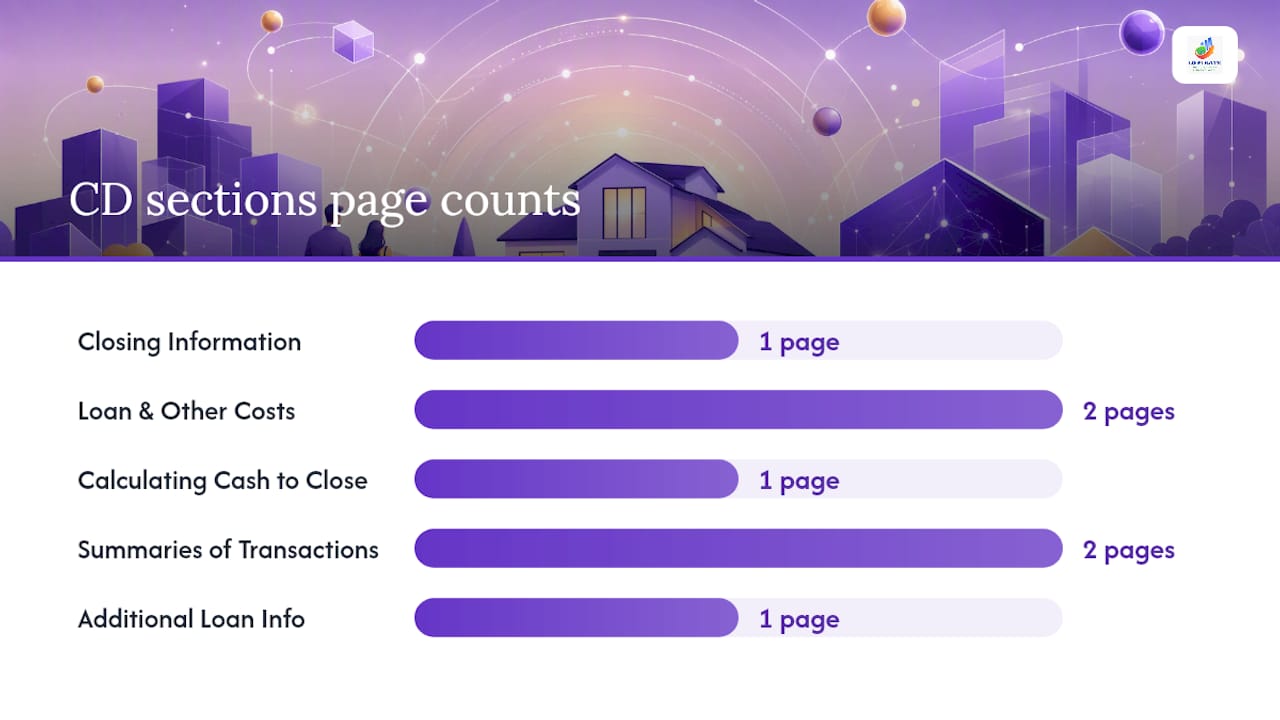
The CD's structure mirrors the LE but adds transaction-level detail:
- Closing Information / Transaction Information (Page 1): closing date, disbursement date, settlement agent, property address, and sale price.
- Loan Terms table (Page 1): same fields as the LE. If the loan amount, rate, or prepayment penalty status changed, you need to know why.
- Projected Payments (Page 1): final monthly payment breakdown.
- Costs at Closing (Page 1): total closing costs and cash to close.
- Loan Costs and Other Costs (Pages 2–3): itemized fees, same categories as the LE.
- Calculating Cash to Close (Page 3): a side-by-side comparison with the LE figure.
- Summaries of Transactions (Pages 3–4): seller credits, earnest money, payoffs, and adjustments. This is where missing seller credits show up.
- Additional Information About This Loan (Page 5): contact info, liability after foreclosure, refinance information, and tax deductibility note.
The CFPB's sample CD forms are the best reference for seeing exactly how each page should look.
Checklist: comparing your CD to the LE
- Confirm the loan amount matches the LE exactly.
- Verify the interest rate and loan type (fixed vs. ARM) are unchanged.
- Check the APR. A change beyond tolerance triggers redisclosure (see the next section).
- Compare total closing costs line by line. Flag any new fees not on the LE.
- Confirm the Cash to Close figure. A higher number needs an explanation.
- Verify all seller credits from your purchase contract appear in the Summaries of Transactions.
- Review the escrow setup. Confirm the monthly escrow amount and initial deposit match your expectations.
For a page-by-page breakdown of the CD, Lofirate's complete guide to mortgage Closing Disclosures covers every table in detail.
Does TRID apply to your loan? Know the exceptions
TRID covers most closed-end consumer mortgage loans secured by real property. That includes purchase loans, refinances, construction loans, and most second mortgages. But several common loan types fall outside TRID's scope, and borrowers in those categories receive different disclosures.
Loans TRID does NOT cover:
- HELOCs (home equity lines of credit): these are open-end credit and use a different disclosure regime under Regulation Z.
- Reverse mortgages: subject to separate disclosure requirements. If you're exploring this option, reverse mortgage counseling requirements explain the distinct rules that apply.
- Mortgages secured by mobile homes or manufactured housing not attached to real property: these use older Truth-in-Lending disclosures.
- Loans made by creditors who originate five or fewer mortgages per year: a lender at that volume may not qualify as a "creditor" under Regulation Z and could be exempt from LE/CD requirements entirely.
That last point deserves attention. Private lenders, seller-financed transactions, and very small community lenders may not be subject to TRID. If you're working with a non-traditional lender, ask in writing which disclosure forms they are required to provide and under what timeline. Don't assume the 3-business-day rules apply.
Pro Tip: Ask any lender early in the process: "Are you required to provide a Loan Estimate and Closing Disclosure under TRID?" A creditor who hesitates or says no should prompt you to verify their licensing and origination volume before proceeding.
What Regulation Z actually requires on the LE and CD, line by line
Regulation Z §1026.37 and §1026.38 are the statutory sources for every field on the LE and CD. The forms are not suggestions. Lenders must use the model forms (H-24 for the LE, H-25 for the CD) or forms that are "substantially similar," and they must follow specific rounding rules: dollar amounts rounded to the nearest dollar, percentages to three decimal places for APR and interest rate.
"The regulation specifies not just what must be disclosed, but how it must be presented — including the sequence of information, the labels used, and the rounding methodology. Deviation from the model form is a compliance violation." — Federal Reserve, Regulation Z §1026.38 commentary
State-law disclosures can be included, but they must appear on separate pages attached after the federally required content. They cannot be embedded within the LE or CD pages themselves.
| Statutory Section | Form | Required Content |
|---|---|---|
| §1026.37(b) | LE | Loan Terms table: amount, rate, monthly P&I, prepayment penalty, balloon |
| §1026.37(c) | LE | Projected Payments: payment breakdown by period |
| §1026.37(f)–(h) | LE | Loan Costs, Other Costs, Calculating Cash to Close |
| §1026.37(l) | LE | Comparisons: APR, TIP, 5-year cost |
| §1026.38(b) | CD | Closing Information and Transaction Information |
| §1026.38(d) | CD | Costs at Closing: Loan Costs and Other Costs |
| §1026.38(e) | CD | Calculating Cash to Close (with LE comparison column) |
| §1026.38(j)–(k) | CD | Summaries of Transactions: borrower and seller sides |
The Cornell Law legal text for §1026.38 is the most accessible version of the full statutory language for practitioners who need to verify specific field requirements.
How do tolerance categories work, and what fee changes are allowed?
Not every fee difference between the LE and CD is a violation. TRID organizes fees into three tolerance buckets, and the rules for each are different.
Zero tolerance: These fees cannot increase from the LE to the CD at all. Any increase is a violation and the lender must cure it (refund the overcharge within three calendar years of consummation). Zero-tolerance items include:
- Origination charges (points, origination fees, application fees)
- Transfer taxes
- Fees for required services where the borrower used the lender's provider list
10% cumulative tolerance: The total of fees in this category can increase by up to 10% from LE to CD. Individual fees within the group can change, but the aggregate cannot exceed the 10% threshold. This category covers recording fees and fees for third-party services where the borrower chose a provider from the lender's written list.
No tolerance (unlimited): These fees can change without limit. They include prepaid interest, property insurance premiums, and amounts placed into escrow. The lender does not control these costs, so no tolerance cap applies.
Comparison checklist: LE vs. CD
- Pull out both forms and open to the Loan Costs and Other Costs pages.
- For each origination charge on the CD, confirm it matches the LE exactly. Any increase is a zero-tolerance violation.
- Add up all recording fees and third-party service fees. If the total exceeds the LE total by more than 10%, flag it.
- Verify that any fee that moved from "cannot shop for" to "can shop for" (or vice versa) is correctly categorized.
- If you find a violation, contact the lender in writing and request a corrected CD or a cure payment.
- If the lender does not respond within a reasonable time, file a complaint with the CFPB.
| Tolerance Category | Example Fees | Rule |
|---|---|---|
| Zero tolerance | Origination charges, transfer taxes | No increase permitted; lender must cure overages |
| 10% cumulative | Recording fees, third-party services (lender's list) | Aggregate increase capped at 10% |
| No tolerance | Prepaid interest, homeowner's insurance, escrow setup | Can change without limit |
For practical guidance on spotting fee discrepancies before they become closing-day surprises, Lofirate's article on hidden mortgage fees covers the most common patterns.
Other federal rules that intersect with mortgage disclosures
TRID is the most visible layer of mortgage compliance, but several other federal rules shape what lenders must document and disclose. The FDIC's mortgage lending compliance resources and CFPB mortgage resources page both organize these rules for practitioners.
- Ability-to-Repay / Qualified Mortgage (ATR/QM): Under the Dodd-Frank ATR rule, lenders must verify a borrower's ability to repay using documented evidence: W-2s, tax returns, pay stubs, or bank statements. This isn't a disclosure form, but the documentation gathered for ATR verification directly supports the accuracy of the income and payment figures that appear on the LE and CD.
- Home Mortgage Disclosure Act (HMDA): Requires covered lenders to collect and report data on mortgage applications and originations, including loan type, amount, applicant demographics, and pricing. HMDA data is public and used by regulators to identify fair-lending issues.
- HOEPA (High-Cost Mortgage Rules): Loans that exceed certain APR or fee thresholds trigger additional disclosure requirements and restrictions on loan terms. If your loan falls under HOEPA, you receive a separate high-cost mortgage disclosure at least three business days before consummation.
- Appraisal rules under ECOA: Lenders must provide a copy of any appraisal or valuation obtained for a first-lien mortgage promptly, and no later than three business days before consummation.
- Escrow and servicing rules (Regulation X): Lenders must provide an initial escrow account statement at or before closing, and servicers must send annual escrow account statements thereafter.
"Compliance with TRID alone is not sufficient. Lenders and brokers must also document ATR verification, maintain HMDA data, and meet HOEPA thresholds — all of which feed into the accuracy of the disclosures a borrower receives." — FDIC, Mortgage Lending Compliance
What to do if your lender missed a deadline or the disclosure has errors
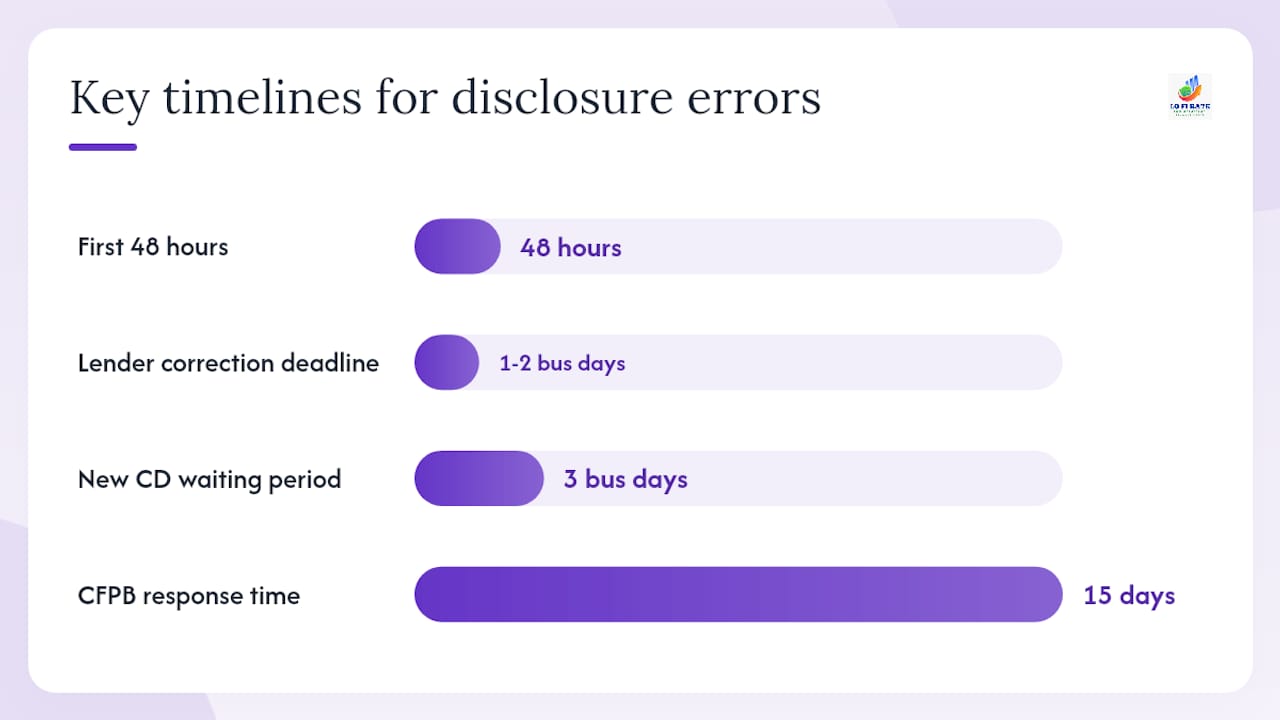
Errors on mortgage disclosures are more common than most borrowers expect, and the steps you take in the first 48 hours matter. Here's the sequence:
- Preserve everything. Save every version of the LE and CD you receive, including email timestamps. Screenshot the delivery date if you received the form electronically.
- Identify the specific error. Is it a tolerance violation (a fee that increased beyond the allowed threshold)? A missing seller credit? An APR that changed without redisclosure? Name the exact issue before you contact the lender.
- Contact the lender in writing. Email is better than a phone call because it creates a record. State the discrepancy, cite the specific line item, and ask for a corrected disclosure and a revised closing timeline if a new waiting period applies.
- Give the lender a reasonable deadline. One to two business days is reasonable for a straightforward correction. A material error in the loan product or APR may require a new CD and a fresh 3-business-day wait.
- Escalate if the lender doesn't respond. If you don't get a corrected form or a credible explanation, file a complaint with the CFPB at consumerfinance.gov/complaint. Include copies of both the LE and CD, your written correspondence with the lender, and a clear description of the discrepancy.
- Contact your state regulator. State banking or mortgage regulators can investigate licensed lenders operating in your state. The CFPB complaint portal routes complaints to the appropriate state agency when relevant.
Documents to assemble before contacting regulators:
- All versions of the LE and CD (with delivery dates)
- Your loan application confirmation
- Any written rate lock agreement
- Email or text correspondence with the lender about the discrepancy
- Your purchase contract (to verify seller credits and closing date)
Pro Tip: A CFPB complaint often prompts a faster response from the lender than a direct escalation. Lenders are required to respond to CFPB complaints within 15 days, and the CFPB publishes complaint data publicly, which creates real accountability.
Key Takeaways
Federal mortgage disclosure rules give borrowers two standardized forms, strict delivery deadlines, and enforceable tolerance limits that protect against last-minute fee surprises at closing.
| Point | Details |
|---|---|
| LE timing | Lenders must deliver the Loan Estimate within 3 business days of receiving your complete application. |
| CD timing | The Closing Disclosure must arrive at least 3 business days before your closing date. |
| Redisclosure triggers | APR changes beyond 0.125% (fixed) or 0.25% (ARM), a new prepayment penalty, or a loan product switch restart the 3-business-day CD wait. |
| Zero-tolerance fees | Origination charges and transfer taxes cannot increase from LE to CD; any overage must be cured by the lender. |
| TRID exceptions | HELOCs, reverse mortgages, and loans from creditors originating five or fewer mortgages per year are not covered by TRID. |
Why accurate disclosures matter more than most borrowers realize
Most borrowers treat the Loan Estimate and Closing Disclosure as paperwork to sign, not tools to use. That's a mistake that costs real money. The entire architecture of TRID was built around one insight: borrowers who can compare standardized numbers across lenders make better decisions. The monthly payment is almost never the right number to compare. The APR, the Total Interest Percentage, and the five-year cost figure on Page 3 of the LE tell you far more about what a loan actually costs over time.
At Lofirate, the reason we emphasize disclosure accuracy isn't regulatory caution. It's because the borrowers who get the best outcomes are the ones who read these forms carefully, ask questions when numbers change, and understand that a lender who resists correcting a tolerance violation is showing you something important about how they operate. A licensed wholesale mortgage broker, by contrast, shops multiple lenders and has a direct incentive to present competitive, accurate numbers from the start because their business depends on repeat referrals and clean closings.
If you're comparing loan offers and want a second set of eyes on the LE and CD figures you've received, Lofirate connects you with licensed wholesale mortgage brokers who can review your disclosures and identify whether the numbers you're seeing are competitive. No obligation, no pressure.

Authoritative sources for mortgage disclosure rules
The sources below are the primary references for every rule covered in this article. Bookmark the CFPB and Federal Reserve pages if you're a real estate professional who needs to verify specific requirements.
- Know Before You Owe: Mortgages | Consumer Financial Protection Bureau
- TILA-RESPA Integrated Disclosure: Guide to the Loan Estimate and Closing Disclosure forms
- SECTION 1026.37—Content of Disclosures for Certain Mortgage Transactions (Loan Estimate)
- SECTION 1026.38—Content of Disclosures for Certain Mortgage Transactions (Closing Disclosure)
- Mortgage resources | Consumer Financial Protection Bureau
- Mortgage Lending | FDIC.gov
This article provides general information about federal mortgage disclosure rules and is not legal or financial advice. Confirm current requirements with the CFPB, your state regulator, or a qualified mortgage professional before making decisions based on specific figures or deadlines.