

TL;DR:
- Lot loans finance vacant land purchases with higher down payments and shorter terms than home mortgages. The land type, credit score, and land conditions significantly affect qualification, interest rates, and costs. Alternative options like seller financing and construction loans can better serve buyers with specific needs or timelines.
A lot loan is a specialized loan designed to finance the purchase of vacant land or a lot without any existing structure on it. Unlike a standard home mortgage, a lot loan treats the land itself as the sole collateral, which means lenders scrutinize the parcel far more closely than they would a house. Down payments run higher, repayment terms run shorter, and interest rates sit above conventional mortgage pricing. If you plan to buy land before breaking ground, understanding how lot loans work is the first step toward securing the right financing.
What are lot loans and how do they work?
Lot loans are not standard 30-year mortgages. Primary lender focus is the land's build-readiness, not the borrower's future plans for it. Because no structure exists to back the loan, lenders carry more risk, and they price that risk into every term they offer.

The industry term you will encounter most often is "land loan," used interchangeably with lot loan. Lenders distinguish between two broad categories: loans for raw or unimproved parcels and loans for improved lots ready for construction. Each category carries different rates, down payment requirements, and approval criteria.
Repayment terms generally run 5–15 years, compared to the 30-year standard on home mortgages. Interest rates sit 1%–3% above conventional mortgage rates. That spread reflects the lender's view that vacant land is harder to sell quickly if a borrower defaults.
How does land type affect your loan terms?
The single biggest variable in vacant lot financing is the type of land you want to buy. Lenders sort parcels into three categories: raw land, unimproved land, and improved land. Each category carries a different risk level, and that risk translates directly into down payment requirements and interest rates.
Raw land is completely undeveloped with no road access, no utilities, and no clear path to construction. It carries the highest lender risk. Unimproved land has some infrastructure nearby but lacks direct connections to utilities or paved roads. Improved land has road access, utility hookups at or near the property line, and is ready for a builder to start work.
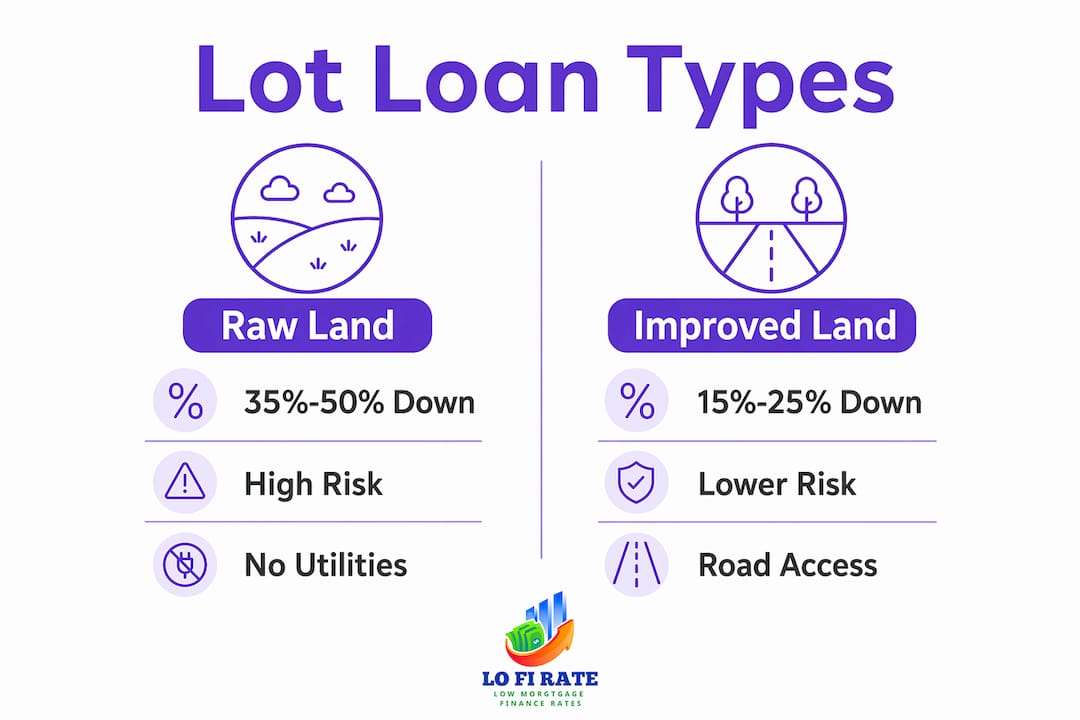
Down payment requirements reflect these risk levels directly:
| Land type | Typical down payment | Risk level | Key lender concern |
|---|---|---|---|
| Raw land | 35%–50% | Highest | No access, no utilities, no zoning clarity |
| Unimproved land | 25%–35% | Moderate | Partial infrastructure, uncertain buildability |
| Improved land | 15%–25% | Lowest | Verified access, utilities, and zoning |
Improved land with road access and utilities near the property line gets better interest rates and lower down payments. That gap between improved and raw land financing is significant enough to change whether a purchase is financially viable.
Pro Tip: If you have flexibility on which parcel to buy, prioritize improved lots. The lower down payment and better rate can save you tens of thousands of dollars compared to financing raw land.
What qualifications do lenders require for lot loans?
Qualifying for a land loan requires more preparation than qualifying for a home mortgage. Lenders apply strict standards because the collateral, the land itself, is less liquid than a finished home.
Most traditional lot loans require a minimum credit score of 680 in 2026. A score below that threshold narrows your options significantly and pushes you toward alternative financing. Strong credit alone is not enough.
Key qualification requirements include:
- Full income documentation. Lot loans are full-documentation loans, requiring W-2s, tax returns, pay stubs, and bank statements.
- Current income only. Lenders do not count projected land income such as farming revenue or future rental income toward your qualification. You qualify on what you earn today.
- Clear title. The parcel must have no liens, boundary disputes, or ownership ambiguities.
- Verified zoning. Lenders confirm the land is legally buildable for your intended use.
- Utility and access confirmation. Lenders want proof that the lot can connect to water, sewer or septic, and electricity.
Lenders weight land parcel characteristics, including access, zoning, and proximity to utilities, heavily in their risk assessment. Your credit score matters, but a parcel with unclear zoning can kill an approval regardless of your financial profile.
Local community banks and credit unions offer favorable lot loan terms because they use manual underwriting and understand local land markets. National lenders rely on automated systems that often reject land loans outright. Starting your search with a regional lender is a practical first move. Understanding your loan prequalification options before you approach any lender puts you in a stronger negotiating position.
What alternative financing options exist for buying land?
Not every land buyer qualifies for a traditional lot loan. Several alternatives exist, each with real trade-offs worth understanding before you commit.
Seller financing, also called owner financing, is the most common alternative. The seller acts as the lender, accepting installment payments directly from the buyer. Seller financing offers flexible credit requirements and faster closings with negotiable terms. It works well for buyers with credit scores below 680 or for parcels that traditional lenders will not touch.
The risks of seller financing are real:
- Balloon payments. Many seller-financed deals require a large lump-sum payment after 3–7 years. You need a plan to refinance or pay it off before that date arrives.
- Higher interest rates. Sellers often charge more than banks because they carry the risk themselves.
- Due diligence burden. Without a bank's underwriting process, you must independently verify title, zoning, and parcel conditions. Skipping this step is costly.
Seller financing is practical for borrowers with credit challenges but requires thorough buyer diligence. Reviewing signs of a qualified buyer from the seller's perspective helps you understand what sellers evaluate before agreeing to carry a note.
Other alternatives worth considering:
- Home equity loans or HELOCs. If you own a home with equity, you can borrow against it to purchase land. Rates are lower than lot loans, and the approval process focuses on your home's value rather than the land's characteristics.
- Hard money loans. These are short-term, asset-based loans from private lenders. They close fast but carry high rates and fees. They work best as a bridge to permanent financing, not as a long-term solution.
Pro Tip: Before choosing seller financing, hire a real estate attorney to review the contract. Balloon payment clauses and prepayment penalties are common and easy to miss without legal review.
How should you plan financing when you intend to build?
Buyers who plan to build within 12 months have a financing option that most people overlook: the construction-to-permanent loan. This single loan covers both the land purchase and the construction phase, then converts to a standard mortgage once the home is complete.
Construction-to-permanent loans combine land purchase and building financing to reduce closing costs and simplify the process. You pay one set of closing costs instead of three separate transactions. That savings alone can justify the slightly more complex approval process.
For buyers who are not ready to build immediately, a standalone lot loan makes more sense. You secure the land now, then apply for a separate construction loan when your plans are finalized. This two-step approach gives you time to design, permit, and budget without pressure.
A practical step-by-step path for financing and building efficiently:
- Assess the lot's build-readiness. Confirm zoning, utility access, and road frontage before making an offer. Problems found after closing are expensive.
- Get prequalified. Know your credit score, debt-to-income ratio, and available down payment before approaching lenders. Use a loan shopping strategy to compare multiple lenders rather than accepting the first offer.
- Choose the right loan structure. If you plan to build within 12 months, pursue a construction-to-permanent loan. If your timeline is longer, use a standalone lot loan.
- Budget for hidden costs. Land surveys, soil tests, environmental assessments, and utility connection fees add up quickly. Budget at least $5,000–$15,000 for pre-construction due diligence.
- Secure the construction loan. Once your plans and permits are in place, apply for construction financing. Lenders will require architectural plans, a licensed contractor, and a detailed budget.
- Convert to permanent financing. After construction is complete, your loan converts to a standard mortgage. Lock in your rate before the conversion date to protect against rate increases.
Understanding the home loan approval timeline for each phase helps you set realistic expectations and avoid costly delays between stages.
Key Takeaways
Lot loans require higher down payments, shorter terms, and stricter land evaluations than conventional mortgages, making land type and parcel quality the most critical factors in your approval and rate.
| Point | Details |
|---|---|
| Land type drives terms | Improved lots require 15%–25% down; raw land requires 35%–50% down. |
| Credit score threshold | A minimum score of 680 is standard for traditional lot loan approval in 2026. |
| Income qualification rules | Lenders count only current verifiable income, never projected land revenue. |
| Local lenders outperform national ones | Community banks and credit unions use manual underwriting that approves loans automated systems reject. |
| Construction-to-permanent loans save money | Combining land and construction financing into one loan reduces total closing costs significantly. |
Why most land buyers get this wrong from the start
Most buyers treat a lot loan like a smaller version of a home mortgage. That assumption costs them. The land itself is the product being financed, and lenders evaluate it the way an appraiser evaluates a house. Zoning, access, and utility availability are not secondary details. They are the primary underwriting criteria.
I have seen buyers fall in love with a remote raw parcel, assume financing will follow, and then discover that no conventional lender will touch it without a 40% down payment. The land was beautiful. The financing reality was brutal. The fix is simple: research the parcel's infrastructure status before you make an offer, not after.
Local lenders are genuinely your best starting point. A regional credit union that has financed land in your county for 30 years understands local soil conditions, zoning boards, and utility districts in ways that a national automated system never will. That local knowledge translates directly into approvals.
Seller financing deserves more serious consideration than most buyers give it. When a motivated seller is willing to carry the note, you can often negotiate a rate and term that a bank would never offer. The key is doing the title and zoning work yourself, since no bank is doing it for you.
What most buyers overlook entirely is the gap between securing a lot loan and starting construction. That gap can stretch to two or three years. During that time, you are paying interest on land that generates no income. Budget for that carrying cost before you buy, not after.
— LoFi
Lofirate connects you with the right lenders for land financing
Financing a land purchase involves more moving parts than a standard home loan. Lofirate connects you with licensed wholesale mortgage brokers who specialize in matching borrowers with lenders suited to their specific situation, including lot loans and construction financing.

Wholesale brokers shop multiple lenders on your behalf instead of offering a single retail rate. That means you see competitive options across lenders who actually work with land and construction loans. Whether you are buying an improved lot or planning a construction-to-permanent loan, Lofirate's loan options give you a clear starting point. Request a no-obligation consultation and find out what rates are available for your land purchase before you commit to any lender.
FAQ
What is a lot loan used for?
A lot loan finances the purchase of vacant land or a lot without any existing structure. Buyers use it to secure buildable land before construction begins.
What credit score do you need for a lot loan?
Most lenders require a minimum credit score of 680 for a traditional lot loan in 2026. Buyers below that threshold should explore seller financing or home equity options.
How much down payment does a lot loan require?
Down payment requirements depend on land type. Improved lots require 15%–25% down, unimproved land requires 25%–35%, and raw land requires 35%–50%.
Can I use future land income to qualify for a lot loan?
No. Lenders require qualification based on current verifiable income and assets only. Projected farming revenue, rental income, or future land use does not count toward your application.
What is the difference between a lot loan and a construction-to-permanent loan?
A lot loan finances land purchase only, with a separate construction loan needed later. A construction-to-permanent loan covers both the land purchase and building phase, then converts to a standard mortgage after completion.