

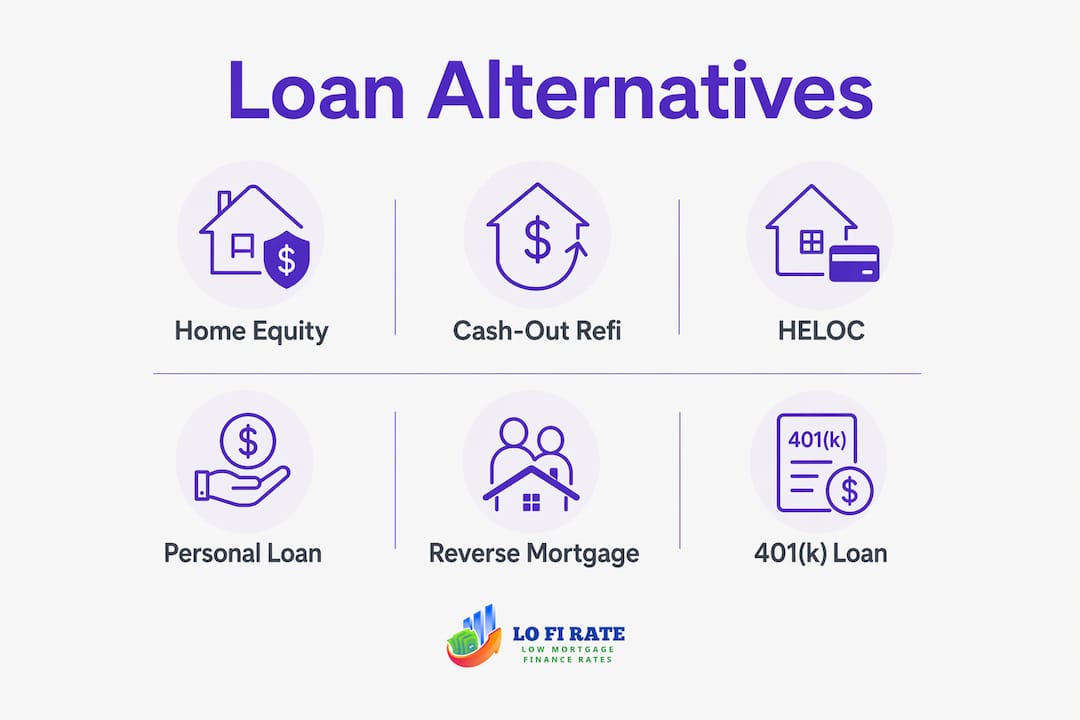
If you're looking for alternatives to reloanscolo.com for mortgage refinancing or home equity access, the strongest options are: home equity loan, cash-out refinance, HELOC, personal loan, reverse mortgage, and 401(k) loan. Each one serves a different financial situation, and the right pick depends heavily on your credit profile, how much equity you hold, and how much risk you're willing to take on.
Here's a quick snapshot of what each alternative offers:
- Home equity loan: Fixed lump sum secured by your home; predictable payments, but your property is on the line
- Cash-out refinance: Replaces your existing mortgage with a larger one and gives you the difference in cash; best when current rates are favorable
- HELOC: A revolving credit line tied to your home equity; flexible draws, variable rate
- Personal loan: Unsecured, no home collateral required; higher rates than home equity products but zero foreclosure risk
- Reverse mortgage: For homeowners 62 and older; converts equity to cash with no monthly payment required
- 401(k) loan: Borrows against your retirement savings; no credit check, but carries real long-term cost
Why refinancing and alternative loans can work in your favor
The clearest benefit of refinancing or tapping an alternative loan product is cost reduction. Replacing a high-rate mortgage with a lower one cuts your monthly payment and the total interest you pay over the life of the loan. That's the most straightforward win.
Beyond rate savings, these products give you access to cash you've already built up. Home improvements, medical bills, and high-interest debt consolidation are the three most common reasons homeowners pull equity. A cash-out refinance or home equity loan can fund a $40,000 kitchen renovation at a rate far below what a credit card charges.
The flexibility across product types is also worth noting. Not every borrower has the equity or credit score for a HELOC. Personal loans fill that gap, and they do it without putting your home at risk. If you're carrying credit card debt at rates near the average 20.97% APR the Federal Reserve reports, consolidating into a personal loan at 11.65% APR is a meaningful improvement.
Choosing the right product also means knowing when not to use home equity. Unsecured loans protect your primary asset. If you miss payments on a personal loan, your credit takes a hit. Miss them on a HELOC, and you could lose your house.
What you need to qualify for refinancing or an alternative loan
Requirements vary by product, but a few factors show up across almost every application.
- Credit score: Conventional refinancing typically requires a score of 620 or higher. Personal loans have more flexible minimums, with some lenders accepting scores as low as 300. HELOCs and home equity loans generally require 620–680.
- Income verification: Expect to provide recent pay stubs, W-2s, or two years of tax returns if you're self-employed. Lenders want to confirm you can service the debt.
- Home equity: Cash-out refinances and HELOCs usually require you to retain at least 20% equity after the transaction. A formal appraisal is standard.
- Debt-to-income ratio (DTI): Most mortgage lenders cap DTI at 43–45%. Personal loan lenders vary, but lower is always better.
- 401(k) loan: No credit check, no income verification. The plan administrator sets the rules, and the IRS caps the loan at the lesser of $50,000 or 50% of your vested balance.
Timelines differ too. A personal loan can fund in one to three business days. A cash-out refinance typically takes 30–45 days from application to closing. HELOCs fall somewhere in between, often 2–6 weeks depending on the appraisal.
Pro Tip: Before submitting a full application anywhere, check whether the lender offers prequalification via soft inquiry. Soft inquiries have zero impact on your credit score, so you can shop multiple lenders and compare real, personalized rates without triggering a single hard pull. Only apply formally once you've identified the best offer.
The six best reloanscolo.com alternatives explained
Home equity loan
A home equity loan gives you a fixed lump sum based on the equity you've built, repaid over a set term at a fixed interest rate. Because the rate is fixed, your monthly payment never changes, which makes budgeting straightforward. Rates are typically lower than personal loans since the loan is secured by your property.

Pros: Fixed rate, predictable payments, lower interest than unsecured options, large loan amounts available. Cons: Your home serves as collateral. Closing costs can add a noticeable amount to the loan expense. Approval requires sufficient equity and a solid credit profile.
Best for: Homeowners with substantial equity who need a large, one-time sum for a defined purpose like a major renovation or debt payoff. For a deeper look at how equity works before you commit, understanding home equity is a useful starting point.
Cash-out refinance
A cash-out refinance replaces your existing mortgage with a new, larger loan. The difference between the two loan amounts comes to you as cash at closing. If your home has appreciated and your current rate is higher than today's market, this can accomplish two things at once: lower your rate and put cash in your pocket.
Pros: Potentially lower rate on the full mortgage balance, single monthly payment, large cash amounts possible. Cons: Resets your loan term, closing costs of 2%–5%, and your home remains collateral. If rates have risen since you originally financed, this product may cost more than it saves.
Best for: Homeowners with a higher-rate existing mortgage who want to refinance anyway and need cash for a large expense. Reviewing home equity refinancing strategies can help you decide whether the timing makes sense.
HELOC
A home equity line of credit (HELOC) works like a credit card backed by your home. You're approved for a maximum credit line, draw from it as needed during the draw period (typically 10 years), and repay what you use. Most HELOCs carry variable interest rates tied to the prime rate.
Pros: Flexible draws, pay interest only on what you use, lower rates than personal loans or credit cards. Cons: Variable rate means your payment can rise. Your home is collateral. Lenders can freeze or reduce the line if your home value drops.

Best for: Ongoing expenses like a phased home renovation or recurring costs where you don't need all the money at once. CNBC Select notes that HELOCs tend to offer lower rates than personal loans, making them a strong fit for home-related costs specifically.
Personal loan
A personal loan is unsecured, meaning no collateral required. You borrow a fixed amount, repay it over a set term, and your home is never at risk. Rates are higher than home equity products, but the tradeoff is real: a missed payment damages your credit, not your housing situation.
Pros: No collateral, fast funding (often same day or next day), fixed rate and payment, no appraisal needed. Cons: Higher interest rates than secured options, lower maximum loan amounts, approval depends heavily on credit score and income.
Best for: Borrowers who lack sufficient equity, don't want to risk their home, or need funds quickly. Experian lists personal loans as one of the primary alternatives to home equity products for borrowers in exactly this position. For home improvement needs specifically, unsecured financing can work well without putting your property on the line, as outlined in this guide to home improvement loan options.
Reverse mortgage
A reverse mortgage lets homeowners 62 and older convert home equity into cash without making monthly mortgage payments. The loan balance grows over time and is repaid when the borrower sells the home, moves out, or passes away. The Federal Housing Administration backs the most common version, called a Home Equity Conversion Mortgage (HECM).
Pros: No monthly payment required, tax-free cash proceeds, borrower retains home ownership. Cons: Loan balance grows over time, reducing the estate's value. Fees and closing costs are higher than most other products. Heirs must repay the balance or sell the home.
Best for: Older homeowners who are equity-rich but cash-poor and plan to stay in the home long-term. This is a narrow use case, but for the right borrower, it's a genuinely useful tool.
401(k) loan
Borrowing from your 401(k) means taking a loan against your own retirement savings. No credit check, no income verification, and the interest you pay goes back into your own account. The IRS caps the loan at the lesser of $50,000 or 50% of your vested balance, and repayment typically happens over five years through payroll deductions.
Pros: No credit check, interest paid to yourself, no impact on credit score. Cons: Reduces your invested retirement balance during the loan period, missing out on market gains. If you leave your job, the full balance may become due immediately. Defaulting triggers taxes and a 10% early withdrawal penalty.
Best for: Borrowers with limited credit options who need a short-term bridge and have a stable employment situation. The risk isn't the interest rate. It's the opportunity cost of pulling money out of a tax-advantaged account during a period when markets may be growing.
| Alternative | Collateral Required | Rate Type | Typical Speed | Home at Risk |
|---|---|---|---|---|
| Home equity loan | Yes (home) | Fixed | 2–4 weeks | Yes |
| Cash-out refinance | Yes (home) | Fixed or adjustable | 30–45 days | Yes |
| HELOC | Yes (home) | Variable | 2–6 weeks | Yes |
| Personal loan | No | Fixed | 1–3 business days | No |
| Reverse mortgage | Yes (home) | Fixed or variable | 30–45 days | Indirectly |
| 401(k) loan | Yes (retirement funds) | Fixed | 2–6 weeks | No |
Pro Tip: If you're comparing home equity products against personal loans, run the actual numbers on total interest paid, not just the monthly payment. A lower rate on a 15-year home equity loan can cost more in total interest than a higher-rate personal loan repaid in 3 years.
How to choose the right alternative for your situation
The most effective approach is matching the loan product to the specific cash problem you need to solve, not simply chasing the lowest advertised rate. A HELOC at 8% is not automatically better than a personal loan at 12% if the HELOC puts your home at risk for a discretionary expense.
Home equity products make sense when the purpose is directly tied to the home (renovations that add value) or when the loan amount is large enough that the rate difference justifies the collateral risk. Unsecured personal loans make sense when speed, simplicity, or asset protection matters more than rate. As Experian notes, unsecured loans protect homeowners from the foreclosure risk that comes with every home-secured product.
One practical step most borrowers skip: shop multiple lenders before committing. Soft credit inquiries let you collect prequalified offers from several sources without any impact on your credit score. The rate difference between the first offer you receive and the best offer available can be several percentage points, which adds up fast on a $50,000 loan.
Avoid stacking short-term fintech credit products as a substitute for a structured loan. Cash advance apps can carry effective APRs exceeding 300%, making them far more expensive than any of the six alternatives covered here for anything beyond a one-time, small-dollar shortfall.
Statistic to know: The Federal Reserve reports average credit card APR at 20.97% vs. 11.65% for 24-month personal loans. If you're carrying a balance on cards, a personal loan consolidation is one of the clearest financial wins available right now.
Getting a second opinion on your mortgage rate before refinancing is also worth the 15 minutes it takes. Wholesale mortgage brokers shop multiple lenders simultaneously, which retail banks don't do. Lofirate connects borrowers with licensed wholesale brokers in their state for exactly this kind of no-obligation rate comparison. You can explore available loan options or go straight to Lofirate's homepage to request a consultation.

Key Takeaways
Matching the loan product to your specific financial need, not just the lowest rate, is the single most important decision a homeowner can make when evaluating refinancing alternatives.
| Point | Details |
|---|---|
| Home equity products carry real risk | HELOCs, home equity loans, and cash-out refinances all put your home on the line as collateral. |
| Personal loans protect your asset | Unsecured loans carry higher rates but eliminate foreclosure risk entirely. |
| Rate shopping costs nothing | Soft credit inquiries let you compare prequalified offers from multiple lenders with zero credit score impact. |
| Credit card debt is expensive | Federal Reserve data shows average credit card APR at 20.97% vs. 11.65% for 24-month personal loans. |
| 401(k) loans have hidden costs | The real risk is lost investment growth, not the interest rate you pay back to yourself. |