

TL;DR:
- Home equity represents the ownership stake in your home after subtracting mortgage and secured debts, and it fluctuates with market changes and payments.
- Borrowing against it through loans or HELOCs involves risks like foreclosure if payments are missed, requiring careful planning.
- Strategic uses include home improvements, debt consolidation, and large expenses, but responsible management is essential to protect your financial stability.
Home equity is defined as the portion of your home's value that you own outright, calculated by subtracting your total outstanding mortgage balance and any other secured debts from the property's current market value. It represents your real ownership stake in the property, not just the title on paper. Products like home equity loans and home equity lines of credit (HELOCs) let you convert that stake into usable funds. Understanding this concept is foundational to making smart decisions about refinancing, renovations, and long-term wealth building.
What is home equity and how does it work?
Home equity is calculated using one straightforward formula: current home value minus total secured debt. If your home is worth $400,000 and you owe $250,000 on your mortgage, your equity is $150,000. That figure represents your financial ownership in the property at this moment in time.

What most homeowners miss is that equity is not a fixed number. It shifts every month as you pay down your mortgage principal, and it shifts whenever the local real estate market moves. A rising market can add tens of thousands of dollars to your equity without you making a single extra payment. A falling market can erase years of progress just as fast.
Equity also has a quality that surprises many first-time homeowners: it is illiquid by nature. You cannot spend it directly. Accessing it requires taking out a new loan product, which adds a monthly obligation to your budget. Fidelity, LendingTree, and Freddie Mac all describe home equity as a long-term asset, not a checking account you can tap on demand.
How to calculate home equity and what affects it
The formula itself is simple. Home Equity = Current Home Value minus Total Secured Debt. Total secured debt includes your primary mortgage, any second mortgage, and any existing home equity loan or lien on the property.
Several forces push your equity up or down over time:
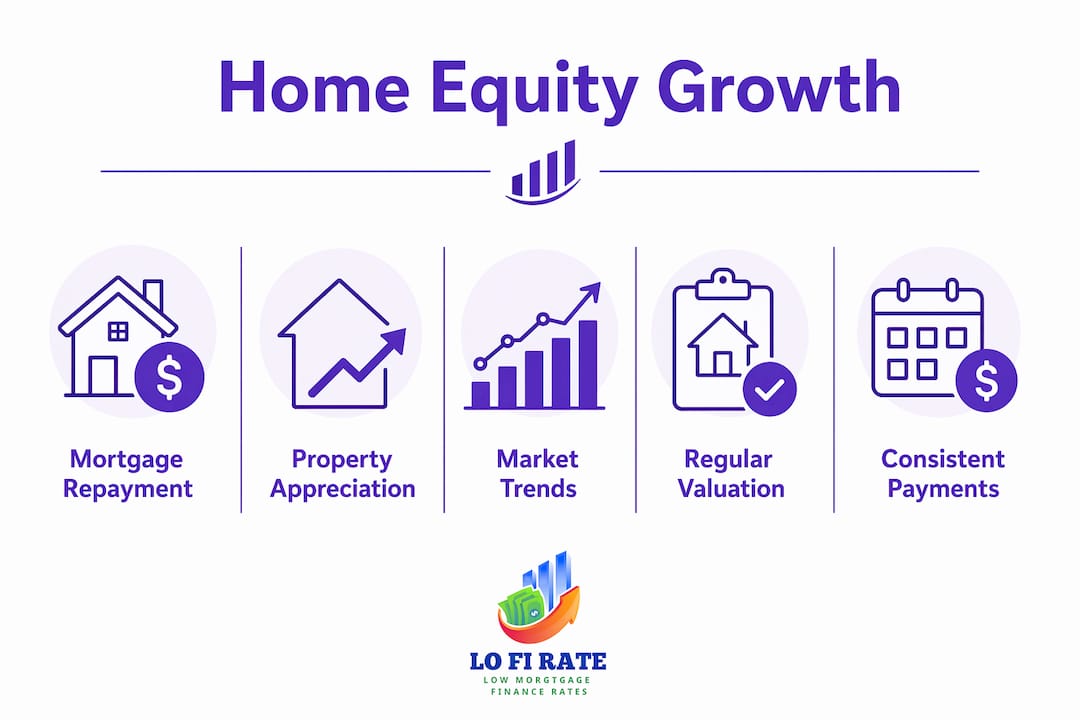
- Mortgage payments: Every payment you make reduces your principal balance, which directly increases your equity. In the early years of a 30-year mortgage, most of your payment goes toward interest, so equity builds slowly at first.
- Home value appreciation: Rising property values in your neighborhood increase your equity without any action on your part. This is why location and market timing matter so much in real estate.
- Home improvements: Strategic renovations, particularly kitchen remodels, bathroom upgrades, and additions, can increase appraised value and therefore your equity position.
- Market downturns: A drop in local property values reduces your equity, sometimes below what you paid into the home. This is called being "underwater" on your mortgage.
- Additional borrowing: Taking out a HELOC or home equity loan reduces your available equity because it adds to your total secured debt.
Equity grows through two primary channels: mortgage repayment and property value appreciation. Both work together over time, which is why homeownership remains one of the most reliable wealth-building strategies available to American households.
Pro Tip: Request a free home valuation from a local real estate agent or use a tool like Zillow's Zestimate as a starting point, then subtract your current mortgage payoff amount from your lender's online portal. That gives you a real-time equity estimate in under five minutes.
What are home equity loans and HELOCs?
Both products let you borrow against your ownership stake, but they work very differently. Choosing the wrong one for your situation costs money and creates unnecessary stress.
A home equity loan delivers a lump sum at a fixed interest rate with fixed monthly payments over a set term, typically 5 to 30 years. You know exactly what you owe every month from day one. Rates on these loans are generally higher than a primary mortgage but lower than credit card rates, making them a cost-effective option for large, one-time expenses.
A home equity line of credit (HELOC) works more like a credit card secured by your home. You get a credit limit based on your equity, and you draw from it as needed during a draw period of 5 to 10 years. After that, you enter a repayment period of 10 to 20 years. During the draw period, some lenders allow interest-only payments, which keeps short-term costs low but delays principal paydown.
| Feature | Home equity loan | HELOC |
|---|---|---|
| Disbursement | Lump sum | Revolving credit line |
| Interest rate | Fixed | Variable |
| Payment structure | Fixed monthly payments | Flexible during draw period |
| Best for | One-time expenses | Ongoing or phased projects |
| Predictability | High | Lower |
HELOC payments fluctuate with variable interest rates, which means your monthly obligation can rise if rates increase. Borrowers who prefer certainty lean toward home equity loans. Borrowers who need flexibility for multi-phase projects, like a year-long renovation, often prefer the HELOC structure.
Pro Tip: Fidelity's guidance is clear: use a home equity loan for one-time costs like a medical bill or tuition payment, and use a HELOC for ongoing projects like a phased home renovation where you draw funds in stages.
You can review real loan scenarios to see how homeowners have used both products in practice before committing to either.
What risks should homeowners understand before borrowing?
Home equity is a powerful financial tool, but it carries one risk that no other consumer debt product carries: you can lose your home if you default.
Borrowing against home equity uses your property as collateral. Miss enough payments, and the lender has the legal right to foreclose. This is not a theoretical risk. It is the same mechanism that drove millions of foreclosures during the 2008 housing crisis, when falling home values left borrowers with more debt than their homes were worth.
Lenders protect themselves, and you, by requiring a minimum equity threshold of 15% to 20% before approving a loan or HELOC. This buffer exists to protect against market downturns. If your home loses value after you borrow, that cushion reduces the chance that you end up underwater.
Home equity is not extra cash lying around. It requires careful repayment planning to avoid foreclosure risk. Treating it like a windfall rather than a loan is the most common and most costly mistake homeowners make.
Other risks worth understanding before you borrow:
- Closing costs: Home equity loans and HELOCs carry origination fees, appraisal costs, and sometimes annual fees that add to your total borrowing cost.
- Rate risk on HELOCs: Variable rates mean your payment can increase significantly if the Federal Reserve raises benchmark rates.
- Reduced financial flexibility: Once you borrow against your equity, you have less cushion if you need to sell quickly or refinance.
- Over-leveraging: Borrowing the maximum available equity leaves no buffer for market corrections or personal financial setbacks.
Understanding your mortgage qualification factors before applying for any equity product helps you enter the process with realistic expectations.
How can you use home equity to improve your financial position?
Used strategically, home equity is one of the lowest-cost borrowing tools available to homeowners. The key word is "strategically." Here are the most effective applications, ranked by financial impact:
-
Home improvements that increase value. Kitchen and bathroom renovations, roof replacements, and energy-efficient upgrades often return 60% to 80% of their cost in added home value. Using home equity for renovations that increase your appraised value is one of the few borrowing decisions that can actually grow your net worth. For homeowners in specific markets, resources like this Naples renovation financing guide show how local loan products can be structured around phased improvement projects.
-
Debt consolidation. If you carry high-interest credit card debt, consolidating it into a home equity loan at a lower rate reduces your total interest cost significantly. A $20,000 credit card balance at 22% APR costs far more over time than the same balance on a home equity loan at 8%. The savings are real, but the risk is also real: you are converting unsecured debt into debt backed by your home.
-
Funding large one-time expenses. College tuition, major medical costs, and business startup expenses are legitimate uses when the alternative is high-interest personal loans or credit cards. The discipline required is borrowing only what you need and committing to a repayment plan before you draw the funds.
-
Refinancing to access equity. A cash-out refinance replaces your existing mortgage with a larger one and gives you the difference in cash. This can make sense when current rates are favorable. Lofirate's home equity refinancing strategies article covers when this approach makes financial sense versus when it costs more than it saves.
-
Building a financial safety net. Some homeowners open a HELOC and leave it untouched as an emergency fund backup. You pay nothing unless you draw from it, but you have access to funds if a major expense hits unexpectedly.
Building equity is a powerful wealth-building strategy, but it demands mindful borrowing and consistent market awareness. Equity that took a decade to build can be borrowed away in a single decision.
Key takeaways
Home equity is the difference between your home's current market value and your total secured debt, and accessing it responsibly requires understanding both its potential and its risks.
| Point | Details |
|---|---|
| Home equity definition | Current home value minus all secured debt, including mortgage and liens. |
| Two main borrowing tools | Home equity loans offer fixed lump sums; HELOCs offer flexible revolving credit. |
| Lender equity requirement | Most lenders require 15% to 20% equity before approving any loan or HELOC. |
| Primary risk | Your home is collateral, and missed payments can lead to foreclosure. |
| Best strategic uses | Renovations, debt consolidation, and planned large expenses with a repayment plan. |
What I've learned from watching homeowners use equity well and poorly
Most homeowners discover their home equity during a financial squeeze, not during a period of calm planning. That timing is the problem. When you are under pressure, a HELOC or home equity loan feels like a solution. But the terms you accept under pressure are rarely the terms that serve you best.
The homeowners I have seen use equity well share one habit: they track their equity position regularly, not just when they need money. They know their approximate home value, their current payoff balance, and how much equity they could access. That awareness lets them make proactive decisions, like refinancing at the right moment or timing a renovation to maximize appraised value before a sale.
The homeowners who struggle are the ones who treat equity as a reward for owning a home. They borrow the maximum available, spend it on things that do not add value, and then find themselves with a higher monthly payment and less financial flexibility than before. The math always catches up.
My honest recommendation: open a HELOC before you need it. Qualification is easier when your finances are strong, and having access to a credit line you do not use costs you almost nothing. When a real need arises, you have options instead of urgency driving your decisions. That shift from reactive to proactive is where most of the financial benefit of homeownership actually lives.
— LoFi
See what your equity could do for you
If you have been building equity in your home, you may have more borrowing power than you realize. Lofirate connects homeowners with licensed wholesale mortgage brokers who can assess your equity position and match you with competitive loan options across multiple lenders, not just one bank's product shelf.

Retail lenders quote you their rate. Wholesale brokers shop the market. That difference can mean a lower rate on a home equity loan or HELOC, which translates directly into lower monthly payments and less total interest paid. Explore your home equity loan options or visit Lofirate's broker matching service to request a no-obligation consultation with a licensed broker in your state.
FAQ
What is the home equity definition in simple terms?
Home equity is the dollar value of your home that you actually own, calculated by subtracting your mortgage balance and any other secured debts from your home's current market value.
How do I calculate my home equity?
Use this formula: Home Equity = Current Home Value minus Total Secured Debt. If your home is worth $350,000 and you owe $200,000, your equity is $150,000.
What is the difference between a home equity loan and a HELOC?
A home equity loan provides a lump sum at a fixed rate with predictable payments, while a HELOC is a revolving credit line with a variable rate and flexible draw periods of 5 to 10 years.
How much equity do I need to qualify for a home equity loan?
Most lenders require a minimum of 15% to 20% equity in your home before approving a home equity loan or HELOC, which protects both the lender and the borrower against market downturns.
Can I lose my home if I borrow against my equity?
Yes. Home equity loans and HELOCs use your property as collateral, which means missed payments can trigger foreclosure proceedings, making repayment planning critical before you borrow.