

TL;DR:
- Leveraging home equity as a larger down payment reduces mortgage size and long-term payments.
- Shopping and negotiating mortgage rates can save thousands over the loan term.
- Proper timing, contingencies, and refinancing strategies maximize savings during a move-up purchase.
Moving up to a larger home is one of the most financially significant decisions you'll make, but too many buyers underestimate just how much they can save with the right approach. The difference between a well-planned move-up purchase and a rushed one can easily run $20,000 or more over the first few years of the loan. From poorly timed sales to unchallenged lender quotes, the money slips away quietly. This guide cuts through the complexity and gives you concrete, expert-backed strategies to protect your equity, negotiate better terms, and lower your long-term mortgage cost at every step of the process.
Table of Contents
- Understand your move-up buying power
- Shop and negotiate for the best mortgage rate
- Strategically use timing, contingencies, and bridge financing
- Refinancing and recasting: Smart moves before and after you buy
- Why most move-up buyers leave money on the table
- Maximize your move-up savings with personalized mortgage solutions
- Frequently asked questions
Key Takeaways
| Point | Details |
|---|---|
| Tap home equity | Using your current home's equity as a down payment lowers your next mortgage and monthly payments. |
| Shop, compare, negotiate | Request multiple loan quotes and negotiate seller concessions to save hundreds or thousands yearly. |
| Time your move wisely | Coordinating buying and selling with smart contingencies or bridge financing minimizes risk. |
| Refinance or recast strategically | Calculate your break-even before refinancing or recasting to ensure real savings before your next move. |
Understand your move-up buying power
Let's start by understanding what gives you financial leverage when moving up.
If you've owned your current home for several years, you're likely sitting on more equity than you realize. Equity is the difference between what your home is worth today and what you still owe on it. In a 2026 balanced market, buyers who already own a home come to the table with a real advantage: that equity becomes your most powerful financial tool.
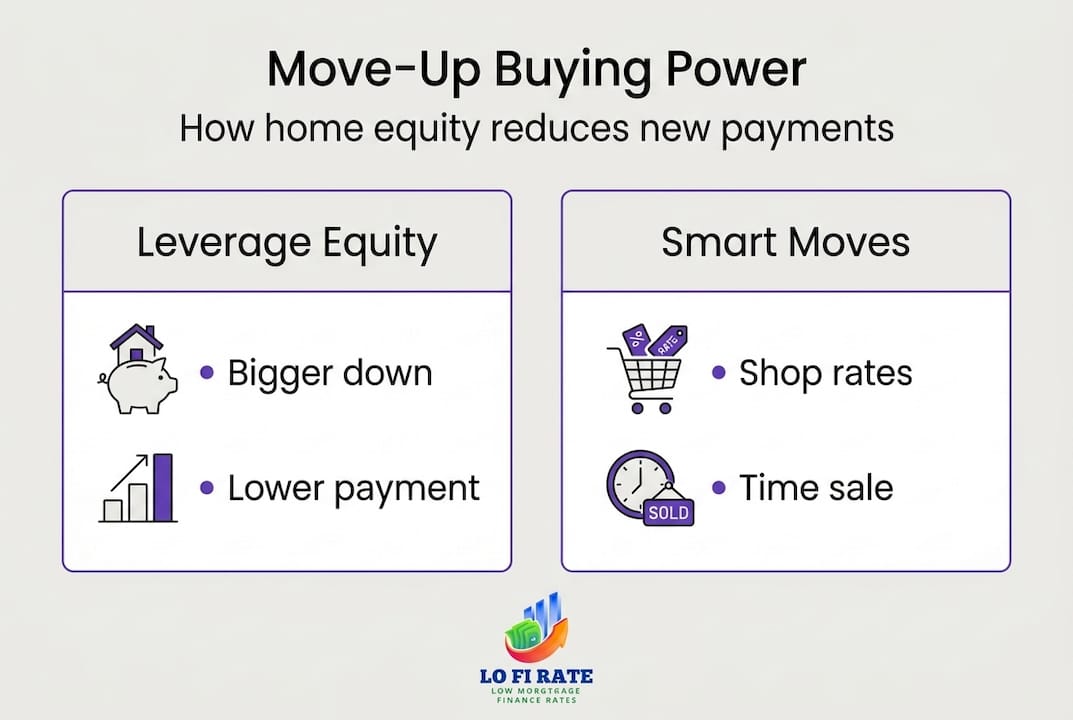
Leveraging equity as a larger down payment on your next home directly reduces your new loan size and your monthly payment. Here's how that plays out in practice:
| Current home equity | Down payment used | New loan amount | Est. monthly payment (7% rate) |
|---|---|---|---|
| $100,000 | $80,000 (16%) | $420,000 | ~$2,795 |
| $150,000 | $120,000 (24%) | $380,000 | ~$2,529 |
| $200,000 | $160,000 (32%) | $340,000 | ~$2,263 |
Those monthly differences add up fast. Over five years, moving from the first to the third scenario saves roughly $32,000 in payments alone.
Beyond payment reduction, a larger down payment delivers several other financial wins:
- Eliminates private mortgage insurance (PMI): Putting 20% or more down means you skip PMI entirely, which typically runs $100 to $300 per month.
- Qualifies you for better loan terms: Lenders reward lower loan-to-value ratios with tighter rate spreads and better fee structures.
- Reduces total interest paid: A smaller loan principal compounds into tens of thousands less in interest over the life of the loan.
- Strengthens your offer: Sellers and agents see larger down payments as a signal of financial stability, which matters in competitive situations.
Before you list your current home, take time to explore your home equity strategies to understand whether a cash-out refinance, HELOC, or straight sale nets you the most usable capital.
Pro Tip: Don't wait until your current home sells to plan your equity deployment. Run the numbers now using your estimated sale price, payoff amount, and closing costs to know exactly what you'll have available as a down payment.
Shop and negotiate for the best mortgage rate
Knowing your financial footing is just step one. Now, let's zero in on the biggest recurring cost: your mortgage rate.
Most move-up buyers accept the first loan quote they receive from their current bank or a referred lender. That habit is expensive. Shopping multiple lenders can save you $600 to $1,200 per year, according to a Freddie Mac study. Over a 30-year loan, that's potentially $18,000 to $36,000 staying in your pocket.
Here's what three competing quotes might look like on a $400,000 loan:
| Lender | Rate | Monthly payment | Annual cost |
|---|---|---|---|
| Lender A | 7.25% | $2,729 | $32,748 |
| Lender B | 7.00% | $2,661 | $31,932 |
| Lender C | 6.75% | $2,594 | $31,128 |
The gap between Lender A and Lender C is $135 per month. That's real money, and it all comes from making a few calls.
To get the best outcome from your rate shopping, follow these steps:
- Request formal Loan Estimates from at least three lenders on the same day so rates are comparable.
- Document every fee in the Loan Estimate, not just the interest rate. Points, origination fees, and APR tell the full story.
- Compare the APR across all quotes to find the true cost of each loan.
- Negotiate directly by showing lenders competing offers. Many will match or beat a rival's pricing.
- Lock your rate once you find the right combination of rate and fees, and get everything in writing.
You can follow the full best mortgage shopping steps to build a systematic approach before you submit a single application.
Savings in action: A move-up buyer on a $425,000 loan who spent two extra days shopping lenders secured a rate 0.375% lower than their first quote. That small difference added up to $1,080 less per year in mortgage payments.
Don't overlook seller concessions either. In a balanced 2026 market, seller concessions for closing costs can cover 2 to 5% of the purchase price. On a $500,000 home, that's $10,000 to $25,000 you don't have to bring to closing. Conventional loans allow sellers to contribute between 3% and 9% depending on your down payment. You can also negotiate a rate buydown, where the seller pays to permanently or temporarily reduce your mortgage rate.
Pro Tip: Always ask for the Loan Estimate, not just a rate quote over the phone. That three-page federal form is the only document that creates a real, binding comparison between lenders. Learn how to compare rates 2026 to read it like a pro.
Strategically use timing, contingencies, and bridge financing
Once you've lined up your rate and offer, the sequence of transactions becomes your next money-saving opportunity.

The classic move-up dilemma is whether to sell your current home first or buy the new one first. Both paths have real financial implications, and the right answer depends on your risk tolerance and cash reserves.
Here are your primary timing options:
- Sell first, then buy: Lowest financial risk. You know exactly how much equity you have before committing to a purchase price.
- Buy first, then sell: More flexibility in finding the right home, but you may carry two mortgages temporarily.
- Use a bridge loan: Short-term financing that lets you buy before selling. Works best when your current home has strong equity and is likely to sell fast.
- Open a HELOC before listing: Draw on your home equity line to fund the down payment on the new home before the sale closes.
- Home sale contingency: Negotiate into your purchase contract that the deal only closes once your current home sells.
For upper-middle-class buyers with stable income and solid equity, coordinating sale and purchase timing carefully can eliminate the need for bridge financing altogether. Here's how to sequence it when you do need a bridge loan:
- Get pre-approved for the bridge loan before making an offer on the new home.
- List your current home simultaneously with or just before placing the offer.
- Use bridge proceeds only for the down payment, not general expenses.
- Budget for bridge loan interest, which typically runs higher than a standard mortgage.
2026 market insight: Balanced market conditions give buyers more room to include contingencies without losing deals. Sellers are more willing to accept home sale contingency clauses than they were in 2021 and 2022, making it a smarter tool again for move-up buyers.
Knowing questions to ask your mortgage broker about bridge financing terms before you commit can save you from expensive surprises.
Refinancing and recasting: Smart moves before and after you buy
Financial tools like refinancing or recasting your mortgage can generate additional savings if used wisely.
If you still have a balance on your current home and rates have dropped since you bought it, a refinance before your move could immediately lower your monthly cost and free up cash flow. The key is calculating your break-even point. Calculate your break-even by dividing your closing costs by your monthly savings. If you'll stay in the home long enough to recover the cost, refinancing makes sense.
Here's how that math looks across different scenarios:
| Loan amount | Current rate | New rate | Closing costs | Monthly savings | Break-even |
|---|---|---|---|---|---|
| $300,000 | 7.50% | 7.00% | $6,000 | $100 | 60 months |
| $350,000 | 7.25% | 6.75% | $7,000 | $145 | 48 months |
| $400,000 | 7.50% | 6.875% | $8,000 | $167 | 48 months |
Closing costs on a refinance typically run 2 to 5% of the loan amount, which on a $300,000 balance lands between $6,000 and $15,000. If your monthly savings are $200, a $6,000 cost takes 30 months to recover.
If a full refinance doesn't pencil out, consider a mortgage recast instead. Recasting means you make a large lump-sum principal payment and your lender recalculates your payment on the new, lower balance. There's no credit check, no appraisal, and the fee is usually just $200 to $500. Your rate stays the same, but your payment drops.
Here's how to approach either option efficiently:
- Pull your current loan statement and calculate your remaining balance.
- Request payoff and recast quotes from your current servicer.
- Get at least two refinance quotes from competing lenders.
- Model both options using the break-even formula.
- Choose the option that reduces your net mortgage cost fastest relative to your timeline.
Pro Tip: Only refinance if your break-even point falls well before your planned move date. A refinance with home equity can also reset your loan to pull out capital for your next down payment.
Savings callout: A borrower who refinanced a $400,000 balance from 7.5% to 6.875% saved $167 per month. After 48 months, they've fully recovered closing costs and reduced their total interest burden by over $8,000.
Why most move-up buyers leave money on the table
Now, let's cut through the noise and focus on what really moves the needle for serious savings.
Most buyers obsess over the purchase price. They negotiate $5,000 off the listing and feel like they won. But the buyers who come out ahead financially are focused on a completely different set of levers. Equity strategy, rate negotiation, concession requests, and transaction timing routinely generate two to four times more savings than squeezing the sticker price.
Seasoned real estate investors think in terms of net cost, not list price. They ask: what does this home actually cost me after rate, PMI, concessions, and equity deployment? That's the number that matters. And why lender shopping matters becomes crystal clear once you do the full math.
There's also the problem of analysis paralysis. Buyers who wait for the perfect rate or the ideal market timing often miss windows where all the conditions are favorable at once. In 2026, with balanced inventory and sellers open to negotiation, the conditions are good. The buyers who act with preparation win. Those who wait for certainty often pay more for less.
Maximize your move-up savings with personalized mortgage solutions
If you're ready to act, partner with experts who specialize in maximizing move-up savings.
At LoFiRate.com, we connect move-up buyers like you with licensed wholesale mortgage brokers who shop multiple lenders to find competitive rate options you won't see at retail banks. That means more choices, more transparency, and more savings potential without the pressure of a single-lender pitch.

Whether you're ready to explore loan options built for your equity position or want to understand what rate you could realistically qualify for today, our process is fast and obligation-free. Explore the full range of LoFiRate services and request a no-cost consultation with a broker in your state. Stop paying retail rates when wholesale access is one click away.
Frequently asked questions
How does using home equity lower my new mortgage payments?
Applying equity as a down payment reduces your total loan size, which directly lowers your monthly payment and can eliminate the cost of private mortgage insurance.
What seller concessions can help offset move-up buying costs?
Seller concessions cover closing costs, repair credits, and rate buydowns, often saving buyers 2 to 5% of the purchase price depending on your loan type and down payment size.
Is it better to sell my current home before or after buying my next one?
Selling first gives you clean access to your equity with no financial overlap, while buying first offers more flexibility but usually requires bridge financing or temporarily carrying two loans.
How do I know if refinancing before moving up makes sense?
Calculate your break-even on refinancing by dividing your total closing costs by your monthly payment reduction. If you'll stay long enough to recover the cost, it's worth doing.