

The main types of mortgage amortization are level-payment (annuity), straight-line, declining-balance, interest-only, negative amortization, balloon/bullet, graduated-payment, and adjustable-rate (ARM) amortization. Level-payment amortization, where you pay the same amount every month for the life of a fixed-rate loan, is the default for most U.S. home mortgages. The type you end up with changes three things that matter a lot: how predictable your payment is, how much interest you pay in total, and how fast you build equity.
- Level-payment (annuity): equal payments; the standard for 15 and 30-year fixed mortgages
- Straight-line (linear): principal drops by a fixed amount each period; payment size shrinks over time
- Declining-balance: payment amount decreases as the balance shrinks
- Interest-only: you pay only interest for a set period, then payments jump
- Negative amortization: unpaid interest gets added to the loan balance instead of paid off
- Balloon/bullet: small payments for years, then one large payment at maturity
- Graduated-payment: payments start low and increase on a set schedule
The amortization method a lender assigns you determines whether your $2,000-a-month budget buys you a fixed, boring, predictable payment, or a payment that could double in five years. That distinction rarely gets explained before closing.
Key Takeaways
Level-payment amortization is the default for U.S. mortgages, but the term length and any extra payments you make matter more to your total cost than the interest rate alone.
| Point | Details |
|---|---|
| Level-payment is standard | Most fixed-rate mortgages use equal monthly payments that shift from interest-heavy to principal-heavy over time. |
| Term length drives total cost | A 15-year loan at 6.5% saves significantly more in interest than a 30-year loan on the same $300,000 balance. |
| Extra payments compound | Even small monthly overpayments or one lump sum can cut years and tens of thousands off a mortgage. |
| Nonstandard types carry risk | Interest-only, balloon, and negative amortization loans lower early payments but raise later payment risk. |
| Ask for the schedule | Request a written amortization table from any lender before closing to confirm how payments break down. |
Table of Contents
- What Are the Types of Mortgage Amortization?
- How Do You Calculate a Mortgage Amortization Payment?
- How Does Loan Term Change Total Interest Paid?
- How Do Extra Payments Change Your Amortization Schedule?
- How Should You Choose Your Amortization Type?
- When Should You Talk to a Mortgage Broker or Loan Officer?
- Where Can You Learn More About Amortization?
- Frequently Asked Questions
- Sources
What Are the Types of Mortgage Amortization?
Level-payment (annuity) amortization is what most people mean when they say "mortgage." You pay the same total amount every month, but the mix shifts: early on, most of that check goes to interest, and by the final years, almost all of it goes to principal. Fixed-rate 15, 20, and 30-year loans work this way. It's the most predictable option for budgeting, and nearly every conforming, FHA, and VA fixed loan uses it. The tradeoff is that you don't control how the interest gets front-loaded; the math does that for you.
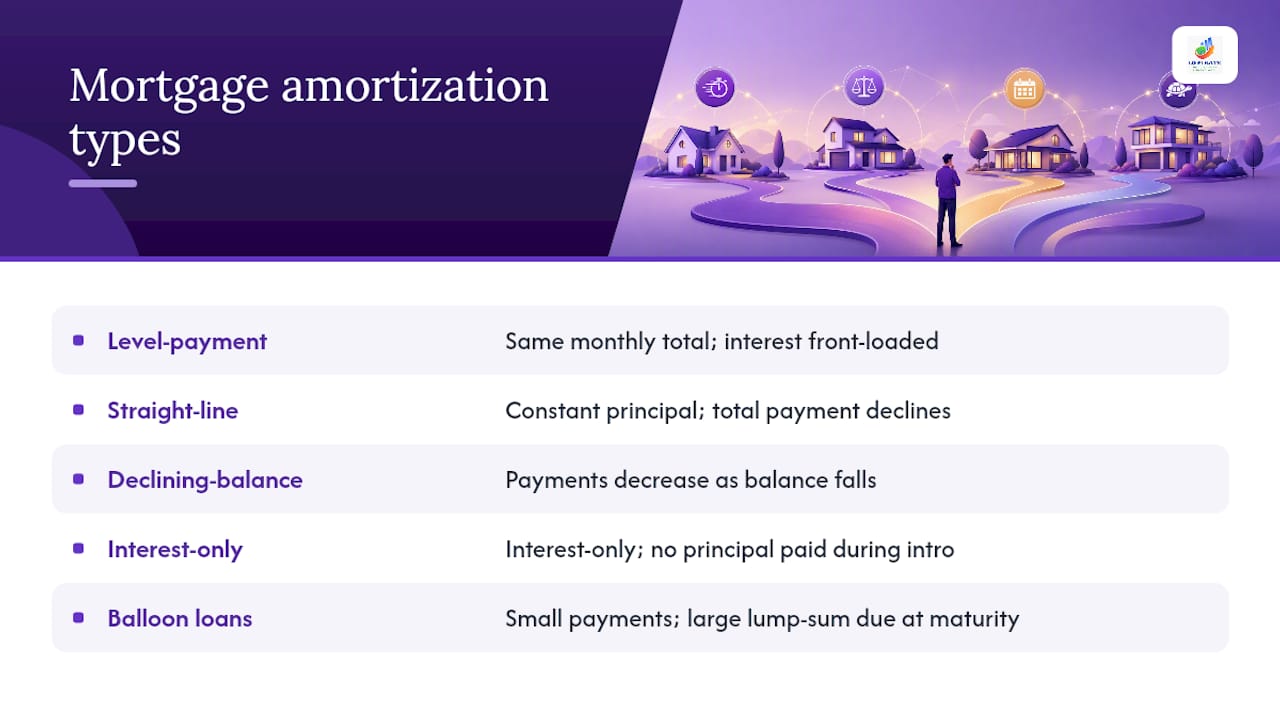
Straight-line (linear) amortization flips the payment structure. Instead of a fixed total payment, the principal portion stays constant every month, so the total payment amount actually declines as interest shrinks. You almost never see this on U.S. home mortgages. It shows up more in commercial lending and some student loan structures, where lenders want principal paid down at a steady, predictable rate rather than smoothing the borrower's payment.
Declining-balance amortization is a close cousin: the payment amount decreases over time as the outstanding balance drops. Some adjustable-rate products and certain commercial notes use variations of this, but it's rare in residential lending outside of niche products.
Interest-only mortgages let you pay just the interest for an introductory period, often five to ten years, with no principal reduction at all during that window. Real estate investors and borrowers with irregular but growing income (commissioned salespeople, business owners) sometimes prefer this because it frees up cash flow early on. The catch: once the interest-only period ends, the loan reamortizes over the remaining term, and the payment can jump substantially since you're now paying off the full principal in fewer years. A deeper look at interest-only structures for investment property explains why investors lean on this timing.
Balloon or bullet loans carry small payments, sometimes interest-only, for a short term, then require one large lump-sum payment at maturity. These show up in some commercial deals and a shrinking slice of residential seller-financing arrangements. The risk is obvious: if you can't refinance or sell before the balloon date, you're stuck with a payment most households can't write.
Graduated-payment mortgages (GPMs) and growing-equity mortgages start with lower payments that increase on a preset schedule, often annually, for five to ten years. GPMs help first-time buyers who expect rising income qualify for a home they couldn't afford under standard underwriting today. Growing-equity versions apply those payment increases directly to principal, accelerating payoff faster than a standard 30-year schedule.
Negative amortization happens when your scheduled payment doesn't even cover the interest due, so the shortfall gets tacked onto your loan balance. Some payment-option ARMs from the 2000s allowed this, and it's rare in today's regulated mortgage market, but it still appears in certain reverse mortgages and some non-QM products. If your balance is growing instead of shrinking, that's the warning sign to ask your lender directly.
ARM amortization typically behaves like a level-payment loan during the fixed introductory period (3, 5, 7, or 10 years), then reamortizes at each adjustment based on the new rate and remaining term. Some ARMs also offer a one-time recast option after a lump payment. Our guide on adjustable-rate mortgages breaks down how those resets actually hit your payment.
How Do You Calculate a Mortgage Amortization Payment?
Level-payment amortization comes from the present-value-of-an-annuity formula:
M = P × [r(1+r)^n] / [(1+r)^n − 1] where P = principal, r = monthly interest rate, n = total number of monthly payments, M = monthly payment.
- Convert your annual rate to a monthly rate by dividing by 12.
- Multiply your loan term in years by 12 to get n.
- Plug P, r, and n into the formula to solve for M.
On a $300,000 loan at 6.5% annual interest over 30 years, r = 0.005417 and n = 360, which produces a monthly payment of roughly $1,896. Here's what the first and last few months look like:
- Notice how interest dominates month 1 and principal dominates month 360.
- This is the "crossover point" textbook amortization examples highlight, where principal paid finally exceeds interest paid.
- Every lender's amortization schedule disclosure should show the full 360-month version before you close, and an online calculator lets you test different rates and terms in seconds.
How Does Loan Term Change Total Interest Paid?
The 30-year loan costs $212,293 more in total interest for the same borrowed amount, even though the monthly payment is $717 lower. That's the core tradeoff: the shorter term is front-loaded with cash-flow pressure but back-loaded with savings, while the 30-year term spreads out affordability at a real long-term cost. It also means the 15-year borrower has built roughly $62,000 more equity by year five.
How Do Extra Payments Change Your Amortization Schedule?
- Extra principal payments reduce your balance immediately, so every future month's interest calculation shrinks too. An extra $100 a month on that $300,000, 30-year loan can cut several years off the term and save tens of thousands in interest over the loan's life.
- Biweekly payment plans often just sneak in one extra full payment per year (26 half-payments equals 13 full payments), which works similarly to a modest monthly overpayment.
- A lump-sum prepayment, say a $10,000 bonus applied to principal in year three, immediately shortens the remaining schedule and cuts interest for every month after that, a pattern Chase's own amortization examples confirm.
- Always confirm your lender's prepayment rules first. Some loans carry prepayment penalties or restrict how extra funds get applied.
Pro Tip: When you send extra money, write "apply to principal" on the payment and confirm with your servicer that it isn't being held as a future payment credit instead.
How Should You Choose Your Amortization Type?
Your decision comes down to a handful of factors: monthly budget, how long you'll own the home, how stable your income is, and how much total interest you're willing to accept for lower payments now.
- Predictability vs. affordability: level-payment wins on predictability; interest-only or graduated-payment structures win on early affordability.
- Long-term cost: shorter terms and extra payments both cut total interest, but they demand more monthly cash flow today.
- Resale horizon: if you're moving in five years, a balloon or ARM's introductory period may cost less than a 30-year fixed.
Ask any lender or broker directly: "Is this loan fully amortizing over the stated term? Are interest-only or balloon options available? What are the prepayment rules?" Some structures aren't available across every program; FHA and VA loans have their own rules, and jumbo loans sometimes offer more flexible amortization than conforming loans.
Fixed-rate, fully amortizing loans give you the most predictable payment; interest-only and balloon structures trade that predictability for lower payments now and more risk later.
When Should You Talk to a Mortgage Broker or Loan Officer?
Licensed brokers shop multiple lenders at once, which matters if you want an amortization structure a single retail lender doesn't offer, like interest-only, graduated-payment, or a shorter recast option. Loan officers, by contrast, can walk you through exactly how their own lender's disclosures and rules apply to your file.
Talk to one when your finances are complex, you're weighing a refinance, or you specifically need a nonstandard structure like interest-only or balloon financing. Bring:
- Recent pay stubs, tax returns, and asset statements
- A clear sense of how long you plan to stay in the home
- Questions about prepayment penalties and reamortization options
A Practical Note on Amortization Choices
Check the actual amortization table before signing anything, not just the quoted rate; ask your lender for a written schedule up front. If your situation calls for interest-only, graduated-payment, or another nonstandard structure, working with a broker who can compare options across multiple lenders tends to surface choices a single retail lender won't offer.
Where Can You Learn More About Amortization?
- OpenStax: Loan Amortization for worked textbook examples
- Investopedia: Amortized Loan for calculation basics
- BCAE Amortization Calculator to test your own numbers
- FHA vs. Conventional loan rules that affect availability
Frequently Asked Questions
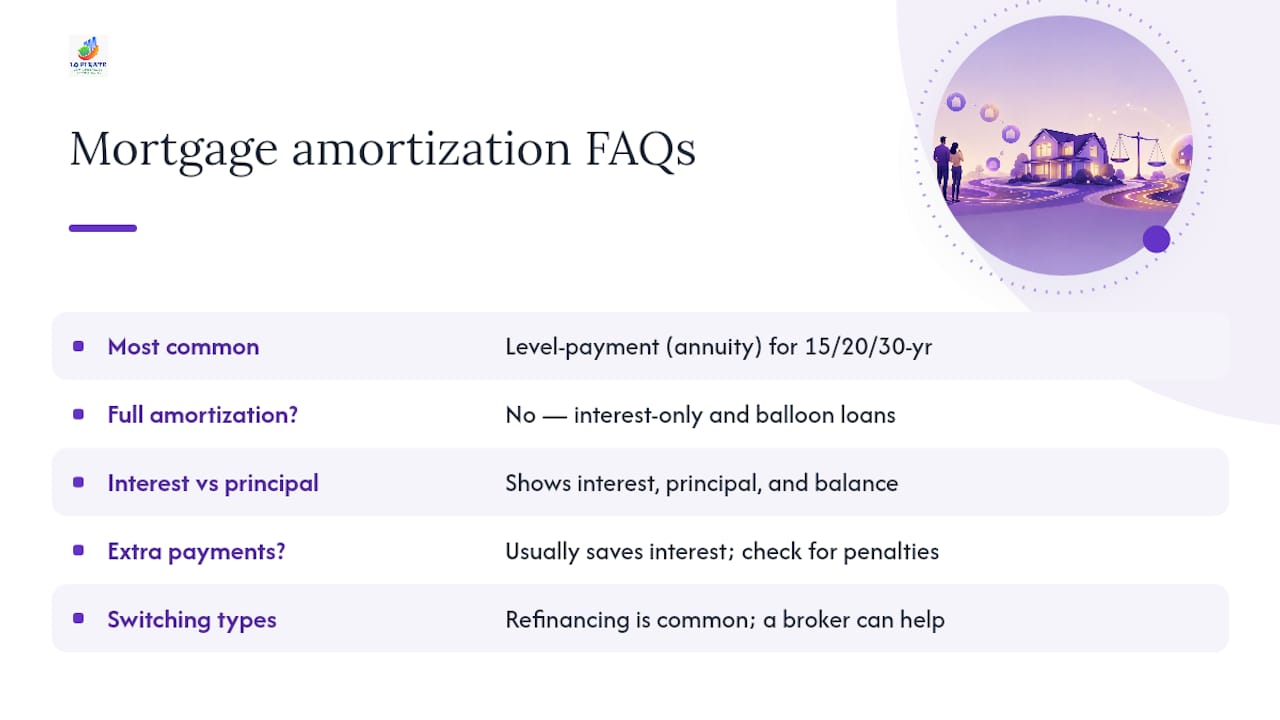
What is the most common type of mortgage amortization? Level-payment (annuity) amortization is the most common. It's the standard structure behind nearly every fixed-rate 15, 20, and 30-year mortgage in the U.S.
Do all mortgages fully amortize? No. Interest-only loans don't amortize during their introductory period, and balloon loans only partially amortize before requiring a lump-sum payoff at maturity.
How does an amortization schedule show interest versus principal? It lists every payment for the loan's life, breaking each one into an interest portion and a principal portion, plus the remaining balance, so you can see exactly when principal paydown overtakes interest.
Does making extra payments always save interest? Extra principal payments almost always reduce total interest and shorten your term, but confirm with your servicer that your lender doesn't apply a prepayment penalty or misapply the extra funds.
Can I switch amortization types after closing? Not directly, but refinancing into a different loan structure, say from interest-only to fully amortizing, is common when your finances or goals change. A broker can help compare refinance options across multiple lenders to find the best fit.
This article is general information, not a substitute for advice from a qualified financial advisor. Consult a qualified financial professional about your own circumstances before acting on anything here.
Sources
- Loan amortization (OpenStax Principles of Finance 2e)
- Amortized Loan: Definition, How to Calculate, Example Schedules | Chase