

TL;DR:
- An amortization schedule is a detailed table showing how each mortgage payment divides between interest and principal over time. It helps homeowners understand where their money goes and enables better financial decisions, especially when planning extra payments or refinancing. Reviewing the schedule regularly can maximize savings and improve loan management.
An amortization schedule is a complete payment table that shows exactly how each mortgage payment splits between principal and interest, month by month, until your loan reaches a zero balance. Every homeowner who carries a mortgage lives inside one of these schedules, whether they know it or not. Understanding what is amortization schedule means understanding where your money actually goes each month. That knowledge is the difference between passively making payments and actively managing one of the largest financial commitments of your life.
What is an amortization schedule and why does it matter?
An amortization schedule is defined as a detailed payment chart that breaks every loan payment into its principal and interest portions, then shows the remaining loan balance after each payment. In a standard 30-year mortgage, that schedule covers 360 monthly payments. The schedule does not just track what you owe. It shows the exact path your loan takes from full balance to zero, giving you a clear picture of your equity growth over time.
The word "amortization" comes from the Latin root meaning "to kill off." You are literally killing off the debt, payment by payment. What makes the schedule so useful is that it reveals something most borrowers never expect: your fixed monthly payment does not mean a fixed split between interest and principal. That ratio shifts dramatically over the life of the loan, and the schedule makes that shift visible.
What are the key components of an amortization schedule?
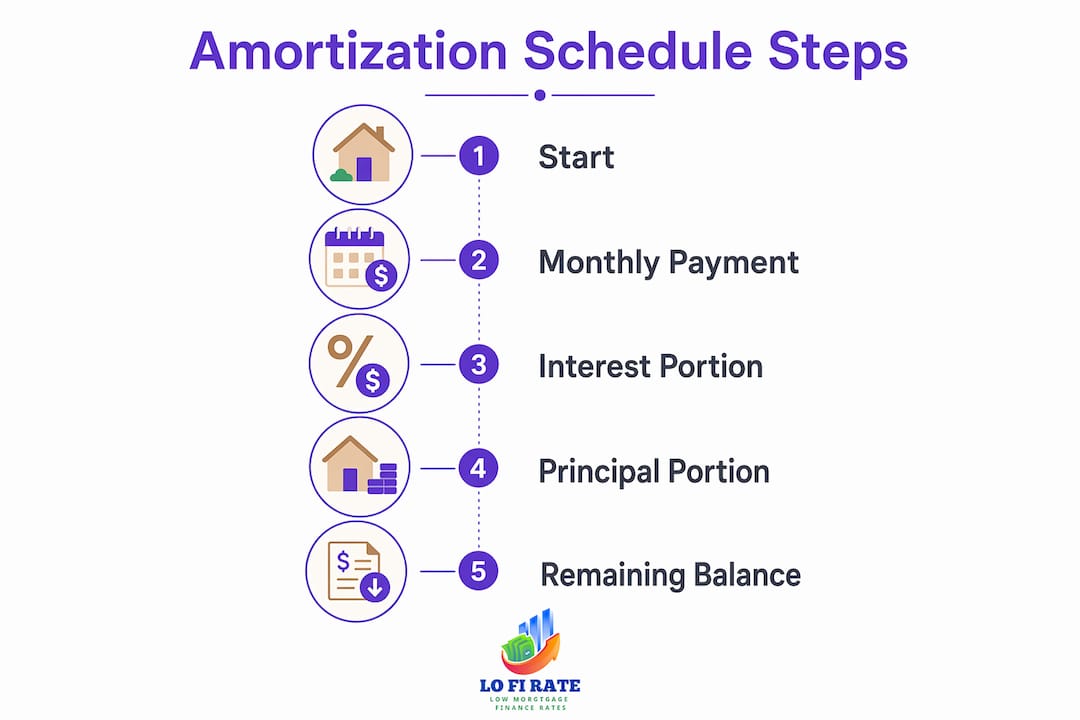
A standard amortization table contains five or six columns that together tell the full story of your loan. Key schedule components include the payment date, total payment amount, interest paid, principal paid, and remaining loan balance. Each column answers a specific question about where your money goes.
Here is what each column tells you:
- Payment date: The month and year of each scheduled payment
- Payment amount: Your fixed monthly total, which stays constant on a fixed-rate mortgage
- Interest paid: The portion of that payment covering the lender's cost for the loan
- Principal paid: The portion that actually reduces your loan balance
- Remaining balance: What you still owe after that payment posts
A sample layout for a $300,000 mortgage at 6.5% over 30 years would look like this:
| Month | Payment | Interest | Principal | Balance |
|---|---|---|---|---|
| 1 | $1,896 | $1,625 | $271 | $299,729 |
| 12 | $1,896 | $1,610 | $286 | $296,803 |
| 60 | $1,896 | $1,548 | $348 | $285,609 |
| 180 | $1,896 | $1,328 | $568 | $244,437 |
| 360 | $1,896 | $10 | $1,886 | $0 |
Notice how the interest column shrinks and the principal column grows as the loan ages. That shift is the core mechanic of amortization, and seeing it in a table makes it concrete.
Pro Tip: Ask your lender for the full amortization table before you sign closing documents. Lenders are required to provide this, and reviewing it gives you a clear picture of your total borrowing cost before you commit.
How is an amortization schedule calculated?
The fixed monthly payment formula is: Monthly Payment = P × r × (1 + r)^n / ((1 + r)^n – 1), where P is the loan principal, r is the monthly interest rate, and n is the total number of payments. That formula produces the same dollar amount every month for a fixed-rate loan. What changes is how that amount divides between interest and principal.
The calculation works in four steps each month:
- Calculate interest owed. Multiply your current outstanding balance by the monthly interest rate. On a $300,000 loan at 6.5% annually, the monthly rate is 0.5417%, so month one interest is $1,625.
- Subtract interest from the payment. Your $1,896 payment minus $1,625 in interest leaves $271 going toward principal.
- Reduce the balance. Your new balance drops from $300,000 to $299,729.
- Repeat with the new balance. Next month, interest is calculated on $299,729, so slightly less goes to interest and slightly more goes to principal.
This is the front-loading effect. Early payments go mostly to interest because the outstanding balance is at its highest. By month 180 on a 30-year loan, the split has shifted noticeably. By the final payments, almost every dollar reduces principal. This is why extra principal payments made early in the loan have an outsized effect on total interest paid.
One term worth clarifying: the amortization period and the loan term are not the same thing. The amortization period is the total time to repay the loan in full. The loan term is the contract length before renewal or refinancing is required. A shorter amortization period reduces total interest significantly, even if it raises your monthly payment.
Pro Tip: Use an online amortization calculator and run two scenarios side by side: your current loan and the same loan with an extra $200 per month toward principal. The interest savings over 30 years will likely surprise you.
What practical benefits do amortization schedules offer homeowners?
Amortization schedules are among the best budgeting tools available to homeowners because they separate interest costs from equity accumulation in plain numbers. That separation matters for every major financial decision you make as a homeowner.
The practical benefits include:
- Tracking equity growth. Your remaining balance column shows exactly how much equity you have built at any point. That number matters when you want to refinance, take out a home equity line of credit, or sell.
- Calculating total interest cost. Add up the interest column across all 360 rows and you see the true cost of borrowing. On a $300,000 loan at 6.5%, that total can exceed $380,000 in interest alone over 30 years.
- Planning extra payments. Knowing that early payments are mostly interest tells you exactly when extra principal payments deliver the most savings. Even one extra payment per year can cut years off a 30-year mortgage.
- Informing refinancing decisions. If you are considering a mortgage refinance, your current schedule shows how much principal you have paid down and how much interest you would save by resetting to a lower rate.
- Reviewing before closing. Lenders provide a proposed schedule before closing so you understand the full cost of the loan before signing.
Choosing the shortest amortization period you can comfortably afford is one of the most effective ways to reduce total interest paid over the life of your mortgage. A longer period lowers your monthly payment but raises your lifetime borrowing cost by a significant amount.
Many borrowers treat their amortization schedule as a simple debt tracker. Experts emphasize it is better understood as a forced savings plan, where each principal payment builds equity toward full homeownership. That reframe changes how you think about every payment you make. Understanding your mortgage loan duration options before you commit to a term is part of the same discipline.
How to read and use an amortization schedule effectively
Reading an amortization schedule is straightforward once you know what to look for. Start with the first row and the last row. The first row shows how little of your initial payment reduces the balance. The last row shows how almost the entire payment goes to principal. That contrast tells the whole story of front-loaded interest.
Here is a practical reading approach:
- Find your current payment row. Locate the row matching your current month. The remaining balance column shows your exact equity position today.
- Identify the crossover point. Find the row where principal paid first exceeds interest paid in a single payment. On a 30-year mortgage at typical rates, that crossover often occurs around year 18 or 19. Knowing this date helps you plan refinancing timing.
- Calculate extra payment impact. If you pay an extra $100 this month, subtract $100 from the current balance and recalculate forward. Most online calculators do this automatically.
- Update after any change. An amortization schedule is a static projection that must be regenerated after refinancing, extra payments, or escrow adjustments. Treat your original schedule as a baseline, not a permanent plan.
Common misunderstandings to avoid: many homeowners assume their payment breakdown stays the same throughout the loan. It does not. Others assume that paying extra principal automatically adjusts their monthly payment. With most fixed-rate mortgages, it does not. Extra principal payments shorten the loan term but keep the monthly payment the same. Confirming this with your lender prevents confusion.
Pro Tip: Generate a personalized amortization table using a free online mortgage calculator. Input your exact loan balance, interest rate, and remaining term. Then run a second scenario with an extra $150 per month to see the payoff date and interest savings side by side.

For a deeper look at how payments divide each month, the principal vs. interest breakdown guide from Lofirate walks through the mechanics with clear examples. Homeowners planning their full housing budget can also use the mortgage budget calculator guide to put amortization numbers into a broader financial context. When you factor in property tax planning alongside your amortization schedule, you get a complete picture of your annual homeownership costs.
Key Takeaways
An amortization schedule is the single most useful document a homeowner can study because it shows the true cost of a mortgage and reveals exactly where extra payments save the most money.
| Point | Details |
|---|---|
| Core definition | An amortization schedule breaks every payment into principal and interest, showing the balance after each payment. |
| Front-loaded interest | Early payments go mostly to interest; extra principal payments made early save the most cumulative interest. |
| Five key columns | Payment date, payment amount, interest paid, principal paid, and remaining balance form the full schedule. |
| Schedules are static | Regenerate your schedule after refinancing, extra payments, or any loan change to keep your payoff plan accurate. |
| Shorter period saves money | Choosing a shorter amortization period raises monthly payments but reduces total interest paid significantly. |
Why every homeowner should treat their amortization schedule as a financial map
Most borrowers file their amortization schedule away after closing and never look at it again. That is a costly habit. The schedule is not paperwork. It is a map of your financial future as a homeowner, and ignoring it means flying blind on one of the biggest expenses in your life.
What I have seen repeatedly is that homeowners who review their schedule annually make better decisions. They refinance at the right time instead of too late. They make extra payments in the early years when those payments have the most impact. They understand why their equity grows slowly at first and accelerates later. That understanding removes the frustration that comes from feeling like you are paying a lot and getting little in return.
The uncomfortable truth about amortization is that most of what you pay in the first decade of a 30-year mortgage goes to the lender, not to your ownership stake. That is not a flaw in the system. It is the math of compound interest working in reverse. Knowing this does not change the math, but it does change your strategy. You start asking better questions: Should I refinance now? Should I make one extra payment this year? Should I choose a 20-year term instead of 30?
Those questions lead to real savings. The schedule gives you the data to answer them.
— LoFi
How Lofirate helps you put amortization knowledge to work
Understanding your amortization schedule is only half the equation. The rate on your mortgage determines how that schedule plays out over decades.

Lofirate connects homebuyers and homeowners with licensed wholesale mortgage brokers who shop multiple lenders to find competitive rate options. A lower rate changes every row of your amortization table, reducing total interest and building equity faster. Whether you are buying your first home or considering a refinance, Lofirate's mortgage broker matching service gives you access to wholesale pricing that retail lenders do not offer directly. Visit Lofirate for a no-obligation consultation and see how a better rate reshapes your amortization schedule from day one.
FAQ
What is an amortization schedule in simple terms?
An amortization schedule is a table that shows every mortgage payment broken down into how much goes to interest and how much reduces your loan balance, listed month by month until the loan is paid off.
How do I read an amortization schedule?
Find your current payment row to see your remaining balance and equity position, then look at the interest and principal columns to understand how your payment splits at that point in the loan.
Why do early mortgage payments go mostly to interest?
Interest is calculated on the outstanding loan balance, which is highest at the start of the loan. As the balance drops, less interest accrues and more of each payment reduces principal.
What is the difference between amortization period and loan term?
The amortization period is the total time to repay the loan in full. The loan term is the contract length, after which you may need to refinance or renew, even if the amortization period is longer.
Does making extra principal payments change my monthly payment?
On most fixed-rate mortgages, extra principal payments do not lower your monthly payment. They shorten the loan term and reduce total interest paid, but your required monthly amount stays the same.