

TL;DR:
- Mortgage escrow is a lender-managed account that collects a portion of your monthly payment to pay property taxes and homeowners insurance. It occurs during both home purchase and ongoing mortgage servicing, with federal laws regulating cushion limits and requiring annual analyses that alter your escrow contributions. Without escrow, homeowners face increased risks of tax liens, insurance lapses, and budgeting difficulties, making escrow essential for financial security in homeownership.
Escrow in mortgages is defined as a lender-managed account that collects a portion of your monthly payment to cover property taxes and homeowners insurance on your behalf. Most first-time buyers encounter this term twice: once during the home purchase process, when earnest money is held in a transaction escrow, and again when their mortgage servicer sets up an ongoing escrow account for taxes and insurance. These are two distinct functions, and confusing the two creates incorrect expectations about what your monthly payment actually covers. Understanding how mortgage escrow works protects your budget, your property, and your relationship with your lender from day one.

What is escrow in mortgages and how does it work?
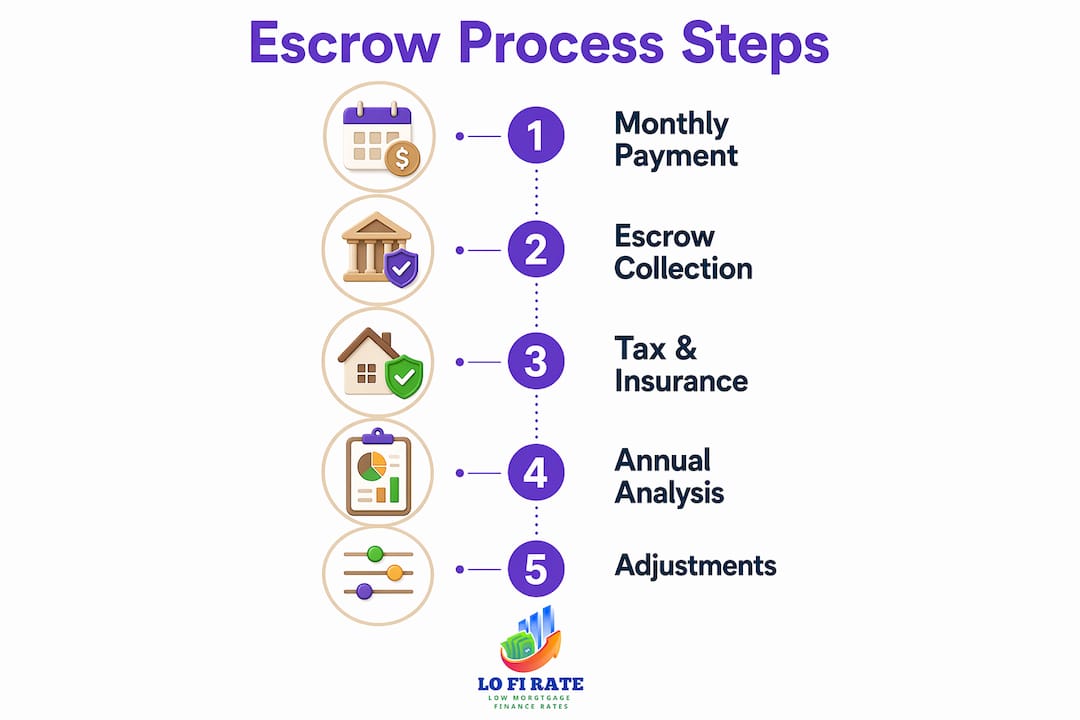
A mortgage escrow account is a holding account your loan servicer controls. Each month, you pay a single mortgage payment that covers four components: principal, interest, property taxes, and homeowners insurance. The tax and insurance portions go directly into your escrow account, where they sit until the bills come due. Your servicer then pays your county tax authority and insurance provider directly, so you never have to write those checks yourself.
Here is how the math works in practice:
- Your servicer estimates your annual property tax bill and your annual homeowners insurance premium.
- Those two amounts are added together, then divided by 12.
- That monthly figure is added to your principal and interest payment to form your total mortgage payment.
- Each month, your servicer deposits the escrow portion into your dedicated account.
- When your tax bill or insurance renewal arrives, the servicer pays bills on your behalf using the accumulated funds.
Federal law caps the escrow cushion your servicer can hold at one-sixth of annual disbursements, which equals roughly two months of escrow payments. This buffer exists to cover timing gaps, such as when a tax bill arrives slightly earlier than expected, without leaving the account short.
Pro Tip: Review your mortgage statement each month and look at the escrow line separately from principal and interest. Knowing what each component covers helps you spot errors and understand why your total payment changes year to year.
Why do escrow payments change over time?
The most common reason escrow payments change is a shift in the underlying costs: your property tax assessment increases, your insurance carrier raises your premium, or both happen in the same year. These changes have nothing to do with your loan's interest rate or principal balance. If you have a fixed-rate mortgage, your principal and interest payment stays the same for the life of the loan. Your escrow portion, however, is recalculated every year.
The mechanism that triggers this recalculation is called an annual escrow analysis. Under RESPA §1024.17, your servicer is required to perform this analysis once per year and send you a statement within 30 days. The analysis compares what was collected against what was actually paid out, then projects the next 12 months of expected costs. Three outcomes are possible:
- Shortage: The account collected less than it paid out, or projections show future costs will exceed current deposits. Your monthly escrow payment increases to make up the difference.
- Surplus: The account holds more than required. If the surplus exceeds $50, your servicer must refund the excess or apply it as a credit to your next payment.
- Balance: Collections and disbursements align closely. Your monthly escrow amount stays roughly the same.
An annual escrow increase is most often traced to a specific line item in the analysis statement, usually a higher tax assessment after a home sale or a renovation permit that triggered a reassessment. Reading that statement line by line is the fastest way to understand exactly why your payment went up.
Pro Tip: When you receive your annual escrow analysis statement, compare the projected tax and insurance figures to your actual bills. If your servicer overestimated either number, you may be able to request a corrected analysis and a lower monthly payment.
When is escrow required and when can you opt out?
Not every borrower has a choice about escrow. The loan type and your equity position largely determine whether escrow is mandatory or optional.
| Loan type | Escrow requirement |
|---|---|
| FHA loan | Escrow is always required for taxes and insurance |
| Conventional loan, less than 20% down | Escrow typically required by lender |
| Conventional loan, 20% or more equity | Escrow may be waivable depending on lender |
| Properties in FEMA flood zones | Flood insurance escrow required for federally related mortgages |
| VA loan | Escrow required in most cases |
Borrowers who meet equity and credit criteria can sometimes waive escrow accounts on conventional loans, but this shifts full responsibility for tax and insurance payments onto the homeowner. Lenders who allow waivers often charge a small fee, sometimes called an escrow waiver fee, to compensate for the added risk they absorb. The rationale is straightforward: if you miss a property tax payment, the county can place a lien on the home, which threatens the lender's collateral. Escrow eliminates that risk entirely from the lender's perspective.
The 2026 OCC rules further clarify that federally chartered institutions retain authority to define escrow terms and that federal law preempts certain state-level escrow regulations. This matters for borrowers in states that historically offered more escrow flexibility, since federal rules now set the floor.
Key escrow terms every homeowner should know
Understanding a handful of specific terms makes every conversation with your servicer more productive. These definitions come up repeatedly in escrow statements, loan disclosures, and federal compliance documents.
Escrow account (also called an impound account): The lender-held account where your monthly tax and insurance contributions are deposited. "Impound account" is the term used most often in California and several western states, but it refers to the same structure.
Escrow cushion: The reserve balance your servicer is allowed to hold above and beyond projected disbursements. Federal law caps this at two months of escrow payments, calculated as one-sixth of your annual escrow costs.
Escrow analysis: The annual review your servicer conducts to compare actual account activity against projections and reset your monthly contribution for the coming year.
Shortage vs. surplus: A shortage means your account ran low or will run low based on projections. A surplus means more was collected than needed. Both trigger adjustments, but in opposite directions.
Escrow agent: During a home purchase, an escrow agent is the neutral third party, often a title company or escrow company, that holds earnest money and coordinates the closing. This role ends at settlement. Your mortgage servicer then takes over as the manager of your ongoing mortgage escrow account. These are separate roles performed by different entities at different stages of the transaction.
One regulatory detail worth knowing: even if you fall behind on your mortgage payments, your servicer is still required to complete the annual escrow analysis. The servicer may delay sending you the statement until your account is current, but the analysis itself cannot be skipped.
What happens without escrow? Risks homeowners face
Without an escrow account, you take on full responsibility for tracking and paying property taxes and homeowners insurance on your own schedule. For disciplined budgeters, this is manageable. For most homeowners, it introduces real financial risk.
The consequences of missing these payments are serious:
- Property tax delinquency can result in late penalties, interest charges, and eventually a tax lien placed on your home by the county. A lien can complicate refinancing or selling the property.
- Lapsed homeowners insurance leaves you personally exposed to the full cost of fire, theft, or storm damage. Your lender will also notice, and most loan agreements allow the servicer to purchase force-placed insurance on your behalf at a significantly higher premium, which gets added to your loan balance.
- Budgeting strain is common when large, infrequent bills arrive without a savings plan in place. A property tax bill of several thousand dollars due in one or two annual installments can disrupt household cash flow.
Lenders require escrow for risk mitigation, especially when borrower equity is low. The logic is simple: the less equity you have, the less financial cushion exists between the lender's collateral and a potential loss. Escrow removes the single largest source of payment default risk outside of the mortgage payment itself.
Mortgage escrow accounts provide budgeting certainty by converting large, irregular bills into predictable monthly contributions. That predictability has real value, particularly in your first few years of homeownership when unexpected costs are most likely to strain your finances.
Key takeaways
Mortgage escrow is a lender-managed account that collects monthly contributions for property taxes and insurance, pays those bills on your behalf, and is governed by federal RESPA rules requiring annual analysis and strict cushion limits.
| Point | Details |
|---|---|
| Escrow account definition | A lender-held account that collects and pays property taxes and homeowners insurance monthly. |
| Annual escrow analysis | Required by RESPA each year; adjusts your monthly payment based on actual costs and projections. |
| Escrow cushion limit | Federal law caps the reserve at one-sixth of annual disbursements, roughly two months of payments. |
| When escrow is mandatory | FHA loans, flood zone properties, and low-equity conventional loans almost always require escrow. |
| Risk without escrow | Missed tax or insurance payments can trigger liens, force-placed insurance, and loan default risk. |
What I've learned about escrow after years in mortgage finance
Most first-time buyers treat the escrow line on their mortgage statement as a fixed number. It is not, and that assumption causes real frustration when the annual analysis arrives and the monthly payment jumps by $80 or $150. The increase is not arbitrary. It reflects a real change in your tax assessment or insurance premium, and the analysis statement tells you exactly which one drove it.
The confusion I see most often is between transaction escrow and mortgage escrow. Buyers hear "escrow" during the purchase process and associate it with the earnest money held by a title company. When their servicer later talks about escrow shortages and annual analyses, it sounds like a different language. It is a different function entirely, and understanding that distinction early saves a lot of unnecessary anxiety.
My practical advice: read your escrow analysis statement the same week it arrives. Do not file it away. Check whether your projected tax figure matches your most recent county tax bill. Check whether your insurance premium matches your policy renewal. If either number looks wrong, call your servicer. Servicers do make projection errors, and catching one early can lower your monthly payment for the entire coming year.
Escrow is genuinely useful. It turns two of the largest recurring homeownership costs into a predictable monthly line item. Use it as a budgeting tool, not a mystery charge.
— LoFi
See how Lofirate helps you understand your full mortgage picture
Understanding escrow is one piece of knowing what your mortgage actually costs. Lofirate connects you with licensed wholesale mortgage brokers who explain every component of your loan, including escrow setup, cushion requirements, and how your total payment is structured, before you sign anything.

Wholesale brokers shop multiple lenders to find competitive mortgage rates rather than offering a single retail price. That means you get a clearer picture of your real loan costs, including how escrow requirements vary by loan type. If you are buying your first home or considering a refinance, explore your loan options at Lofirate for a no-obligation consultation with a broker licensed in your state.
FAQ
What is an escrow account in a mortgage?
A mortgage escrow account is a lender-held account that collects a portion of your monthly payment to cover property taxes and homeowners insurance. Your servicer pays those bills directly when they come due, so you do not have to manage them separately.
Why did my escrow payment go up?
Your escrow payment increased because your property tax assessment or homeowners insurance premium rose, triggering a shortage identified in your annual escrow analysis. The servicer adjusts your monthly contribution to cover the higher projected costs for the coming year.
Is escrow required on all mortgages?
Escrow is required on FHA loans, most VA loans, and conventional loans with less than 20% equity. Borrowers with sufficient equity on conventional loans may qualify to waive escrow, though lenders often charge a fee for that option.
What is the difference between an escrow agent and a mortgage escrow account?
An escrow agent is a neutral third party, typically a title or escrow company, that holds earnest money during a home purchase and coordinates closing. A mortgage escrow account is managed by your loan servicer after closing to handle ongoing tax and insurance payments. These are separate roles.
How much can my lender hold in escrow?
Federal law limits the escrow cushion to one-sixth of your estimated annual escrow disbursements, which equals approximately two months of escrow payments. Any surplus above $50 must be refunded or credited to your account after the annual analysis.