

TL;DR:
- Loan origination encompasses the entire process from application to final funding or denial, including document verification and underwriting. The process significantly impacts your approval chances, interest rate, and overall mortgage costs, making proactive decision-making and document accuracy crucial. Comparing Loan Estimates from different lenders beforehand enables better negotiation and reduces delays during loan approval.
Most homebuyers assume getting a mortgage is just filling out an application and waiting. The reality is more layered. What is loan origination? It's the complete process a lender uses to evaluate your application, verify your finances, and decide whether to fund your loan. This process directly shapes your interest rate, your loan terms, and whether you get approved at all. Understanding it before you apply gives you a real advantage. This guide walks you through every stage, the fees you will encounter, and how to position yourself for the best possible outcome.
Key takeaways
| Point | Details |
|---|---|
| Loan origination is end-to-end | The process runs from your first application through underwriting to final funding or denial. |
| Underwriting is the critical gate | Your credit score, income, and debt-to-income ratio determine approval and the terms you receive. |
| Fees are disclosed early | You must receive a Loan Estimate within three business days of completing your application. |
| Consistency speeds approval | Submitting accurate, matching documents from the start cuts back-and-forth and reduces delays. |
| Brokers find better pricing | Wholesale mortgage brokers can shop multiple lenders, often uncovering lower origination costs than retail. |
What is loan origination, defined
Loan origination is the end-to-end process that begins when you submit a mortgage application and ends when the loan is either funded or denied. Every step in between, including document collection, credit checks, property appraisal, and final approval, falls under this umbrella.

A common point of confusion is the difference between origination and servicing. Origination covers everything up to funding. Servicing starts after. Once your loan closes, a servicer handles your monthly payments, escrow, and any future modifications. These are two completely separate functions, sometimes handled by completely different companies.
Mortgage origination is a specialized form of loan origination. It follows the same general framework but adds layers specific to real estate, such as title searches, property appraisals, and government-mandated disclosures. Several parties play active roles throughout:
- Borrower: Provides financial information, documentation, and consents.
- Loan officer: Acts as your primary contact and guides you through the application.
- Loan processor: Verifies and organizes your documents before sending them to underwriting.
- Underwriter: Reviews your full file and makes the approval or denial decision.
- Closing agent or escrow officer: Handles final paperwork and fund disbursement at closing.
The origination process is not just administrative. Every step directly influences the rate and terms your lender offers. Treat it like a job interview, not a formality.
The five stages of the loan origination process
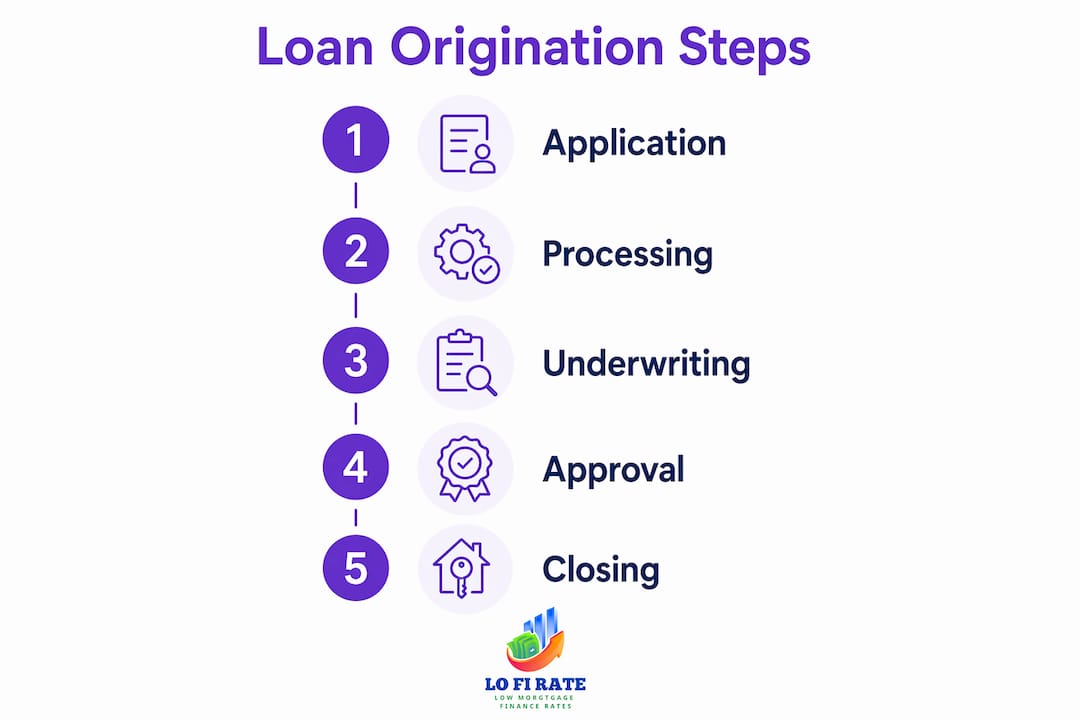
Understanding loan origination means knowing what actually happens at each stage, not just that stages exist. Here is how a typical mortgage moves from inquiry to funding.
-
Pre-approval. This is optional but strongly recommended before you shop for homes. A lender reviews your credit score, income, and debt snapshot to give you an estimated borrowing limit. Pre-approval is not a guarantee. It is a preliminary signal that you are a credible buyer. Sellers take it seriously.
-
Formal loan application. Once you have an accepted offer, you complete a full application, typically the Uniform Residential Loan Application (Form 1003). You will provide employment history, income documentation, tax returns, bank statements, and details about the property.
-
Loan processing. A processor reviews everything you submitted, orders a credit report, verifies employment, and coordinates the property appraisal. This stage can take one to two weeks. Gaps or inconsistencies in your documents are the most common cause of delays here.
-
Underwriting. This is where approval or denial is determined. The underwriter analyzes your creditworthiness, the property's appraised value, and all supporting documentation. They may issue a "conditional approval," meaning they need additional items before giving a final green light.
-
Closing and funding. You sign final loan documents, pay closing costs, and the lender transfers funds to the seller (or to you, in a refinance). At this point, the origination process is complete.
Pro Tip: If you receive a conditional approval, respond to every condition the same day you receive it. Each day of delay adds real days to your closing timeline.
How origination affects your approval and mortgage costs
The loan origination process is not neutral. Every decision made during it either works in your favor or against you.
Credit score, income, and debt-to-income ratio are the three metrics underwriters weight most heavily. Your credit score signals how reliably you have repaid past debts. Your income documents confirm you can handle the new payment. Your debt-to-income ratio, calculated by dividing your total monthly debt payments by your gross monthly income, tells the lender how much financial room you have. Most conventional loans require a debt-to-income ratio below 43%, though some programs allow higher.
How the underwriter reads these inputs directly affects your outcome:
- A higher credit score typically unlocks lower interest rates.
- A lower debt-to-income ratio improves approval odds and may allow larger loan amounts.
- A larger down payment reduces lender risk and can eliminate private mortgage insurance requirements.
- Documented, consistent income signals stability and speeds underwriting decisions.
Origination charges also add up. These are the fees lenders assess for processing and underwriting your loan. They usually represent a percentage of the total loan amount and show up clearly on your Loan Estimate. Paying a higher origination fee in exchange for a lower interest rate (often called "buying points") can make sense if you plan to stay in the home for many years.
Pro Tip: Ask your loan officer specifically whether any origination fee reduction is available by slightly adjusting your rate. This trade-off calculation is often not offered unless you ask.
Loan origination fees and what to expect in disclosures
One of the most borrower-friendly rules in U.S. mortgage law is the Loan Estimate requirement. By law, you must receive this three-page disclosure form within three business days of completing your application. It breaks down your estimated interest rate, monthly payment, and all closing costs in a standardized format across every lender.
The Loan Estimate separates two distinct categories of fees:
- Lender-controlled fees: Origination charges, underwriting fees, and points. These are where you have the most negotiating room.
- Third-party fees: Appraisal, title insurance, escrow, and recording fees. These are largely set by outside vendors, though you may be able to shop for some of them.
Here is a quick comparison of what these fee types mean for your decision-making:
| Fee type | Who controls it | Negotiable? | Example |
|---|---|---|---|
| Origination charges | Lender | Yes | 0.5%–1% of loan amount |
| Underwriting fee | Lender | Sometimes | $400–$900 |
| Appraisal | Third party | Rarely | $400–$700 |
| Title insurance | Third party | Sometimes | $1,000–$2,000 |
| Recording fee | Government | No | $50–$250 |
Origination fees vary widely between lenders, which is exactly why comparing Loan Estimates side by side matters. The interest rate headline is not enough. Two loans at the same rate can carry dramatically different origination costs. When you use a mortgage fees guide to understand what each line item means, you are far less likely to overpay.
Borrowers who take the Loan Estimate seriously and ask questions before proceeding significantly cut origination delays and avoid cost surprises at closing.
Best practices for navigating origination smoothly
Knowing the steps is one thing. Executing them well is another. These practices separate borrowers who close on time from those who spend extra weeks chasing conditions.
- Gather documents before you apply. Two years of W-2s, two months of bank statements, your most recent pay stubs, and a copy of your government-issued ID. Having these ready on day one eliminates the most common processing delay.
- Keep your finances stable. Do not open new credit accounts, make large deposits without documentation, or change jobs between application and closing. Each of these can trigger re-verification and stall the file.
- Be consistent across all documents. Matching income figures, asset totals, and debt balances across every document reduces follow-up requests and shortens the origination timeline. Discrepancies, even minor ones, require written explanations that slow everything down.
- Communicate proactively with your loan officer. If something in your financial picture changes after you apply, disclose it immediately. Surprises late in underwriting are far more damaging than early transparency.
- Review every disclosure promptly. Timely borrower review of your Loan Estimate and any lender follow-up requests prevents timeline slippage and potential cost changes before closing.
Pro Tip: Create a dedicated folder, physical or digital, for every document your lender might request. Label each file clearly. When a processor calls for something specific, you can respond within the hour rather than the day.
For a deeper look at positioning yourself before you even apply, the mortgage qualification guide from Lofirate covers the 2026 qualification landscape in practical detail.
My honest take on loan origination
I have watched countless borrowers treat loan origination like a waiting game. They submit their application and then sit back, assuming the lender will figure things out. That passive approach costs people real money and real time.
What I have seen firsthand is that the borrowers who get the best outcomes are the ones who treat origination like a collaborative project. They respond within hours, not days. They ask specific questions about fee structures before accepting a rate. They understand that underwriting delays are almost always documentation problems, not lender problems.
The other thing most articles will not tell you: the lender you start with is not always the one you should close with. Many borrowers lock in with a retail bank because it feels familiar, then discover later that the origination fees and rate were higher than what a wholesale broker could have offered. By the time they realize this, they are too far into the timeline to switch. Going into origination with rate options already compared, rather than a single lender, changes the negotiating dynamic entirely.
If one thing stands out in my experience helping people understand mortgage decisions, it is this: knowledge early in the process compounds. Every question you ask before you apply is worth ten you ask after conditional approval.
— LoFi
Find better rates before your loan origination begins

The loan origination process works better when you go in with competing options. Lofirate connects homebuyers with licensed wholesale mortgage brokers who shop multiple lenders on your behalf, giving you real rate comparisons before you commit. Retail lenders only offer their own pricing. Wholesale brokers have access to a wider market. When you explore loan options through Lofirate, you get a no-obligation consultation that could reveal meaningful savings on both your rate and origination costs. If you are buying or refinancing in 2026, get started with Lofirate today before you settle for the first number a lender shows you.
FAQ
What is loan origination in simple terms?
Loan origination is the full process a lender uses to evaluate, approve, and fund a loan, starting from your application and ending at closing.
How long does the loan origination process take?
Most mortgage originations take 30 to 60 days from application to closing, though timely document submission and quick responses to lender requests can shorten this significantly.
What are typical loan origination fees?
Origination charges typically range from 0.5% to 1% of the loan amount and cover the lender's costs for processing and underwriting your file. These fees appear clearly on your Loan Estimate form.
What is loan underwriting and how is it different from origination?
Loan underwriting is one stage within the broader origination process. It is the point where an underwriter reviews your complete file to make the final approval or denial decision based on verified credit, income, and property value.
Can I negotiate loan origination fees?
Yes. Origination fees are negotiable and vary between lenders. Comparing Loan Estimates from multiple lenders, including wholesale brokers, gives you the leverage to negotiate or choose the more cost-effective option.