

An asset depletion mortgage lets you qualify for a home loan by converting your liquid assets into a notional monthly income, even if your tax returns show almost nothing. Fannie Mae's selling guide spells out one version of this math, and the OCC's supervisory bulletin governs how banks are expected to underwrite it responsibly. Lofirate connects borrowers to licensed brokers who work with lenders offering these programs.
This works best for three kinds of borrowers:
- Retirees living off a portfolio rather than a paycheck
- Recently exited business owners sitting on sale proceeds
- High-net-worth or self-employed borrowers whose tax returns understate real financial strength
The trade-off: expect more paperwork than a conventional loan, tighter reserve requirements, and generally higher interest rates. This is a legitimate path to homeownership and not a shortcut.
TL;DR:
- The depletion period used by lenders, ranging from 60 months to 360 months, can significantly impact your qualifying income and loan amount.
- Non-QM lenders often use shorter depletion periods, which inflate income figures compared to agency programs like Fannie Mae's 360-month assumption.
- Lenders require your assets to remain untouched until closing, and re-verification may reveal unspent large deposits or transfers that can disqualify your application.
- Asset depletion loans favor retirees with portfolios, recent business sellers, and self-employed individuals with understated taxable income.
- Shopping with brokers like Lofirate allows comparison of different depletion methodologies and pricing, which can be crucial for maximizing your qualification chances.
Table of Contents
- What Is an Asset Depletion Mortgage and How Do Programs Differ?
- How Lenders Calculate Your Qualifying Income
- Which Assets Count and What Lenders Want to See
- Credit, Reserves, and What Asset Depletion Loans Cost
- Who Actually Benefits From This Kind of Loan
- How to Find a Lender and What to Ask Before You Apply
- How LoFiRate Helps You Compare Asset Depletion Programs
- Does Market Volatility Affect Your Asset Depletion Approval?
- What Are the Tax Implications of Using Assets to Qualify?
- How Lenders Confirm Your Assets Are Real
- Asset Depletion vs. Bank-Statement and Stated-Income Loans
- What Could Go Wrong With an Asset Depletion Mortgage
- Why the Depletion Period Matters More Than the Lender's Name
- Shop Asset Depletion Programs Through Lofirate
- Key Takeaways
- Sources
What Is an Asset Depletion Mortgage and How Do Programs Differ?
Asset depletion, sometimes called asset dissipation, is a method lenders use to turn a pile of savings into a hypothetical monthly paycheck for underwriting purposes. The OCC calls it a "hypothetical cash annuity" approach and expects banks to apply it with real discipline, not as a workaround for weak files.
There are two distinct roads here, and they produce very different numbers. Agency programs, following Fannie Mae's employment-related-assets rules, divide your net documented assets by the loan term, often 360 months. That produces a conservative, modest monthly figure. Non-QM portfolio lenders take a different approach entirely: they use much shorter depletion periods, frequently several years, which inflates the qualifying income considerably on the same asset base.
Most of these loans are written for primary residence purchases or limited cash-out refinances. Second homes are usually eligible too, but investment properties often face tighter restrictions or may not qualify with all lenders' asset-depletion programs. Which route fits you depends less on your assets and more on how aggressively you need the numbers to work.
How Lenders Calculate Your Qualifying Income
The core formula is simpler than it sounds: take your eligible asset balance, subtract any withdrawal penalties and funds needed for the down payment, closing costs, and reserves, then divide what's left by the depletion period in months. That final number becomes your notional monthly income for debt-to-income purposes, which you can then compare against how lenders calculate debt-to-income ratio on a conventional file.
Haircuts matter here. Retirement accounts like IRAs and 401(k)s typically get reduced to account for early-withdrawal penalties and taxes if you're under 59½, and many lenders only count a percentage of the vested balance, commonly 70%, to be conservative. Brokerage and cash accounts usually count closer to full value since there's no penalty for touching them.
The depletion period you're assigned changes everything. A 60-month divisor can generate four to six times the qualifying income of a 360-month divisor on the exact same asset pool.
Here's what that looks like on $1,000,000 in net eligible assets:
The same portfolio can support a dramatically different loan amount depending purely on which lender's methodology you land with, before your credit or down payment even enters the picture.
Which Assets Count and What Lenders Want to See
Lenders are fairly consistent about what qualifies and what gets rejected outright. Eligible accounts generally include:
- Checking, savings, and money market accounts
- Brokerage accounts holding stocks, bonds, and mutual funds
- Certificates of deposit
- Vested retirement accounts (IRA, 401(k), pension funds), subject to access rules and penalty haircuts
Ineligible or heavily scrutinized items include cryptocurrency, unvested stock options or restricted stock, and recent large deposits or gifts without a clear paper trail explaining where the money came from. Retirement accounts get extra attention: if you're not yet eligible to withdraw without penalty, lenders will discount the balance further or ask for proof of your withdrawal rights.
Expect to produce two to three months of recent account statements, a 1099-R or distribution letter if you're already drawing from retirement funds, and documentation proving you actually own the account rather than merely having signing access. Fannie Mae's guidance requires this kind of net documented assets verification before any calculation happens, and lenders will re-check balances again closer to closing.
Credit, Reserves, and What Asset Depletion Loans Cost
Underwriting bars for these programs run tighter than a plain-vanilla conventional loan. Here's what to expect:
- Credit score: Non-QM lenders typically seek higher credit scores, often around 700 or above, with some flexibility at lower scores accompanied by higher rates
- Loan-to-value: Agency programs often cap around 70%, though some allow up to 80% for borrowers age 62 and older; non-QM programs frequently max out near 80% as well, depending on the lender
- Reserves: Many lenders want the qualifying assets to remain untouched and available through closing, on top of separate reserve funds covering several months of principal, interest, taxes, and insurance
- Down payment: Non-QM asset-based loans often call for 20 to 30% down depending on loan size
Pricing generally carries a modest premium above comparable conventional rates, though that premium narrows with stronger credit, a larger down payment, and lower leverage.
Who Actually Benefits From This Kind of Loan
Three profiles show up again and again in asset depletion files:
- The retired homeowner. Social Security and a modest pension don't reflect the $2 million portfolio sitting in a brokerage account, so depletion math fills the income gap conventional underwriting can't see.
- The recent business seller. A liquidity event just handed you seven figures, but you haven't drawn a paycheck since closing the sale, and tax returns from your old business no longer represent your finances.
- The self-employed owner with light taxable income. Aggressive deductions keep your tax bill low but also keep your reported income too thin to qualify conventionally, even though cash reserves tell a different story.
If your income is real but just not documented cleanly, bank-statement loans might fit better. If the strength is genuinely in your balance sheet, asset depletion is usually the more direct route.
How to Find a Lender and What to Ask Before You Apply
These programs mostly live with non-QM portfolio lenders, though some agency-eligible routes exist through traditional channels. Terms vary enough between lenders that shopping around isn't optional if you want a competitive result.
Before signing anything, ask each lender or broker directly:
- What depletion period do you use, and can it change based on account type?
- What haircut applies to retirement versus brokerage assets?
- How many months of reserves do you require beyond the qualifying assets?
- What's your maximum LTV for this program, and does my age or occupancy type affect it?
- What's the realistic rate premium versus a conventional loan at my credit tier?
Gather your last two to three months of statements, any 1099-R forms, and proof of account ownership before you start applying, since re-verification close to closing is standard practice. Review a general loan approval checklist so you know what else underwriters will expect alongside your asset documentation.
Pro Tip: Don't move money between accounts or make large withdrawals once you've applied. Lenders re-verify balances before closing, and unexplained account activity is one of the most common reasons asset-depletion files get delayed or denied.
How LoFiRate Helps You Compare Asset Depletion Programs
Depletion-period methodology varies so much between lenders that the difference between a 60-month and 360-month divisor can decide whether you qualify at all. Lofirate connects you with licensed wholesale mortgage brokers who shop asset-depletion-capable lenders on your behalf, rather than pitching you a single institution's fixed formula.
A consultation through Lofirate is free and comes with no obligation. Brokers can walk you through how different lenders calculate your notional income, what haircuts apply to your specific mix of assets, and where the LTV and reserve requirements land for your situation. You can also confirm any broker's license status directly through NMLS Consumer Access before moving forward.
Does Market Volatility Affect Your Asset Depletion Approval?
Yes, and it matters more than most borrowers expect. Because your qualifying income is calculated directly from account balances, a drop in the market between application and closing can shrink the very number your loan approval depends on.

Lenders typically lock in your qualifying calculation based on statements pulled at application, but most also re-verify balances shortly before closing. If your brokerage account has fallen 15% during a rough month for equities, and your file was already tight against the LTV or DTI limits, that swing alone can push you out of qualification range or force a smaller loan amount.
This cuts both ways with account type. Cash and CDs don't move with the market, so they're the most stable qualifying assets. Retirement accounts and brokerage portfolios heavy in stocks carry real volatility risk, especially during the weeks between application and closing.
A few practical implications follow from this. First, borrowers relying heavily on volatile assets should build in a cushion rather than qualifying at the exact edge of what their portfolio supports today. Second, timing matters: applying during a market downturn when your portfolio is already depressed can work against you twice, once on the initial calculation and again if values keep sliding before closing. Third, some borrowers deliberately shift a portion of qualifying assets into cash or short-term instruments before applying, specifically to remove volatility from the equation. None of this is a guarantee against a bad underwriting outcome, but it does put more of the outcome in your control.
What Are the Tax Implications of Using Assets to Qualify?
Using your assets to qualify for a mortgage does not, by itself, trigger a tax event. The lender's calculation is a paper exercise for underwriting purposes, and regulators are explicit that this is a notional method to demonstrate repayment capacity, not a requirement that you actually liquidate anything. Your money stays exactly where it is.
Where taxes do enter the picture is in how lenders discount certain accounts. The math already assumes you'd lose a chunk to taxes and penalties if you actually tapped the account, so it protects both you and the lender from overstating what's really available.
If you do eventually draw down assets to cover a down payment, closing costs, or ongoing payments, that withdrawal can carry real tax consequences depending on account type. Selling appreciated brokerage holdings may trigger capital gains tax. Pulling from a retirement account ahead of retirement age adds the early-withdrawal penalty on top of ordinary income tax.
None of this is unique to asset depletion mortgages. It's the standard tax treatment for touching these accounts under any circumstance. The mortgage program itself doesn't add a tax burden. It just requires you to show the assets exist and that using them wouldn't leave you in a worse tax position than the underwriting assumes. Talk to a tax professional before making withdrawal decisions tied to your closing, since timing can shift your liability meaningfully.
How Lenders Confirm Your Assets Are Real
Asset depletion underwriting only works if the assets are genuine, liquid, and actually available. That's exactly why the OCC pushed banks toward more rigorous asset dissipation underwriting controls: the entire loan hinges on numbers pulled from account statements, and inflated or fabricated balances are a real fraud vector.
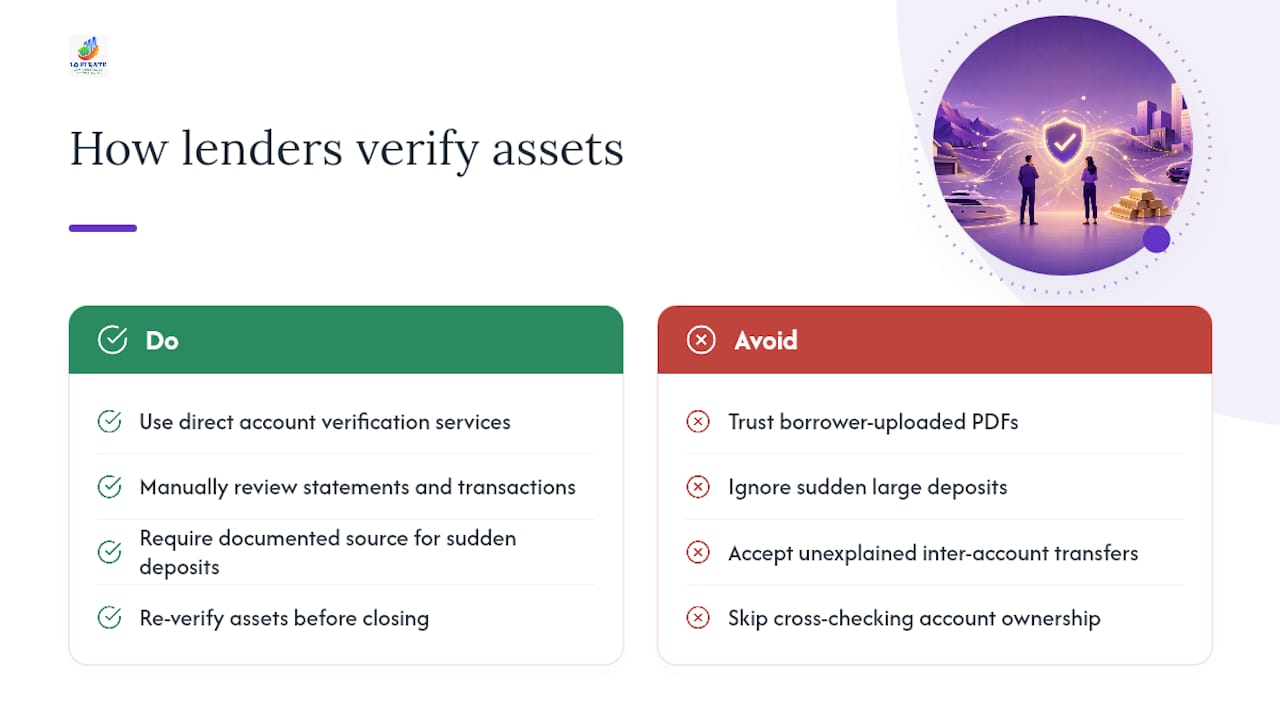
Lenders typically verify assets through a combination of direct account verification services, which pull data straight from the financial institution rather than trusting a PDF the borrower uploads, and manual review of statement formatting, account history, and transaction patterns. A sudden six-figure deposit that appeared two weeks before application is a common red flag, and underwriters will usually ask for a documented source of funds before counting it toward your qualifying assets.
Large, unexplained transfers between accounts also draw scrutiny, since they can indicate an attempt to make the same money appear in multiple places or to disguise a loan disguised as a gift. Lenders cross-reference account ownership documentation against your identification and loan application to confirm you actually control the funds being used, not just that you have viewing access.
This is also why re-verification before closing exists. It's not just about market volatility. It confirms the same assets you claimed at application are still there in roughly the same form, held by the same person, without unexplained movement in between. Borrowers sometimes find this level of scrutiny frustrating, but it's the mechanism that keeps asset-based programs viable and keeps rates from climbing even higher to offset fraud risk.
Asset Depletion vs. Bank-Statement and Stated-Income Loans
Asset depletion mortgages get lumped in with other non-traditional products, but the underlying logic is different enough that mixing them up leads to picking the wrong program.
Bank-statement loans look at deposits flowing into your business or personal accounts over 12 to 24 months to estimate real cash flow, which suits self-employed borrowers whose tax returns undersell what they actually earn. Asset depletion ignores cash flow entirely and instead treats your existing balance sheet as the income source. If you're actively earning but your deposits are messy or seasonal, bank-statement underwriting usually fits better. If you have a large static pool of assets and little or no active income, depletion is the more natural fit.
Stated-income loans, the pre-2008 product that let borrowers declare income with minimal verification, are largely gone from today's mainstream market and where they exist in non-traditional mortgage form, they carry heavy restrictions and pricing premiums. Asset depletion is fundamentally different: it's not a declaration, it's a documented calculation built from real account statements, penalties, and verified balances. Regulators treat it as a legitimate underwriting method rather than a workaround, precisely because the math is transparent and auditable.
The practical takeaway: match the program to the shape of your finances. Steady but undocumented income points toward bank statements. A strong balance sheet with thin income points toward depletion. Neither is inherently better; they solve different documentation problems.
What Could Go Wrong With an Asset Depletion Mortgage
The math that makes these loans possible is also where the risk concentrates. A handful of drawbacks deserve real attention before you commit to this path.
The rate premium is real and persistent. Expect to pay more than you would on a conventional loan, and that gap compounds over a 30-year term into a meaningful amount of extra interest, even when the premium looks small on a rate sheet.
Reserve requirements can feel restrictive if your net worth is concentrated in one or two accounts. Lenders wanting your qualifying assets to remain untouched through closing, on top of separate reserves, can mean a large share of your net worth is effectively frozen for weeks or months during underwriting.
Depletion-period inconsistency between lenders creates real qualification risk. A borrower who gets quoted a 360-month divisor at one bank might qualify for far less than at a non-QM lender using a 60-month period on identical assets, so choosing the wrong lender first can mean walking away thinking you don't qualify when you actually do.
Market volatility, discussed earlier, remains a genuine threat to a file that's tight on the numbers. And documentation demands are heavier and slower than a conventional W-2 file, which can frustrate borrowers used to a faster process. None of these drawbacks make the product a bad choice. They make it a product that rewards careful shopping and a realistic read of your own asset mix before you apply.
Why the Depletion Period Matters More Than the Lender's Name
The biggest misconception in asset depletion lending is that the product itself is standardized. It isn't. Two lenders can look at the exact same brokerage statement and produce qualifying income figures that differ by a factor of four, purely because one uses a 60-month divisor and the other uses 360. Most borrowers spend their energy comparing rates and fees when the depletion period assigned to their file is the variable actually deciding whether they qualify at all.
Conventional advice tends to treat asset depletion as a niche fallback option, something you settle for once regular income documentation fails. That framing undersells it. For a retiree with a well-funded portfolio or a business owner sitting on sale proceeds, asset depletion isn't a consolation prize. It's often the more accurate reflection of real financial strength than a tax return ever could be.
What the reader should prioritize first isn't the interest rate quote. It's asking every lender the exact depletion period and haircut methodology they'll apply, before comparing anything else. Get that number pinned down early, run the math yourself using the formula in this guide, and only then start comparing pricing. A slightly higher rate from a lender using a shorter depletion period can put you in a materially larger loan than a cheaper rate paired with a conservative 360-month divisor.
— LoFi
Shop Asset Depletion Programs Through Lofirate
Lofirate is the alternative to walking into a single bank and accepting whatever depletion formula they hand you. Because wholesale brokers shop multiple lenders at once, you get to compare depletion-period methodologies, haircuts, and pricing side by side instead of taking one institution's math at face value.

A Lofirate consultation is free, has no obligation attached, and connects you with a licensed broker in your state who already knows which lenders offer competitive asset-depletion terms. That broker can walk through your specific asset mix and tell you, in plain terms, which programs are realistic for your balance sheet before you commit to a full application. Explore the loan options Lofirate helps borrowers access, or head straight to request a consultation and get a second opinion on what your assets can actually qualify you for.
Key Takeaways
The depletion period a lender assigns to your assets, not your credit score or the interest rate quote, is the single biggest factor determining how much home you can qualify for.
| Point | Details |
|---|---|
| Depletion period drives everything | A 60-month divisor can produce four to six times the qualifying income of a 360-month divisor on identical assets. |
| Agency and non-QM routes differ sharply | Fannie Mae uses the loan term (often 360 months) while non-QM lenders commonly use several years. |
| Keep assets untouched through closing | Lenders re-verify balances before closing, and withdrawals or large transfers can derail approval. |
| Documentation is non-negotiable | Expect to provide recent statements, 1099-R forms, and proof of account ownership before underwriting proceeds. |
| Shop lenders before committing | Lofirate connects borrowers to licensed brokers who compare depletion methodologies and pricing across multiple lenders. |
This article is general information, not a substitute for advice from a qualified financial advisor. Consult a qualified financial professional about your own circumstances before acting on anything here.
Sources
- Employment Related Assets as Qualifying Income | Fannie Mae
- Mortgage Lending: Lending Standards for Asset Dissipation Underwriting | OCC
- Asset Depletion Mortgage Guide | Defy Mortgage
- The Asset-Based Mortgage Master Guide | LoanWise