

Yes, most VA loans are assumable, but only with servicer or VA approval. A qualified buyer, veteran or civilian, steps into the seller's exact rate and remaining balance, which is a real advantage when current rates run higher. The catch: the seller must lock in a written release of liability, and if the buyer isn't a substituting veteran, the seller's VA entitlement stays tied to that property until the loan is paid off or refinanced.
TL;DR:
- Assumable VA loans require servicer or VA approval, and a seller must secure a written release of liability before transfer.
- Civilians can assume VA loans, but only eligible veterans can substitute entitlement, potentially freeing the VA benefit for future use.
- The most attractive assumption scenarios involve inheriting a significantly lower interest rate and avoiding high origination fees when the equity gap is fundable.
- Risks include funding the equity gap, entrapment of VA entitlement, and the possibility that defaults reduce future VA loan eligibility.
- The assumption process varies depending on whether the servicer holds automatic approval authority, impacting timelines and paperwork complexity.
Table of Contents
- What Is a VA Loan Assumption, Exactly?
- Who Can Assume a VA Loan?
- Why Buyers and Sellers Both Chase These Deals
- The Risks: Equity Gaps, Trapped Entitlement, and Foreclosure Exposure
- How the Assumption Process Actually Works, Step by Step
- What Assuming a VA Loan Actually Costs
- Finding and Marketing an Assumable VA Loan
- Buyer and Seller Checklist Before You Sign Anything
- Getting Expert Help Comparing Assumption Versus New Financing
- When Assumption Makes Sense, and When It Doesn't
- Compare Your Options Before You Commit to an Assumption
- Sources
- FAQ
What Is a VA Loan Assumption, Exactly?
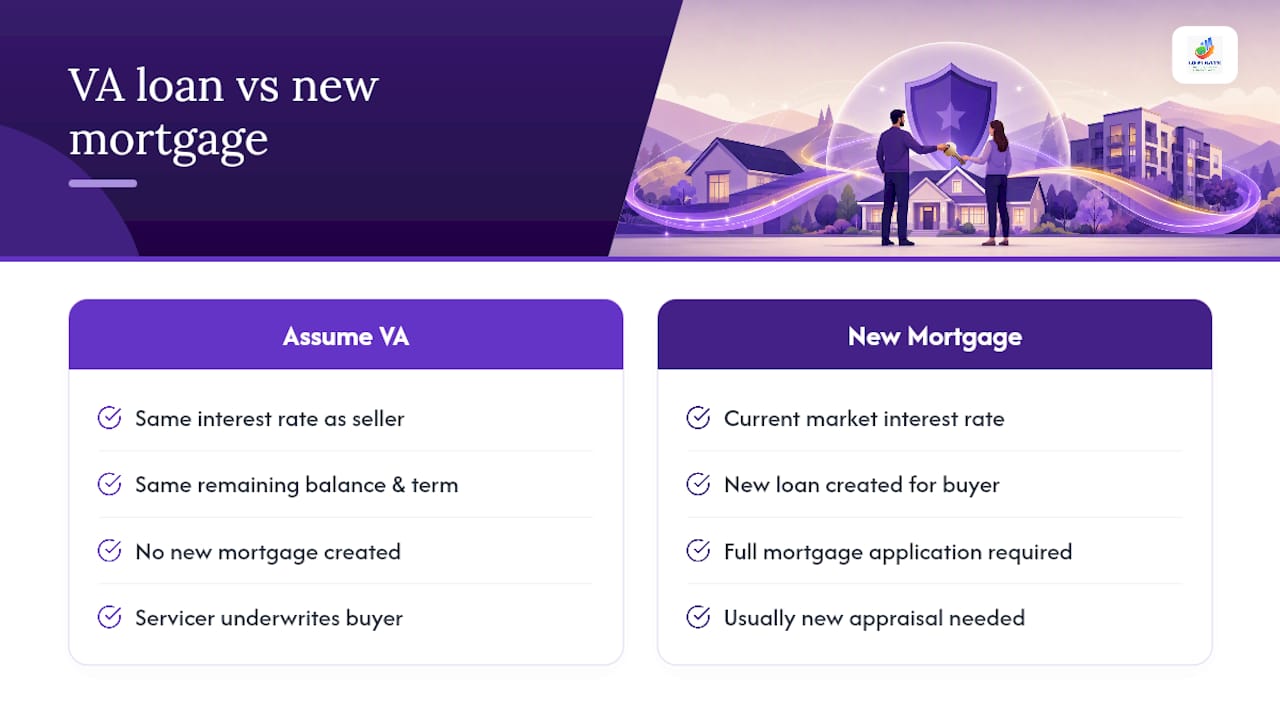
A VA loan assumption means the buyer takes over the seller's existing VA-backed mortgage exactly as it stands: same interest rate, same remaining balance, same loan term. There's no new mortgage created. That's the whole appeal.
Say the seller locked in a low interest rate a few years ago, and today's market sits well above that. A buyer who assumes that loan inherits the seller's original rate instead of whatever a fresh mortgage would cost, potentially saving a significant amount of money over time.
Operationally, assumption looks different from a standard purchase loan. The servicer underwrites the buyer's credit, income, and debt load, similar to a normal mortgage application, but there's typically no new appraisal required and origination costs run lower. The VA Home Loan Guaranty Buyer's Guide confirms that anyone who qualifies can assume a VA loan, and a funding fee usually applies unless the assumer is exempt. The buyer also needs cash or financing to cover any gap between the sale price and the remaining loan balance, since assumption transfers the debt, not the equity.
Who Can Assume a VA Loan?
Civilians can assume a VA loan. That surprises a lot of people, including agents who've sold real estate for years. Military points out that the misconception "only veterans can assume" keeps buyers from pursuing what can be one of the sharpest tools available in a high-rate market.
That said, eligibility to assume is not the same as eligibility to restore entitlement. Anyone, veteran or not, can go through servicer underwriting for credit, income, and occupancy intent. Only an eligible veteran can substitute their own entitlement for the seller's, freeing the seller's VA benefit for future use. That process requires a Certificate of Eligibility, requested via VA Form 26-1880, plus supporting paperwork the servicer forwards to the VA.
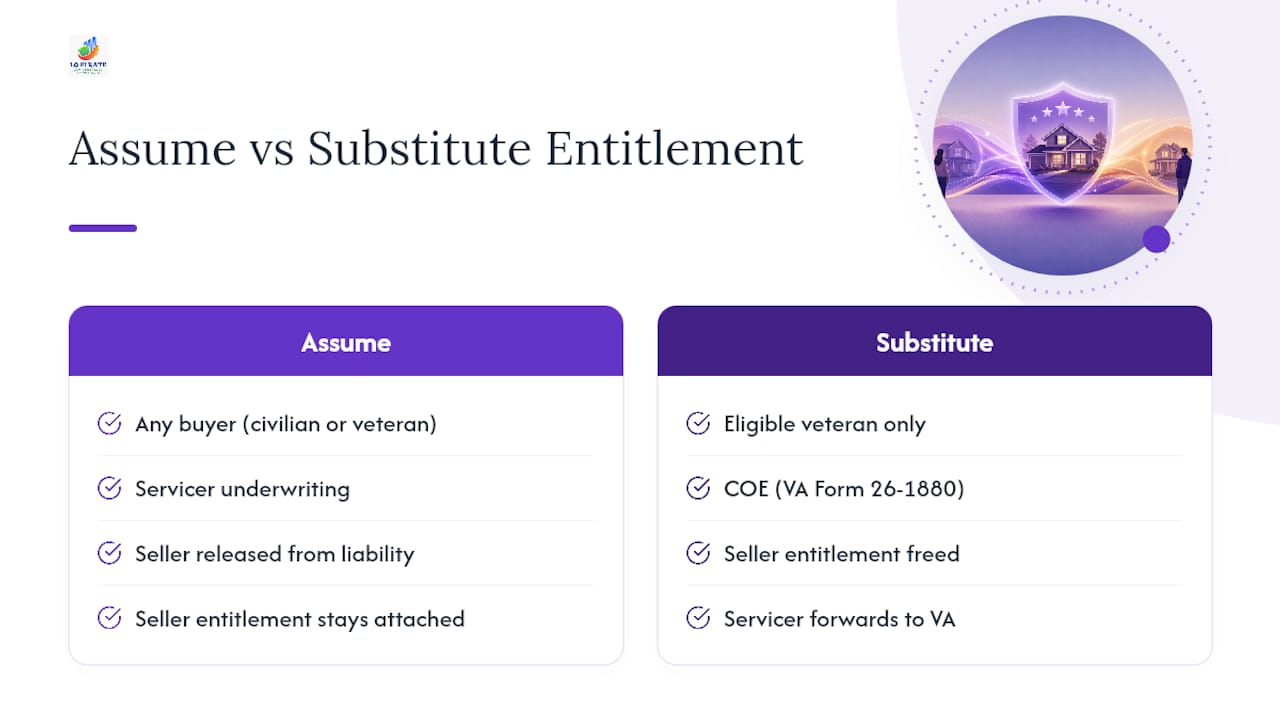
Picture this: a seller with full entitlement sells to a civilian buyer who simply assumes the loan. The seller gets a release of liability for future defaults, but their entitlement stays attached to that house until the loan is satisfied. If they wanted to buy another home with VA financing right away, they might find their entitlement partially or fully unavailable. Selling to a veteran willing to substitute entitlement avoids that trap entirely.
Why Buyers and Sellers Both Chase These Deals
The financial case for assumption gets stronger every time market rates climb. When the loan being assumed carries a rate meaningfully below current offers, both sides have real incentive to make the deal work.
Buyer-side advantages:
- Inherit the seller's original interest rate, often two to three points below current market pricing.
- Pay a lower VA funding fee, commonly 0.5% of the loan balance, versus the higher fee tiers tied to new VA purchase loans.
- Skip many of the origination costs and fees that come with a fresh mortgage, since there's no new loan being created.
- Move through underwriting that's often faster than a full purchase-loan process, especially when the servicer holds automatic authority.
Seller-side advantages:
- Market the home to a wider buyer pool, since assumable financing is a genuine selling point when rates are elevated.
- Close deals that might otherwise stall if a buyer can't qualify for a new loan at today's rates.
- Use the assumable rate as leverage in negotiations, sometimes commanding a stronger price.
The math weakens fast when there's a large equity gap. If the seller has $150,000 in built-up equity, the buyer needs to cover that difference through cash, a second mortgage, or a bridge loan, on top of qualifying for the underlying debt. At that point, the deal can become just as expensive as fresh financing, minus the flexibility.
The Risks: Equity Gaps, Trapped Entitlement, and Foreclosure Exposure
Assumption isn't a free lunch for either side. Three risks show up again and again in these transactions.
The equity gap problem. Buyers must fund the gap between the purchase price and the remaining loan balance. That money typically comes from one of three places:
- Cash paid at closing, straightforward but not always available in a competitive market.
- A second mortgage or home equity line, which adds a monthly payment and can push the buyer's debt-to-income ratio past what's comfortable.
- A short-term bridge loan, useful but usually carrying a higher rate than the assumed VA loan itself.
Trapped entitlement. A written release of liability protects the seller from being on the hook if the buyer defaults down the road, but it does nothing for entitlement. Per VA Circular 26-23-10, release of liability and substitution of entitlement are two separate legal events. A veteran seller can be fully released from liability while their entitlement remains encumbered indefinitely unless a qualifying veteran substitutes in.
Foreclosure exposure. If the buyer later defaults and the VA pays a claim on the guaranty, the original veteran's entitlement gets reduced by that claim amount, even after a release of liability, unless the claim is repaid. That can quietly shrink how much VA loan a veteran qualifies for on their next purchase.
Pro Tip: Never close an assumption without a written release of liability in hand. A verbal assurance from the servicer or buyer means nothing if a default happens two years later, and chasing down documentation after the fact is far harder than insisting on it up front.
How the Assumption Process Actually Works, Step by Step
The path an assumption takes depends entirely on whether the servicer holds "automatic authority" from the VA to approve assumptions on its own, or whether the file has to go to the VA for prior approval. That single distinction drives most of the timeline.
- Confirm assumability and request the packet. Contact the servicer, confirm the loan qualifies (loans closed on or after March 1, 1988 require formal approval), and ask for the assumption application packet.
- Assemble the underwriting file. This mirrors a standard VA purchase underwriting package: pay stubs, tax returns, credit authorization, and a Certificate of Eligibility if the buyer is a veteran substituting entitlement, requested through VA Form 26-1880.
- Servicer automatic-authority path. If the servicer has automatic authority, it can approve or deny the package on its own, typically within 45 calendar days for a complete file, per VA Circular 26-23-10.
- VA prior-approval path. Without automatic authority, the servicer submits the file to the VA within 35 days of receiving a complete application.
- Required forms. Expect VA Form 26-8106 (Statement of Veteran Assuming GI Loan), and where entitlement consequences apply, VA Form 26-10291 (Assumption Entitlement Acknowledgement), all tracked through the VA's VALERI system.
- Funding fee remittance. The servicer records and remits the funding fee through the VA Funding Fee Payment System.
- Appeals. If the servicer denies the assumption, the applicant has 30 days to appeal to the VA, which then issues its own decision on a complete package, generally within 10 business days.
You can't choose which servicer holds your loan, and servicers without automatic authority add real time to the process. Ask about authority status on day one, not week three.
What Assuming a VA Loan Actually Costs
According to VA's funding fee guidance, that fee must be recorded in the VA Funding Fee Payment System and remitted within 15 days of closing.
Servicers can also charge a processing fee for handling the assumption paperwork, and some jurisdictions add local recording or transfer fees on top. If a servicer denies the assumption after an appeal, certain processing fees may be refundable, a rule worth confirming directly with the servicer before paying anything.
On timing, plan for roughly 45 days if the servicer has automatic authority and a complete file. Add time if the loan needs VA review, since that path runs on a 35-day submission window followed by a VA decision, typically within 10 business days once the package is complete. Closing itself usually happens within a couple of weeks after approval, assuming the equity gap financing is already lined up.
Finding and Marketing an Assumable VA Loan
For buyers, the search starts with a simple question to the listing agent or seller: is this a VA-backed loan, and is it assumable? Ask the servicer for the assumption packet early, and find out whether they hold automatic authority before you get emotionally attached to a timeline.
- Sellers and agents should disclose assumable terms clearly in the listing and require a written release of liability as a closing condition, not an afterthought.
- If the seller wants their entitlement restored, insist on a buyer who's an eligible veteran willing to substitute entitlement.
- Build a realistic closing window into the purchase contract, since VA prior-approval cases run longer than a standard sale.
- For the equity gap, weigh buyer cash, a seller-carried second mortgage, or a seller credit, and factor how any secondary financing affects the buyer's debt-to-income ratio during underwriting.
Buyer and Seller Checklist Before You Sign Anything
Before either side commits to an assumption, pull together the paperwork and set the guardrails that protect you if something goes sideways later.
- Buyer documents: income verification, credit report, a Certificate of Eligibility if claiming veteran substitution, proof of funds to cover the equity gap, and the servicer's assumption application.
- Seller protections: a written release of liability secured before or at closing, a request for substitution of entitlement if the buyer is an eligible veteran, and documentation of any seller-carried financing.
- Red flags to watch: a servicer that won't produce an assumption packet, refusal to issue a written release of liability, a buyer who won't share proof of funds, or unexplained delays that stretch past the standard timelines.
Pro Tip: Keep a paper trail of every document exchange with the servicer. If the file gets misrouted, and mis-stacking documentation is a common error that adds weeks, you'll want a timestamped record showing when you submitted what.
Getting Expert Help Comparing Assumption Versus New Financing
Deciding whether assumption beats a fresh mortgage isn't always obvious, especially once you factor in the equity gap and secondary financing costs. Licensed wholesale mortgage brokers shop multiple lenders, rather than quoting a single retail rate, so you can see how assumption stacks up against refinancing or a new VA or conventional loan side by side.
That comparison matters most when you're weighing bridge financing for the equity gap or trying to gauge how a second lien affects your debt-to-income ratio. A broker can run those numbers with you before you commit to either path. If you're still building your eligibility paperwork, start with the VA loan eligibility and COE guide to understand what documentation you'll need either way.
When Assumption Makes Sense, and When It Doesn't
Assume the loan when the rate gap is real, the equity gap is fundable without stretching into risky leverage, and the seller has a release of liability or a substituting veteran lined up. Those three conditions together make assumption one of the strongest moves available in a high-rate market.
Lean toward new financing instead when you don't have cash or a clean way to cover the equity gap, when the servicer's timeline creates more risk than the rate savings justify, or when you need loan terms an old assumed mortgage simply can't offer.
— LoFi
Compare Your Options Before You Commit to an Assumption
An assumption only wins if the numbers actually beat what a broker can find you on the open market, and that's not something you can know without shopping it. Instead of taking whatever one bank quotes, get matched with licensed wholesale brokers who compare pricing across multiple lenders on your behalf, at no cost and with no obligation to move forward.

If you're weighing an assumption against a refinance or a new purchase loan, gather the documents covered earlier in this guide, then head to Lofirate's services page to request a broker match. Want to see the full range of loan types a broker might steer you toward instead, including how assumption compares to jumbo, FHA, or cash-out refinance options? Check the loan options page and start a no-obligation consultation today.
This article is general information, not a substitute for advice from a qualified financial advisor. Consult a qualified financial professional about your own circumstances before acting on anything here.
Sources
FAQ
How Difficult Is It to Assume a VA Loan?
It depends heavily on whether the servicer has automatic authority; a complete file with automatic authority can close in about 45 days, while files needing VA prior approval take longer and require more coordination.
What Are the Downsides of a VA Assumable Loan?
The main downsides are funding an equity gap, the risk of a seller's entitlement staying tied to the property if the buyer isn't a substituting veteran, and reduced future entitlement if the assumer later defaults and the VA pays a claim.
What Is the 4% Rule on a VA Loan?
There's no official VA rule by that name; if you've seen it referenced elsewhere, it likely refers informally to rate-gap thresholds some buyers use to judge whether assuming a lower rate is worth pursuing, not an actual VA regulation.
Who Is Allowed to Assume a VA Loan?
Both veterans and civilians can assume a VA loan if they meet the servicer's credit, income, and occupancy requirements, though only an eligible veteran can substitute entitlement to fully restore the seller's VA benefit.