

Most active-duty service members, veterans with a non-dishonorable discharge, qualifying National Guard and Reserve members, and certain surviving spouses are eligible for a VA-backed home loan. The VA is the only body that can confirm this, so the first move is requesting a Certificate of Eligibility (COE) yourself online or asking a lender to pull it through the Web LGY system. A COE opens the door, but your lender still checks your credit and income before approving the loan.
TL;DR:
- Most veterans and eligible service members must obtain a Certificate of Eligibility (COE) to verify VA loan entitlement, which does not guarantee loan approval.
- Service length requirements vary by era, with 24 months of active duty needed for recent periods and six credible years for Guard and Reserve members, excluding time in the IRR.
- Surviving spouses can qualify for VA loans if they meet specific conditions, such as being unremarried and receiving DIC benefits, with required documentation including a death certificate and marriage certificate.
- Lenders conduct additional underwriting, including credit checks and residual income evaluations, and often set a minimum credit score around 620, regardless of VA guidelines.
- Applying for a COE online through VA.gov or via a lender’s Web LGY system offers faster processing than mailing forms, which is crucial during the initial loan qualification phase.
Table of Contents
- What VA Loan Eligibility Actually Means
- How Long Do You Have to Serve to Qualify?
- Can Surviving Spouses Get a VA Loan?
- How Do You Get a VA Certificate of Eligibility?
- What Do Lenders Check Beyond VA Eligibility?
- What Documents Should You Gather Before Applying?
- What Commonly Delays or Denies a VA Loan?
- LoFiRate's Role for Eligible Borrowers
- Our Recommended Path to a Lender-Ready Application
- Compare Broker Options Once Your COE Is Ready
- Sources
What VA Loan Eligibility Actually Means
Getting a VA-backed mortgage is a two-part process, and mixing up the parts causes most of the confusion online. The VA determines whether you meet the service-based eligibility rules and issues your COE. No lender, real estate agent, or online calculator can override that determination. Only the VA can say yes or no on entitlement.
Your lender handles the second part: underwriting. That means checking your credit history, verifying income, and running a residual income calculation to confirm you can actually carry a mortgage payment alongside your other obligations. A COE proves you're entitled to the benefit. It does not guarantee loan approval.
There's also an occupancy rule that trips people up: VA loans are built for primary residences, not rental properties or vacation homes. A few key facts to keep straight:
- The VA certifies eligibility; lenders certify affordability.
- A COE confirms entitlement, not approval.
- You generally must intend to occupy the home as your primary residence.
- Lenders can decline a loan even when your COE checks out.
How Long Do You Have to Serve to Qualify?
Service length requirements shift depending on when and how you served, and knowing your era matters more than most applicants realize.
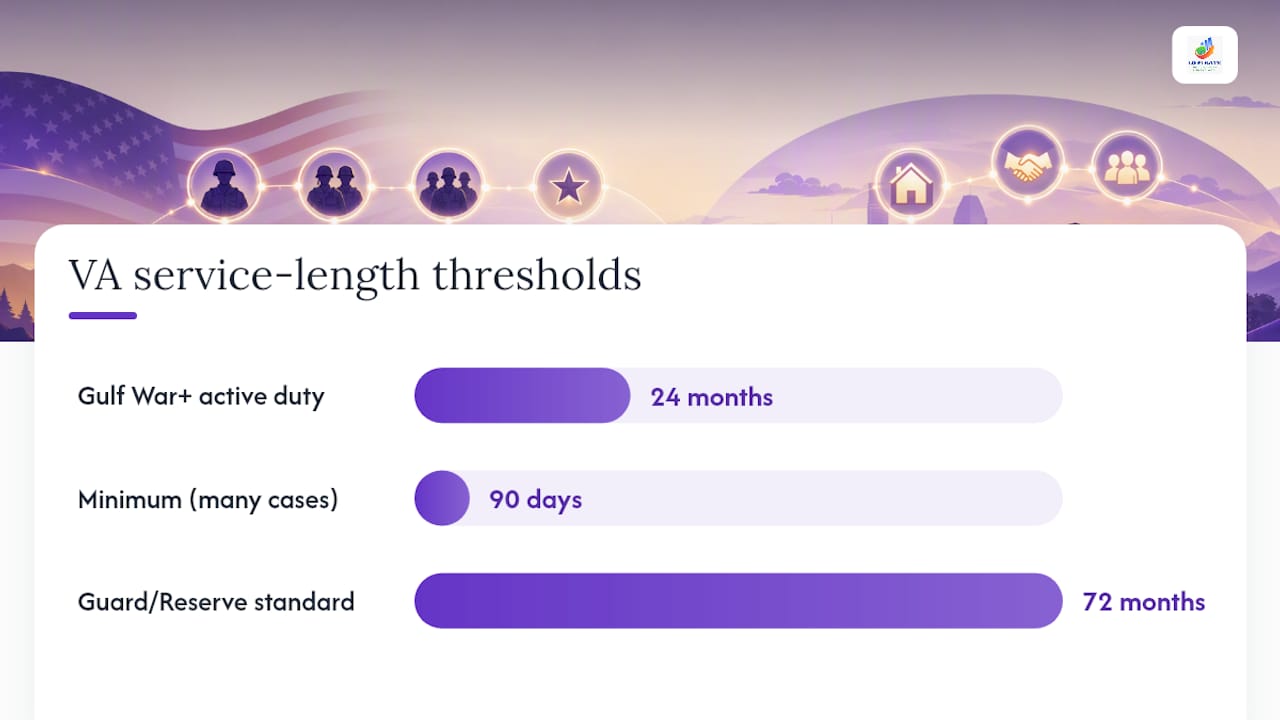
For the Gulf War era (starting August 1990) through today, the general threshold is 24 continuous months of active duty, or the full period you were called to active duty if shorter, with a minimum of 90 days in many cases. Service members discharged early for a service-connected disability are often exempt from the full-length requirement. For those who served in the 1980s and early 1990s, or during Vietnam and earlier conflicts, the minimums and qualifying dates vary and are worth confirming directly against your specific service dates.
Active duty for training purposes generally doesn't count the same way as full active duty, so it's worth knowing the difference before assuming you qualify.
National Guard and Reserve members typically need six credible years of service, unless they were activated onto federal active duty for qualifying periods. A critical detail here: time spent in the Individual Ready Reserve (IRR) usually doesn't count toward those six years. That distinction catches a lot of Guard and Reserve applicants off guard when they assume every year in uniform counts equally.
To document any of this, you'll typically need:
- A DD214 showing character of service, for separated veterans.
- NGB Form 22 and NGB Form 23 for Guard and Reserve members.
- A statement of service signed by your commander if you're still on active duty.
Can Surviving Spouses Get a VA Loan?
Yes, in several defined situations. Unremarried surviving spouses of veterans who died while on active duty, or who died from a service-connected disability, are eligible for the VA home loan benefit. Spouses who receive Dependency and Indemnity Compensation (DIC) may also qualify, and remarriage rules and effective dates can affect eligibility, so it's worth confirming your specific situation directly with the VA.
Beyond the standard categories, eligibility extends to a short list of less common groups, including certain spouses of prisoners of war or those missing in action, and in some historical cases, members of NOAA, the Public Health Service, or specific WWII-era allied forces.
Surviving spouses typically need to gather:
- VA Form 26-1817 (Request for Determination of Loan Guaranty Eligibility for Unmarried Surviving Spouses).
- VA Form 21P-534 if applying for DIC-related benefits.
- A certified death certificate.
- A marriage certificate.
How Do You Get a VA Certificate of Eligibility?
You have three practical routes, and one is faster than the others.
- Apply online through VA.gov. Sign in with an ID.me or DS Logon account and request your COE directly through the eBenefits portal.
- Ask your lender to pull it electronically. Most participating lenders can access Web LGY and generate a COE instantly when the VA already has your service records on file.
- Mail in VA Form 26-1880. This route works if you don't have online access or your records aren't in the VA's system, but it takes considerably longer than the digital options.
Each route needs supporting evidence: your DD214 for separated veterans, a statement of service for active duty, NGB Form 22 and 23 for Guard and Reserve members, or the spouse-specific forms mentioned above for surviving spouses.
Pro Tip: Before you mail anything, call a lender and ask them to try a Web LGY pull first. When VA records are current, this can produce a COE in minutes instead of the weeks a mailed application often takes.
What Do Lenders Check Beyond VA Eligibility?
Your COE proves entitlement, but the loan still has to clear underwriting, and that's where lender-specific standards come into play. The VA doesn't set a minimum credit score. Instead, the VA Home Loan Guaranty Buyer's Guide requires lenders to calculate residual income, a measure of leftover monthly income after major expenses, to confirm you can actually afford homeownership.
In practice, many lenders still apply their own credit floor, commonly around 620 for conventional VA lenders, even though the VA itself has no such rule. That gap between VA policy and lender practice is exactly why shopping around matters if your score sits on the lower end.
A few other underwriting realities worth knowing:
- Occupancy matters: lenders expect you to move in within a reasonable timeframe after closing.
- Most borrowers pay a VA funding fee, though some disabled veterans and certain surviving spouses may be exempt.
- Debt-to-income ratios factor in, but residual income often carries more weight in VA underwriting than DTI alone.
Entitlement isn't necessarily used up after one loan, either. You can often restore entitlement after selling and paying off a home purchased with a VA loan, and in some cases a qualified buyer can assume the loan and substitute their own entitlement. If a prior loan wasn't fully repaid, you may still have partial entitlement available for a smaller loan amount.
One more wrinkle worth flagging: if you're refinancing through an Interest Rate Reduction Refinance Loan (IRRRL), you typically don't need a new COE at all, since you're refinancing an existing VA loan rather than establishing new entitlement.
What Documents Should You Gather Before Applying?
Pulling your paperwork together before you talk to a lender saves real time. Here's the compact version:
- Service records: DD214 with character of service listed, or NGB Form 22 and 23 for Guard and Reserve, or a statement of service if you're still active duty.
- Spouse documentation: marriage certificate, death certificate, and the applicable VA forms if you're a surviving spouse applicant.
- Financial paperwork: recent pay stubs, W-2s, two years of tax returns, and bank statements, though this checklist can vary by lender.
It's also worth budgeting for a separate home inspection. A VA appraisal confirms value and checks Minimum Property Requirements, but it isn't a substitute for a full inspection of the property's condition.
What Commonly Delays or Denies a VA Loan?
Discharge status is the most common snag. A dishonorable discharge typically disqualifies you, though some discharge upgrades can restore eligibility after review. Missing service records cause delays too. If your DD214 was lost, you can request a replacement from the National Archives.
- Mailed COE applications can take weeks; a lender's Web LGY pull is almost always faster.
- Denials often come from lender underwriting, not the VA. If credit or income is the issue, working on specific fixes or trying another lender can resolve it.
LoFiRate's Role for Eligible Borrowers
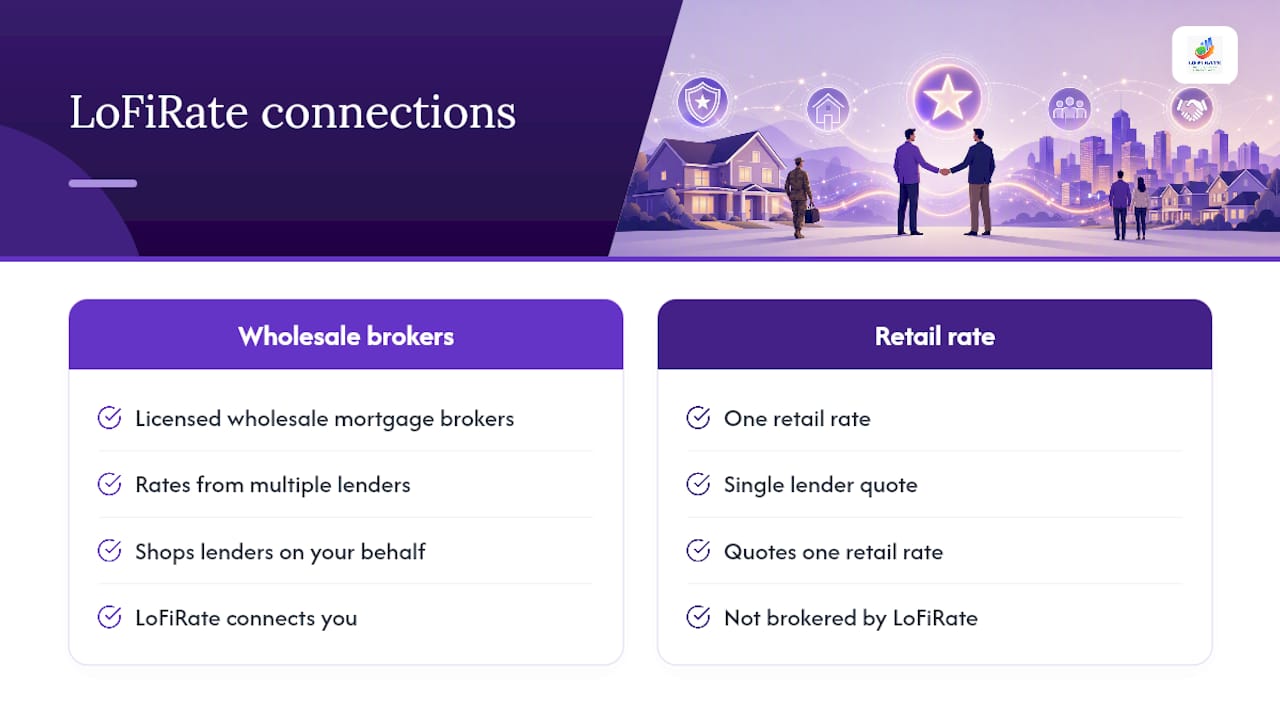
Once your eligibility is confirmed, The platform connects you with licensed wholesale mortgage brokers who shop multiple lenders on your behalf, rather than quoting one retail rate.
Our Recommended Path to a Lender-Ready Application
Verify your COE early, gather your service records now, and ask a lender to attempt a Web LGY pull before mailing anything. That sequence avoids weeks of dead time and keeps your negotiating position strong once you start comparing brokers.
— LoFi
Compare Broker Options Once Your COE Is Ready
Once you've got a COE in hand, or a lender confirms one is coming through Web LGY, the real savings conversation starts. Retail lenders quote you their own pricing and nothing else. The platform connects you with licensed wholesale mortgage brokers who shop your loan across multiple lenders at once, which means you see competitive options instead of a single take-it-or-leave-it rate.

That matters most right after you've confirmed eligibility, because this is exactly when borrowers tend to accept the first offer they see out of relief that they qualify. A wholesale broker match through the platform costs you nothing to explore and comes with no obligation to commit. If you're ready to see what a broker can find for your VA loan or refinance, start a broker match through Lofirate's services page and compare real offers before you sign anything.