

Biweekly mortgage payments split your monthly payment in half and collect it every two weeks instead of once a month. Because a year has 52 weeks, that schedule quietly sneaks in 26 half-payments, which equal 13 full monthly payments instead of the usual 12. That extra payment goes straight toward principal, which is why the strategy typically shortens the loan term and reduces interest paid. Before you sign up, confirm your servicer applies that extra money to principal immediately and check for setup fees.
TL;DR:
- The main benefit of biweekly payments comes from making an extra full payment each year, which accelerates principal reduction and cuts interest costs.
- If your servicer holds the extra half-payments in suspense instead of applying them immediately to principal, your savings may be diminished or delayed.
- Setting up a true biweekly program often involves fees and strict policies; directly making one extra payment annually can achieve the same savings without additional costs.
- Biweekly payments work best if your income is stable and your servicer applies payments promptly; otherwise, DIY strategies can be more flexible and cost-effective.
- Comparing interest rate options with a mortgage broker before committing to biweekly payments can maximize savings, especially if lower rates outweigh accelerated payoff benefits.
Table of Contents
- How Biweekly Mortgage Payments Work (And Why the Math Favors You)
- What a Biweekly Payment Calculator Shows You
- Weighing the Benefits and Drawbacks of Biweekly Payments
- Setting Up Biweekly Payments the Right Way
- The Fees and Processing Traps That Can Erase Your Savings
- Alternatives That Get You the Same Result
- Should You Actually Switch to Biweekly Payments?
- Where Payment Strategy Meets Rate Shopping
- Get Matched With a Broker Before You Commit to a Payment Strategy
- Verify the Rules Before You Enroll
- Sources
How Biweekly Mortgage Payments Work (And Why the Math Favors You)
The trick isn't really about frequency. It's about volume. A standard mortgage bills you 12 times a year. A biweekly schedule bills you 26 times, at half your normal payment each time, and 26 half-payments add up to 13 full payments a year, according to Forbes Advisor. That thirteenth payment is the whole engine behind the savings.
Here's what changes in your amortization schedule once that extra payment lands:
- Your outstanding principal balance drops faster than a standard 12-payment schedule would allow.
- Because interest accrues on a shrinking balance, you pay less interest over the life of the loan.
- Your payoff date moves earlier, often by several years on a 30-year loan.
A common misconception is that switching to biweekly billing itself creates savings through some kind of compounding trick. It doesn't. Financial writers who cover this consistently point out that the extra annual payment, not the frequency, does the heavy lifting, per Forbes Advisor. You can get the identical result by making one extra full payment every year on your own schedule, with zero change to how often your servicer bills you. Understanding how your payments split between principal and interest makes it obvious why an early extra payment matters more than one made in year 25.
What a Biweekly Payment Calculator Shows You
Run the numbers on a $350,000 loan at a 6.5% fixed rate over 30 years, and the difference is not small. Sticking to standard monthly payments, you'd pay off the loan in 30 years and rack up roughly $445,000 in total interest. Switch to biweekly payments on that same loan, and you could pay it off earlier, saving a significant amount in interest, according to examples cited by Investopedia. Exact figures shift with your rate and remaining balance, but the direction is always the same: less interest, faster payoff.
Quick fact: The single biggest variable in your savings isn't your loan size. It's your interest rate. Higher rates mean more interest accrues per day, so an early extra payment against principal saves more in dollar terms on a 7% loan than on a 4% loan of the same size.
To run your own numbers on any biweekly mortgage calculator, enter these:
- Your original loan amount or current remaining balance.
- Your interest rate and remaining loan term (in months).
- Your current monthly payment (principal and interest only, not escrow).
- Any extra principal payments you've already made.
One caveat matters more than people expect: the result assumes your servicer applies each half-payment to principal as soon as it arrives. If your servicer instead parks the money until it has a full month's payment, you lose the timing advantage and your real savings shrink. Reviewing sample amortization breakdowns before you enroll helps you see exactly where that extra payment is supposed to land.
Weighing the Benefits and Drawbacks of Biweekly Payments
Biweekly payments aren't a universal upgrade. They're a good fit for some borrowers and an unnecessary complication for others.
The upside:
- Faster payoff and real interest savings, often measured in years and thousands of dollars.
- Easier budgeting if your paycheck already arrives every two weeks, since the payment amount tracks your income rhythm.
- Forced discipline. Once it's automated, you're not relying on willpower to make an extra payment each year.
The downside:
- Some lenders or third-party processors charge setup or administrative fees, according to Rocket Mortgage.
- A few loans still carry prepayment penalties, though these are rare on conventional mortgages today.
- Locking cash into a rigid biweekly draft reduces flexibility if your income is irregular or seasonal.
Pro Tip: If you're not paid biweekly yourself, don't force the schedule. Set up a monthly autopay for 1/12 extra and get the same math without fighting your own cash flow.
Advisors generally suggest prioritizing an emergency fund and any high-interest debt before locking into an accelerated mortgage plan, since Forbes Advisor notes that rigid acceleration schedules can strain a budget that isn't ready for them.
Setting Up Biweekly Payments the Right Way
Getting this right takes a phone call and a few pointed questions, not just a form on your servicer's website.
- Pull your current loan documents and confirm there's no prepayment penalty clause.
- Call your servicer and ask specifically whether they offer a true biweekly program or only a "biweekly draft" that holds funds until a full payment accumulates.
- Request written confirmation that any extra amount collected applies directly to principal, not to future interest or escrow.
- Ask whether there's a setup fee, an ongoing service fee, or a cost to cancel later.
- Choose automatic enrollment through your servicer, or set up the payment manually through your own bank if you'd rather skip any fee entirely.
The questions that matter most: How is the extra payment applied? When does it post? Does escrow get pulled from the biweekly draft or handled separately? If the answers are vague, that's a signal to build the extra payment yourself instead of paying someone else to manage it.
The Fees and Processing Traps That Can Erase Your Savings
The math on biweekly payments looks great on paper. In practice, how your servicer processes the money determines whether you actually see those numbers.
- Some banks and third-party processors charge a setup fee just to enroll, and a few charge per transaction, according to Rocket Mortgage.
- Many servicers don't apply your half-payments to principal right away. Instead, they hold the money in a suspense account until it adds up to a full monthly payment, which Wells Fargo confirms is standard practice for some automatic payment options.
- That holding pattern delays when your extra principal payment actually reduces your balance, which quietly shrinks your expected savings.
Get the payment application policy in writing, then pull your amortization schedule six months after enrolling to confirm the balance is dropping the way the property maintenance checklist predicted. Reading up on common mortgage fees before you sign up gives you a baseline for spotting anything that looks off.
Alternatives That Get You the Same Result
You don't need a formal biweekly program to capture these savings, and skipping it often means skipping the fees too.
- Make one extra full mortgage payment a year, applied directly to principal, which Investopedia confirms mimics a biweekly plan without enrollment.
- Add a small fixed amount, roughly 1/12 of your payment, to each monthly payment instead of waiting for a lump sum.
- Apply windfalls like tax refunds, bonuses, or side income directly to principal whenever they show up.
- Consider a refinance to a shorter term or lower rate if the math works out better than acceleration alone.
Should You Actually Switch to Biweekly Payments?
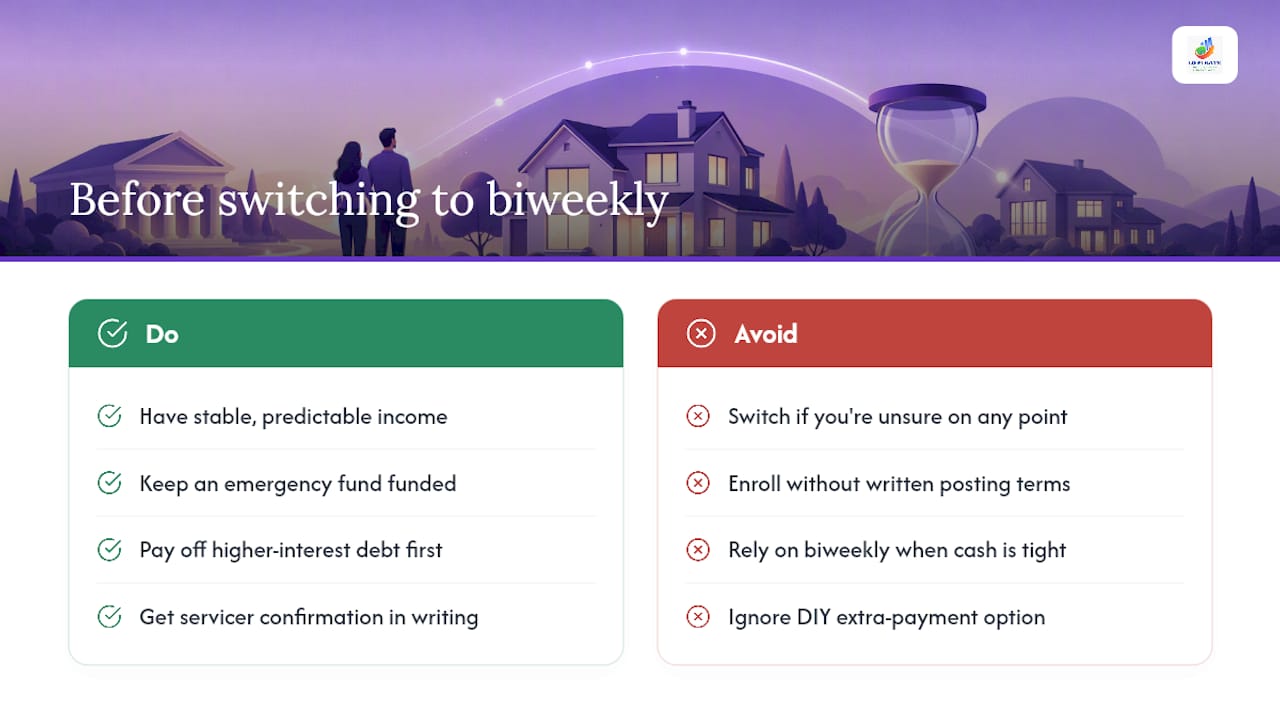
Run through this before you enroll: Do you have stable, predictable income? Is your emergency fund funded? Are you free of higher-interest debt like credit cards? Has your servicer confirmed in writing that extra payments post to principal immediately, with no meaningful fee?
If you answered yes across the board, biweekly payments are a solid, low-risk way to trim years and interest off your loan. If you're unsure on any point, especially cash flow, run a calculator first and consider the DIY extra-payment route instead. It costs nothing to set up and gives you the flexibility to skip a payment in a tight month, something a locked-in biweekly draft won't offer.
Where Payment Strategy Meets Rate Shopping
Accelerating payments only pays off as much as your rate allows. A borrower grinding out extra principal payments on a 7.5% loan is often better served checking whether a lower rate exists before committing years of extra payments to the current one. That's the gap this platform exists to close: comparing wholesale rate access against whatever you're paying now. Before enrolling in any biweekly plan, get your servicer's payment-application policy in writing. It's a five-minute call that protects years of intended savings.
— LoFi
Get Matched With a Broker Before You Commit to a Payment Strategy
Biweekly payments save money by shrinking your balance faster, but a lower interest rate saves money on every single payment, biweekly or not. This service connects you with licensed wholesale mortgage brokers who shop multiple lenders on your behalf, instead of quoting you one bank's own rate sheet.

If you're weighing an accelerated payoff against a possible refinance, that's exactly the moment to get a second opinion. A wholesale broker can tell you whether a rate reduction would save more than an aggressive payment schedule, and whether current loan options fit your situation better than your existing terms. Request a no-obligation consultation through Lofirate's broker-matching service and find out what your real options look like before you lock into any payment plan.
Verify the Rules Before You Enroll
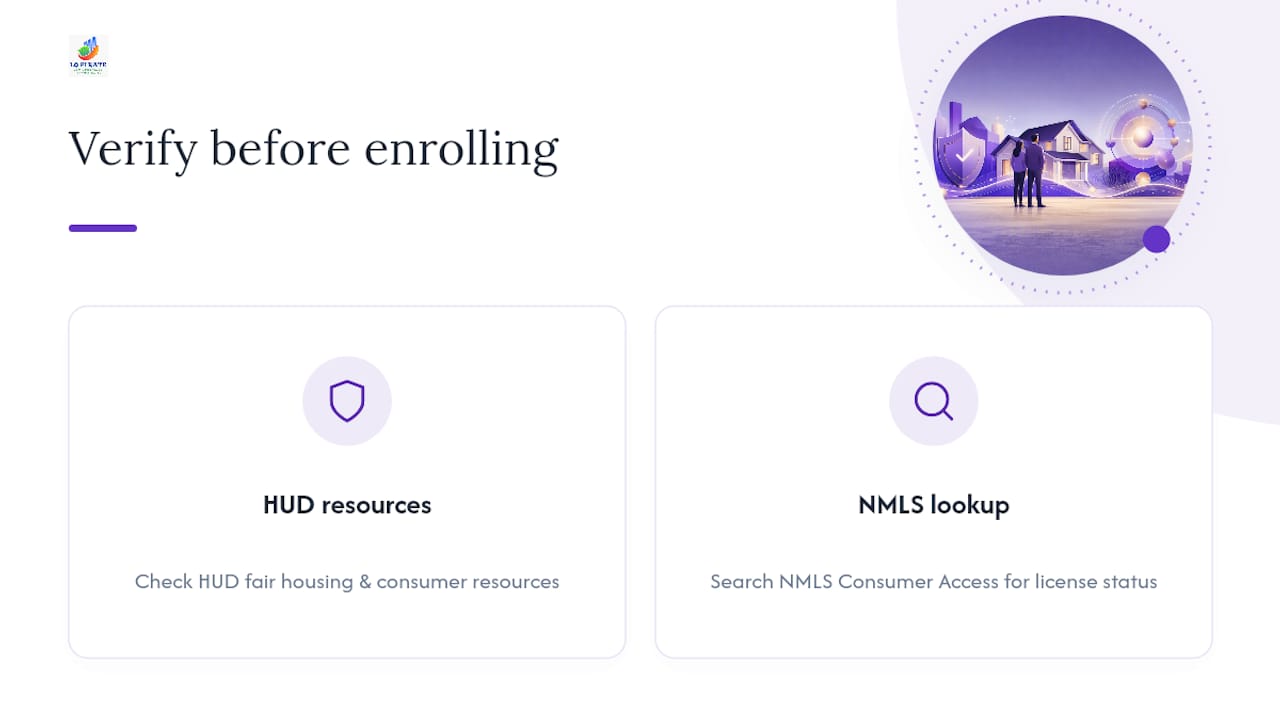
For consumer protections around servicer conduct, check HUD's fair housing and consumer resources. To confirm a broker or servicer's license status, search NMLS Consumer Access directly.
Sources
- Should You Make Biweekly Mortgage Payments? – Forbes Advisor
- Biweekly mortgage – Investopedia
- HUD – Office of Fair Housing and Equal Opportunity