
The national baseline conforming loan limit for a one-unit home jumps to $832,750 in 2026, up 3.26% from 2025. In designated high-cost areas, the ceiling climbs to $1,249,125. Multi-unit properties and FHA loans have their own thresholds, all set by the same annual government process, and knowing where your county falls determines whether your mortgage counts as conventional or jumbo.
TL;DR:
- Counties with median home prices exceeding the national limit qualify as high-cost, with limits calculated at 115% of local median prices, capped at 150% of the baseline.
- FHA loan limits in 2026 match high-cost conforming ceilings for most areas, but exceptional markets like Hawaii and Alaska have much higher statutory caps.
- Loans processed before the end of 2025 may still fall under 2025 limits if delivered in early 2026; delivery date, not application date, determines the applicable limit.
- Borrowers near their county’s limit should verify their loan classification early with lenders to avoid unexpected jumbo status at closing.
Table of Contents
- 2026 Conforming Loan Limits at a Glance
- How High-Cost Areas and Special Exceptions Work
- FHA Limits for 2026 and How They Connect to Conforming Limits
- Conforming vs. Jumbo: What the New Limits Mean for Your Mortgage
- How to Check the 2026 Limit for Your Specific Property
- LoFi Perspective: What Borrowers Should Watch in 2026
- Compare Conforming and Jumbo Pricing Before You Commit
- Sources
- FAQ
2026 Conforming Loan Limits at a Glance
The baseline figure applies to most of the country, but limits scale up for multi-unit properties and in expensive housing markets. Here's how the numbers break down for 2026.
| Property type | Baseline limit (most counties) | High-cost area ceiling |
|---|---|---|
| One-unit | $832,750 | $1,249,125 |
| Two-unit | $1,066,250 | $1,599,375 |
| Three-unit | $1,288,800 | $1,933,200 |
| Four-unit | $1,601,750 | $2,402,625 |
These figures come directly from the FHFA's 2026 announcement, which raised every category by the same 3.26% tied to national home price growth. Alaska, Hawaii, Guam, and the U.S. Virgin Islands operate under special statutory exceptions that push their ceilings even higher than the standard high-cost cap, reflecting the elevated construction and land costs in those markets. If you're buying in one of those areas, don't assume the mainland ceiling applies to you.
How High-Cost Areas and Special Exceptions Work
A county earns "high-cost" status when its median home price exceeds the national baseline limit. FHFA calculates a local limit equal to 115% of that county's median home value, capped at 150% of the national baseline, which is how you arrive at that $1,249,125 ceiling for one-unit homes.
Counties across California, New York, Massachusetts, Colorado, and parts of Washington and Virginia routinely land in high-cost territory. Some individual counties sit between the baseline and the absolute ceiling, since the formula scales with local prices rather than jumping straight to the maximum.
A few things worth knowing about how this process actually works:
- FHFA recalculates every county's limit annually using its own House Price Index data.
- Limits can rise or, in theory, hold flat, but they don't fall below the previous year's floor under current statutory rules.
- Lenders and local housing agencies can request a review if they believe FHFA's county data misrepresents local median prices.
- Adjustments outside the annual cycle are rare and generally reserved for data corrections, not market shifts.
You won't find an appeals hotline for individual borrowers. The mechanism exists mainly for institutional stakeholders flagging data errors, not homeowners hoping for a higher number.
FHA Limits for 2026 and How They Connect to Conforming Limits
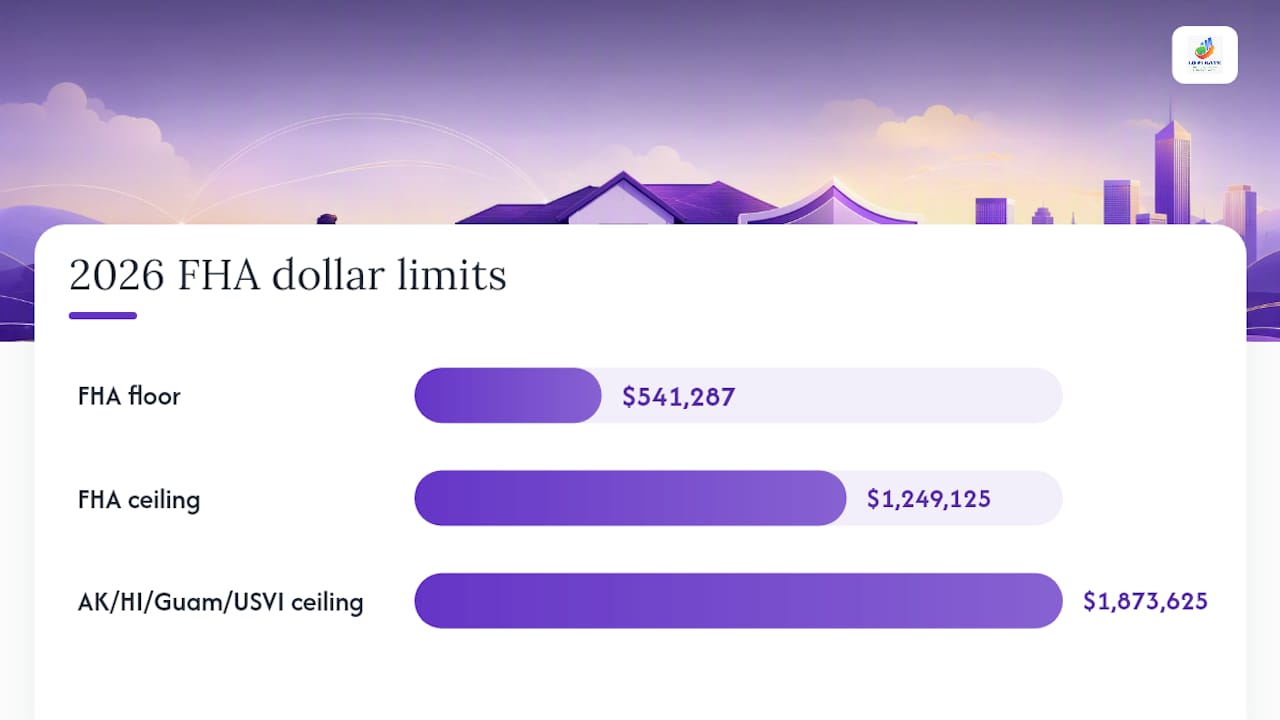
FHA loans run on a parallel but distinct scale. For 2026, the FHA's nationwide floor for a one-unit property sits at $541,287, while the ceiling matches the conforming high-cost ceiling at $1,249,125, according to HUD's 2026 loan limit announcement.
Special exceptions push the ceiling further in a handful of markets:
- Alaska, Hawaii, Guam, and the U.S. Virgin Islands carry a one-unit ceiling of $1,873,625, well above the standard cap.
- FHA's floor represents 65% of the national conforming baseline, a ratio set by statute rather than adjusted at FHFA's discretion.
- These 2026 figures apply to FHA case numbers assigned on or after January 1, 2026, so a case number pulled in December still falls under 2025 limits.
FHA limits move in lockstep with the conforming baseline because both use the same statutory formula, which is why FHA's ceiling and FHFA's high-cost ceiling land on the identical number every year.
Conforming vs. Jumbo: What the New Limits Mean for Your Mortgage
The rule is simple on paper: if your original loan amount exceeds the conforming limit for your property's county, you're in jumbo territory. That's true even if your down payment is large and your credit profile is spotless.
Timing gets trickier than most borrowers expect. A loan can be underwritten under old assumptions but still land under new limits depending on delivery.
- Origination doesn't lock in the limit. A loan processed through Desktop Underwriter before the new year can still be treated under 2026 limits if it's delivered to Fannie Mae in a January 2026 pool, per Fannie Mae's Lender Letter LL-2025-04.
- Delivery date, not application date, often controls. Ask your loan officer directly which year's limits apply to your specific file.
- Jumbo loans typically carry different underwriting. Expect tighter debt-to-income requirements, larger reserve requirements, and sometimes a higher rate than a comparable conforming loan.
- Verify investor classification before you compare offers. Two lenders quoting the "same" loan amount might be underwriting it differently if one classifies it as conforming and another as jumbo.
Pro Tip: If your purchase price sits within about $20,000 of your county's limit, ask your lender to run numbers both ways. Sometimes a slightly larger down payment keeps you under the conforming threshold and saves you from jumbo pricing altogether.
For a deeper look at how jumbo underwriting differs, see what a jumbo loan actually requires in 2026.
How to Check the 2026 Limit for Your Specific Property
Guessing your county's limit is a bad idea when six figures of financing hang on the answer. The tools to confirm it are free and public.
- Start with the FHFA's interactive map, which lists every county's baseline and high-cost limit for 2026.
- Cross-check conventional figures on Fannie Mae's loan limit page, which also includes downloadable county tables.
- For FHA loans, HUD publishes its own county-by-county lookup reflecting the same special-exception areas mentioned earlier.
- Enter your county or MSA, select your property's unit count, and compare the result against your target purchase price.
Run this check before you write an offer, not after. A property that looks conforming on paper can turn into a jumbo file if you're shopping near a county line where limits differ, and your broker needs lead time to structure the loan correctly.
LoFi Perspective: What Borrowers Should Watch in 2026
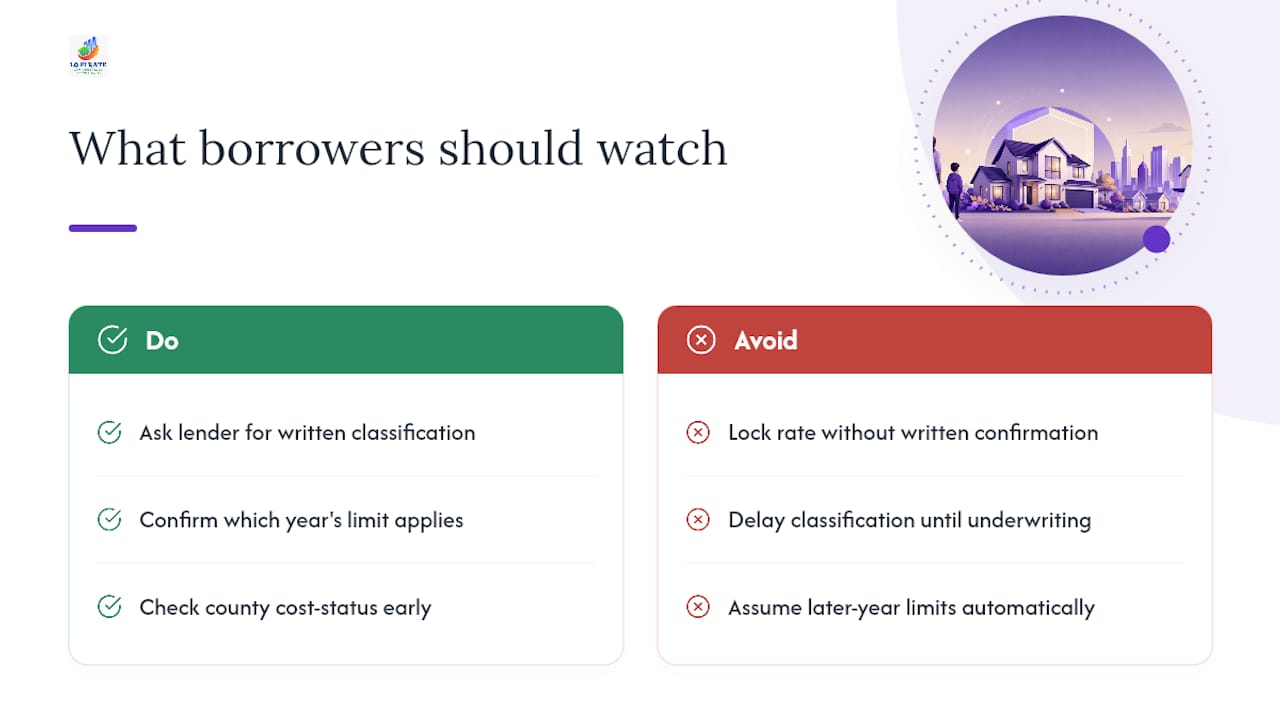
It won't turn a jumbo purchase into a conforming one overnight, but it does give buyers hovering near last year's ceiling a little more room without restructuring their financing.
The bigger issue isn't the number itself. It's timing. Buyers under contract in late 2025 who close in January need to know which year's limits actually govern their loan, and that answer depends on delivery mechanics most homebuyers never think about. If you're shopping in a high-cost county, or your purchase price sits close to either the baseline or the FHA ceiling, get your lender to confirm your classification in writing before you lock a rate. Waiting until underwriting to find out you're jumbo is how deals fall apart.
— LoFi
Compare Conforming and Jumbo Pricing Before You Commit
If your purchase price puts you within shouting distance of your county's conforming limit, the loan type you end up with can swing your rate more than your credit score does. You can connect with licensed wholesale mortgage brokers who shop multiple lenders at once, rather than quoting just one bank's in-house pricing.

That matters most right at the conforming/jumbo line, where pricing gaps between lenders can be wide and inconsistent. A matched broker can run your file both ways, conforming and jumbo, and show you the actual cost difference instead of a generic rate estimate. Whether you're buying, refinancing, or exploring FHA, VA, or investment property financing, the process starts with a free, no-obligation consultation. Head to Lofirate and get matched with a broker who can tell you exactly where your loan falls under the 2026 limits, before you're locked into a rate that assumed the wrong classification.
This article is general information, not a substitute for advice from a qualified financial advisor. Consult a qualified financial professional about your own circumstances before acting on anything here.
Sources
- FHFA Announces Conforming Loan Limit Values for 2026
- HUD: Federal Housing Administration Announces 2026 Loan Limits
- Fannie Mae Lender Letter LL-2025-04
- Loan Limits | Fannie Mae
FAQ
Will Conforming Loan Limits Increase in 2026?
Yes. The national baseline rose to $832,750 for one-unit properties, a 3.26% increase from 2025, according to FHFA's official announcement.
What Are the FHA Loan Limits for 2026?
FHA's 2026 floor for a one-unit property is $541,287, with a ceiling of $1,249,125 in high-cost areas, and special-exception areas like Hawaii and Alaska have higher ceilings set by statute.
Can a 70 Year Old Man Get a 30 Year Mortgage?
Yes. Age isn't a legal factor in mortgage approval, and lenders can't deny a loan based on how old a borrower is; approval depends on income, credit, assets, and debt-to-income ratio regardless of the borrower's age.
When Do the New 2026 Loan Limits Take Effect?
Conforming limits apply based on delivery timing to Fannie Mae or Freddie Mac, while FHA's 2026 limits apply to case numbers assigned on or after January 1, 2026, per HUD's guidance.
How Do I Find the Conforming Loan Limit for My County?
Use the FHFA's conforming loan limit map or Fannie Mae's loan limit lookup tool to check your exact county or MSA figure for 2026.