

TL;DR:
- Mortgage origination fees are upfront charges that lenders collect to process and underwrite loans, adding substantial costs for homebuyers.
- These fees typically range from 0.5% to 1.2% of the loan amount and can be negotiated or compared across multiple lenders for better deals.
A mortgage origination fee is the upfront charge a lender collects to cover the administrative work of processing and underwriting your loan. Explaining origination fees matters because this single line item can add thousands of dollars to your closing costs, yet most homebuyers see it for the first time on their Loan Estimate without any context. Origination fees typically range from 0.5% to 1.2% of the loan amount, which translates to $2,000 to $4,800 on a $400,000 mortgage. Knowing what drives that number, and how to push back on it, puts real money back in your pocket.
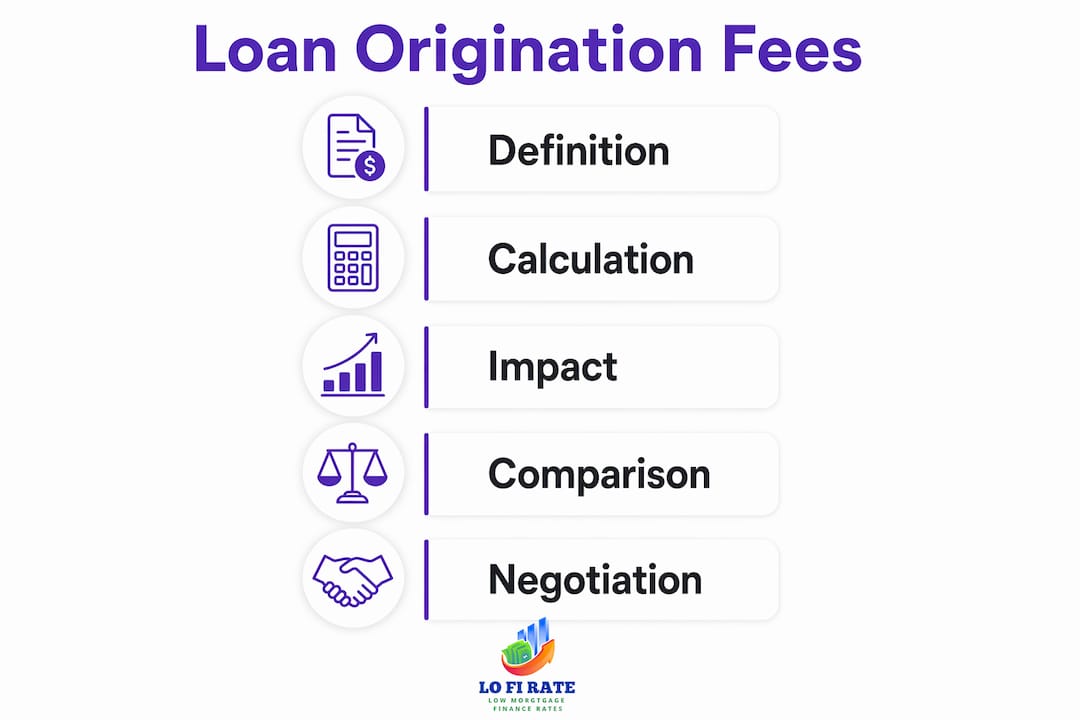
Explaining origination fees: how they are calculated
The origination fee is expressed in points, and 1 point equals 1% of the loan principal. On a $300,000 mortgage, 1 point costs $3,000. The fee scales directly with the loan size, so larger loans carry larger dollar amounts even at the same percentage rate.

The fee is not arbitrary. Lenders bundle it to cover underwriting, document preparation, loan officer compensation, and internal processing costs. Think of it as the lender's invoice for the labor involved in turning your application into a funded loan.
Some lenders charge a flat dollar fee instead of a percentage. Flat fees favor borrowers with larger loan amounts because the cost does not grow with the balance. Percentage-based fees favor borrowers with smaller loans. Always convert both formats to a dollar figure before comparing.
The table below shows how the fee scales across common loan sizes at three typical rates.
| Loan Amount | 0.5% Fee | 1.0% Fee | 1.2% Fee |
|---|---|---|---|
| $200,000 | $1,000 | $2,000 | $2,400 |
| $300,000 | $1,500 | $3,000 | $3,600 |
| $400,000 | $2,000 | $4,000 | $4,800 |
| $500,000 | $2,500 | $5,000 | $6,000 |
Pro Tip: Ask every lender for the total origination charge as a single dollar figure. Some lenders split the fee across multiple line items with different labels. Adding them up yourself gives you the real number for a fair comparison.
What is the difference between origination fees and discount points?
This is the most common point of confusion on a closing disclosure. Both are expressed as a percentage of the loan amount, but they serve completely different purposes.
Origination fees pay for loan processing. Discount points are optional prepaid interest that buys down your mortgage rate. Paying one discount point typically lowers your interest rate by a small but meaningful amount over the life of the loan.
Here is a clean breakdown of the key differences:
- Purpose. Origination fees compensate the lender for administrative work. Discount points reduce the interest rate you pay every month.
- Optionality. Origination fees are charged by the lender and are part of the deal structure. Discount points are a choice you make at closing.
- Long-term impact. Origination fees are a one-time sunk cost. Discount points generate monthly savings that compound over years.
- Break-even math. Discount points only make financial sense if you keep the loan long enough for the monthly savings to exceed the upfront cost.
- Disclosure placement. Both appear in Section A of the Loan Estimate under "Origination Charges," which is exactly why borrowers confuse them.
Distinguishing these two items prevents costly mistakes when reviewing closing disclosures. A borrower who conflates them might pay for rate buy-down thinking it is mandatory, or skip it entirely without running the numbers.
Understanding property financing basics also helps you see how these upfront costs fit into the broader picture of what you pay to close on a home.
How do origination fees affect your APR?
The interest rate on your loan documents is not the full cost of borrowing. The Annual Percentage Rate, or APR, is. APR folds in the origination fee, other lender charges, and the interest rate into a single annualized figure. That is why APR gives a fuller picture of what a loan actually costs.
A 1% origination fee raises the APR by roughly 0.1 to 0.25 percentage points on a 30-year fixed mortgage. That gap may look small, but it represents real dollars across a 30-year term. Two loans with identical interest rates but different origination fees will carry different APRs, and the higher APR loan costs more.
The table below illustrates how the same interest rate produces different APRs depending on the origination fee charged.
| Interest Rate | Origination Fee | Approximate APR |
|---|---|---|
| 6.75% | 0% | 6.75% |
| 6.75% | 0.5% | ~6.85% |
| 6.75% | 1.0% | ~6.90–7.00% |
| 6.75% | 1.2% | ~7.00–7.05% |
Always compare loans using APR, not the interest rate alone. A lender advertising a low rate with a high origination fee can end up costing more than a lender with a slightly higher rate and no fee. For a deeper look at this distinction, the guide on APR vs. interest rate breaks down exactly what mortgage shoppers need to know.
Pro Tip: When you receive multiple Loan Estimates, line up the APR column first. Then look at the total origination charges. Those two numbers together tell you more than the interest rate ever will.
Can you negotiate origination fees?
Yes. Origination fees are negotiable, and most borrowers do not realize that. The degree of flexibility depends on three factors: your credit profile, the complexity of your loan file, and how much competition exists among lenders in your market.
- Pull your credit before applying. A strong credit score signals low risk to lenders. Low-risk borrowers have more room to push back on fees because the lender wants their business.
- Get at least three Loan Estimates. Federal law requires lenders to issue a Loan Estimate within three business days of your application. Collecting multiple estimates creates direct price competition.
- Use a mortgage broker. Brokers can negotiate lower fees by shopping your file across multiple wholesale lenders simultaneously. A broker's access to wholesale pricing often beats what a retail lender will offer directly. Lofirate connects homebuyers with licensed wholesale brokers who do exactly this.
- Compare total lender fees, not individual line items. Lenders itemize fees differently, so one lender's "processing fee" is another's "underwriting fee." Add up all lender charges in Section A of the Loan Estimate for an apples-to-apples comparison.
- Evaluate no-origination-fee loans carefully. Some lenders waive the origination fee but charge a higher interest rate instead. You pay the cost either upfront or over time. Run the math based on how long you plan to keep the loan before assuming the no-fee option is cheaper.
How long you plan to stay in the loan is the deciding variable. If you sell or refinance within five years, paying a high origination fee rarely makes sense. If you plan to hold the mortgage for 20 years, a lower rate bought with an upfront fee can save significantly more over time.
For more on spotting costs before they surprise you at closing, the guide on hidden mortgage fees covers what to watch for on your Loan Estimate.
Key Takeaways
Origination fees are a negotiable, percentage-based upfront charge that directly affects your APR and total mortgage cost, making comparison across lenders the single most effective way to reduce what you pay.
| Point | Details |
|---|---|
| Fee range | Origination fees typically run 0.5% to 1.2% of the loan amount. |
| APR impact | A 1% origination fee raises the APR by roughly 0.1 to 0.25 percentage points. |
| Fees vs. points | Origination fees cover processing costs; discount points buy down your interest rate. |
| Negotiability | Strong credit and multiple Loan Estimates give you real leverage to reduce fees. |
| No-fee caution | Loans with no origination fee often carry a higher rate, increasing long-term cost. |
What I have learned from watching borrowers read their Loan Estimates
Most borrowers fixate on the interest rate and treat everything else as fine print. That is the single most expensive habit in mortgage shopping. The origination fee, the APR gap, the no-fee-but-higher-rate trade-off — these are where lenders quietly recover margin from borrowers who are not paying attention.
The "no origination fee" pitch is the one I find most misleading. It sounds like a discount. It is usually a repackaging. The lender builds the cost into a higher rate, and if you hold that loan for 10 or 15 years, you pay far more than you would have with a modest upfront fee and a lower rate. The math is not complicated, but you have to run it.
The other thing I tell every homebuyer: do not compare loans by their interest rate. Compare them by APR and total lender fees side by side. Two loans at 6.75% can have meaningfully different costs once you account for what each lender charges to originate the loan. A broker who shops wholesale pricing across multiple lenders is the fastest way to see that spread clearly.
Loan duration matters more than most people realize. If you are buying a starter home and expect to move in five years, paying a higher origination fee for a marginally lower rate rarely breaks even. If you are buying your forever home, the calculus flips. Know your timeline before you decide what to pay upfront.
— LoFi
How Lofirate helps you get a better deal on origination fees
Retail lenders set their own pricing and rarely volunteer that you could do better elsewhere. Lofirate works differently. It connects homebuyers and homeowners with licensed wholesale mortgage brokers who shop multiple lenders to find competitive rates and lower fees.

Wholesale brokers have access to pricing that retail channels do not offer directly to consumers. That access translates into real savings on both the interest rate and the origination fee. Whether you are buying your first home or refinancing an existing mortgage, a no-obligation consultation through Lofirate's broker matching puts a licensed professional in your corner before you sign anything. See what wholesale pricing looks like for your loan at Lofirate.
FAQ
What are origination fees on a mortgage?
A mortgage origination fee is an upfront charge the lender collects to cover processing, underwriting, and document preparation. It typically ranges from 0.5% to 1.2% of the loan amount.
Are origination fees the same as closing costs?
Origination fees are one component of closing costs, not the total. Closing costs also include title insurance, appraisal fees, prepaid taxes, and other third-party charges.
Can origination fees be rolled into the loan?
Some lenders allow borrowers to roll origination fees into the loan balance instead of paying them at closing. Doing so increases the loan principal and the total interest paid over time.
How do I compare origination fees across lenders?
Request a Loan Estimate from each lender and add up all charges listed in Section A under "Origination Charges." Then compare APRs across estimates to see the full cost difference.
Is a no-origination-fee mortgage always a better deal?
Not always. Lenders that waive the origination fee often charge a higher interest rate to recover the cost over time. Run the total cost comparison using APR and your expected loan duration before deciding.