

Below 500, FHA is off the table entirely. Those two numbers are the fastest gut check, but they're not the whole story.
Two more things decide this before you go any further. And every FHA borrower gets screened through CAIVRS (Credit Alert Verification Reporting System), a federal database that flags anyone delinquent on federal debt. A hit there stops the loan cold until it's resolved.
Run these three checks first:
- Pull your credit score and see which down payment tier you fall into (3.5% or 10%)
- Estimate your debt-to-income ratio against the ~43% guideline
- Confirm you're not flagged in CAIVRS for federal debt (student loans, tax liens, prior FHA claims)
Mortgage insurance premiums (MIP) apply no matter which tier you land in, and that cost can continue throughout the life of the loan in some cases.
Key Takeaways
FHA eligibility comes down to three checks: your credit tier, your available down payment, and a clean CAIVRS record, backed by documentation that proves stable income and verified assets.
| Point | Details |
|---|---|
| Credit and down payment | A 580 score requires 3.5% down; 500 to 579 requires 10% down; below 500 disqualifies you. |
| Watch for lender overlays | FHA's floor is lower than what many retail lenders actually enforce, so one denial isn't final. |
| Mortgage insurance adds up | Upfront MIP runs 1.75% of the loan amount, and annual MIP can last the life of the loan under 10% down. |
| Clear CAIVRS issues early | Resolve federal debt or document a repayment plan before you apply, not after a denial. |
| Compare wholesale pricing | Lofirate connects borrowers with licensed wholesale brokers who shop multiple lenders for FHA pricing. |
Table of Contents
- FHA Mortgage Requirements: Credit, Borrowers, and Eligible Properties
- Documentation and Underwriting Checklist for FHA Applicants
- What the Home Itself Must Meet: FHA Property Standards
- Budgeting for Your Down Payment, Closing Costs, and Mortgage Insurance
- The Roadblocks That Kill FHA Applications, and How to Clear Them
- Applying for an FHA Loan: The Realistic Timeline
- When FHA Makes Sense, and When It Doesn't
- How Lofirate Helps You Shop FHA Pricing
- Sources
FHA Mortgage Requirements: Credit, Borrowers, and Eligible Properties
FHA loan eligibility starts with your credit profile, but it doesn't end there. The program's actual credit thresholds are simple on paper: a 580 score unlocks the 3.5% minimum down payment, a score between 500 and 579 requires 10% down, and anything under 500 disqualifies you outright under FHA's own rules.
Here's the part most first-time buyers miss: FHA sets the floor, but individual lenders often set a higher bar. This is called an overlay, and it's why one lender might reject a 600-credit-score applicant while another approves the same file without blinking.
- 580+ credit score: 3.5% minimum down payment
- 500-579 credit score: 10% minimum down payment
- Below 500: ineligible for FHA financing
- Many retail lenders add overlays, requiring 620 or higher despite FHA's official floor
Pro Tip: If one lender turns you down for credit reasons, don't assume you're FHA-ineligible. A wholesale broker who shops multiple lenders at once can often find one without that overlay, since the underlying FHA rule hasn't changed.
FHA also has specific rules about who can be on the loan. You need a valid Social Security number, and non-citizens must have lawful permanent residency or eligible work authorization. Non-occupant coborrowers are allowed in many cases, which helps buyers who need a parent or relative to strengthen the application.
Property eligibility matters just as much as borrower eligibility. FHA insures 1 to 4 unit properties, condos in FHA-approved projects, and even manufactured homes titled as real property. What FHA won't do is finance a vacation home or rental property you don't plan to live in. Owner-occupancy is a hard requirement, not a suggestion, and it shapes several other rules you'll encounter later in the process.

Documentation and Underwriting Checklist for FHA Applicants
Gathering the right paperwork before you apply saves weeks of back-and-forth with underwriting. FHA lenders follow a fairly standard checklist, and knowing it in advance means you can start pulling documents today.
- Employment history. Lenders typically want two years of employment verified through a Verification of Employment (VOE), your two most recent pay stubs, and W-2 forms covering the past two years.
- Self-employed documentation. If you work for yourself, expect to submit two years of federal tax returns plus a current profit-and-loss statement, and sometimes a balance sheet if your business structure requires one. Underwriters typically average your net income over those two years, using the lower of that average or your current year-to-date net income when qualifying you.
- Asset verification. A Verification of Deposit (VOD) or two months of bank statements shows you have funds for closing and reserves. If part of your down payment comes from a relative, a signed gift letter documenting the source and confirming it's not a loan is required.
- Standard HUD forms. Your loan officer will walk you through the Uniform Residential Loan Application (URLA) and, depending on the transaction, HUD-92900-LT, the addendum lenders use for FHA-specific underwriting details.
Organizing this ahead of time is one of the most effective ways to speed up your file once it lands with an underwriter.
What the Home Itself Must Meet: FHA Property Standards
FHA doesn't just underwrite you. It underwrites the house too, and that surprises a lot of first-time buyers who assumed appraisal meant simply confirming value. An FHA appraisal also checks the property against HUD's Minimum Property Requirements (MPRs), covering structural soundness, a functioning roof, safe electrical and plumbing systems, and working utilities.
- Homes built before 1978 get extra scrutiny for lead-based paint hazards
- Safety issues like exposed wiring or a failing foundation typically must be fixed before closing
- The appraisal is only valid for 120 days, so delays can force a costly re-inspection
- Minor cosmetic issues usually don't hold up approval, but structural or safety defects do
There's also a timing rule that catches people off guard: you're required to occupy the home within 60 days of closing and live there as your primary residence for at least one year. That's the tradeoff for FHA's lower down payment and looser credit rules. It's a program built for people who plan to actually live in the house, not flip it or rent it out.
Budgeting for Your Down Payment, Closing Costs, and Mortgage Insurance
The dollar math on FHA is straightforward once you see it laid out. On a $300,000 loan, 3.5% down means $10,500 out of pocket at the 580+ credit tier. Drop into the 500 to 579 tier, and that same loan requires $30,000 down instead, since the minimum jumps to 10%.
Mortgage insurance is where FHA gets more expensive over time. Every FHA loan carries an upfront MIP of 1.75% of the loan amount, which you can roll into the loan rather than pay in cash. On that same $300,000 loan, that's $5,250 added to your balance. Annual MIP then gets charged monthly, and if your down payment is under 10%, that annual premium typically sticks around for the life of the loan rather than dropping off once you hit 20% equity.
FHA allows down payment funds to come from personal savings, gift funds from family, or approved down payment assistance programs, which gives buyers with limited savings more flexibility than some conventional loan products allow.
The Roadblocks That Kill FHA Applications, and How to Clear Them
CAIVRS is the disqualifier nobody warns you about. It's a federal database that flags anyone delinquent on federal debt, and HUD requires every FHA lender to screen for it. A flag doesn't mean permanent rejection, but it does mean the loan stops until you resolve the debt or document a valid repayment plan with the agency involved.
Bankruptcy and foreclosure carry waiting periods too. Expect roughly two years after a Chapter 7 bankruptcy discharge and around three years after a foreclosure or FHA claim before you're eligible again, though documented extenuating circumstances can sometimes shorten that timeline.
- Check CAIVRS status early. Don't wait until underwriting flags it.
- Resolve federal debt or get a documented repayment agreement in writing.
- Confirm your bankruptcy discharge date and foreclosure claim date with HUD's Homeownership Center records.
- Shop more than one lender. Overlays vary widely and one lender's "no" is often another's "yes."
Pro Tip: If you've had a past FHA claim, ask your servicer for the exact claim date in writing. Waiting periods are calculated from that date, not from when you moved out, and lenders need documentation, not memory.
Applying for an FHA Loan: The Realistic Timeline
Getting from "I think I qualify" to closing day follows a predictable sequence, and knowing it ahead of time keeps you from panicking when it takes longer than four days.
- Run your eligibility checks. Credit score, CAIVRS status, and a rough DTI estimate, all before you contact a lender.
- Gather documentation. Pay stubs, tax returns, bank statements, and gift letters if applicable, following the underwriting checklist above.
- Get preapproved. This is also the point to consider a wholesale broker instead of a single retail lender, since brokers shop multiple lenders and tend to carry fewer restrictive overlays.
- Move through appraisal and underwriting. This typically takes two to four weeks, longer if the appraisal flags repairs.
- Close. Delays usually come from missing documentation or appraisal repair negotiations, not from FHA rules themselves.
When FHA Makes Sense, and When It Doesn't
FHA earns its reputation with buyers who have limited savings or credit that isn't quite bank-perfect. But if your score sits above roughly 700, conventional financing often costs less over time, since it avoids the lifetime mortgage insurance FHA charges on low-down-payment loans.
Either way, don't take the first quote you get. Overlays and pricing vary enough between lenders that shopping around, or working with a broker who does it for you, often changes the outcome.
— LoFi
How Lofirate Helps You Shop FHA Pricing
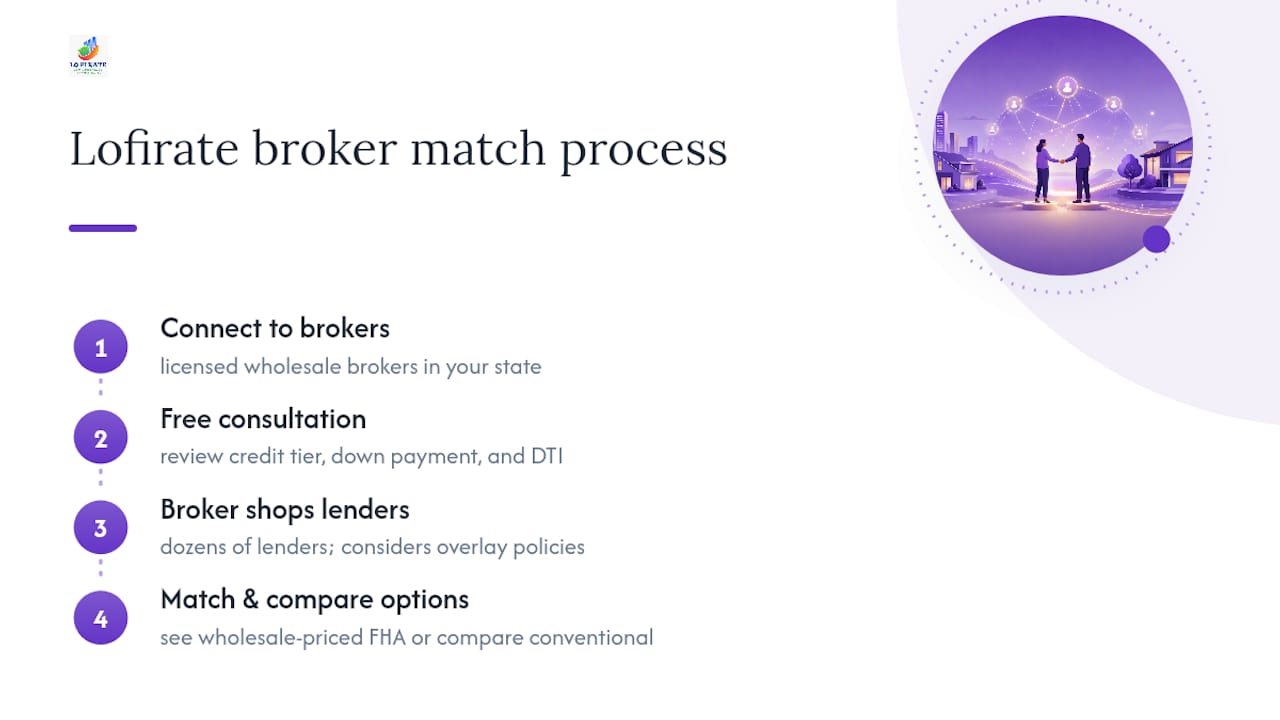
Retail lenders quote you their own rates. Wholesale brokers shop dozens of lenders at once, which matters most for FHA borrowers since overlay policies vary so widely from one lender to the next. Lofirate connects you with licensed wholesale mortgage brokers in your state, at no cost to you and with no obligation to move forward.

A consultation typically walks through your credit tier, down payment plan, and DTI, then matches you with a broker who already knows which lenders are approving files like yours. If you're weighing FHA against conventional, or just want a second opinion before committing to one lender's quote, explore your loan options or start with a broker match through Lofirate's services page to see what a wholesale-priced FHA loan actually looks like for your situation.
This article is general information, not a substitute for advice from a qualified financial advisor. Consult a qualified financial professional about your own circumstances before acting on anything here.
Sources
For the underlying rules behind everything above, HUD's own Section A Borrower Eligibility Requirements covers documentation and disqualification standards directly. HUD's consumer loan pages explain MIP and program basics in plain language, and NAR's FHA primer breaks down credit tiers for real-world use.