

Your mortgage statement is a monthly document from your loan servicer that shows exactly where your money goes and where your loan stands. Knowing how to read mortgage statements puts you in control of one of the biggest financial commitments you will ever make. Every statement covers the same core elements, and once you recognize them, the whole document clicks into place.
Here is what a standard mortgage statement includes, per Fannie Mae:
- Amount due — the total payment required for the current billing cycle
- Payment due date — the date your payment must be received to avoid a late fee
- Payment breakdown — how your payment splits between principal, interest, and escrow
- Outstanding principal balance — the remaining loan amount you still owe
- Loan servicer contact information — phone, address, and account number for questions or disputes
These five elements let you verify that every dollar is applied correctly and that your loan is progressing as expected.
Table of Contents
- How to read mortgage statements section by section
- What else might appear on your statement
- How to get your mortgage statement if you are not receiving it
- How to review your statement for errors and red flags
- Key Takeaways
How to read mortgage statements section by section
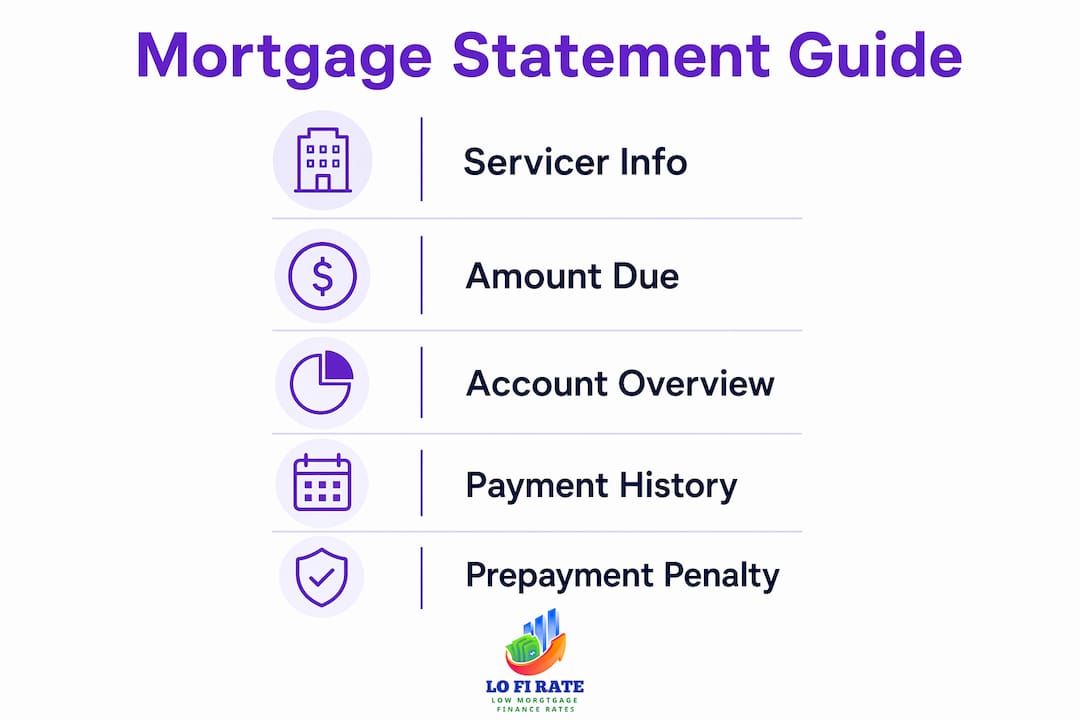
Most statements follow a predictable layout, even when servicers format them differently. The Consumer Financial Protection Bureau published a model form that outlines the standard sections all servicers must include. Getting familiar with each one takes the guesswork out of the whole document.
Servicer information and account number
The top of your statement identifies your loan servicer, their mailing address, phone number, and your unique account number. Servicers include this prominently so you can reach them quickly if something looks wrong. Keep this section in mind whenever you call about a payment discrepancy, because the account number is the first thing a representative will ask for.
Amount due and payment breakdown
This is the section most homeowners look at first, and for good reason. Your payment breaks down into three parts:
- Principal — the portion that reduces your actual loan balance
- Interest — the cost of borrowing, calculated on your remaining balance
- Escrow — funds collected to pay property taxes and homeowners insurance on your behalf
On a fixed-rate loan, the principal and interest portions stay the same every month. The escrow portion, however, can shift from year to year as tax assessments and insurance premiums change.
Account overview
This section shows your outstanding principal balance, your current interest rate, and sometimes a payoff amount. The payoff figure is always slightly higher than your principal balance because it includes any accrued interest through the payoff date. If you are considering refinancing or selling your house with a mortgage, this number is the one that matters.

Payment history
Your statement typically lists your last payment, the date it was received, and how it was applied. Checking this history confirms that your servicer credited your payment correctly and on time. A payment that shows as received late, even when you sent it on time, is worth a phone call.

Prepayment penalty notice
Not every loan carries a prepayment penalty, but if yours does, the statement will note it. This fee applies when you pay off your loan early, either through a lump sum or by refinancing. Read this section carefully before making any extra principal payments, because the penalty can offset the interest savings you were hoping to capture.
| Statement section | What it tells you | What to check |
|---|---|---|
| Servicer info | Who manages your loan and how to contact them | Account number accuracy |
| Amount due | Total payment required this cycle | Matches your loan agreement |
| Payment breakdown | Split between principal, interest, escrow | Escrow changes from prior month |
| Account overview | Remaining balance and interest rate | Balance decreasing over time |
| Payment history | Last payment date and application | Credited correctly and on time |
| Prepayment penalty | Whether early payoff triggers a fee | Terms before making extra payments |
What else might appear on your statement
Beyond the standard sections, some statements include details that catch homeowners off guard. None of these are cause for alarm on their own, but each one deserves a second look.
- Escrow account analysis notice — Servicers review escrow accounts annually. If your property taxes or insurance premiums increased, your servicer will adjust your monthly escrow contribution. Fannie Mae experts identify escrow fluctuations as the primary reason a fixed-rate borrower's monthly payment changes. A small increase is normal; a large jump warrants a call to confirm the new tax or insurance figures are accurate.
- Late fee notice — If your last payment arrived after the grace period, the statement will show the fee charged. Most servicers offer a grace period after the due date before assessing a late fee, though the exact window depends on your loan terms.
- Delinquency notice — Missed payments trigger a formal notice on your statement. This section will outline the total amount past due and may reference foreclosure timelines if the delinquency continues.
- Suspense account balance — If you made a partial payment that your servicer could not fully apply, the funds sit in a suspense account until the full amount is received. Seeing a suspense balance means your payment was not credited and you likely still owe the full amount due.
- Adjustable-rate change notice — On an adjustable-rate mortgage, the statement will show the upcoming rate adjustment, the new interest rate, and how your payment will change. This notice typically appears one to two billing cycles before the change takes effect.
Understanding escrow in mortgages helps you anticipate these fluctuations before they show up as a surprise on your statement.
How to get your mortgage statement if you are not receiving it
Federal law gives you the right to request your mortgage statement at any time. Under Regulation Z, servicers of most residential mortgages must send periodic statements for each billing cycle. If yours are not arriving, here is how to get them:
- Log in to your servicer's online portal. Most major servicers offer a customer account portal where you can view, download, and print statements going back several years. Look for a "Statements" or "Documents" tab after logging in.
- Call your servicer directly. Request paper copies by phone. The servicer contact information on your last known statement is the fastest starting point.
- Submit a written request. Borrowers have a legal right to request mortgage servicing information from their servicer at any time, regardless of the normal billing cycle. A written request creates a paper trail.
- Set up email or text alerts. Most servicer portals let you opt into notifications when a new statement is available or when a payment posts. This prevents statements from going unnoticed in a spam folder or a pile of mail.
If you recently refinanced and your loan was transferred to a new servicer, there is often a brief gap in statement delivery during the transition. The new servicer is required to notify you of the transfer and provide contact details, so check for that letter if statements suddenly stop.
Pro Tip: Save a PDF copy of each statement as soon as it becomes available. Servicer portals sometimes limit how far back you can access archived documents, and having your own records makes disputes much easier to resolve.
How to review your statement for errors and red flags
Reading your statement once a month takes about five minutes. Catching an error early can save you from a credit hit or an overpayment that takes months to recover.
- Verify the payment amount matches your loan agreement. Your principal and interest payment should not change on a fixed-rate loan. If the total due looks different from last month, check whether an escrow adjustment or a new fee is driving the change.
- Confirm your principal balance is decreasing. Each payment should reduce your outstanding balance. If the balance stayed flat or increased, your payment may not have been applied correctly, or you may have a negatively amortizing loan feature worth reviewing.
- Check for unexpected fees. Unexpected fees or escrow changes should prompt immediate attention. Common culprits include force-placed insurance (when a servicer buys a policy on your behalf because yours lapsed) and property inspection fees tied to a delinquency.
- Review the grace period terms. Experian notes that while a grace period prevents late fees, it does not protect your credit score if the payment posts after your loan's stated due date. Paying within the grace period keeps the fee off your statement, but your servicer may still report the payment as late to credit bureaus depending on how far past due it falls.
- Cross-reference your escrow balance. Your statement shows how much is currently in your escrow account. If the balance looks unusually low, your servicer may be undercollecting, which often leads to a larger adjustment at the next annual review.
The CFPB's monthly mortgage payment checklist is a free, printable resource that walks through each verification step in plain language. Keeping a copy next to your statements makes the monthly review faster and more consistent.
When you spot an error, contact your servicer in writing rather than by phone alone. A written notice creates a record and triggers a formal response obligation under federal servicing rules. Document the date, the specific discrepancy, and the dollar amount involved. For a deeper look at how each line item connects to your overall loan costs, the mortgage payment breakdown guide from Lofirate walks through real examples with current figures.
Pro Tip: Compare three consecutive statements side by side once a year. Gradual changes in escrow or fees are easy to miss month to month but become obvious when you look at a three-month span together.
Lofirate connects homeowners with licensed wholesale mortgage brokers who can review your current loan terms and shop multiple lenders for a better rate. If your statement is showing a rate or payment that no longer fits your situation, a no-obligation consultation through Lofirate takes minutes to request and could surface savings you did not know were available.

Key Takeaways
Your mortgage statement gives you everything you need to verify your loan is on track, but only if you know what each section is telling you.
| Point | Details |
|---|---|
| Five core elements | Every statement includes amount due, due date, payment breakdown, principal balance, and servicer contact info. |
| Escrow drives payment changes | Property tax and insurance adjustments are the main reason a fixed-rate payment changes from year to year. |
| Grace periods have limits | Paying within the grace period avoids late fees but may not prevent a late mark on your credit report. |
| You can always request statements | Federal law gives you the right to request your mortgage statement at any time, outside of normal billing cycles. |
| Written disputes work best | Contacting your servicer in writing about errors creates a paper trail and triggers a formal response obligation. |