

An interest-only mortgage lets you pay only the interest for a set period, usually 3 to 10 years, which keeps your early payments low but leaves the full loan balance untouched. The trade-off is real: once that window closes, your payment jumps because you start paying off principal on a shorter timeline. It tends to fit borrowers with a short ownership horizon, rising income, or strong cash reserves, not someone planning to stay put for 30 years without a plan.
TL;DR:
- The initial interest-only payments are lower because they cover only interest, but payments increase significantly after recasting, often by around 40% or more.
- Qualification requirements are stricter than for conventional mortgages, with lenders analyzing future amortized payments and scrutinizing your ability to repay based on higher, recast loan terms.
- Building reserves of six to twelve months of the higher post-IO payment before closing can help manage payment shocks if refinancing or sale options fall through.
- Interest-only loans remain outside Qualified Mortgage rules, resulting in higher credit score, down payment, and reserve requirements, with approval relying on a thorough ability-to-repay analysis.
- Comparing loan estimates side by side is crucial to understand recast dates, caps, and post-IO payments, as structural differences greatly affect long-term affordability.
Table of Contents
- How Does an Interest-Only Mortgage Work?
- How Do You Calculate an Interest-Only Mortgage Payment?
- What Are the Pros and Cons of an Interest-Only Mortgage?
- Why Are Interest-Only Loans Harder to Qualify For?
- What Do Lenders Require to Approve an Interest-Only Loan?
- What Happens When the Interest-Only Period Ends?
- What Should You Compare Across Loan Estimates?
- Does an Interest-Only Mortgage Affect Your Credit Score?
- Are There Tax Considerations With Interest-Only Mortgage Payments?
- LoFi's Take: When an Interest-Only Loan Actually Makes Sense
- How LoFiRate Helps You Shop an Interest-Only Loan the Right Way
- Where This Guide's Information Comes From
- Sources
- FAQ
How Does an Interest-Only Mortgage Work?
An interest-only mortgage runs in two distinct phases. During the first phase, your scheduled payment covers only the interest charged on the loan, and the principal balance generally doesn't shrink at all. When that period ends, the loan recasts, meaning the lender recalculates your payment so the remaining balance amortizes over whatever term is left.
Most interest-only loans in the U.S. come wrapped in an adjustable-rate structure. Freddie Mac's SOFR-indexed ARM programs, for example, use adjustment schedules like 3/6, 5/6, 7/6, and 10/6, each pairing a fixed introductory stretch with periodic rate changes tied to an index and margin.
Don't confuse this with a payment-option ARM. Those let you choose a minimum payment that can be lower than even the interest owed, which causes the unpaid interest to get added back to your balance, a process called negative amortization. A true interest-only loan never does that.
- Interest-only phase: payment covers interest only, balance stays flat
- Amortization phase: payment rises to include principal over the remaining term
- ARM linkage: rate can adjust based on an index plus a margin after the fixed period
- Payment-option ARMs are a different, riskier product that can grow your balance
How Do You Calculate an Interest-Only Mortgage Payment?
The math behind the interest-only payment is simple. Take your loan balance, multiply it by your annual interest rate, then divide by 12. That's your monthly payment during the IO period, with nothing going toward principal.
Once the interest-only period ends, the calculation changes completely. Now the lender uses a standard amortizing payment formula, spreading the full remaining balance across whatever time is left on the loan, often 20 or 25 years instead of the original 30. That shorter runway is the real reason payments jump, even if your interest rate stays exactly the same.
Here's a worked example, using round numbers and excluding taxes and insurance:
- Loan amount: $300,000 at a 6% interest rate, interest-only for the first 10 years
- Interest-only payment: $300,000 × (0.06 ÷ 12) = $1,500 per month
- Post-IO payment: the same $300,000 balance now amortizes over the remaining 20 years, pushing the payment to roughly $2,150 a month at that same rate
Stress-Test Snapshot: Experian's calculation approach shows why the jump matters: a borrower who only budgets for the $1,500 payment can be blind sided by a payment that's 40% higher once amortization kicks in, even with no rate change at all. Add a 1 to 3 percentage point rate increase on top of that, and the gap widens further.
Run the numbers using your actual recast date and remaining term, not just the introductory figure lenders advertise.
What Are the Pros and Cons of an Interest-Only Mortgage?
The appeal is straightforward: a lower required payment early on frees up cash for other goals, whether that's paying down higher-interest debt, investing, or covering a renovation. You also retain the option to pay extra toward principal whenever you want, without being obligated to.
The downside is just as real. Because the balance doesn't shrink during the IO period, you build equity slower, and if home values dip, you carry more risk of owing more than the property is worth. Over the life of the loan, you'll typically pay more total interest than with a standard amortizing mortgage, and interest-only products often carry higher down payment and credit requirements to begin with.
- Pro: lower initial monthly payment frees up cash flow
- Pro: flexibility to make optional extra principal payments
- Con: no forced equity growth during the IO phase
- Con: higher lifetime interest cost compared to a fully amortizing loan
- Con: payment shock risk when the loan recasts
A borrower relocating for work in five years, with a signed contract and predictable savings, is a reasonable fit. A borrower planning to stay 20 years with no cushion for a higher payment later is not.
Pro Tip: Ask your lender for the exact recast date in writing, and calendar a reminder two years ahead of it so you have time to refinance, save more, or adjust your budget before the payment changes.
Why Are Interest-Only Loans Harder to Qualify For?
Interest-only mortgages almost always fall outside the Qualified Mortgage category under CFPB rules, because QM standards generally exclude loans with interest-only features. That doesn't make them illegal or unavailable. It means lenders can't rely on the QM safe harbor and instead must perform a full, documented Ability-to-Repay analysis on every applicant.
In practice, that means underwriters look past the introductory payment entirely. They calculate what you'd owe once the loan fully amortizes and qualify you against that higher figure, not the temporary low one. They also weigh your debt-to-income ratio, verified assets, and reserves more heavily than they would on a conventional 30-year fixed loan.
- Lenders evaluate the future fully amortizing payment, not just the IO payment
- Debt-to-income ratios are scrutinized against that higher future obligation
- Asset and reserve documentation carries more weight in the decision
By the Numbers: Because IO loans generally can't earn Qualified Mortgage status, lenders must document a reasonable, good-faith determination that you can repay the loan, which is one reason these products come with tighter credit and reserve requirements than standard fixed-rate mortgages.
That regulatory reality explains why interest-only loans aren't sitting on every lender's shelf, and why the ones you find often carry stricter terms.
What Do Lenders Require to Approve an Interest-Only Loan?
Lenders typically want a stronger overall financial picture for an interest-only loan than they would for a plain vanilla fixed-rate mortgage. Expect higher minimum credit scores, a lower maximum debt-to-income ratio, and often a larger down payment than a comparable conventional loan.
On the documentation side, be ready to hand over the same core paperwork required for any mortgage, just under closer review:
- Recent pay stubs and two years of tax returns, plus a profit-and-loss statement if you're self-employed
- Two to three months of bank and investment statements to verify assets and reserves
- A documented plan for handling the post-IO payment, especially if you're counting on income growth or a future refinance
Some lenders will also ask you to explain your exit strategy directly in the application file. Having that answer ready before you apply speeds up the process considerably.
What Happens When the Interest-Only Period Ends?
You have four realistic exits when the IO period runs out: refinance into a new loan, sell the property, let the loan recast into an amortizing payment, or make a lump-sum payment to reduce the balance before amortization starts. Each carries its own risk.
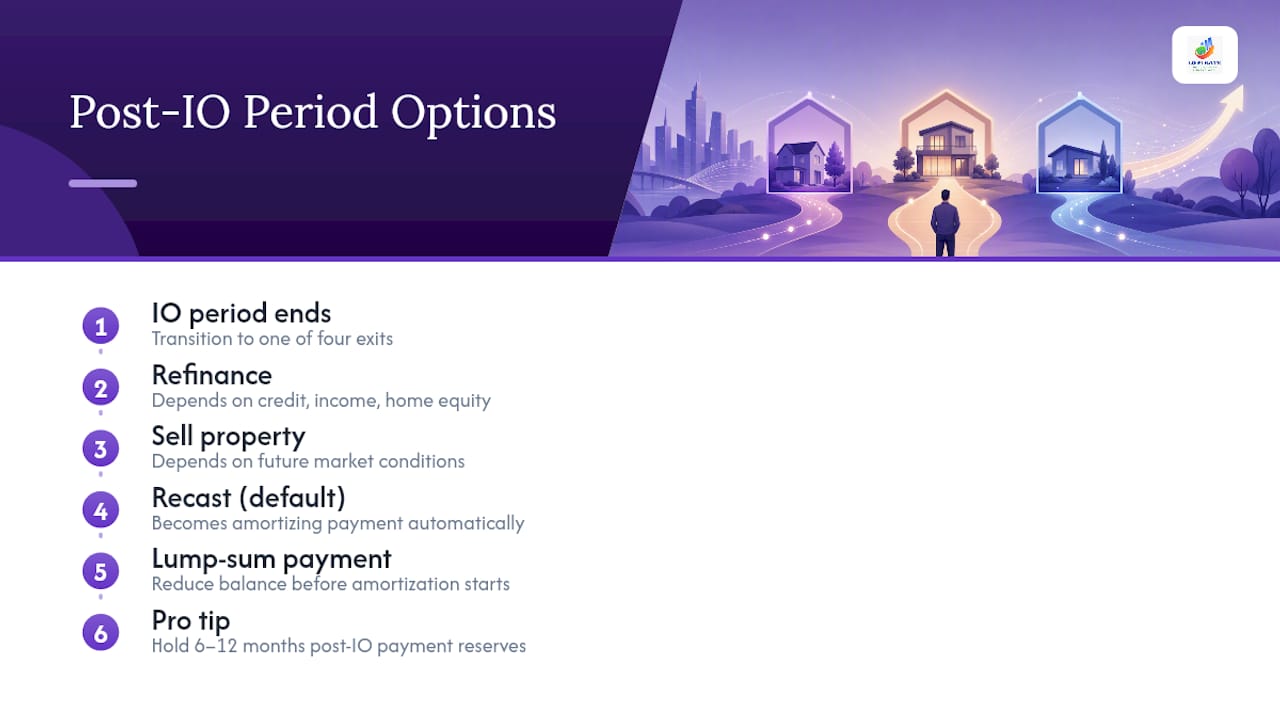
Refinancing depends on your credit, income, and home equity at that future date, none of which are guaranteed to cooperate. Selling depends on market conditions you can't predict a decade out. The CFPB explicitly warns against assuming either option will be there when you need it, which is exactly why a documented backup plan matters more with this loan type than with a standard fixed-rate mortgage.
Recasting is the default if you do nothing, and it's the scenario you should budget for since it requires no cooperation from lenders or buyers.
Pro Tip: Build reserves equal to 6 to 12 months of the higher, post-IO payment before you close, not after. That cushion is what turns a rate spike or a slow home sale from a crisis into a manageable delay.
What Should You Compare Across Loan Estimates?
Every Loan Estimate you receive for an interest-only loan should get lined up side by side on the same fields, because small differences in structure matter more than the headline rate. The Loan Estimate and Closing Disclosure are designed to make that comparison possible if you know what to look for.
- Length of the interest-only period and the exact recast date
- Index and margin used for rate adjustments, plus any caps or floors
- The first fully amortizing payment amount, not just the intro payment
- Points, lender credits, and total closing costs
- Any prepayment penalty or balloon payment clause buried in the fine print
Calculate the worst-case payment for each offer before comparing rates. A guide to reading a Loan Estimate line by line can help you spot terms that look similar on the surface but behave very differently once the IO period ends.
Does an Interest-Only Mortgage Affect Your Credit Score?
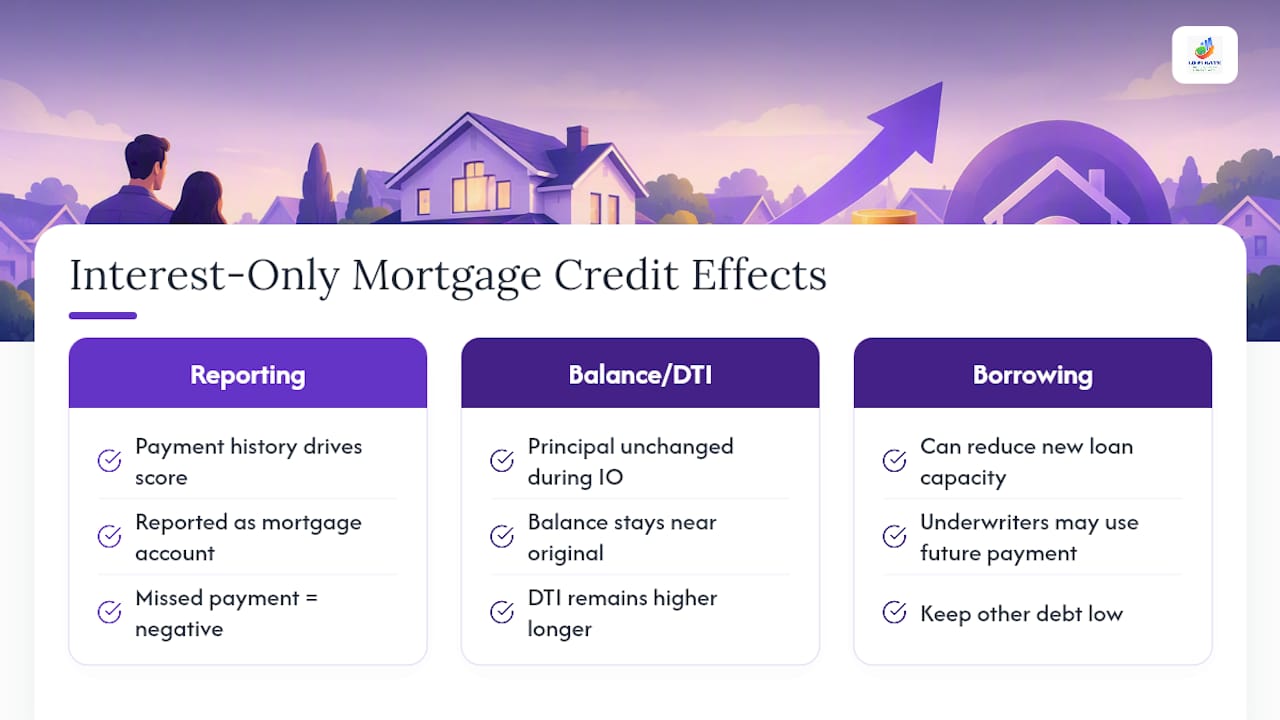
Making your interest-only payments on time affects your credit score the same way any mortgage payment does: positively, and mostly through payment history, which is the single biggest factor in most credit scoring models. The fact that you're only paying interest doesn't get flagged separately to credit bureaus. What shows up is simply "mortgage account, paid as agreed" or a missed payment if things go wrong.
Where interest-only loans create a subtler credit effect is through your loan balance and debt-to-income ratio staying higher, longer. Because principal doesn't decline during the IO period, your reported balance on that account remains close to the original loan amount for years, unlike a traditional mortgage where the balance visibly shrinks with each payment. That static balance can make your overall debt load look less improved over time to future lenders reviewing your file for other credit, even though you haven't missed a payment.
This matters most if you plan to borrow again before the IO period ends, say for a car loan, a home equity line, or a second mortgage on an investment property. Lenders calculating your debt-to-income ratio for that new application will count your current mortgage payment as-is, and some underwriters may look ahead to the future amortizing payment if the recast date falls within the new loan's term. That can shrink your borrowing capacity in ways a standard amortizing mortgage wouldn't. It's worth keeping other debt low and your credit utilization tight while you're in the interest-only phase, precisely because your mortgage isn't doing the usual work of improving your leverage ratios on its own.
Are There Tax Considerations With Interest-Only Mortgage Payments?
Mortgage interest on an interest-only loan is generally deductible under the same federal rules that apply to any mortgage interest, provided you itemize deductions and the loan meets IRS requirements for acquisition debt on a qualified residence. Because 100% of your payment during the IO period is interest, rather than a mix of interest and principal, the entire payment can potentially count toward that deduction, up to the loan limits the IRS sets for the tax year in question.
That's a meaningful difference from a standard amortizing mortgage, where only the interest portion of each payment is deductible and that portion shrinks every year as principal repayment grows. With an interest-only loan, the deductible interest amount stays relatively level throughout the IO period, since the balance isn't declining.
There's a flip side worth understanding. Because you're not paying down principal, you're also not building the kind of equity that some homeowners tap through tax-advantaged strategies tied to home sale exclusions. And once the loan recasts and you start paying both principal and interest, your annual deductible interest amount will begin its normal decline, just later than it would have on a conventional mortgage.
Tax rules around mortgage interest deductions change periodically and depend on your specific filing situation, loan amount, and whether you itemize at all. A qualified tax professional should review your specific numbers before you count on any deduction as part of your decision to go interest-only.
LoFi's Take: When an Interest-Only Loan Actually Makes Sense
We don't think interest-only mortgages are a shortcut. They're a narrow tool for a narrow set of situations, a known relocation date, a documented income jump on the horizon, or reserves thick enough to absorb a bad refinance market. Outside those cases, the lower payment is usually just deferred pain.
What we see most often is borrowers underestimating how much underwriting has tightened around this product since the CFPB's Ability-to-Repay rules took hold. Shopping multiple brokers tends to surface Loan Estimates with meaningfully different recast terms and caps, differences that are easy to miss without a side-by-side comparison.
— LoFi
How LoFiRate Helps You Shop an Interest-Only Loan the Right Way
You can connect with licensed wholesale mortgage brokers who shop your file across multiple lenders instead of quoting you one bank's single rate sheet. That matters more with interest-only loans than almost any other product, because two lenders can offer the same introductory rate with very different recast schedules, caps, and post-IO payments buried in the fine print.

Since interest-only loans fall outside standard Qualified Mortgage underwriting, the paperwork and reserve requirements vary more between lenders than they do on a conventional 30-year fixed loan. Working with brokers who have access to multiple wholesale lenders can reveal those differences side by side instead of gathering separate Loan Estimates one bank at a time.
The practical next step: pull together your recent pay stubs, two years of tax returns, and a couple months of bank statements, then request a no-obligation broker match through Lofirate. You'll get a second opinion on your Loan Estimate terms before you commit to anything, and there's no cost or obligation to move forward with whichever broker you're matched with.
Where This Guide's Information Comes From
- Consumer Financial Protection Bureau: definition, borrower warnings, and Qualified Mortgage rules for interest-only loans
- Office of the Comptroller of the Currency: payment shock guidance and the distinction between true IO loans and payment-option ARMs
- Freddie Mac Single-Family: SOFR-indexed ARM structures and margin ranges common to IO products
- Experian: payment calculation methodology and worked examples for IO versus amortizing payments
Sources
- What is an "interest-only" loan? | Consumer Financial Protection Bureau
- SOFR-Indexed ARMs - Freddie Mac Single-Family
- What Is an Interest-Only Mortgage? | Experian
FAQ
Which Banks Offer Interest-Only Mortgages?
Interest-only mortgages aren't offered by every retail bank, since they fall outside standard Qualified Mortgage rules and require stricter ability-to-repay underwriting. Availability varies by lender and changes with market conditions, so working with a broker who has access to multiple wholesale lenders, such as through Lofirate's broker matching, tends to surface more current options than calling banks one by one.
How Much Is an Interest-Only Mortgage on $100,000?
Once the IO period ends, that same balance amortizes over the remaining term, which raises the monthly payment, following the same calculation approach Experian outlines.
Is It Difficult to Get an Interest-Only Mortgage?
It's harder than qualifying for a standard fixed-rate mortgage, mainly because these loans generally can't be Qualified Mortgages and require lenders to fully document your ability to repay the future, higher payment. Expect closer scrutiny of your credit score, debt-to-income ratio, assets, and reserves than a conventional loan would demand.
How Much Would I Pay Monthly on a 30-Year Interest-Only Mortgage?
Your monthly payment during the interest-only phase equals your loan balance multiplied by your annual rate, then divided by 12, with no principal included.
What Happens if I Can't Refinance When the Interest-Only Period Ends?
If refinancing or selling isn't available when your IO period ends, your loan simply recasts and your payment increases to a fully amortizing amount over the remaining term. This is exactly why the CFPB advises against counting on refinancing or a sale as guaranteed, and why building reserves for that higher payment matters before you close, not after.