

The main cost factors in home financing break into two buckets: what you pay to get the loan and close on the house, and what you pay to keep it every month after that. Closing costs, including the origination fee and third-party charges, typically run 2% to 5% of the purchase price. That is cash you need on hand before you get the keys. The bigger number over the life of the loan is almost always interest, shaped by your rate, your loan term, and how the loan is structured.
Here is the one-sentence verdict: your down payment and closing costs determine how much cash you need right now, but your interest rate and loan structure determine how much the house actually costs you over 30 years. Miss that distinction and you can end up choosing a lower monthly payment that costs you tens of thousands more down the road.
The main buckets to track:
- Down payment — cash paid upfront, reduces loan-to-value
- Lender and origination fees — typically 0.5% to 1% of the loan, per Cornell Law School's Legal Information Institute
- Points and lender credits — optional trades between upfront cash and rate
- Third-party and government fees — appraisal, title, recording
- Prepaids and escrow — first-year insurance, prepaid interest, tax reserves
- Monthly costs — principal, interest, taxes, insurance, PMI if applicable
- Ownership costs — maintenance, HOA dues, utilities
The Consumer Financial Protection Bureau splits mortgage costs the same way: some you pay once at closing, others you pay every month for years. Fannie Mae's own research on how 30-year mortgage rates get set shows why that monthly number moves more than most buyers expect. Both threads matter, and this breakdown covers each one.
Key Takeaways
Total home financing cost comes down to two separate decisions: how much cash you can put down and pay at closing, and how your rate and loan structure shape what you pay over the next 15 to 30 years.
| Point | Details |
|---|---|
| Split cash needs from lifetime cost | Down payment and closing costs hit your bank account now; interest and loan structure determine what you pay over decades. |
| Shop multiple lenders | Origination fees alone can vary by thousands of dollars between lenders on the same loan amount. |
| Improve credit before applying | Credit score is one of the few rate factors you fully control, and it moves your quote more than almost anything else. |
| Check PMI and escrow rules early | Know your PMI removal threshold and how escrow adjustments can raise your payment after year one. |
| Run the breakeven math | Calculate breakeven before buying points or refinancing, and compare it honestly to how long you'll actually keep the loan. |
| Compare wholesale options | Lofirate connects buyers with licensed wholesale brokers who shop multiple lenders for rate and fee comparisons beyond a single retail quote. |
Table of Contents
- Cost Factors in Home Financing: Upfront Costs at Closing
- How Monthly Mortgage Costs Break Down
- What Determines the Interest Rate You're Offered
- Private Mortgage Insurance and Its Alternatives
- Points vs. Lender Credits: The Breakeven Math
- One-Time Homebuying Extras Beyond the Mortgage
- Estimating Your Total Cost: A Worked Example
- Practical Ways to Lower Your Costs
- When You'll Actually Pay Each Cost
- Refinancing: When the Costs Are Worth It
- Why Total-Cost Thinking Beats Rate Shopping
- Get a Broker Match Through Lofirate
- Frequently Asked Questions
- Sources
Cost Factors in Home Financing: Upfront Costs at Closing
Your down payment is the biggest lever you control before closing. Conventional loans allow as little as 3% down for qualified first-time buyers, FHA loans require 3.5%, and VA and USDA loans can go to zero down for eligible borrowers. The size of that payment sets your loan-to-value ratio, and LTV drives almost everything else: your rate, whether you owe mortgage insurance, and how much cash you need on closing day.
Lender fees come next. Origination fees, the charge for processing and underwriting your loan, typically fall between 0.5% and 1% of the loan amount. On a $350,000 loan, that is $1,750 to $3,500 before you touch anything else. Some lenders bundle this into a flat "processing fee" or "underwriting fee" instead of calling it origination, so read your loan estimate line by line rather than trusting the label.

Third-party fees are set by whoever performs the service, not your lender, though your lender usually coordinates payment. Appraisals run roughly within a few hundred dollars, home inspections commonly cost a few hundred dollars as well, and title insurance and search fees add more on top. Government recording fees and transfer taxes vary by county and state and are essentially non-negotiable.
Then come prepaids: your first year of homeowners insurance paid in full at closing, a chunk of prepaid interest covering the days between closing and your first payment, and an initial deposit into your escrow account for taxes and insurance. None of these are fees exactly. They are costs you would pay eventually anyway, just collected early.
Pro Tip: Ask every lender for a lender credit quote alongside their standard rate quote. A lender credit trades a slightly higher rate for cash toward your closing costs, which can be the difference between closing and coming up short if your savings are tight. Also ask the seller directly about concessions, since many sellers will cover $3,000 to $6,000 in closing costs to keep a deal moving, especially in a slower market.
Origination fees and lender credits are negotiable. Appraisal and title fees are largely fixed by the provider, though you can sometimes shop title companies. Government fees are not negotiable at all.
How Monthly Mortgage Costs Break Down
Your monthly mortgage bill is rarely just principal and interest. Most lenders roll property taxes and homeowners insurance into what is called an escrow account, collecting a monthly slice of your annual bill so you are not hit with a $6,000 tax bill once a year. If your down payment is under 20% on a conventional loan, private mortgage insurance gets added to that same monthly total.
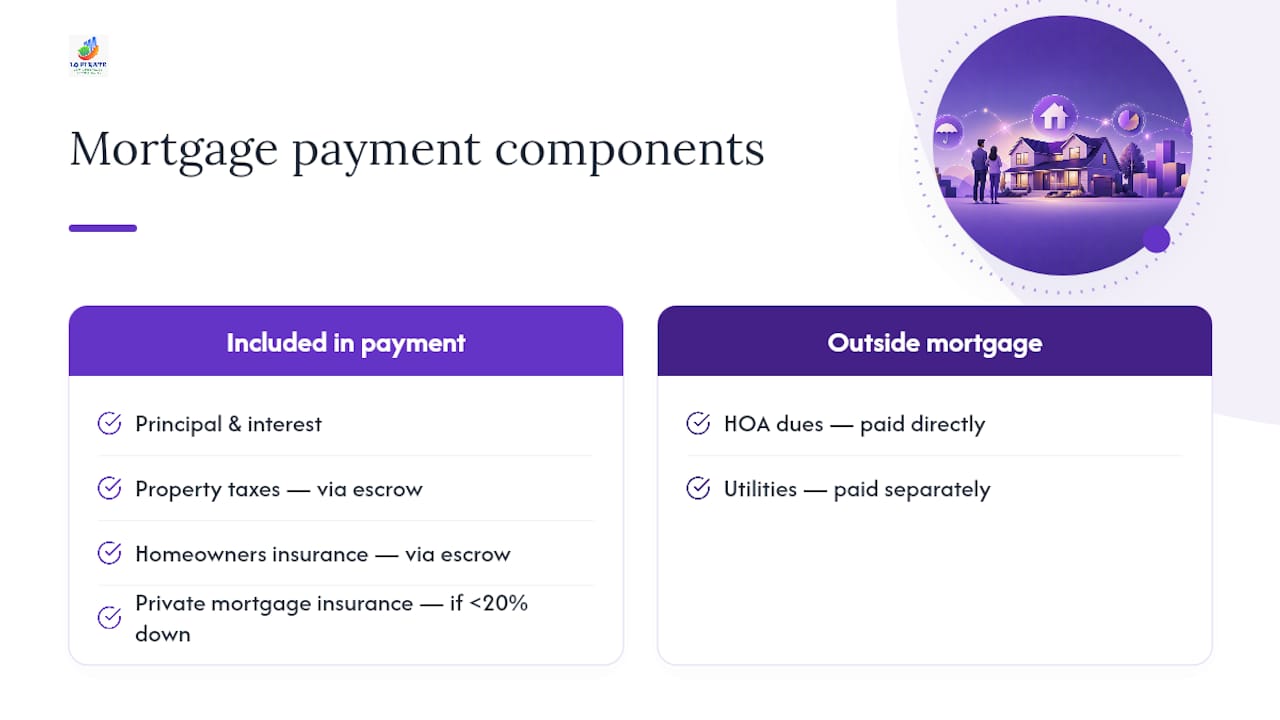
HOA dues and utilities sit outside the mortgage payment entirely. Lenders factor HOA dues into your debt-to-income ratio when qualifying you, but they do not collect or forward that payment. You pay the HOA directly, and if you miss it, the consequences are separate from your mortgage standing, at least initially.
Escrow accounts are the reason your payment can change even with a fixed-rate loan. If your county reassesses your property and your tax bill rises, or your insurer raises premiums at renewal, your escrow contribution adjusts and so does your total monthly payment. Buyers are often blindsided by this. A guide to how escrow works is worth reading before you close, not after your payment jumps $180 in year two.
Non-mortgage recurring costs, taxes, insurance, utilities, and maintenance, frequently add up to more than half of a homeowner's annual spending once you look past the mortgage payment itself, according to Freddie Mac's research on homeowner spending patterns. Interest dominates the lifetime total, but the recurring stuff dominates the year-to-year budget.
What Determines the Interest Rate You're Offered
Two sets of forces set your rate: what you bring to the table, and what the broader market is doing that day. You control the first set. You do not control the second.
On the personal side, the CFPB identifies seven factors that shape your quote:
- Credit score
- Home location
- Home price and loan amount
- Down payment size
- Loan term
- Loan type (fixed, adjustable, FHA, VA, conventional)
- Broader market conditions at the time you lock
Credit score does the heaviest lifting among these. A borrower in the high 700s will typically see a noticeably better rate than a borrower in the low 600s on an identical loan, and that gap compounds over 30 years into tens of thousands of dollars. If your score needs work before you apply, a breakdown of what actually moves credit scores is a better use of your time than shopping lenders while your score is depressed.
On the market side, Investopedia's breakdown of rate drivers points to inflation, Federal Reserve policy, and bond market activity, particularly the 10-year Treasury yield. Lenders do not pull rates from thin air. Fannie Mae's research shows the rate you're quoted is built by adding a spread to the 10-year Treasury, and that spread itself splits into two pieces: a primary-secondary spread covering origination costs, and a secondary spread reflecting the risk of mortgage-backed securities relative to Treasuries. When you hear that rates "jumped" even though the Fed didn't move, this spread mechanic is usually why.
Your credit score's effect on the rate you're offered is the one lever most buyers can still pull in the weeks before applying, unlike Treasury yields or Fed policy, which are entirely out of your hands.
Private Mortgage Insurance and Its Alternatives
If your down payment on a conventional loan is under 20%, you will almost certainly pay private mortgage insurance. The CFPB is explicit that PMI protects the lender, not you, in case you default, yet you are the one paying for it every month.
- PMI cost drivers. Your rate depends mainly on your credit score and your LTV. A borrower putting 15% down with strong credit might pay PMI in the range of 0.3% to 0.5% of the loan annually, while a borrower at 5% down with weaker credit could pay closer to 1% or slightly more.
- A quick example. On a $300,000 loan, PMI at 0.5% annually adds roughly $125 a month. At 1%, that climbs to about $250 a month, money that builds you no equity and disappears once you qualify to drop it.
- FHA mortgage insurance works differently. FHA loans charge an upfront mortgage insurance premium plus an annual premium that, for most FHA borrowers, sticks around for the life of the loan rather than dropping off at 20% equity.
- VA and USDA loans skip PMI entirely. VA loans charge a one-time funding fee instead of monthly mortgage insurance, and USDA loans charge upfront and annual guarantee fees that function similarly but are usually cheaper than conventional PMI.
- Removing PMI. On conventional loans, you can request removal once you reach 20% equity, and the lender must automatically cancel it once you hit 22% equity based on your original amortization schedule, assuming your payments are current.
A full explainer on how mortgage insurance affects your rate and payment walks through the FHA versus conventional trade-off in more depth if you are trying to decide between loan types with a smaller down payment.
Points vs. Lender Credits: The Breakeven Math
A discount point costs 1% of your loan amount, paid upfront, in exchange for a lower interest rate, usually somewhere around 0.25% off your rate per point, though the exact trade varies by lender and market conditions. A lender credit works the opposite direction: you accept a slightly higher rate in exchange for cash toward your closing costs. The CFPB frames this correctly as trading upfront cost against monthly cost, and the right answer depends entirely on how long you plan to keep the loan.
The breakeven formula is simple: divide the upfront cost of the point by the monthly savings it generates. If one point on a $350,000 loan costs $3,500 and drops your payment by $58 a month, you break even in about 60 months, or five years. Stay in the home past that point, and buying it saves you money. Sell or refinance before then, and you lose money on the trade.
Pro Tip: Before you buy points, ask yourself honestly how long you'll keep this loan. Most first-time buyers underestimate how often life circumstances (a job change, a growing family, a move for school) push them to sell or refinance inside five years, which is exactly the window where points rarely pay off.
Mortgage interest, including points paid at closing in some circumstances, can be tax-deductible, but the rules depend on your specific loan and whether you itemize. A closer look at how discount points affect your loan covers the mechanics in more detail, and a tax advisor should confirm your specific deduction before you count on it in your budget.
One-Time Homebuying Extras Beyond the Mortgage
Not every cost tied to buying a home comes from your lender. Several are third-party services you arrange yourself, and some are optional, even when everyone tells you they are not.
- Home inspection: roughly $300 to $500, optional but strongly advisable on any resale property
- Appraisal: roughly $300 to $700, required by nearly every lender to confirm the home is worth the loan amount
- Title search and insurance: varies by state, protects against ownership disputes and liens
- Notary and courier fees: typically small, but they add up on a closing statement
- Real estate agent commissions: historically paid by the seller, though commission structures have shifted in recent years and buyers should confirm who pays what before signing a buyer agreement
Title insurance actually comes in two forms. Lender's title insurance protects the bank's interest in the property and is required for financing. Owner's title insurance protects you, the buyer, and while it is optional in most states, skipping it means you have no protection if a title defect surfaces after closing. The one-time premium is usually a small fraction of the purchase price and is paid once, not annually.
Of these, only the appraisal is universally required to close a mortgage. The inspection and owner's title policy are optional but the kind of "optional" that experienced buyers rarely skip.
Estimating Your Total Cost: A Worked Example
Numbers make this concrete. Take a $400,000 home purchase with 10% down, a 30-year fixed loan, and an origination fee at the midpoint of the typical 0.5% to 1% range.
Rolling that $2,700 origination fee into your loan instead of paying it in cash lowers your cash-to-close, but it also means you are paying interest on that fee for up to 30 years, which can turn a $2,700 charge into $5,000 or more of total cost over the life of the loan.
Use this checklist before you make an offer:
- Confirm your cash-to-close figure includes down payment, closing costs, and prepaids, not just the down payment alone.
- Set aside first-year reserves for insurance, taxes, and at least one unexpected repair.
- Budget for recurring monthly items: principal, interest, escrow, PMI if applicable, and HOA dues.
- Apply the 1% annual maintenance rule of thumb, so a $400,000 home gets roughly $4,000 a year set aside for upkeep.
Practical Ways to Lower Your Costs
Cutting your total cost happens on two fronts: what you pay to get the loan, and what you pay to keep the house running every month afterward.
To reduce interest and fees, start by improving your credit score before you apply, since even a modest jump can shift your rate tier. Increase your down payment if you can, both to shrink PMI and to lower your loan-to-value. Compare quotes from multiple lenders rather than accepting the first offer, since origination fees and rates both vary more than most buyers expect. Ask directly whether the origination fee is negotiable and whether a lender credit is available if your cash is tight.
To reduce ongoing ownership costs, buy a home sized to your actual needs rather than your aspirational ones, since a bigger house means bigger taxes, insurance, and maintenance across the board. Shop homeowners insurance separately from your mortgage, since the first quote your lender suggests is rarely the cheapest available. Look into property tax appeals if your assessment seems out of line with comparable homes nearby. Budget for maintenance every year rather than treating repairs as a surprise, and weigh energy upgrades like better insulation or efficient appliances against their long-term utility savings.
Before you commit, ask your lender directly: is this origination fee negotiable, what would a 0.25-point rate reduction cost me in points, and how is my escrow deposit calculated? Ask the seller whether they will cover closing costs, and confirm exactly what commission structure applies to your purchase before you sign anything.
When You'll Actually Pay Each Cost
Cost timing catches almost every first-time buyer off guard, because the money moves in three distinct waves.
This money usually applies toward your down payment later, but it is cash you need available weeks before closing.
At closing, everything converges at once: your down payment, your closing costs, prepaid interest, your first year of homeowners insurance, and your initial escrow deposit all come due the same day. This is the single largest cash outlay of the entire process.
After closing, the picture shifts to monthly cadence: principal, interest, and escrow contributions arrive every month, alongside utilities, HOA dues if applicable, and ongoing maintenance. Property tax and insurance adjustments inside your escrow account tend to show up with a lag, often 12 to 18 months after closing, once your county reassesses or your insurer renews at a new rate. That lag is exactly why a payment that felt affordable at closing sometimes climbs the following year.
Refinancing: When the Costs Are Worth It
Refinancing is not free, and treating it as free is the most common mistake homeowners make. You'll typically pay a new origination fee, a fresh appraisal, title fees, and other closing costs, generally similar in scope to what you paid on your original purchase loan. Some loans also carry prepayment penalties, so check your current note before assuming a refinance is clean.
- Add up the total refinance cost. Include origination, appraisal, title, and any other closing fees quoted by your lender.
- Calculate your monthly savings. Subtract your new payment from your current payment to find the monthly difference.
- Divide cost by savings to find your breakeven. If refinancing costs $6,000 and saves you $150 a month, you break even in 40 months, a little over three years.
- Compare that breakeven to your expected time in the home. Investopedia notes that refinancing makes sense when your interest savings clearly outpace costs within a reasonable window, and there's no cap on how many times you can refinance, provided you requalify each time.
Rate reduction is not the only reason to refinance. Shortening your term from 30 years to 15 builds equity faster and cuts total interest dramatically, even if your monthly payment rises. Cash-out refinancing lets you tap equity for renovations or debt consolidation, though it resets your loan balance higher. Be cautious about rolling refinance closing costs into the new loan balance. It lowers your cash need today but stretches those fees across another 15 or 30 years of interest.
Why Total-Cost Thinking Beats Rate Shopping
Most buyers fixate on the interest rate and treat everything else as an afterthought. That's backward. A quarter-point rate difference between two lenders matters, but it can be dwarfed by a $3,000 gap in origination fees or a lender who won't budge on title fees that another lender would waive entirely. The number on the rate sheet is not the number that determines what you actually pay.
Broker shopping exists precisely because retail lenders have no incentive to show you a competing lender's better fee structure. A wholesale broker works across multiple lenders and can surface pricing you would never see by walking into a single bank. That is not a marginal advantage. On a $400,000 loan, a half-point difference in origination fees alone is $2,000, before you even get to rate.
This guide exists because Lofirate's whole reason for being is helping buyers see past the single number a retail lender puts in front of them, toward the full stack of costs that actually determines what a mortgage costs over 30 years.
Get a Broker Match Through Lofirate
Retail lenders show you one price: theirs. Wholesale mortgage brokers work differently. They shop your loan across multiple lenders simultaneously, which is exactly the kind of comparison this article just walked you through: origination fees, points, lender credits, and rate all vary more between lenders than most buyers realize.

Lofirate connects you with licensed wholesale brokers in your state for a free, no-obligation consultation. There's no cost to compare, and no obligation to move forward if the numbers don't work for you. A broker can walk through your loan estimate line by line, flag which fees are negotiable, and help you decide whether points or a lender credit makes more sense for how long you plan to keep the loan. Whether you're buying your first home, refinancing, or exploring an FHA, VA, or jumbo loan option, the goal is the same: access to wholesale pricing instead of a single retail quote. Start by requesting a broker match through Lofirate's services page and see what a second opinion on your rate actually looks like.
Frequently Asked Questions
What are the biggest cost factors in home financing? Down payment and closing costs drive your immediate cash needs; rate and loan structure drive your lifetime cost.
How much should I budget for closing costs? Plan for 2% to 5% of the purchase price in closing costs on top of your down payment. On a $400,000 home, that's $8,000 to $20,000 in addition to whatever you're putting down.
Does a bigger down payment always lower my costs? Usually, yes. A larger down payment lowers your loan-to-value ratio, which can improve your rate, reduce or eliminate PMI, and shrink the total interest you pay over the loan term. It does mean more cash needed at closing, so it's a trade-off between upfront and long-term cost.
When does PMI go away?
Is it better to pay points or take a lender credit? It depends on how long you'll keep the loan. Points make sense if you'll stay past the breakeven point, calculated by dividing the point's upfront cost by your monthly savings. A lender credit makes more sense if you expect to sell or refinance sooner, or if you need to lower your cash-to-close.
Why did my monthly mortgage payment go up even though my rate is fixed? Your principal and interest stay fixed, but your escrow contribution for property taxes and homeowners insurance can rise if your assessment or premium increases. That adjustment shows up as a higher total monthly payment even though your rate never changed.
This article is general information, not a substitute for advice from a qualified financial advisor. Consult a qualified financial professional about your own circumstances before acting on anything here.
Sources
- What costs come with taking out a mortgage? | Consumer Financial Protection Bureau (CFPB)
- origination fee | Legal Information Institute | Cornell Law School
- What determines the rate on a 30-year mortgage? | Fannie Mae
- What are closing costs and how much will I pay? | Freddie Mac MyHome blog