

A non-occupant co-borrower signs the mortgage note and usually appears on title, but never lives in the home. Lenders add that person's income to the household's qualifying numbers, which helps borrowers hit debt-to-income targets they'd otherwise miss. The trade-off is real: the non-occupant co-borrower carries full legal liability for the loan, and their credit takes the same hit as the occupant's if payments slip.
TL;DR:
- FHA loans allow non-occupant co-borrowers only for family members to maintain a 96.5% LTV, but using friends reduces the maximum LTV to 75%.
- Conventional loans permit non-occupant co-borrowers on purchases and certain refinances, with LTV caps at 95% through automated underwriting and lower for manual cases.
- VA loans rarely allow unrelated non-occupant co-borrowers, typically restricting to spouses or other eligible veterans, while USDA loans generally exclude them entirely.
- Lenders include the non-occupant co-borrower’s income, debts, and credit score in the qualification process, often limiting the borrower’s approval chances or increasing costs.
- Removing a non-occupant co-borrower usually requires refinancing into a single-occupant loan, with exceptions like death or divorce, and lender overlays significantly influence approval options.
Table of Contents
- FHA, Conventional, VA, and USDA Rules for a Non-Occupant Co-Signer Mortgage
- How Do Lenders Combine Income, Debt, and Credit Scores?
- Weighing the Pros, Cons, and Risks for Both Signers
- What Documents Do You Need to Add a Co-Borrower?
- Can You Remove a Non-Occupant Co-Borrower Later?
- Shopping Lenders Before You Add a Co-Borrower
- Why Program Rules Alone Don't Tell the Full Story
- Compare Lender Overlays Before You Lock In a Rate
- Sources
- FAQ
FHA, Conventional, VA, and USDA Rules for a Non-Occupant Co-Signer Mortgage
Program rules vary enough that the same buyer could qualify easily under one loan type and get shut out under another. Here's how the major programs treat a non-occupant co-borrower:
- FHA: FHA allows non-occupant co-borrowers, but the relationship matters. A qualifying family member keeps the standard 96.5% loan-to-value ratio, meaning a 3.5% down payment. Bring in a friend or unrelated party instead, and the maximum LTV drops to 75%, which means 25% down, according to HUD's FHA guidance. Both parties sign the note and are obligated on the mortgage, per HUD Handbook 4155.1, and non-occupying borrowers must maintain a principal U.S. residence, with narrow exceptions for military service or U.S. citizens living abroad.
- Conventional (Fannie Mae/Freddie Mac): Fannie Mae permits non-occupant borrowers on purchase transactions and certain refinances. Loans run through Desktop Underwriter typically have a maximum LTV under 100% when a non-occupant's income is used, while manually underwritten loans have a lower allowed LTV, according to Fannie Mae's selling guide. Manual underwriting also applies a "first 5%" rule limiting how much of the down payment can come from the non-occupant's funds.
- VA: VA loans restrict this heavily. Generally, only a veteran's spouse or another eligible veteran can occupy a co-borrower position, based on VA loan program guidance. A friend or unrelated relative typically can't be added as a non-occupant co-borrower on a VA loan.
- USDA: USDA loans generally don't accommodate non-occupant co-borrowers, since the program is built around household income limits tied to the property itself.
Always confirm current overlays with your lender. Comparing FHA and conventional programs side by side helps clarify which path fits your situation before you commit to one.
How Do Lenders Combine Income, Debt, and Credit Scores?
Underwriters don't treat a non-occupant co-borrower as a side character. They pull that person's income and debts into one combined debt-to-income ratio for the whole loan file, per Freddie Mac-related guidance. That means the co-borrower's car payment, student loans, and credit card balances count against the loan just as much as their paycheck helps it.
The credit score rule catches people off guard. Lenders typically use the lowest middle score among all borrowers to price the loan. If the occupant has a 760 and the co-borrower has a 640, the loan gets priced closer to the 640, not averaged between the two.
Most conventional loans cap standard qualifying DTI around 43%, though FHA loans sometimes allow higher ratios with strong compensating factors like reserves or residual income.
Two quick scenarios show the swing:
- A parent with $9,000 in monthly income and minimal debt, added to a child buying a starter home, often pushes DTI comfortably under 43% and can unlock approval.
- A friend with $9,000 in income but $4,500 in existing debt payments adds almost nothing to the DTI math and may drag the credit-score pricing down instead.
Weighing the Pros, Cons, and Risks for Both Signers
Adding a non-occupant co-borrower is a financial and legal decision, not just a paperwork step. Here's what's actually on the table:
- Pro: More qualifying income. A co-borrower's paycheck can be the difference between a denial and an approval, and under FHA family rules, it can also preserve the 3.5% down payment option.
- Con: Full liability, not partial. The co-borrower owes the entire loan if the occupant stops paying, and missed payments hit both credit files equally, according to industry summaries of FHA co-borrower rules.
- Con: It follows them. The debt shows up on the co-borrower's own DTI for any future loan they apply for, which can limit their ability to buy a car or a home of their own.
- Risk: Ownership leverage. If the co-borrower is on title, selling or refinancing the home later usually requires their signature, giving them an effective veto.
Pro Tip: Put the repayment arrangement in writing before closing, even between family. A simple signed agreement outlining who pays what, and what happens if someone falls behind, prevents a lot of painful conversations later.
What Documents Do You Need to Add a Co-Borrower?
Every borrower on the loan, occupant or not, completes the Uniform Residential Loan Application and goes through the same underwriting screen. Expect to gather:
- Two years of pay stubs, W-2s, and tax returns for each borrower
- Bank and asset statements showing where down payment funds originate
- Signed credit authorization forms for every borrower
- Note and mortgage signatures from anyone obligated on the debt, plus title signatures for anyone on ownership
Loans run through automated underwriting sometimes accept slightly different asset documentation than manually underwritten files. Ask your broker directly about lender-specific overlays. A quick loan approval checklist can help you prepare before you apply.
Can You Remove a Non-Occupant Co-Borrower Later?
Removing a non-occupant co-borrower almost always means refinancing into a loan held solely by the occupant. That requires the occupant to qualify alone under full underwriting, including their own income, debts, and credit score.
- Standard path: Refinance into a new loan in the occupant's name only.
- Limited exceptions: Death, divorce with a court order, or a lender-approved assumption can sometimes remove a co-borrower without a full refinance, but expect to provide documentation and a clean payment history.
- Streamline refinances usually won't work: FHA and VA streamline programs are built for rate reduction, not borrower removal, so most lenders won't process a name change through that channel.
Shopping Lenders Before You Add a Co-Borrower
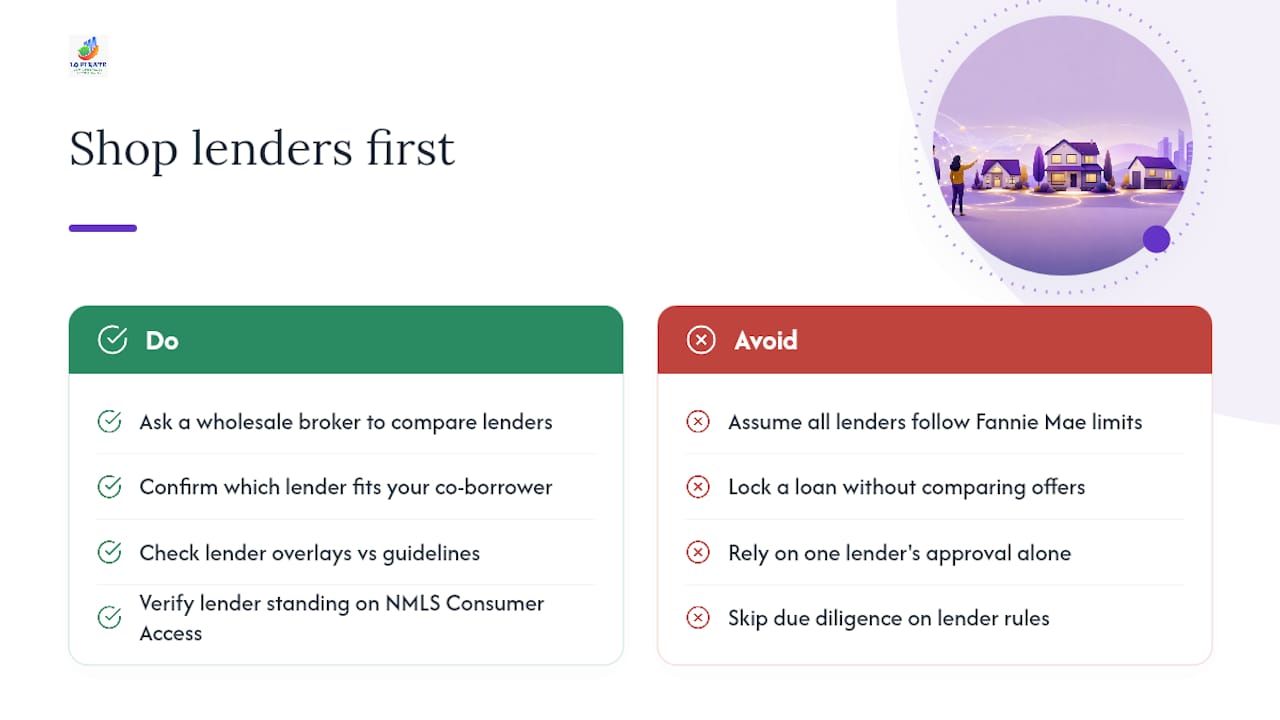
Lender overlays on non-occupant co-borrower files vary more than most buyers expect. One lender might cap LTV tighter than Fannie Mae's own guidelines allow, while another accepts a non-family co-borrower more readily. The platform connects buyers with licensed wholesale mortgage brokers who can walk through how different lenders price and structure these files. Because brokers see multiple lenders' guidelines side by side, they often spot which one treats your specific co-borrower scenario best. Before locking anything in, it's worth checking a lender's standing through NMLS Consumer Access as part of your own due diligence.
Why Program Rules Alone Don't Tell the Full Story
The rules themselves aren't complicated once you see them laid out: FHA rewards family relationships, conventional loans cap LTV based on underwriting method, and VA locks the door almost entirely to non-spouses. What most advice gets wrong is treating those rules as the whole decision. They're not. The real variable is how a specific lender's overlay stacks on top of the baseline program rule, and that changes file by file.
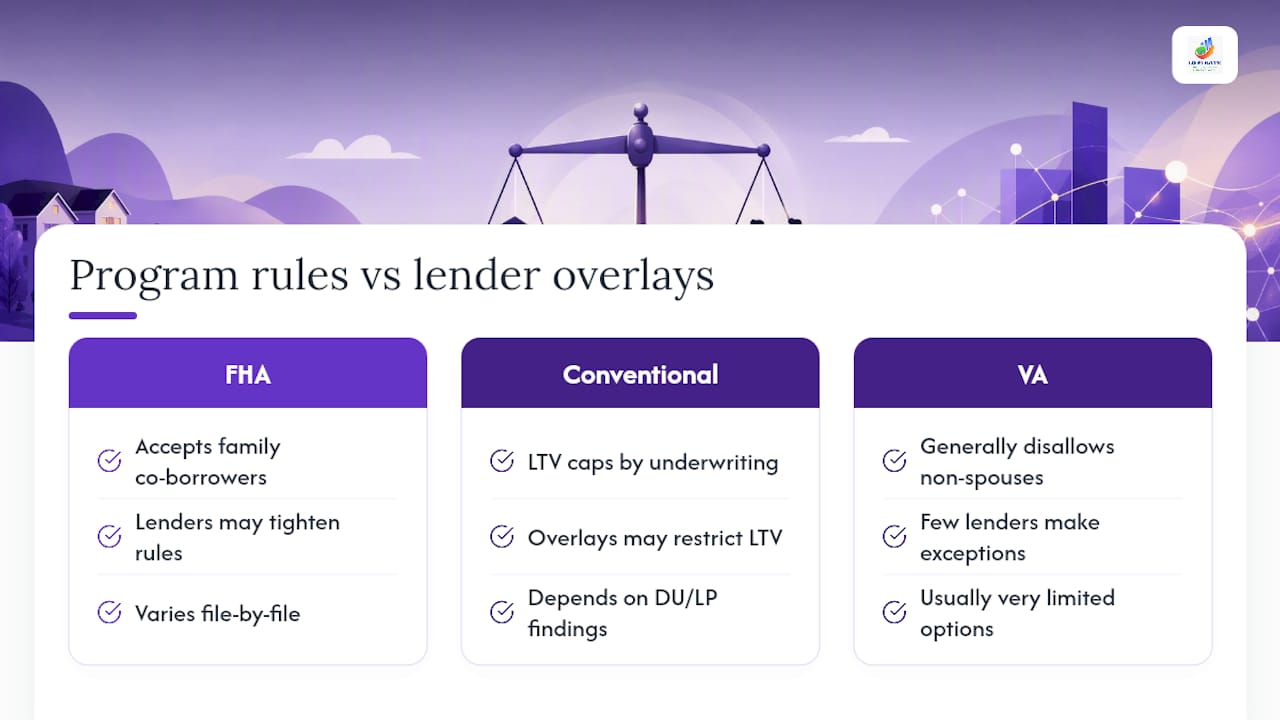
Buyers who add a non-occupant co-borrower without shopping multiple lenders often accept the first answer they get, even when a different lender would have offered a better structure for the same borrower profile. A non-traditional mortgage option might even outperform the co-borrower route entirely, depending on income documentation.
The honest priority order: confirm the family relationship question for FHA first, run the DTI math with real numbers second, and only after that start comparing how individual lenders price the file. Skipping straight to "who can co-sign for me" without that sequence is how buyers end up locked into worse terms than they needed.
— LoFi
Compare Lender Overlays Before You Lock In a Rate
Every lender treats a non-occupant co-borrower a little differently, and that gap can be worth thousands over the life of the loan. This service matches you with licensed wholesale mortgage brokers who shop your file across multiple lenders instead of quoting you one bank's own pricing.

That matters most right here: a broker can flag which lenders accept a non-family co-borrower, which ones cap LTV tighter than Fannie Mae's baseline, and which pricing tier your combined credit scores will land in, all before you commit to anyone. The consultation carries no obligation, and you're never required to choose the broker you're matched with. If you're weighing whether to add a co-borrower or explore other loan options, start by requesting a broker match at Lofirate and get a second opinion before you lock a rate.
This article is general information, not a substitute for advice from a qualified financial advisor. Consult a qualified financial professional about your own circumstances before acting on anything here.
Sources
- HUD Handbook 4155.1: Borrower and Coborrower Requirements
- Fannie Mae selling guide: Guarantors, Co-Signers, or Non-Occupant Borrowers
- What are the guidelines for co-Borrowers and Co-signers? (HUD/FHA guidance)
- Homebuyer
- Benefits
FAQ
Does a Non-Occupant Co-Borrower Have to Be a Family Member?
Not always, but the relationship changes your options significantly. FHA requires a family relationship to keep the standard 3.5% down payment; a non-family co-borrower drops the maximum FHA loan-to-value to 75%, according to HUD's guidance. VA loans go further, generally limiting non-occupant co-borrowers to a veteran's spouse or another eligible veteran.
What Are Fannie Mae's Guidelines for Non-Occupant Co-Borrowers?
Fannie Mae allows non-occupant borrowers on purchase transactions and certain refinances. Loans run through Desktop Underwriter cap LTV at 95%, while manually underwritten loans cap out at 90% when the non-occupant's income is factored in, per the Fannie Mae selling guide.
Can a Friend Be a Co-Borrower on a Home Possible Mortgage?
A friend can be added as a non-occupant co-borrower on many conventional affordable-lending programs, but expect tighter LTV limits and full underwriting on both incomes and debts. Program-specific overlays vary by lender, so confirming eligibility for a particular affordable housing product directly with your broker matters more than assuming it works the same way FHA does.
Can You Do a Cash-Out Refinance With a Non-Occupant Co-Borrower?
Yes, though the co-borrower must go through full underwriting again, including income, debt, and credit review. Lenders combine both borrowers' income and debts into the DTI calculation and use the lowest middle credit score to price the new loan, the same way they would on a purchase transaction.