

A portfolio mortgage is a home loan a lender originates and keeps on its own books instead of selling it off. That distinction lets the lender write its own underwriting rules, which is why self-employed borrowers, real estate investors, and buyers of unusual or high-value properties turn to portfolio lending options when a conventional mortgage says no. The tradeoff is real: more flexibility, usually at a higher rate.
TL;DR:
- Portfolio loans typically have higher interest rates and fees than conventional mortgages due to retained risk and custom underwriting.
- They are ideal for self-employed, real estate investors, and buyers of high-value or unique properties who struggle with standard loan requirements.
- Lenders often require larger down payments, 15 to 25 percent, and reserves of six to twelve months of payments, with qualification criteria varying widely by institution.
- Portfolio loans are less predictable in cost and availability and may offer limited refinancing options, especially if income documentation remains nonconforming.
- Comparing multiple preapprovals from licensed brokers is essential to avoid overpaying and to find the best terms in a niche, less standardized market.
Table of Contents
- What Is a Portfolio Loan, and Why Do Lenders Offer Them?
- Portfolio Loan vs Conventional Mortgage: What Actually Changes
- Who Actually Benefits From Portfolio Lending
- Qualification and Underwriting: What Lenders Actually Ask For
- What Portfolio Loans Actually Cost
- How to Get a Portfolio Loan: Application Roadmap
- Weighing the Tradeoffs: Portfolio Loan Pros and Cons
- How LoFiRate Helps You Find the Right Portfolio Lender
- Does a Portfolio Loan Affect Your Credit or Future Borrowing?
- Where the Portfolio Lending Market Stands Right Now
- The Real Risks Worth Understanding Before You Sign
- What I'd Tell a Friend Considering a Portfolio Loan
- Get Matched With a Portfolio Lending Specialist
- Sources
What Is a Portfolio Loan, and Why Do Lenders Offer Them?
Most mortgages get sold within weeks of closing. The originating bank hands the loan off to Fannie Mae, Freddie Mac, or a private investor, collects a fee, and moves on. A portfolio mortgage skips that step entirely. The lender funds it, holds it, and collects the payments for the life of the loan, or until it chooses to sell.
That single difference changes everything downstream, because the lender isn't packaging the loan to meet Fannie Mae or Freddie Mac guidelines. It doesn't have to follow their rulebook on income verification, debt ratios, or property type. It can write its own criteria based on what it's actually willing to risk.
This is the core mechanic behind every custom mortgage solution built around nontraditional income or unusual collateral. A few things follow directly from the hold-to-maturity model:
- The lender absorbs the default risk instead of passing it to a secondary-market investor
- Underwriting can weigh bank deposits, assets, or rental income instead of W2 pay stubs
- Approval decisions happen in-house, often faster than loans destined for resale
- Terms, from rate structure to prepayment rules, are negotiable case by case
Portfolio Loan vs Conventional Mortgage: What Actually Changes
The portfolio loan vs conventional mortgage decision comes down to four practical differences, and borrowers rarely weigh them evenly.
Secondary market treatment. Conventional loans have to meet Fannie Mae and Freddie Mac standards because they're built for resale. Portfolio loans skip that market entirely, which is the whole reason they're nonconforming and not bound by agency loan limits.
Underwriting flexibility. Conventional underwriting leans almost entirely on tax returns and W2s. Portfolio lenders often accept bank-statement programs and asset-based analysis, which matters enormously for a business owner whose tax return shows a fraction of actual cash flow. Debt-to-income calculations get more latitude too.
Property eligibility and loan size. Non-warrantable condos, mixed-use buildings, five-plus unit properties, and jumbo-sized purchases that exceed agency limits all fit more easily into portfolio lending than conventional financing.
Rate and fee predictability. Conventional rates track the broader bond market closely and are fairly uniform across lenders. Portfolio loan rates vary widely by institution because each one is pricing its own retained risk.
Here's the practical shorthand:
- Conventional: cheaper, standardized, strict documentation, capped loan size
- Portfolio: pricier, negotiable, flexible documentation, no agency size cap
Neither is "better" outright. The right answer depends on whether your file fits the conventional box.
Who Actually Benefits From Portfolio Lending
Portfolio loans aren't a niche curiosity. They solve specific documentation and collateral problems that conventional underwriting can't handle.
Self-employed borrowers and business owners. If your accountant is good at their job, your tax returns probably understate your real income through legitimate deductions. Conventional underwriting takes that lower number at face value. Portfolio lenders can look at bank deposits instead.
Real estate investors. Buy-and-hold mortgage strategies often involve LLC ownership, multiple simultaneous loans, or properties that don't cash-flow on paper the way agency guidelines want to see. Investors buying non-warrantable condos or multi-unit buildings frequently have no conventional path at all.
Luxury and atypical property buyers. Rural acreage, unique construction, or purchase prices above agency jumbo thresholds all push toward portfolio financing.
Foreign nationals and irregular-income borrowers. Without a U.S. credit history or a steady paycheck, conventional loans are often out of reach, but a portfolio lender with strong liquid assets on the file may still say yes.
A quick gut check: if your income statement, your property, or your ownership structure looks anything but standard, portfolio lending options deserve a look before you assume you're stuck.
Qualification and Underwriting: What Lenders Actually Ask For
Portfolio lenders set their own rules, so qualification criteria swing more from institution to institution than with conventional loans. Still, a general pattern holds.
Credit score ranges vary by lender and by how much risk they're absorbing. Some portfolio lenders will work with scores in the mid-600s if reserves and equity are strong; others hold to 700-plus for their best pricing. There's no universal cutoff the way there is with agency loans.
DTI treatment gets more forgiving with alternative underwriting. A bank-statement program might average 12 to 24 months of deposits to establish qualifying income, rather than using a net tax figure. Asset-based underwriting can even convert liquid savings into an imputed income stream for borrowers who are retired or living off investments.
Down payments and reserves tend to run higher than conventional loans. Expect 15% to 25% down on many portfolio programs, plus proof of six to twelve months of mortgage payments held in reserve. That's the price of flexibility elsewhere in the file.
Here's the rough sequence most portfolio applications follow:
- Confirm the lender is licensed through NMLS Consumer Access before sharing any financial documents
- Gather two years of bank statements, or tax returns and P&Ls if going the traditional documentation route
- Get a written preapproval that specifies rate, fees, and reserve requirements
- Compare that offer against at least one other lender before committing
Pro Tip: Run your own FDIC BankFind search on any bank offering a portfolio loan. A federally insured institution with a clean regulatory record is a meaningfully safer counterparty than an unlicensed private lender promising the same terms.
What Portfolio Loans Actually Cost
Retained risk isn't free, and it shows up in the price. Because the lender can't offload the loan to a secondary-market investor, it prices in a cushion for the risk it's holding. That's why portfolio loans typically carry higher rates and fees than a comparable conforming mortgage.
Expect these line items to show up on a portfolio loan estimate more often, or at higher amounts, than on a conventional one:
- Origination fees running 1% to 2% of the loan amount, sometimes more
- Underwriting and processing fees that aren't standardized across lenders
- Prepayment penalties on some programs, particularly investor loans
- Larger cash-reserve requirements tied up at closing
Rate structure matters as much as the number itself. A fixed-rate portfolio loan gives payment certainty; an adjustable or interest-only structure lowers the initial payment but shifts risk onto the borrower if rates rise or the interest-only period ends and principal payments kick in.
The best defense against overpaying is comparison. Getting two or three written preapprovals side by side, and asking each lender for an itemized fee breakdown rather than a single bundled number, tends to surface the padded charges fast.
How to Get a Portfolio Loan: Application Roadmap
Portfolio lenders aren't hard to find once you know where to look: community banks, credit unions, boutique regional lenders, and non-QM specialty lenders are the most common sources, far more than large national retail banks.
- Identify candidate lenders. Start with community banks and credit unions in your area, then look at wholesale-broker networks that connect to multiple portfolio lenders at once.
- Request written preapprovals from at least two sources. Compare rate, fees, and reserve requirements side by side, not just the headline rate.
- Assemble your documentation early. Depending on the underwriting path, that means two years of tax returns, or 12 to 24 months of bank statements, profit-and-loss statements, and LLC formation documents if you're buying under an entity.
- Submit and expect a shorter, more direct underwriting cycle since decisions are made in-house rather than routed through agency automated systems.
- Close, then confirm servicing terms, since some portfolio lenders retain servicing while others outsource it.
Red flags worth walking away from: a lender who won't put fees in writing, pressure to sign before you've compared a second offer, or an entity you can't find on NMLS Consumer Access at all.
Weighing the Tradeoffs: Portfolio Loan Pros and Cons
The case for a portfolio loan is flexibility. The case against it is cost and scarcity.
- Pro: Custom underwriting fits self-employed income, asset wealth, or unconventional collateral
- Pro: No agency loan-limit cap, useful for luxury and multi-unit purchases
- Pro: In-house decisioning can move faster than agency-bound underwriting
- Con: Rates and fees run higher to offset the lender's retained risk
- Con: Far fewer lenders offer them, which limits shopping power
- Con: Some carry prepayment penalties or variable terms that shift risk to the borrower
| Factor | Portfolio Loan | Conventional Loan |
|---|---|---|
| Underwriting flexibility | High | Low, agency-standardized |
| Typical cost | Higher rate and fees | Lower, market-standard |
| Lender availability | Limited, niche institutions | Widely available |
| Best fit | Nonstandard income or property | W2 income, standard property |
For many buyers, a portfolio loan is a bridge: a way to buy now on the file you have, with a plan to refinance into conventional financing once tax returns catch up to actual income.
How LoFiRate Helps You Find the Right Portfolio Lender
Portfolio lending is scattered across small banks, credit unions, and specialty lenders, which makes comparison shopping the single hardest part of the process. Mortgage connection platforms can link homebuyers and investors with licensed wholesale mortgage brokers who shop multiple lenders on your behalf, rather than pitching you one institution's in-house pricing.
That matters specifically for portfolio lending, where rates and terms vary far more between lenders than they do on a conventional loan. A broker who can pull several written preapprovals gives you real bargaining leverage instead of a single take-it-or-leave-it offer.
Before working with any broker or lender, verify their license through NMLS Consumer Access and check the bank's standing with FDIC BankFind. Such platforms do not lend money or set rates directly. They connect you with licensed professionals who do, for a no-obligation conversation about your specific file.
Does a Portfolio Loan Affect Your Credit or Future Borrowing?
A portfolio loan reports to the credit bureaus the same way a conventional mortgage does. On-time payments build your history and score just like they would with any other mortgage, and missed payments hurt it just as badly. The loan type itself isn't flagged on your credit report as riskier or different.
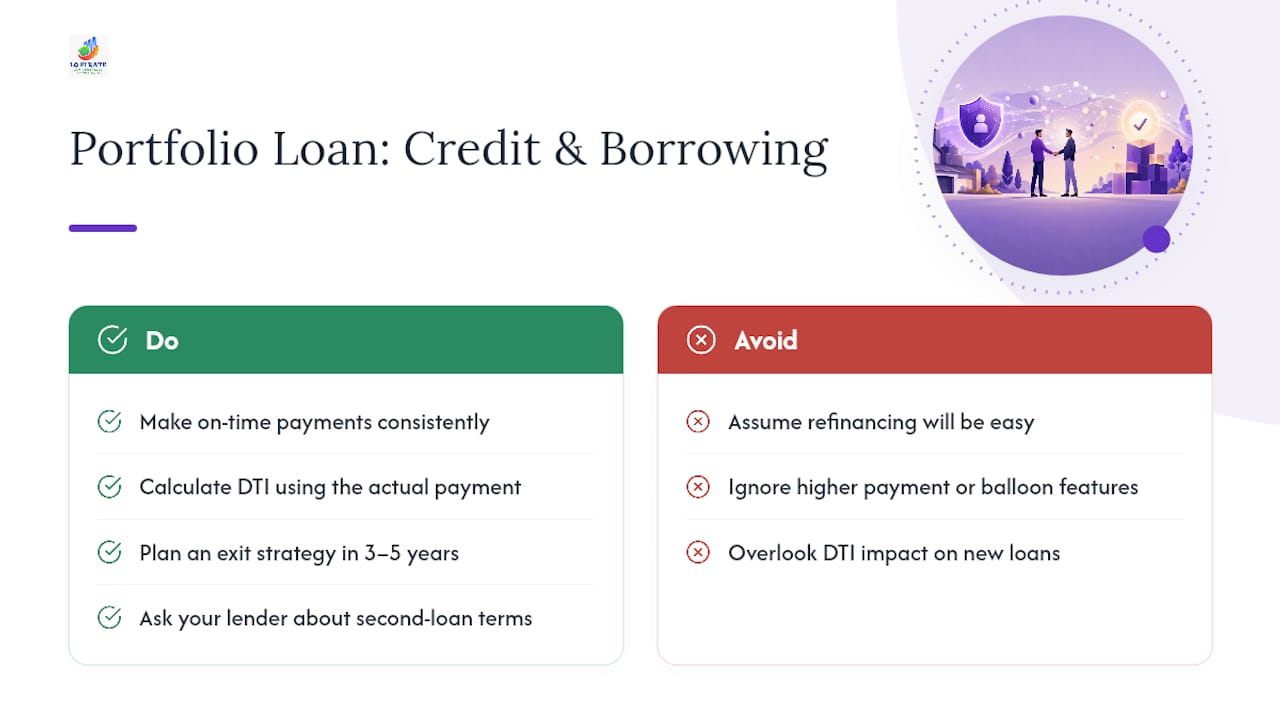
Where it gets more complicated is downstream borrowing capacity. Because portfolio loans sometimes carry higher payments, interest-only structures, or balloon features, they can push your debt-to-income ratio higher than a comparable conventional loan would. That matters if you plan to finance a second property or a business loan soon after closing, since the next lender will calculate DTI using your actual payment, not a hypothetical conventional one.
Refinancing out of a portfolio loan later isn't guaranteed to be simple, either. If your income documentation still doesn't fit conventional agency standards by the time you want to refinance, you may be shopping the portfolio market again rather than moving into a cheaper conforming rate. That's part of why treating a portfolio loan as a deliberate bridge, with a plan for what happens in three to five years, matters more than it does with a standard 30-year fixed mortgage.
One overlooked upside: a portfolio lender who already knows your file and payment history may offer better terms on a second loan than a lender starting from scratch, particularly for investors building a multi-property portfolio with the same institution.
Where the Portfolio Lending Market Stands Right Now
Portfolio lending isn't a fringe product anymore. As agency guidelines have tightened around self-employed income documentation and non-warrantable condos, demand for alternatives has pushed further into non-traditional mortgage loans generally, and portfolio lending is one of the largest categories inside that shift.
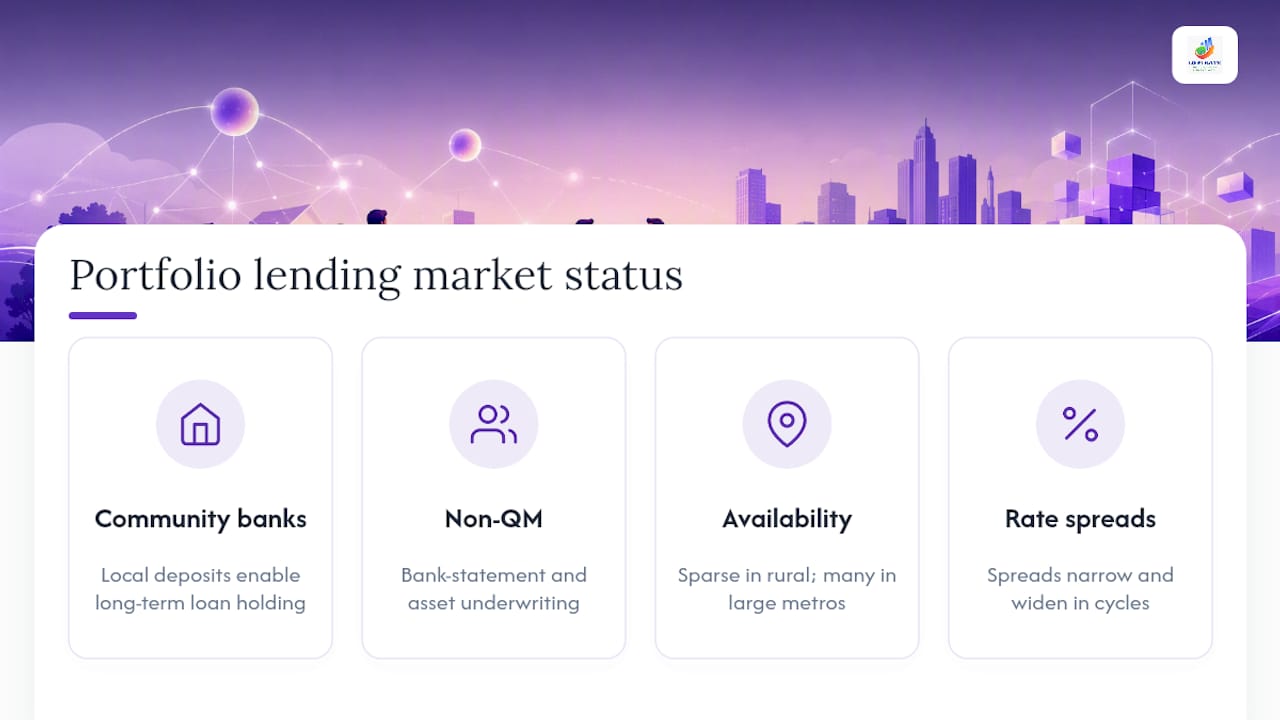
Community banks and credit unions remain the most consistent source, largely because their local deposit base gives them the balance-sheet capacity to hold loans long-term. Alongside them, a growing set of non-QM specialty lenders has built entire business lines around bank-statement and asset-based underwriting, competing directly for the self-employed and investor borrowers that agency lending increasingly turns away.
Availability still isn't uniform across the country. Rural markets and smaller metro areas may have only one or two active portfolio lenders, while larger metro areas support dozens of competing options, including wholesale-broker networks that can shop several at once. That geographic unevenness is one more reason broker shopping tends to pay off more in this category than in conventional lending, where pricing is more standardized regardless of who originates the loan.
Rate spreads between portfolio and conventional loans have also narrowed and widened in cycles, tracking the broader cost of capital for the small institutions that hold these loans. Borrowers who wait for a "perfect" rate environment often miss the point: the real value of a portfolio loan is qualifying at all, not timing a market bottom.
The Real Risks Worth Understanding Before You Sign
Flexibility on the front end comes with tradeoffs that show up later, and they deserve equal attention.
Limited refinancing options. If your income documentation still doesn't fit conventional standards when you want to refinance, you're back in the same narrow portfolio market, possibly with fewer lenders willing to take the deal than when you first bought.
Underwriting can tighten without warning. A portfolio lender that's generous today can pull back its guidelines tomorrow if it decides it's holding too much risk on its books. There's no regulatory floor guaranteeing the same terms will be available next year.
Prepayment penalties and rate resets carry real payment-shock risk. Adjustable schedules and interest-only periods shift risk onto the borrower, and a rate reset or the end of an interest-only window can raise a monthly payment substantially with little notice.
Fewer lenders means less leverage if something goes wrong. With a smaller pool of institutions offering these loans, a dispute over servicing or terms leaves you with fewer places to turn for a competing offer.
None of this makes portfolio loans a bad choice. It makes them a choice that rewards reading the fine print closely, particularly around rate adjustment triggers and prepayment clauses, before signing anything.
What I'd Tell a Friend Considering a Portfolio Loan
I'd tell them to stress-test the payment before falling for the flexibility. Run the numbers assuming your rate resets to its worst-case ceiling, not just today's teaser figure. Ask every lender for the exact same fee breakdown so you're comparing real numbers, not marketing language. And don't take the first yes: a second written preapproval, ideally sourced through a broker shopping multiple lenders at once, usually reveals whether the first offer was fair or padded. If you want a second opinion before committing, some platforms offer no-obligation consultations for that conversation.
— LoFi
Get Matched With a Portfolio Lending Specialist
Community banks and non-QM lenders each price portfolio loans differently, and calling them one by one to compare terms eats weeks you probably don't have if you're under contract. Lofirate's loan options page connects you with licensed wholesale mortgage brokers who shop multiple portfolio lenders on your behalf, so you're comparing real written offers instead of guessing which bank might say yes.

Some broker networks operate across purchase, refinance, and investment-property scenarios, including the bank-statement and asset-based programs this article covers. These platforms don't lend money or set rates themselves. They serve as connection points to licensed professionals who do that work directly, with no obligation to move forward until you see terms you actually like. Start with a free consultation on the loan options page and get a second opinion before you commit to any lender's first offer.
Sources
Confirm licensing and cross-check the guidance in this article before signing with any lender.